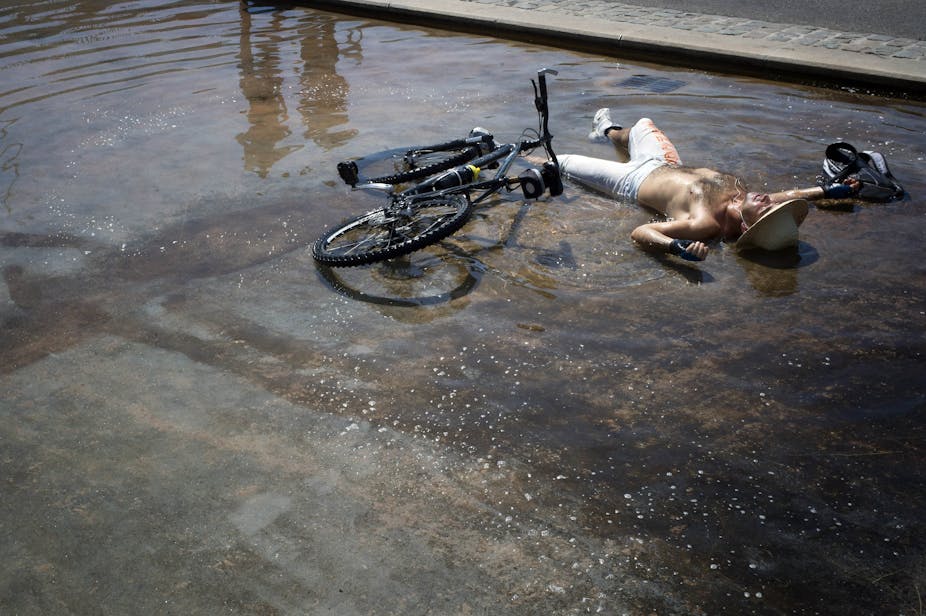
Could we acclimatise to the hotter summers to come?

Acclimatising to heat is a tough gig. Since 1970, central Australian regions have warmed 1.2ᵒC and as the world continues to get warmer, increasingly common and increasingly intense heat waves will make acclimatising even tougher. Our physiology is fantastically clever. Humans have managed to successfully…

Yqs558s6-1357791447
The 2003 European heat wave caused 80,000 deaths at temperatures Australians usually experience in a regular summer. AAP

Acclimatising to heat is a tough gig. Since 1970, central Australian regions have warmed 1.2ᵒC and as the world continues to get warmer, increasingly common and increasingly intense heat waves will make acclimatising even tougher.

Our physiology is fantastically clever. Humans have managed to successfully inhabit most of the earth’s land surface, from sub-zero zones to the scorching hot. But regardless of environmental temperatures, we homeotherms, or warm-blooded animals, successfully maintain our core temperature within a very narrow range around 36.2ᵒC. When a fever raises our temperature above 38ᵒC, we start to feel unwell and death is likely if core temperature passes 40ᵒC.

In cold weather, we don clothing, shelter out of the elements, and huddle around heating. Exercising also warms us. This explains why human settlements can be found in sub-zero temperatures that are 36ᵒC cooler than our bodies.

But could we live in a climate that is 36ᵒC above our optimal core temperature? The answer is simple. No. Exercising, working, or even walking at a fast pace becomes difficult to sustain at temperatures above 35ᵒC.

So we are better suited for cooler-than-us weather (less than 36ᵒC), rather than hotter-than-us (more than 36ᵒC), especially if we want to move, walk or work.

Coping mechanisms

We have three mechanisms to cope with the heat – our physiology via our thermoregulatory system, behaviour, and engineering.

We can live in temperatures 36ᵒC cooler than our bodies. Serge

Sweating is the primary cooling mechanism to maintain thermoregulation, making us thirsty as it induces dehydration. But sweating becomes ineffective in the saturated air on days of high humidity.

Lethargy is another physiological response to avoid overheating, acting as a disincentive to maintain physical activity. Feeling warm drives us to seek shade. This evolves into cultural adaptation as societal norms develop in response to environmental conditions. Hence, cultural mores on Pacific Islands differ markedly from those of Inuit communities.

Finally, human adaptive ingenuity leaps to the fore with our technical response to override environmental extremes. Fans, air-conditioning, passively cooled housing design, plumbing water to our homes, and crafting green spaces and shade gardens exemplify our capacity modify our environment to our meet our physiological needs.

Death in Europe

But despite all this, the 2003 European heat wave caused 80,000 deaths at temperatures Australians usually experience in a regular summer. Why did they fail the heat test, and why does Melbourne exhibit heat morbidity at temperatures that cause minimal health burden in Adelaide? I suspect this relates to acclimatisation and the three coping mechanisms.

Humans can acclimatise to heat after five or six weeks of consistent exposure. Europeans didn’t have much lead time in 2003, when the temperature rose 12ᵒC higher than their summer average. They were unprepared to respond appropriately both behaviourally and culturally, and many deaths at home were caused by severe dehydration. What’s more, European housing is designed to retain heat, not to shed it.

Australia is already hot, and it is warming. So we must learn to acclimatise to the heat, and to temperature swings. But it’s difficult to acclimatise to exceptionally hot days when a cool change comes in, as it does regularly in Melbourne for instance, where the temperature suddenly plummets 10ᵒ and the next week is comfortably below 30ᵒC.

Queenslander-style houses are better suited to hot climates. jojof/Flickr

The main problem is that Australia’s major cities are not well suited to these new heat extremes, as Melbourne’s buckling train lines demonstrated in the 2009 heatwaves, along with the soaring death toll. New houses leave little space for trees and garden to provide shade, and many don’t have eaves. They are heat traps, and if people can’t afford cooling, they may die.

Better ways

Designing suburbs of houses that must rely on air conditioning to provide thermal comfort is counter productive at best, and bordering on suicidal – at the species level – at worst. But there are other options. The Queenslander housing style, for instance, which has the house set high on stilts with wide verandas, provides passive cooling, and is perfectly suited to hot climates. It also offers flood protection.

Changing our biology is impossible, but revisiting the wisdom of the past appears sensible. Maintaining hydration is the number one rule. Part filling a bath so household members can pop in and out provides refreshment. Wetting clothes and wearing wet neck scarves provides cooling.

We need to reorient our lifestyle to the cooler part of the day during heat extremes, and take rest breaks. In particular, work needs to be redesigned to prevent workers from suffering from heat stress. We must also factor heat into urban and housing design, plant shade trees, and use our garden water judiciously to preserve trees.

Foremost, of course, we must – collectively and institutionally – urgently embrace a carbon neutral economy to preserve the health and well-being of our future, and our children’s future. Material goods will offer little comfort as we swelter in regular 45ᵒC heat, when plant life has withered and food is scarce.

Sign in to Favourite

Want to follow The Conversation?

Sign up to our free newsletter to get the day's top stories in your inbox each morning, with a special wrap on Saturday.

Spinner
Help us have better conversations — donate

Join the conversation

132 Comments sorted by

Comments on this article are now closed.

  1. Kim Peart

    Researcher & Writer

    Before we can hope to achieve a "carbon neural" economy, we must first enter a carbon negative phase, to drive CO2 back below 350 ppm, if we would like to gift a safe Earth to future generations.

    The business plan for climate change at present is more like the proclamation of a zombie lurch, than a trajectory that will assure our survival.

    With the Arctic now warming fast, Nature is giving us the BIG BOOT, with greenhouse gases that will drive a much hotter world into hell.

    I may have mentioned…

    Read more
  2. John McLean

    logged in via email @connexus.net.au

    It is difficult to respond politely when the basis for this article so badly distorted. The world is NOT continuing to get warmer. I don't know why the author repeats this fallacy. According to Phil Jones of the CRU there has been no statistically significant warming for 16 years. A few years ago it was game-over if no warming for 15 years, but when that was reached the goal-posts were moved to 17 years. When there's still no warming ...?

    The article says our optimal core temperature is 36…

    Read more
    1. Geoffrey Edwards

      logged in via email @gmail.com

      In reply to John McLean

      "I don't know why the author repeats this fallacy"

      LOL. Which thouroughly debunked piece of misinformation would you like to cite in reference to your claims? Daily Mail? WND? Bolt?

      "Funny how how I've seen no-one suggesting that temperatures will rise to 72 degrees."

      The statement was one to highlight what our bodies and technologies contribute. We can exist in temperatures 36 degrees below core by simply putting on warm clothes. But we cannot exist at temperatures 36 degrees above core by such a simple strategy.

      The point to be made was that 36 one way is fine, but even a few degrees the other can be fatal.

      report
    2. Chris O'Neill

      Telecommunications Engineer

      In reply to John McLean

      "The world is NOT continuing to get warmer."

      What a shameless lie.

      No statistically significant warming (in a limited period) does NOT mean the same as no warming.

      report
    3. Glenn Tamblyn

      logged in via Facebook

      In reply to John McLean

      Sorry John. I don't know why you waste your time here with this rubbish.

      Simply showing up regularly to say that if one takes a really narrow view then one can see that black is white, doesn't convince many people. Because the narrow cherry-picked perspective needed to achieve this photo-negative perspective is pretty obvious tomost people.Sticksout like those proverbial balls.

      Some simple facts John. Warming hasn't stopped. The oceans are warming just as much as ever. Around 4 Hiroshima bombs…

      Read more
    4. Ron Chinchen

      Retired (ex Probation and Parole Officer)

      In reply to John McLean

      Seems to me there is always going to be that decreasing minority who declare that the Earth is flat. Belief in what you want to believe despite the evidence has always been one of humanity's flawed conditions

      report
    5. George Crisp

      Medical Practitioner

      In reply to John McLean

      Studies is several Australian Capital cities ( as well as those overseas ), Melbourne included, demonstrate clear relationships between morbidity and mortality with rising minimum and maximum temps. Excess deaths are apparent in major Aus cities once maixma exceed 28C.

      In Brisbane mortality increased by 7% for every increase 1C increase in average monthly temp in the >65 age group.

      IN Melbourne minimum daily temps appear a better predictor of mortality than minixima. With 15 -17% increase in average daily mortality when mean daily temps exceed a threshold of 30C and when minimum temps exceeded 24C.

      You can see the problem here. Climate change is affecting all of the above, in particular nighttime ( ie minimum ) temps have increased more than daytime temps.

      s for the climate denial... give it a rest, it' very boring john

      report
    6. Andrew Vincent

      Marketing . Communications . Multimedia

      In reply to John McLean

      Wow, John.

      You actually don't know the meaning of the term "statistical significance".

      report
    7. Andrew Vincent

      Marketing . Communications . Multimedia

      In reply to John McLean

      More specifically...

      When Jones was asked this question about no statistically significant warming he replied "Yes, but only just". i.e. The certainty level had dropped below 95%... to 93%. In other words - there is a 7% chance that the planet had not warmed; that the warming observed could be put down to a noisy weather signal.

      That's a SEVEN percent chance that as you put it "The world is NOT continuing to get warmer" is an accurate statement.

      report
    8. Chris O'Neill

      Telecommunications Engineer

      In reply to Andrew Vincent

      "That's a SEVEN percent chance"

      Actually, that was a 3.5% chance the world was NOT continuing to get warmer. The 93% confidence interval for the warming trend extended from zero to double the regression trend. There was a 3.5% chance the warming trend was more than double the regression trend and a 3.5% chance the trend was cooling.

      report
    9. Alex Cannara

      logged in via LinkedIn

      In reply to John McLean

      Statistics can be daunting, as we see John & Andrew persisting in making Fool's Wagers.

      The use of confidence intervals, etc. is based on key assumptions not necessarily in evidence, such as a stationary distribution of data with a single mode (e.g., a Normal/Gaussian distribution).

      These assumptions work for roughly symmetric data, but are only guidelines.

      In any event, crowing "that's a 7 percent" chance of not having global warming be true is not simply foolhardy statistical inference, it's worse than playing roulette in America, where we have the green square no one can bet on and on which the house always wins.

      By the way, in order to keep some reality that CO2 is only part of the story...
      http://arctic-news.blogspot.co.uk/p/global-extinction-within-one-human.html.

      One can even Google "sonar pictures of methane bubbles" in N. Atlantic, to get an i9dea of some of the nnasty positive feedback caused by sea warming due to ice melt, due to increased GHGs...

      report
  3. Peter Ormonde

    Peter Ormonde is a Friend of The Conversation.

    Farmer

    A lot of what we must do is to "unlearn" the comfort provided by the mythology of unlimited cheap electricity (and unlimited water actually).

    It means looking back at the houses and lifestyles our grandparents lived in and the way they coped with heat. Verandahs, lattice, shade and air flow ... It means looking at those sensible Spaniards and their siestas.

    It also means losing weight collectively. Try seeing how the old thermoregulation deals with 45 degrees when just standing up and walking across the room is a life-threatening experience.

    This challenge will test everything.

    report
    1. James Jenkin

      EFL Teacher Trainer

      In reply to Peter Ormonde

      We in Australia can play around with ideas like low-energy futures - we'll be fine if we use the aircon less or ride a bike.

      The problem is this vision also means less energy for most of the world, who don't enjoy our affluence. The world needs cheap and abundant energy so people can escape poverty and malnutrition, and dare aspire to a comfortable and enjoyable life.

      report
    2. Aden Date

      Manager of the Guild Volunteer Hub at University of Western Australia

      In reply to Peter Ormonde

      "It means looking back at the houses and lifestyles our grandparents lived in and the way they coped with heat. Verandahs, lattice, shade and air flow ... It means looking at those sensible Spaniards and their siestas."

      Keep in mind that our grandparents weren't also dealing with the consequences of a burgeoning population - out of control urban sprawl, disastrous commutes, and unaffordable housing.

      We do need smart, cool domiciles but it must be consistent with the trend towards dense urbanisation.

      report
    3. Glenn Tamblyn

      logged in via Facebook

      In reply to James Jenkin

      James

      Your absolutely right.

      Human well-being in much of the world depends on fossil fuels at present. Particularly the fossil fuels that are pumped into every farmpaddock tofeed the world.

      And continued use of those same fossil fuels will be just as destructive to human well-being. Crop yields simply cannot be maintained in a warmer world. And there is a simple calculus to this. Each 10% decline in crop yields equals 500 million or so people starving to death.

      All our main food sources…

      Read more
    4. Peter Ormonde

      Peter Ormonde is a Friend of The Conversation.

      Farmer

      In reply to Aden Date

      Yep couldn't agree more. And folks have been living in big cities in hot places for a long time. Not us I'd hastily mention.

      But one sees some very clever gadgets in the middle east and India for keeping life bearable - less so of late as the ubiquitous box airconditioner has made all sorts architectural crimes possible.

      Going up actually makes excellent sense when you're trying to get airmovement - of cool courtyards pouring cool humid air into the surrounding towers... the Moors had this down pat and the influence is still obvious all over southern Spain.

      Lord knows there might be even something we can do to lighten the burden of life in those high rise filing cabinets - specially if you can strap a turbine to them.

      But yep - big cities have some benefits as well as costs.

      report
    5. Greg Boyles

      Lanscaper and former medical scientist

      In reply to Peter Ormonde

      Dense cities with continuous concrete nd asphalt also creates a heat island effect.

      So increased air movement and cooling from 'going up' may well be nullified by the increased heating caused by building denser cities and suburbs.

      So thanks Peter but no thanks!

      report
    6. Greg Boyles

      Lanscaper and former medical scientist

      In reply to Greg Boyles

      You live on some sort of rural or semi-rural property Peter.....if my memory serves me correctly.

      Is this correct Peter?

      report
    7. Alex Cannara

      logged in via LinkedIn

      In reply to Greg Boyles

      LA has considered painting streets white! Problem with tall buildings also is the heat storage in their walls & roofs, so some cities, even Beijing, are opting for rooftop gardens.

      report
    8. Greg Boyles

      Lanscaper and former medical scientist

      In reply to Alex Cannara

      Light coloured concrete, e.g. at pubic pools, still gets damn hot on a summer's day.

      Such strategies are just cosmetic pi$$ing against the wind.

      report
    9. Peter Ormonde

      Peter Ormonde is a Friend of The Conversation.

      Farmer

      In reply to Greg Boyles

      Oh I don't see too much asphalt happening in our cities if they are to survive at all. Or concrete for that matter what with its CO2 output - we'll be doing something else or nothing at all.

      But there are some logistical benefits of cities that even cud-chewing bush dwellers like myself can see. Mostly things to do with movement, with transport, of people and things with economies of scale and efficiency of infrastructure ... Especially if there a lot of us.

      And it's not impossible to pack a decent density into a small place - Venice is kinda cute. The tourists seem to think so anyway. And quite a few pop into Paris or lob into London. But no I wouldn't want to live there. Maybe Venice - I reckon I could cope with that.

      But actually I think suburbs are a much more difficult and wicked problem. Short of wholesale demolition, I don't see any easy routes to making the urban sprawl of the last 50 years habitable.

      report
    10. Greg Boyles

      Lanscaper and former medical scientist

      In reply to Peter Ormonde

      Then perhaps we should compulsorarily acquire your rural property, fill it up with high rise appartments and of course you can have one of them for free.

      Would you be OK with that Peter?

      It is all very well to impose high density living on others when you have no intention of living with the personal and social consequences of it yourself.

      report
    11. Peter Ormonde

      Peter Ormonde is a Friend of The Conversation.

      Farmer

      In reply to Greg Boyles

      There you go again Greg tilting at the wobbly windmills of your own imaginings.

      Strangely, for some reason or another - mostly overwhelmingly economic - folks seem to like living in cities. More do than don't now.

      And even if they all get an attack of common sense and go bush - chances are we will be stuck with the dubious heritage of our cities for a long while.

      Hydroponics and aquaponics sound useful when it comes to asphalt and concrete incidentally and I've seen some extremely productive…

      Read more
    12. Paul Richards

      strategic foresight

      In reply to Greg Boyles

      Greg Boyles wrote; " .... compulsorily acquire your rural property, fill it up with high rise appartments and of course you can have one of them for free." Your tone over high density living through the demand for exponential profit and growth is understandable. Walking backwards and looking at 'our' record it is not very encouraging.
      On the positive side of this issue, many architects have been working toward humanising cities, by taking back streets from motor vehicles and 'form based building' designs. There is a growing trend in even in the US to develop whole communities with central density, that can be accessed by foot, convenient for business and empty nesters.
      One of the most famous urban designers is worth listening to, Jan Gehl;
      http://www.youtube.com/watch?v=nbp95LNgV_I&feature=share&list=PL1BE9A8FAB3FDA95D

      report
    13. Greg Boyles

      Lanscaper and former medical scientist

      In reply to Peter Ormonde

      Well given that city appartement sales have stalled in many of our capital cities, it seems clear to me that many Australians and many people who come to Australia don't want to live in high rise dog boxes.

      So while your high rise appartments and greenhouses may be a solution for a small number of Australians it is clearly not an acceptible solution for the majority who still want their little bit of private land for their kids to play in!

      And you haven't answered my question. Why aren't you setting the example by living in a high rise appartment yourself........hypocrit!

      report
    14. Peter Ormonde

      Peter Ormonde is a Friend of The Conversation.

      Farmer

      In reply to Greg Boyles

      Look Greg the name calling really doesn't worry me at all - says more about you than me. But the spelling is too much to tolerate.

      Editors ... can we have another principle - that's right not "principal" Greg - slipped into the community standard page please. Something along these lines: "when abusing fellow contributors to the Conversation's comments section, please ensure that your grammar, spelling and punctuation are of a decent working adequacy".

      Just a note of reality here Greg - Australia - this one here - is the most urbanised country on earth. Try getting doctors to come and set down roots in Woolibuddha. They'd rather live in Elizabeth Bay, overlooking the water, with a string of yachts.

      Aren't some folks plumb silly?

      report
    15. Greg Boyles

      Lanscaper and former medical scientist

      In reply to Paul Richards

      I would go right along with designing better more humanised housing developments etc etc.

      But that is not what Peter and others are on about. They are more about turning our suburbs into glorified high rise slums as in Singapore and Hong Kong in order to maximise profit or maximise the number of asylum seekers we can accomodate.

      report
    16. Alex Cannara

      logged in via LinkedIn

      In reply to Greg Boyles

      Actually, Greg, the reality is reflected (excuse me) by the various analyses done over the years, such as by Lawrence Berkeley Labs, that simply increasing the reflectivity of human structures now in existence by ~40% would have the same effect as not driving any of the fuelled vehciles on earth for a decade.

      See, the sun gives us about 1kW/sq meter at the surface. About half is IR, the other half visible & UV. Dark colors convert incoming light to IR. So, you can figure a 100sq meter dark…

      Read more
    17. Greg Boyles

      Lanscaper and former medical scientist

      In reply to Peter Ormonde

      Well you know all about name calling don't you Peter.

      report
    18. Greg Boyles

      Lanscaper and former medical scientist

      In reply to Alex Cannara

      Given a high rise apartment block, how much square meterage the building faces can even dozens of shade trees actually shade.

      Not much given that the tallest of trees are around 30m and high rise appartment blocks are often considerably taller than this.

      The fact is that even with all the best heat island mitigation strategies in play the heat island effect will still be substantial compared to a rural landscape.

      report
    19. Paul Richards

      strategic foresight

      In reply to Greg Boyles

      Greg Boyles wrote; " ..... Peter and others are on about." Yes, the dream of big futuristic Disneyland cites of the future from the 1950s. Take a look at any current video of Chinese cities and it looks like they modeled this 1950s GM video of the North American Dream. The same utopian dream was attached to nuclear power, just how well has that gone?
      The baby boomer version of our future is a relic, we are living the result of their reality with gridlocked and heat sink cities. Some still cling…

      Read more
  4. Liz Hanna

    Convenor, Climate Change Adaptation Research Network - Human Health at Australian National University

    I invite the doubters to read the scientific literaure and collated IPCC reports rather than relying on isolated contratrians or media for their information.

    The evidence of warming is now indesputable, and we succumb ... see Victoria's Chief Health Officeer Repot on the Jan 2009 heatwave . . . http://www.health.vic.gov.au/chiefhealthofficer/publications/heatwave.htm

    And to those who shun climate science, I ask if they also shun enigneering, physics & biomedical science.

    Is Australia…

    Read more
    1. Paul Guy

      Scientist

      In reply to Liz Hanna

      At least King Cnut knew he couldn't hold back the tide. The deniers pick and choose media/inet comment and run with it. It is a little like debating creationists. There is a common misconception that scientific rigor, peer review and dissent means that the issue doesn't have "any" consensus.

      This mantra about the past 16yrs having no "statistically significant" warming ignores the big picture seen when looking at an accurate graph of the past 120 years. The complexitiy of climate science means that it is a lot more than just temperature that should ring alarm bells. Change in the movement of water into an out of the atmosphere (more precipitation, less precipitation), change in ocean currents etc. Are none of the deniers worried about the loss of the ice caps or the potential health effects on them and their children?

      report
    2. Paul Guy

      Scientist

      In reply to Liz Hanna

      It is interesting that morbidity can be so much worse when we are not "acclimatised". The differences you cite between Adelaide and Melbourne suggest interesting behavioural variations. Melbourne certainly gets respite from the heat with its cool changes which tend to limit extreme weather to days rather than the "heat waves" seen in Adelaide.

      The adaptive behaviours you mention for dealing passivley with heat I recall from hot periods of the 1960's and 70's, pre air conditioning. It may be we have lost some behavioural traits with the ease of switching on a device. Your postulations and subsequent research are very timely.

      report
    3. Mark McGuire

      climate rebel

      In reply to Liz Hanna

      Is Australia & the world warming?

      The Climate Commission answers:

      " Just because 2011 was cooler than 2010,... One or two cooler years does not provide evidence that warming of the Earth has stopped."

      http://climatecommission.gov.au/questions/is-the-world-still-warming/

      If not 'stopped', this 'pause' in warming was NOT forecast, modelled or predicted by any of the links you cite.

      Matter of fact, NONE of the 'recommended sources' predict, model or forecast the end of drought in Australia…

      Read more
    4. Glenn Tamblyn

      logged in via Facebook

      In reply to Mark McGuire

      Mark

      What is 'forecast, modelled or predicted.' is that the world will have a broad underlying warming trend, combined with other shorter term factors that result in fluctuations in that trend. These fluctuations can't be predicted as well as the underlying trend.

      To ask whether the underlying trend has chaned you have to estimate the shorter factors and remove their effects to look at what the underlying trend is doing. This video does that: www.skepticalscience.com/16_more_years_of_global_warming.html

      How long is 'short term'? The World Meteorological Organisation's definition of climate is that it is weather averaged over 30 years. Lessthan that is still relatively short term.

      report
    5. Paul Richards

      strategic foresight

      In reply to Liz Hanna

      Liz Hanna wrote ; "I invite the doubters to read the scientific literature .... " Thanks for the effort.
      The doubters do actually read scientific literature. However, without hard critical thinking it is pointless. A open mind or different perspective might work, hope is always there.

      report
    6. Chris O'Neill

      Telecommunications Engineer

      In reply to Paul Richards

      "The doubters do actually read scientific literature."

      Yes, they quote-mine it.

      report
  5. Greg Boyles

    Lanscaper and former medical scientist

    I think 'culling' of the global population due to heat waves is unavoidable.

    There is little likelihood that there will be sufficient global cooperation to move to a carbon neutral or carbon negative economy.

    Short term self interest will continue to rule our decision making perhaps until there is a substantial regular death toll due to global warming.

    report
  6. Greg Boyles

    Lanscaper and former medical scientist

    Who the hell could possibly fall for 'sending money via western union' outisde the payment system of gumtree or ebay or what ever?

    How can people be so foolishly naive????

    report
  7. Comment removed by moderator.

  8. Alex Cannara

    logged in via LinkedIn

    This article illustrates our problem -- feckless politicians and "look at this new shiny object" journalism.

    The international Heat Island Group has been explaining for years how to build with climate in mind, both from standpoints of occupant comfort and minimizing structural aggravation of global warming.

    This piece also illustrates lack of serious study of what emissions have been doing broadly & globally and what will be the most serious, imminent threats. Warmth and sea rise will not be the first th threaten many millions.

    Why does a piece get written that doesn't seem interested in conveying the relative importance of the several, real emissions effects?

    report
    1. Peter Ormonde

      Peter Ormonde is a Friend of The Conversation.

      Farmer

      In reply to Alex Cannara

      If as I suspect you are giving the authors a nudge towards the effects of ocean acidification - couldn't agree more.

      Bit more to this than how comfy we feel. But after reading your previously posted links on acidification, the consequences - immediate inevitable - do not even bear thinking about. But it provides incontrovertible final proof of our impact on the place.

      Perhaps this is what it takes to serve as a "warning". Hell of a way to learn isn't it?

      report
    2. Alex Cannara

      logged in via LinkedIn

      In reply to Peter Ormonde

      Yep, Peter. Humans need bats to the head to wake up to reality, when thinking of that reality interferes with immediate comforts.
      ;]
      At least in Scandinavia, they are very concerned with acidification, given their dependence on fisheries and damage already seen there.

      report
    3. Peter Ormonde

      Peter Ormonde is a Friend of The Conversation.

      Farmer

      In reply to Alex Cannara

      Yes "acclimatising" doesn't seem to capture the essence of a massive retreat of poulation from the world's coasts and the collapse of the entire economy and food production of a decent slab of the world's peoples - and not exclusively third worlders either.

      Like I said, doesn't bear thinking about. Where's me bat????

      report
  9. Ivan Quail

    maverick

    Wake-up you lot. Just ignore the deniers comments and skip to the next post.

    Kim Peart. Do you have a cost per Kw hr?

    The Tides of the Kimberly's can generate 10 times more power than is currently generated nationally and that power can be transmitted to the far corners of Australia for 1c per Kw hr by HVDC. Power can be generated 24 hours a day 7 days a week.

    We dont have time to rebuild our housing infrastructure. We can build renewable Tidal Power stations to supply 80% of our electricity needs and convert to electric powered vehicles in 20 years.
    What we need is some political will.

    report
  10. Paul Richards

    strategic foresight

    Thank you Liz Hanna for raising awareness on this important issue. Just the ability to get a fresh water drink from a public fountain in a capital city demonstrates how blind our culture has become to human needs.
    Liz Hanna wrote ; "The Queenslander housing style, for instance, ........ is perfectly suited to hot climates."
    Just adding a commonly missed building option that with foresight is well suited to our climate.
    Those who have been aware of the need to conserve energy and improve our building…

    Read more
  11. Peter Sommerville

    Scientist & Technologist

    I just love all the speculation and commentary that springs from articles such as this. Choosing a baseline of 1970 is interesting. When I grew up, prior to 1970, in the Mallee and Wimmera, heat waves were common and no less intense that what we are experiencing today. We just lived with them, without air conditioning.

    report
    1. Alex Cannara

      logged in via LinkedIn

      In reply to Peter Sommerville

      Might look at the data from 1880 to now, Peter. It's free, available, and enlightening.

      Could look it up at NOAA, NCDC, etc.for CO2 & global temps. This is a good starting point...
      www.youtube.com/watch?v=SQW3xi6Q9eE.

      Wonder how our scientists ever got to Moon & Mars when they also 'fib' about climate change, sea rise ice loss & ocean temps here?
      ;]

      report
  12. Colin MacGillivray

    Retired architect

    The answer to the question "Could we acclimatise to the hotter summers to come?" is probably yes.
    Visitors to where I live, Sarawak, just north of the equator often remark how the temperature is cooler when they've been here a few weeks . Of course it isn't. Our temperature is almost the same every day 24-32C and humid. They've simply got acclimatized.
    (The sun rises and sets at about 6.45 and the day length varies by 12 minutes through the year- hence the sameness.)

    report
    1. Mark Amey

      logged in via Facebook

      In reply to Colin MacGillivray

      I dunno Colin. I used to be able to cycle to work in 45 degree heat. Now that I'm in my 50s (and still reasonably fit) I'm buggered once it's over 35.

      BTW 'Retired Architect' living in Sarawak sounds bloody interesting!

      report
  13. Ian L. McQueen

    Retired

    Amusing letters as usual from people who actually believe blogs like Skeptical Science. For interest, compare the content at SkS with those at Watts Up With That (http://wattsupwiththat.com/) and Climate Audit (http://climateaudit.org/). Any honest person will see that the latter two are the ones to be trusted.

    As for Donna Laframboise, I suggest to Geoffrey Edwards that he actually read her book and see how much of the iPCC reports were written by unqualified people.
    And in http://nittygrittyscience.com/2011/11/03/an-open-letter-to-donna-laframboise-or-you-have-got-to-be-f-kidding-me/, try to find any mention of the fact that, while numerous items by unqualified people were included in the IPCC reports, input from acknowledged experts like Reiter and Morner were refused.

    report
    1. Alex Cannara

      logged in via LinkedIn

      In reply to Ian L. McQueen

      There you go again, Ian. Faking science and indignation. Hiding in the IPCC bureaucracy won';t do it Ian.

      Haven't you used your keen mind to figure out that you can go out and measure stuff for yourself? Or, we can all chip in for a kit, that'll let you measure sea rise, ocean pH, etc?

      Keep hiding in the imagined skullduggery of all those thousands of modestly-paid nasty, colluding scientists, Ian.

      But watch out, handlers don't like it when fact avoiders expose themselves so easily to refutation.

      report
    2. Paul Richards

      strategic foresight

      In reply to Ian L. McQueen

      Ian L. McQueen wrote " Amusing letters as usual from people who actually believe blogs like Skeptical Science." Ok, your opinion and it is clear there is passion attached to your tireless efforts. Could you please answer two questions as short as possible?
      In your opinion;
      Is the Bering Sea opening up and demonstrating ice melt and warming?
      If there is warming is this due to human activity?
      Yes or no answers could work, its up to you.

      report
  14. Jenny Mountford

    Community Nurse

    When are you climate change sceptics going to get your heads out of the sand- maybe when it burns your face!
    If we wait until everyone agrees we will all perish [our grandchildren anyway].
    It is time we really looked hard at our building codes and stop building houses that will fry us.
    People are going to die and not too far away. There are government directives that stop worker's attending people's homes in extreme heat. Where does that leave the poor elderly person in a heat wave. 2 possibilities- hospital or a morgue. I know that's a bit dramatic but we must get real about climate change now while there is time left to do something. Those vested interests that have created and fuelled climate scepticism have a lot to answer for. Can we as a planet not afford to take it all seriously?

    report
  15. Ian L. McQueen

    Retired

    Jenny and others-
    Have a read at http://www.prweb.com/releases/2013/1/prweb10308274.htm for a better look at Donna L.

    And Jenny, things are not nearly as bad as you have been (mis)led to believe. Australia has always had very hot spells. Look into your history and don't rely only on what the warmist alarmists write. Ask them if they have actually researched what they write or if they are only repeating what they have heard from similar sources.

    IanM

    report
    1. Alex Cannara

      logged in via LinkedIn

      In reply to Ian L. McQueen

      Ahhh Ian. We see up here that Aussie weather reporting has had to add a new color to its temperature mapping that gives a nice deep representation of temps above 130F.

      Keep to misinformation coming, Ian. It's fun!
      ;]

      report
  16. David Marshall

    Pricipal Fellow, Art History at University of Melbourne

    It is interesting that whenever The Conversation publishes an article on climate change the 'conversation' is immediately derailed by a climate change denier. Presumably they are paid to do this, as no disinterested person could possibly hold these views. It is a waste of effort to respond, as it is not serious discussion. The Conversation (as the little blurb prior to make a comment makes clear) insists upon avoiding personal abuse. Presumably abusive comments are moderated out of existence. The reason for such a policy is, when you think about, not so much legalistic as a judgement about what makes a site like this workable. On the same grounds, these climate change deniers should be moderated away, or a least flagged with a little symbol composed of a bushfire combined with a melting iceberg. After all, they do more real damage that a bit of personal abuse, and sidelining them would mean that the rest of the members of the 'conversation' could get on with a more useful discussion.

    report
    1. Alex Cannara

      logged in via LinkedIn

      In reply to David Marshall

      David, I see paid or unpaid fibbers as an opportunity to get good info out to the rest of the folks here.

      In essence, whether they're paid or not, the deniers/fact-avoiders are easily called out and dispensed with, to the benefit of others who may need more info.

      It also drives any handlers of these few inconsiderate folks crazy to see that every time they puff themselves up, as if having 'gotchas' to drop on real scientists, they expose both their ignorance and motives.

      The long, $-laden arms of scurrilous groups like Heartland, American Traditions, etc. really dislike exposure of their puppetry. Just look at how they reacted to the Glieck expose.
      ;]
      Again, as a US citizen, I must apologize for our garbage groups like Heartland.

      report
    2. Roger Davidson

      Student

      In reply to Alex Cannara

      I would agree with this. Just look at how effectively that statement by John McLean up the top of these comments was dispatched by several commentators. The guy never came back to defend himself.

      These needs to happen all the time. The denialists need to know if they make a claim they better be prepared to back it up, at least on this site.

      report
  17. Daniel Boon

    logged in via LinkedIn

    Acclimatise / adaptation ... what all-encompassing words, offering so much, yet unable to address the situation.

    It is annoying to read so much gentile rubbish when there is so much at stake. Observations that "designing suburbs of houses that must rely on air conditioning to provide thermal comfort is counter productive at best".

    More than 15 years ago, I suggested to local and state government about how estates should be developed and house been built to be energy efficient (requiring NO…

    Read more
  18. Ian L. McQueen

    Retired

    David Marshall wrote a very interesting comment. Basically he says that any comment that he does not agree with "should be moderated away". This call means that he is in possession of THE TRUTH. But we must ask how he, and many others, have come by their knowledge about climate.

    I note that Mr. Marshall's specialty is Art History. How much knowledge does he have of important and related matters like ENSO, PDO, NAO, AMO, Rossby Waves, jet stream, etc.? Does he really believe that carbon dioxide…

    Read more
    1. Daniel Boon

      logged in via LinkedIn

      In reply to Ian L. McQueen

      Denial is a trait most share ... tobacco smoking doesn't kill everybody; however, global warming will kill off most ... so what have tobacco smoke and global warming have in common ? In excessive doses in short periods of time, both will kill (nicotine and heat).

      The crucial, live-saver is vegetation (on land and in ocean); if they cannot survive, nothing will.

      report
    2. Chris O'Neill

      Telecommunications Engineer

      In reply to Ian L. McQueen

      Ian L. McQueen: "the world stopped warming 16 years ago"

      No statistically significant warming (in X years) does not mean the same as no warming or stopped warming.

      If you say it again then we'll know you're a pathological liar.

      report
    3. Alex Cannara

      logged in via LinkedIn

      In reply to Ian L. McQueen

      Chris, Ian, like Monckton, Nicol, etc., loudly display their knowledge of their own fibbery -- otherwise, why wouldn't they take the bet that's been repeatedly offered?
      ;]

      report
    4. Alex Cannara

      logged in via LinkedIn

      In reply to Ian L. McQueen

      Wow, in a couple of sentences, Ian reveals he's truly climate ignorant, but expertly manipulative...

      " I note that Mr. Marshall's specialty is Art History. How much knowledge does he have of important and related matters like ENSO, PDO, NAO, AMO, Rossby Waves, jet stream, etc.? Does he really believe that carbon dioxide has caused warming and the sun none?"

      How about dropping a few more terms you clearly don't understand, Ian? It'll be another source of snickers.
      ;]
      So, Ian, how indeed could…

      Read more
  19. David Leigh

    logged in via Facebook

    A great article Liz and one that is needed in this climate debate.

    As far as thinking people go, there is no debate, just discussion on how to prepare for the worst. There are many partial solutions and some are thousands of years old and long forgotten. One of the best is to build all structures from Hempcrete. This is a trade name for a building material made from crushed limestone, hemp hurd fibres, a little sand and a touch of water, to bind the materials. Houses and other buildings made from…

    Read more
    1. Chris O'Neill

      Telecommunications Engineer

      In reply to David Leigh

      Judging by your last paragraph David, it appears that what you wrote about what humans should do are just hypotheticals. The only remaining issue is what will finish the human race first.

      report
  20. Ivan Quail

    maverick

    Ian McQueen. It is a fundamental, cold hard peer reviewed scientific fact that Co2 is 62% better as a thermal insulator than air is. As Dr Bindschadler (NASA) pointed out we know how many million tons of coal, oil and gas are burnt each year. We know fairly accurately how much additional Co2 is released into the atmosphere each year.

    Could you or anyone else double or treble the amount of salt or sugar on your food without risk to your health and wellbeing?

    See, no contentious climate science. Just old fashioned logic. That upon which all science and physics is based

    report
    1. Daniel Boon

      logged in via LinkedIn

      In reply to Ivan Quail

      To add to what you pointed out Ivan ...

      Give or take ... 86 million barrels of oil a day; 21 million tonne of coal a day and 9 billion cubic metres of gas is burned every day ... not counting bush fires, Amazon and the like burn-offs and fugitive gasses caused by mining (CSG and the like) ... all contributing to the C02e ...

      I can't recall the scientist's name (deceased American), but he explained it like a bathtub, with water / C02 pouring in and the waste (the world's vegetation) as the waste releasing a similar quantity ... a balance; however, we have increased the flow in while restricting the waste out ...

      report
    2. Alex Cannara

      logged in via LinkedIn

      In reply to Daniel Boon

      Daniel, I don't know which Yank you refer t, but the carbon cycle has been discussed by many folks up here and the present data indicate we're dumping ~30 times as much carbon into the air & water as the natural recycling into seabed limestone can handle.

      Follow the links here to papers listed at UC's DePaolo group...
      http://energyseminar.stanford.edu/node/461

      This is the source of ocean acidification, which is coming on fast & furious, with far more immediate consequences than warming or sea rise.

      Nordic nations are now most immediately seeing trouble...
      www.regjeringen.no/nb/dep/md/dok/regpubl/stmeld/2008-2009/stmeld-nr-37-2008-2009-/6.html?id=560227
      wwwp.dailyclimate.org/tdc-newsroom/2013/01/ocean-acidification-report

      We anger the Norse gods at our risk.
      ;]

      report
  21. Ivan Quail

    maverick

    Daniel Boon. Thanks for that. Two heads are better than one.

    Regarding building regulation and codes. The authorities are firmly under the control of Big Oil, Coal and Gas and are not interested in doing anything that might endanger the fossil fuel business model.
    However, renewable energy such as Tidal Power (see earlier post) can power the existing energy in-efficient and wasteful housing stock and Big industry as well as the transport sector with no ongoing Co2 emissions.

    report
  22. John Harland

    bicycle technician

    The reaction to Peter's suggestion about verandahs, lattice and airflow show no more than a schoolroom eagerness to deride.

    Most Australians are still living on the same-sized blocks of land as their grandparents were. If they have problems installing verandahs and lattice it may be because they have chosen to live in bigger houses on those same blocks of land.

    The basic notions of shading and airflow apply just as much to high.rise buildings. And shade does not have to be trees growing as high as the buildings. Someone had a bit of brain fade from the heat, perhaps?

    Although we seem only to have had one denier of global warming we seem to have too many who believe that we can do nothing about it.

    report
    1. Daniel Boon

      logged in via LinkedIn

      In reply to John Harland

      If you referred to me, 'schoolroom eagerness' ... at 60, I am happy with that ... that fact is, verandahs and lattice do not a comfortable / energy efficient house make ... its to do with orientation, design and choice - and placement - of building materials

      report
    2. John Harland

      bicycle technician

      In reply to Daniel Boon

      Yes, verandahs as such are usually wider than is optimal and a galvanised-iron vrandah will radiate down almost as much heat as it shades you from, but shading and airflow are part of the appropriate pacement of building materials.

      Orientation is important, as is choice of materials, and their placement, but there is a lot more to it than those factors alone.

      Having lived in a couple of places in Amsterdam that were unbearably hot from solar gain through their south-facing windows, I am familiar with some of the limitations of current "Green building" dogma.

      report
    3. Daniel Boon

      logged in via LinkedIn

      In reply to John Harland

      John, it depends on what you're smoking at the time ... the use of double glazed in Europe is high (which captures heat) which is pretty much useless in Australia aside from the most extreme cold ...

      I'd be more interested what you do know rather than what you're familiar with ... association is not the same as articulation in energy efficient home design and build ...

      report
    4. John Harland

      bicycle technician

      In reply to Daniel Boon

      Double-glazed, north-facing, windows are commonly recommended and installed, in southern Australia.

      Generic comments such s "useless in Australia" imply a similarity of climate across Australia, and across Europe.

      report
    5. Daniel Boon

      logged in via LinkedIn

      In reply to John Harland

      And your point is ? Can you provide me with addresses and energy consumption rates
      [people living along the Ipswich Motorway have them as well ... for noise reduction, but the houses are hotter]

      Most houses (under the BCA) face east - west ... air-conditioner sales are re-broken every year ...

      One could safely suggest there are considerable temperature variances Australia compared to Europe ...

      report
  23. Peter Redshaw

    Retired

    John McLean's comment on this article that the world is not continuing to get warmer is a repeated deniers misleading statement. John has obviously been looking at too many climate deniers’ websites and not at the real data. Or, maybe John reads the Australian and the likes of Graham Lloyd, the so called Environment Editor, too much as he makes the same misleading argument. I always find it amazing how someone can write an analysis on reports like the latest UK Met Office report and come up with…

    Read more
    1. Alex Cannara

      logged in via LinkedIn

      In reply to Peter Redshaw

      "too little ... too late "

      Now there's a leadership statement!

      Consider the old, retired general, who'd asked his gardener to plant one of his favorite trees.

      The gardener, holding the sapling thought and said: "But sir, you'll likely pass before this tree matures.".

      The general replied: "Then we must not hesitate. Plant it at once".

      ...In case one misunderstands why successful generals are successful in getting things done that need doing.
      ;]
      If Daniel wanted to contribute, he'd read up on the Carbon Cycle and realize that though we're now committed to thousands of years of adversity, doing nothing will guaranteed more than just "adversity". Our descendents are watching.\

      report
  24. Greg Boyles

    Lanscaper and former medical scientist

    By far the most effective means of reducing CO2 emissions and getting climate change under control is to reverse global population growth.

    Providing free contraception to the third world and thus stop them breeding like rabbits will be by far more effective than attempting to implement renewable energy sources on a vast scale required to sustain our current global population.

    report
    1. Greg Boyles

      Lanscaper and former medical scientist

      In reply to Alex Cannara

      Then why are you and 99,99% of the others in here afraid to acknowledge the elephant in the room?

      Are you afraid you will loose your job if you speak out?

      Or cop a bit of flack from morons like Peter Ormande?

      report
    2. Greg Boyles

      Lanscaper and former medical scientist

      In reply to Greg Boyles

      "A statement both courageous and true, for all populations."

      report
    3. Alex Cannara

      logged in via LinkedIn

      In reply to Greg Boyles

      Did you not read what I said, Greg? Why the contentiousness? I've said what you said before here. I said it in a high-school theme (lousy grade).
      ;]

      report
    4. Chris O'Neill

      Telecommunications Engineer

      In reply to Greg Boyles

      "Then why are you and 99,99% of the others in here afraid to acknowledge the elephant in the room?"

      Isn't that what he did?

      report
    5. Greg Boyles

      Lanscaper and former medical scientist

      In reply to Chris O'Neill

      It seems that I am the only one prepared to keep on population message as it relates to all these sustainability issues.

      Everyone else seems to just fall into lock step on the 'cosmetic' fixes - solar, wind, cost,........ and largely ignore the population issue.

      What ever we do with renewable energy sources, population reduction must be an integral part of the strategy.

      Because I just don't see that any renewable energy sources can provide enough energy on their own without 'subsidization' by fossil fuel energy.

      report
    6. Ron Chinchen

      Retired (ex Probation and Parole Officer)

      In reply to Greg Boyles

      On the contrary Greg, though I havent mentioned that issue on this particular forum, I have on many occasions before indicated that population pressure is our fundamentally most serious problem to address. Trouble is that with so many nation stations, such disproportionate wealth and power influence, the question arises, how to you achieve serious population reduction fairly.

      The population is already unsustainable but any serious population reduction policy is going to have serious political…

      Read more
    7. Greg Boyles

      Lanscaper and former medical scientist

      In reply to Ron Chinchen

      Clearly we cannot promote third world population reduction through the barrel of a gun so to speak.

      But also very clearly Australia could set the example and implement a zero net population growth policy and stop panerdering to developing world immigrants by providing THEM and their Nations with an easy option for dealing with their excess population, i.e. dump them in Australia.

      Stop spending money of infratsructure and services demanded by our currently growing population and start increasing…

      Read more
    8. Greg Boyles

      Lanscaper and former medical scientist

      In reply to Greg Boyles

      I am not really content to sit back and allow another plague to oblierate humanity.

      I would prefer we spare no expense or effort to find away to bring down our population in as orderly a fashion as possible.

      report
    9. Peter Ormonde

      Peter Ormonde is a Friend of The Conversation.

      Farmer

      In reply to Ron Chinchen

      War doesn't do a bad job of culling either Ron. Far too pacific of late obviously. Not enough WMDs. It's not enough just to be rude and unpleasant to refugees - we've gotta get proactive and thin the flock fmore decisively.

      So who should we take out? - a large mob of skinny hard working poor brown folks who don't eat much or all these fat white rich folks who do nothing but eat. Decisions decisions.

      Seems that for every complex problem there is an obvious and simple solution. And it is invariably wrong.

      report
    10. Daniel Boon

      logged in via LinkedIn

      In reply to Greg Boyles

      Greg .... I did say we are over populated - Peak Population - and had my posts removed.

      Some 10 years ago I predicted that half the worlds population would be dead or dying from starvation by 2020 ... its a safer bet today than yesterday or yesteryear ...

      9 out of every 10 food energy calories represent fossil fuels which are in diminishing supply and accordingly cost a great deal more (oil $23 a barrel about 10 years ago) .... Australia will run out in less than 10 years ...

      We talk of…

      Read more
    11. Alex Cannara

      logged in via LinkedIn

      In reply to Greg Boyles

      "It seems that I am the only one prepared to keep on population message" -- really, Greg? No one else has the concerns you do, really?

      You even miss one of the key and threatening developments from or population growth -- geetic threats.

      The AAAS published papers last year explaining how our burgeoning world population has now allowed innumerable genetic defects to expand their coverage in terms of individuals -- folks that likely would not have survived to reproduce years back.

      This is a direct consequence of medical interventions along with other health improvements, which allowed humans to go from the decimations of the pandemic ages only a hundred or so years ago, to over 7 billion.

      The graph of population growth is far more than the infamous "hockey stick". I have the paper's PDF, if anyone wants a good fright.
      ;]

      report
    12. Ron Chinchen

      Retired (ex Probation and Parole Officer)

      In reply to Peter Ormonde

      War can slow populations down but then you have a reaction after, such as the baby boom after WW2.

      Besides in that short 1918-9 period when the Spanish Flu hit world wide (and a pandemic has to be continent or world wide), it is believed that significantly more people died than the combined number of people lost in war in WW1 and WW2 combined (and dont forget as many people at least die of disease in war as war wounds) ...something in the order of 100 million (a lot of articles suggest less but…

      Read more
    13. Peter Ormonde

      Peter Ormonde is a Friend of The Conversation.

      Farmer

      In reply to Ron Chinchen

      Yes ... baby booms ... hope springing eternal. Something springing eternal anyway.

      Well we'll just have to show 'em that this sort of post-apocalypse lewd behaviour will not be tolerated this time around.

      I agree obviously regarding the death rates of a decent global pandemic - but chances are Ron a lot of rich faty white fellas would pull through thanks to modern medicine. Less so for poor folks. Maybe we could opt for something spread by air-conditioners or mobile phones. Car scent…

      Read more
    14. Ron Chinchen

      Retired (ex Probation and Parole Officer)

      In reply to Peter Ormonde

      I dont know if the fatty white rich folks even if they do survive, will find a world very much to their liking. I remember several dystopic novels and series about this event and the general tone was that, the dead were the lucky ones.

      report
  25. John Harland

    bicycle technician

    Pandemics would seem to be an unfair way to reduce population because they tend to take out a lot of people who don't consume very much and largely spare those who consume most and those who spend most on propagating denial of climate change.

    Not that our judgements of fairness are likely to affect outcomes in any way.

    report
    1. Ron Chinchen

      Retired (ex Probation and Parole Officer)

      In reply to John Harland

      I think the Black Death and the Spanish Flu took their fair share of the wealthy as well as the poor, mainly because, especially with the Black Death, they didnt know what was causing it and for both, there was no cure available.

      Destroyed Justinian's efforts to re-establish the full Roman Empire by wiping out a large proportion of his army in the 6th century and ended European dominance for many centuries.

      Many a location where the Black Death hit, unless the people ran, the doctors, priests…

      Read more
  26. Ivan Quail

    maverick

    In reply to Greg Boyle
    As David Suzuki pointed out last year (Legacy) We westerners consume 20 times more per person than the average Chinese and 60 times more than the average Bangladeshi!

    Our whole Economy is built on exponential growth.What we call a standard of living is in fact a standard of wastage.

    If the rest of the world is going to live to our standard then we need another 3 planets like ours to sustain and support it.

    The planet grows 1.5 times more food than we need for the current 7B population. Beef and other animal producers can pay for the surplus food and grain so they get it and the starving humans starve.

    The elephant in the room is not population but exponential growth and waste. 50% of the food purchased in Australia is thrown away.
    75% of the clothing sold in the UK and I suspect Australia goes to landfill
    not because it is worn out but because it is out of fashion!

    report
    1. Greg Boyles

      Lanscaper and former medical scientist

      In reply to Ivan Quail

      I realise all that Ivan, but in the end it is irrelevant.

      If the west halved its consumption tomorrow it would not suddenly cause the developing world to develop a global conscience and not follow our former wasteful example.

      There would simply be a swap or roles. We would become responsible frugal consumers and the developing world would become wasteful consumers as we were. It is human nature. They want we we have had for decades and nothing will change that.

      So if the developing world seeks to become rich like us then there simply must be far less of all of us. But the fact is that the developing world has by far the biggest obligation to cut its fertility.

      We can do our bit by ending at least some of our outrageously wasteful, indulgent and entirely unecessary consumption.

      report
    2. Alex Cannara

      logged in via LinkedIn

      In reply to Greg Boyles

      We consume the amount of energy generated by burning ~3 cubic miles of oil each year.

      "A Cubic Mile of Oil" is a good read. I know the author, who was trying to get a metric for our energy profligacy that people could grasp.

      We did an alternate calculation. A top athlete can generate 1/2 horsepower for a while. That's about 373 Watts. If athletes could be found to work full out all day every day, at that rate, then we'd need 116 trillion of them working 24/7, including Xmas, just to do…

      Read more
    3. Daniel Boon

      logged in via LinkedIn

      In reply to Alex Cannara

      Alex ... do you have a more detailed / extensive comparisons ?

      Also, when I first read of the cubic miles, I thought it was 1.8 miles (which I converted to the 3 k's; the list then showed many comparatives including nuclear ... but world consumption is about 86 million barrels a day nevertheless ...

      A link would be good (all my data is trapped on a corrupted hard-drive) ...

      report
    4. Daniel Boon

      logged in via LinkedIn

      In reply to Alex Cannara

      Alex .... I am prepared to fight, but with, not against you and would like the PDF

      report
  27. Greg Boyles

    Lanscaper and former medical scientist

    I am heartened that a number of you are now discussing the over population issue after some prompting.

    This problem WILL not be even addressed at the global level unless people like us continually talk about it every where we can and pester the dam growth obsessed politicians about it.

    Don't allow youself to be shut down on this issue.

    If you have to create multiple forum aliases and basically behave like a fly on $hit. Don't take no for an answer from anyone.

    That is what it is going to take as far as I can see to get this issue on the naional agenda and keep it there.

    report
    1. Peter Ormonde

      Peter Ormonde is a Friend of The Conversation.

      Farmer

      In reply to Greg Boyles

      Oh dear ... looks like one of the fences has packed it in and we've got strays wandering off into oncoming traffic...

      So let's turn to the real burning issue in Greg's concern over population growth - them out there ... the vast swarthy breeding masses - and particularly that thin end of the overpopulation wedge - refugees.

      That's the starting point innit Greg? How we should be sending them back, locking them up - saying go away really loudly and rudely. Nukes if necessary. "Whatever it takes" ...

      See Greg's seen it dinnee ... what happens when you flood a place with foreigners. Look at Brixton and Manchester and all those ghettos back home. And now he's here - telling us who to let in and who to keep out. Who should be denied the charity we offered him.

      Nasty stuff this at the core.

      All based on some myth that we - as a big island - are in any way sustainable or even self-reliant. Or ever will be. This is a furphy.

      report
  28. John Harland

    bicycle technician

    What if Third-World nations did develop a conscience about resource use, Greg? They would put us to shame for having no real conscience ourselves, collectively. Sanctimoniousness, certainly, and in great measure, but not conscience..

    Australia and the rest of the First World have had more than thirty years to set an example of how to economise on fuel and other resources. We have utterly failed to set that example and have no moral right to criticise others for aspiring to our rates of energy and other resource usage.

    Few refugees come to Australia because of overpopulation. Most seek to escape the consequences of wars. The majority of those wars are connected pretty directly with maintaining supply of oil and other resources to wealthy nations, such as Australia.

    report
    1. Peter Ormonde

      Peter Ormonde is a Friend of The Conversation.

      Farmer

      In reply to John Harland

      Nah Nah nah John ... you're getting this all wrong.

      There's "us" and there's "them" see. There's lots and lots of them and not many of us and they want what we've got.

      And so we have to send them all away ... all of them ... and spend vast amounts of money on troops, detention centres, razor wire and "sending messages" to others like them by being simply horrid neighbours.

      And the best bit is we will be doing this forever... more and more each year. And we will become a gated community of fat sick scared people in a sea of very skinny angry people.

      It's as if George Orwell had programmed this fella.

      We used to have a White Australia policy here once Greg until 1973. We outgrew it and threw it away. Now these frightened poms come in here telling us to bring it back. Like it's something new and untried. We have a long history of running selective migration programs here and look where and what that got us.

      report
    2. Daniel Boon

      logged in via LinkedIn

      In reply to John Harland

      I believe you're wrong John ... pretty much all refugees come to Australia because of over-population / over-running natural resources ... otherwise they wouldn't leave ...

      and even well educated ones (deceived by our government) come over to take up positions as well educated cleaners and taxi drivers (as their accreditation of country of origin is not accepted here) ...

      As Peter Ormonde said, the numbers will continue to escalate ...

      report
    3. Peter Ormonde

      Peter Ormonde is a Friend of The Conversation.

      Farmer

      In reply to Daniel Boon

      Oooh Daniel, only someone who doesn't know any refugees could make such a statement.

      I have met young men and women bearing the physical and psychological scars of horrendous torture and violence - particularly from Africa where this sort of thing seems endemic.

      But also they come because they have been thrown out - like the Rohinga Muslims/Bangla from Burma whose not-particularly-Buddhist neighbours just came over and burned down their villages to the ground. They literally have nothing…

      Read more
    4. Daniel Boon

      logged in via LinkedIn

      In reply to Peter Ormonde

      Only someone who doesn't know me would make that sort of statement Peter ... but you're entitled to your opinion even if you're wrong ...

      IMO, competition of resources starts when the abundance diminishes due to over-population ... the three pyramid systems of religion and corporate government all work on increasing revenue and as competition increases, so too does the excesses in maintaining the flow of income to the top ...

      report
    5. Peter Ormonde

      Peter Ormonde is a Friend of The Conversation.

      Farmer

      In reply to Daniel Boon

      Sorry Daniel - this wasn't intended as a personal slight - just that it conflicts so sharply with my own experiences of successful refugee applicants - all of whom carry that twitchy nervousness of a hunted animal - especially in the presence of uniforms.

      And some have bits missing and nights of hell.

      It is good to offer hope. The time to worry is when folks like this stop coming but go somewhere else - somewhere preferable, somewhere more welcoming, more charitable, more humane than us.

      report
    6. Daniel Boon

      logged in via LinkedIn

      In reply to Peter Ormonde

      Can you name such a place ... and for how long will the 'welcome mat' be out for before that place too is over-run ?

      report
    7. Peter Ormonde

      Peter Ormonde is a Friend of The Conversation.

      Farmer

      In reply to Daniel Boon

      Not too long at all I'd imagine but here's a few places that punch above their weight refugee-wise ... Sweden, Austria (maybe they think they're coming here) Norway, even Switzerland, Canada, the Netherlands ... heaps actually.

      You have to sort through the list here to find countries of final settlement rather than the camps next door. http://en.wikipedia.org/wiki/List_of_countries_by_refugee_population

      And I'm not suggesting that we operate an open slather immigration policy before you start. I am suggesting that we had better get together with the rest of the neighbourhood and start working out what to do and how to pay for it all... it means moving lots of people and "acclimatising" in a global sense. Or we just start killing each other and nuke up.

      report
    8. Mark Amey

      logged in via Facebook

      In reply to Peter Ormonde

      Yes, Peter, we here in Newcastle, had a whole family from Sudan huddled in the kitchen with all of the lights off, for over a week. They thought that the meter reader (in uniform) was a policeman looking to deport them (or worse).

      report
    9. Daniel Boon

      logged in via LinkedIn

      In reply to Mark Amey

      I lived with an Argentinean woman (here in Qld0 ... when the cops came re an un-paid traffic fine, she panicked and thought my number was up ...

      report
  29. Greg Boyles

    Lanscaper and former medical scientist

    --------------------------------------------------------------------------------------------------------------What if Third-World nations did develop a conscience about resource use, Greg? They would put us to shame for having no real conscience ourselves, collectively. Sanctimoniousness, certainly, and in great measure, but not conscience..

    Australia and the rest of the First World have had more than thirty years to set an example of how to economise on fuel and other resources. We have utterly…

    Read more
  30. Ivan Quail

    maverick

    To all those who think that renewables will be too expensive and Nuclear is the only real option.

    The Tides of the Kimberly can generate 10 times more electricity than we currently generate in the whole of Australia. Installed National generating capacity is about 60Gwatts

    Too far away you think. A 6G/watt (6,000Mw) bulk HVDC power line can transmit the power to Sydney for a cost of 1c per Kw hr. It is cheaper to build and operate a bulk HVDC transmission line than a natural gas pipeline…

    Read more