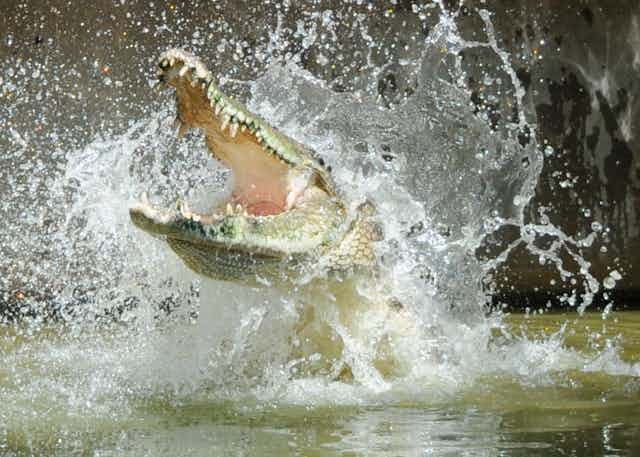
Crocodile culls won’t solve crocodile attacks

There have been two fatal saltwater crocodile attacks on people in the Northern Territory (NT) in the last four weeks. Calls to “cull” the wild population of crocodiles have inevitably surfaced. More school children in the NT will be assigned projects aimed at assessing the arguments for and against…

Km2742nw-1354838683
What keeps crocodiles under control? Bigger crocodiles. Grahame Webb

There have been two fatal saltwater crocodile attacks on people in the Northern Territory (NT) in the last four weeks. Calls to “cull” the wild population of crocodiles have inevitably surfaced. More school children in the NT will be assigned projects aimed at assessing the arguments for and against culling. More tourists will learn about the NT through the media, and in a macabre twist, there will be an increase in tourist bookings.

There is no way of avoiding nor sugarcoating the predatory nature of saltwater crocodiles. If you dive off the Adelaide River bridge, 60 km east of Darwin’s city centre, and start swimming, there is 100% chance of being taken by a saltwater crocodile. It is not the same as swimming with sharks.

The central problem is that there are now a lot of crocodiles in the NT, and for many people the solution to the problem of crocodile attacks lies in reducing the number of crocodiles by culling. But it is not so simple.

For over four decades the crocodile population in the NT has been increasing, crocodile attacks have been occurring, and calls for culling have been raised. But politicians in the NT, where most crocodiles in northern Australia live, have not authorised a widespread cull.

Residents in the NT generally support that decision – although sometimes begrudgingly. Their decision has little to do with ecology, biology, Archesorial ancestry or the intrinsic value of crocodiles, which people such as myself hold dearly. It is because the public and politicians accept that the benefits of abundant saltwater crocodiles ultimately outweigh the costs.

Conserving wildlife that prey on people is one of the world’s great challenges. Most predators were historically eradicated as pests; if they had a valuable skin, well all the more reason to rid the world of them.

A valuable skin was a historically powerful incentive to eradicate crocodiles. In the NT it’s now an incentive to conserve. Grahame Webb

It was only as biological extinction loomed – the risk of losing the last one – that the net values changed. Positive values were attributed to avoiding extinction, and because attacks were rare or non-existent due to population depletion, the negative values had essentially disappeared.

But where predator conservation action is successful, the threat of extinction dissipates (along with the positive values attributed to overcoming it), and the negative values escalate as more and more attacks occur. Calls for action (culling) escalate and a political problem emerges. People have always seen themselves as having rights to be protected from marauding wild animals.

In the NT, depleted saltwater crocodile populations were protected in 1971. Since then the wild population has expanded some 20 times in abundance and 100 times in biomass. The role of competing “values” in paving the way for that recovery was recognised in the early 1980s and remains central to their management today.

Commercial use based on both ranching (collecting and selling wild eggs), and limited direct wild harvesting, is clearly biologically sustainable and allows landowners to benefit financially from the increasing number of crocodiles on their lands.

Crocodile farming, based largely on ranching (collecting and selling wild eggs), generates some $25 million per year in skin sales for the international high fashion industry and has extensive commercial flow-on effects in the community. Tourism, based on wild and captive crocodiles, is the mainstay of the “Top End” tourist industry.

Tourism is everyone’s business in the NT. It is the second largest industry and biggest employer of people. National and international documentaries and media attention on the NT’s successful crocodile management program is arguably the primary vehicle through which Top End tourism is promoted against competing destinations.

Against these positive values, associated with having abundant crocodiles, a refined public education program ensures residents and visitors are well-informed about “crocodile safety”. An active problem crocodile program is dedicated to trying to keep crocodiles extinct in Darwin Harbour, where most people live, and to removing individual crocodiles that cause problems in remote communities – thereby reducing negative values.

So there are areas in the NT where abundant crocodiles are favoured and appreciated, and areas where they are not. It is not a perfect system, but it has worked remarkably well. Widespread culling, with the general goal of reducing the total population in all areas, has not been implemented because it would come at a cost to those benefiting from having abundant crocodiles in most areas.
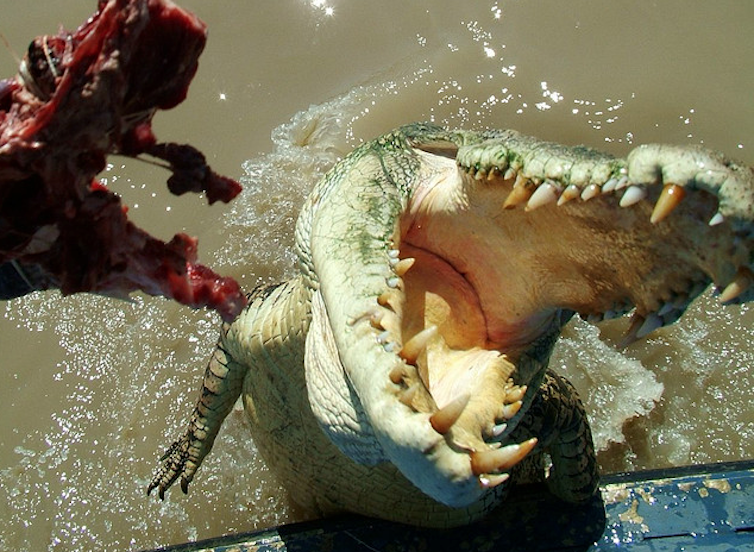
NT tourism in the ‘Top End’ would be nowhere without the croc. May Martin

Issues like “trophy hunting” are not about improving public safety, but rather about finding more ways in which landowners can gain more commercial returns from killing the same crocodile than they can do now to sell its skin.

Steadily improving the problem crocodile program, especially in Darwin Harbour, involves strategic culling at a level that does improve public safety – taking out every crocodile possible. A strong case may be made for eradicating saltwater crocodiles that move well-upstream, out of core areas, and become established in new areas from which they have not been known historically – an increasing risk to people.

Such management decisions, in the case of the NT, need to be made in the context of risk assessment within the NT. Pragmatism with crocodile management is a critical ingredient.

The idea that culling the wild population as a whole would help public safety may be true if the cull was very severe, and aimed at bringing the population back to the pre-protection levels. However, if the population was reduced by say one half: “which politician would say it is now safe to go back into the water?”.

It clearly would not be safe. Is it safer to see abundant crocodiles in a wetland, where swimming would not even be considered, or be lulled into a false sense of security by having a lesser number of more wary crocodiles?

Then there is the response to culling. It could stimulate an increase in the wild population, as occurred with caimans in Venezuela. It is crocodiles that are controlling the size of the wild crocodile population, and if the larger ones are selectively removed, the population could be expected to expand.

In any overview, selective culling has a role to play in the overall management of crocodiles, but is not the public safety panacea that it may superficially appear to be.

Sign in to Favourite

Want to follow The Conversation?

Sign up to our free newsletter to get the day's top stories in your inbox each morning, with a special wrap on Saturday.

Spinner
Donate and become a friend of The Conversation

Join the conversation

13 Comments sorted by

  1. Jack Arnold

    Director

    Thank you Grahame for a well balanced, considered article on what could become a very emotive topic among readers without your extensive knowledge of crocodiles.

    This just shows the high standard that may be achieved by graduates from regional universities like the University of New England.

    report
  2. Dianna Arthur

    Dianna Arthur is a Friend of The Conversation.

    Environmentalist

    I respect any indigenous animals right to live in their environment - especially crocodiles, one should not play favourites but there is a lot to respect about crocs - from their territorial natures (a natural due accorded to an apex predator) through to the care for their young - not all reptiles put such an investment in the early stages of juveniles as a female crocodile.

    I can state all this from the safety of my home in Southern Australia, which, due to climate is a crocodile free zone. I…

    Read more
  3. Mike Archer AM

    Professor, Evolution of Earth & Life Systems Research Group at University of New South Wales

    Spot on, Grahame. The best way to conserve wild species in the wild is to focus on conservation through sustainable use. It's been proven to be successful many times over, particularly when the local community becomes involved in benefiting financially from the sustainable use. You've led rational thinking on this topic around the world in relation to crocodile conservation and it's that hard-earned, field-tested wisdom that needs to be embraced by Australia now more than ever. An interesting recent…

    Read more
  4. Pat OBrien

    Activist

    Yes a good article, and culling is something similar to the shark net arguments. A crocodile cull won't make the NT waterways safe, any more than shark nets make the Southern beaches safe for swimmers.

    However I find that comments about the commercial crocodile farming as being sustainable a bit hard to swallow. My understanding is that the Industry is (or has been) financed by the NT government and tourism visitation to the farms. Crocodile skin products are also outrageously expensive, with limited local or overseas markets.

    But still, an otherwise good article, and I hope it draws lots of comments.

    report
  5. Rosie Cooney

    Visiting Fellow at University of New South Wales

    Thanks Grahame, a really valuable article. It highlights very clearly how fundamental people's values are in determining conservation outcomes for species, and how important economic benefits can be in determining whether people are willing to live with them. We should all be very grateful that crocodile skin products are "outrageously expensive"! This value, feeding back down the value chain as it does, is a major reason landholders are willing to tolerate crocodiles, particularly in remote areas where the tourists don't go.

    report
  6. Comment removed by moderator.

  7. Gordon Angus Mackinlay

    Clinical Psychologist

    Having over the past forty years had a bit to do with crocs, including an extremely frightening attack in the lagoon of Manus Island by a very large creature on our Zodiac, they have a certain interest to me. Having just returned from the Burketown area of Far Western Queensland, and visiting a station owned by a family member, crocs remain a problem there. Not from taking stock, but, the sheer threat. The last floods left a substantial number inland, who as the waters retreated they moved back…

    Read more
  8. wolf sievers

    director

    good points Mr Webb, well made. There is one two legged species on this earth that has trebled in number in my lifetime, to 7 billion. When do we start considering the impact that is having, instead of continually making room by getting rid of those animals less able to defend themselves.

    report
    1. Lieberman David

      logged in via Facebook

      In reply to wolf sievers

      Crocks are alive , well and flourishing . They were here well before we were and are masters of survival and the don't give a stuff about us or anything else . They don't need us to care for them and as Nature decrees it is ''Survival of the fittest '' and Adaptation to the Environment .
      They will still be here long after Man has perished
      Let's live our lives well without polluting the Earth too much and leave the animals alone especially the natural killers so that they can help to keep the population down . If you are of a religious belief system then remember this is all occurring under your god's eyes , assuming he/she has more than one , condoning all .
      Just don't go where the killers are ... except in the zoo.... SIMPLE

      report
  9. Clara Lucia Sierra Diaz

    Biologist, Colombia

    Hi! Dr.Webb, we are very much in accordance with you. From our place, at Cispata Bay, San Antero, Colombia, we are concerned because we could be face with similar situations. That is reason why we believe that one of the most important goal for the conservation program, at this point, is to be able to downlist the C. acutus population from Cispata and, particularly the local community involved in benefiting financially from the sustainable use. It has to be note that Cispata Bay could be consider, by now, like a ¨natural oasis¨ and the population can be very much in risk in case that a similar situations happen. In the same way, it will have a negative impact to reach the population recovery of other crocodile’s at Colombia that are very much diminish at extreme, without knowing their real situation.

    report
  10. Greg Miles

    Conservation lobbyist

    While there is intensive Croc control around Darwin (and to a lesser degree around other large coastal towns) the main interface between crocs and humans is an indigenous one. In that great arc from Townsville to Exmouth it is mainly indigenous people who stare down crocs. In this sense the issue of croc/human predation is up to the indigenous community to take the lead on. This raises some interesting questions, as most indigenous people under 40 years of age have not had the same exposure to…

    Read more
  11. Grahame Webb

    Adjunct Professor, Environment & Livelihoods at Charles Darwin University

    Apologies for not responding to some of the observations - have had difficulty connecting to tnhe "Conservation".

    There is a scientific time scale problem in trying to conserve crocodiles based only on the intrinsic values that some of us hold for crocodiles. The conservation problems exist today, and must be solved with today's people living with crocodiles, using the diverse values they hold. To establish a precondition that intrinsic values will be the only ones used to drive conservation…

    Read more