A recent report on coral loss from the Great Barrier Reef has pointed the finger at cyclones and Crown of Thorns starfish. The real culprit is human activity, and until we reduce port activity and pollution, coral will be unable to bounce back.
Three recent studies, published in 2004, 2007 and this week, have shown that at least 50% of the corals on the Great Barrier Reef have disappeared in recent decades.
Last year, another report claimed the declines were more modest and the result of a natural cycle. But the latest report, from the Australian Institute of Marine Science, confirms earlier studies – the Great Barrier Reef is in trouble.
Corals are the backbone of the reef, providing habitat for many other species. Measuring coral cover on a reef is the simplest way to monitor its condition. But other metrics – like counts of sharks, dugongs and turtles – also show alarming downward trajectories. The decline in coral cover highlights UNESCO’s concerns about the dwindling Universal Heritage Values of the Barrier Reef.
The key question now is, what are we going to do about these losses?
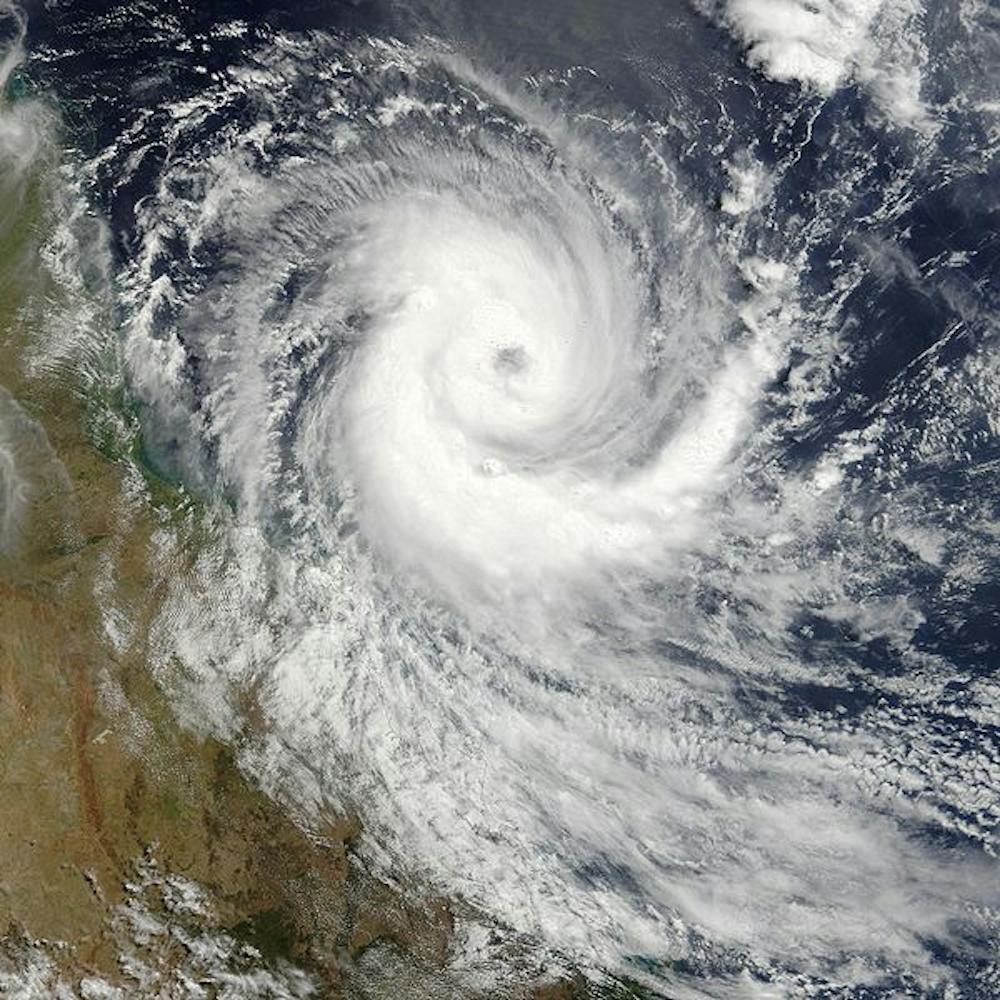
First, we need to consider why coral cover changes. The amount of coral goes down when they reproduce less, grow more slowly or die more frequently. Even under ideal conditions, about one-quarter to one-third of a coral population dies each year from background mortality. They can die from old age, disease, predation, competition with a neighbour, erosion of their skeleton, smothering by sediment, severe coral bleaching, and from storms.
On a healthy reef, loss of cover is balanced by new recruitment of young corals and by new growth. It’s just like a human population – we measure births, deaths and net migration to track demographic changes. Measuring mortality alone won’t help us to plan for schools or new roads.
Next consider where the loss of coral cover is greatest. The 50% decline in coral cover is averaged over the whole Great Barrier Reef (GBR). However, there has been no net loss of coral cover in the remote north beyond Cooktown or on reefs far from shore. Consequently, most reefs that are close to the coast (and to people) have lost far more than 50% of their cover.
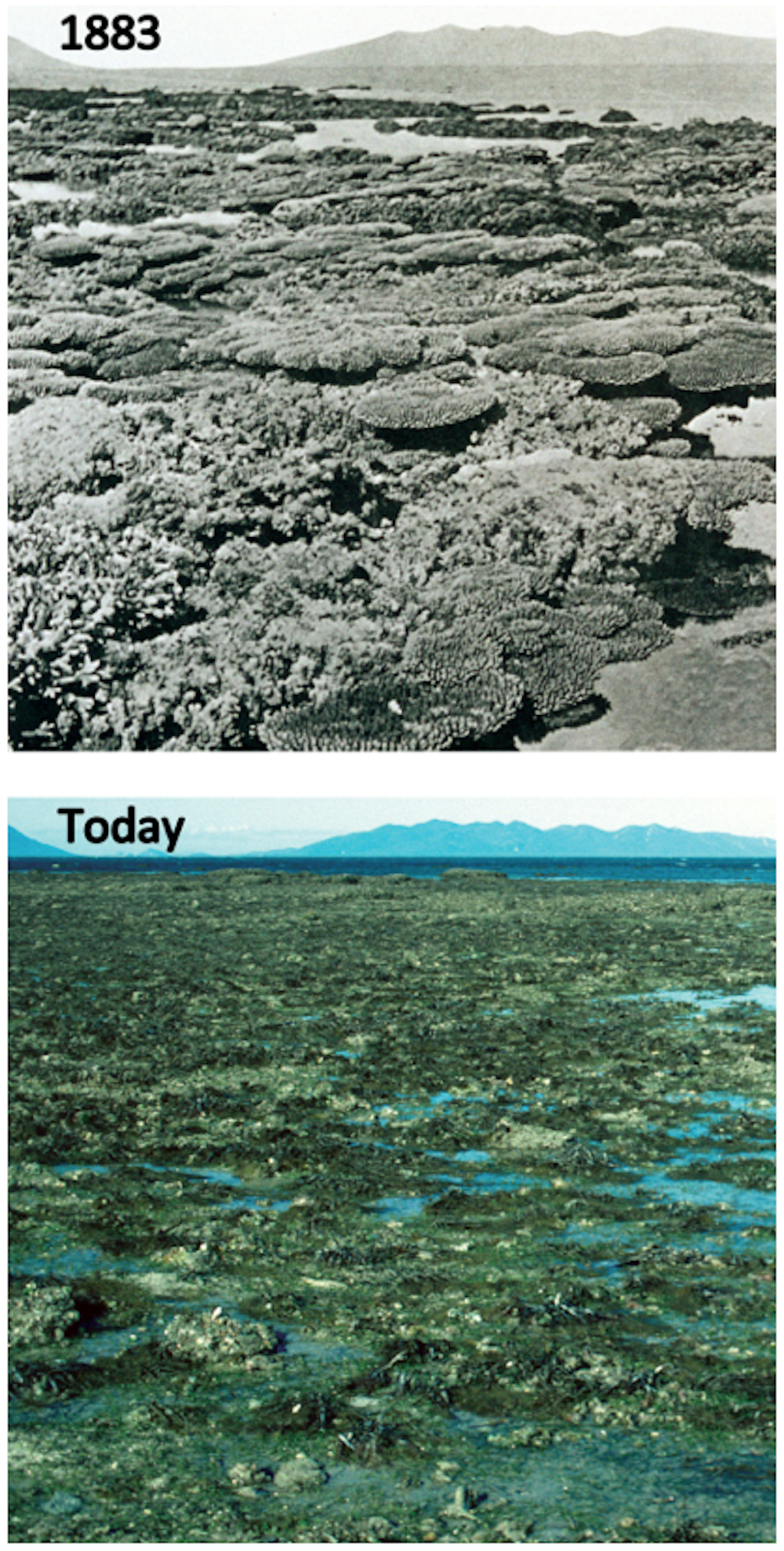
Coastal reefs have been obliterated by runoff of sediment, dredging and pollution. Once-thriving corals have been replaced by mud and seaweed (see Figure 1).
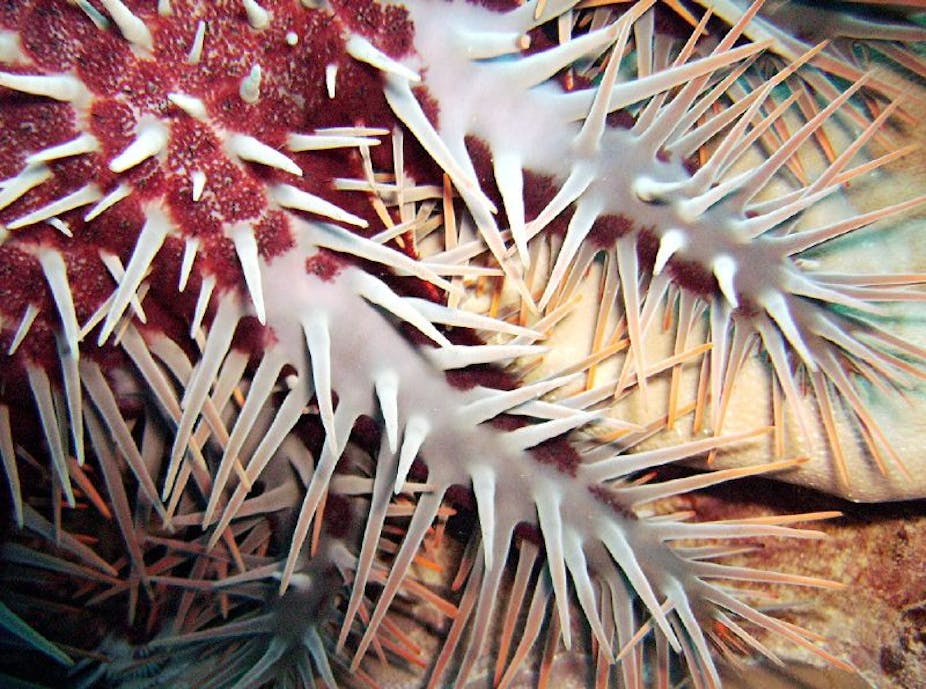
The latest study attributed 100% of the loss of coral cover solely to higher mortality, due to just three causes – cyclones (48%), crown-of-thorns starfish (42%) and coral bleaching due to climate change (10%). However, reefs have coped with cyclones for millions of years, and – despite some claims to the contrary – the number of cyclones per decade has actually dropped slightly in the past 100 years. Too many starfish is a symptom of the decline of the Great Barrier Reef, not the direct cause.
In reality, we are responsible for the loss of corals, not storms and starfish. Before people, corals recovered from routine shocks like recurrent cyclones, and now they don’t (except in the most remote places).
The rush by many reef scientists to focus solely on climate change research has distracted attention from other ongoing threats to the reef that, so far at least, have been much more destructive. Four outbreaks of crown-of-thorns starfish have occurred on the Great Barrier Reef since the 1960s, and widespread damage from the first two of them led to the initiation of formal monitoring of corals in the 1980s.
There are two plausible but unproven theories about the causes of outbreaks of crown-of-thorns starfish. One suggests that dredging and runoff of nutrient pollution from land promotes blooms of phytoplankton which speeds up the development of starfish larvae, contributing to outbreaks. The other surmises that the changes we have made to the structure of foodwebs have resulted in fewer juvenile starfish being eaten.

The best way to restore foodwebs and rebuild fish stocks is to create a network of no-take fishing reserves. The success of the GBR green zones in rebuilding depleted fish stocks bolsters the Commonwealth’s plan for a national system of marine reserves.
There is no shortage of crackpot solutions being proposed to fix the problems of the Great Barrier Reef – like covering corals with shade cloth to prevent bleaching, moving corals out of harm’s way, or killing millions of starfish one at a time with a syringe. There is a new outbreak of crown-of-thorns underway, the fourth in 50 years, and it is far too late to stop it. Direct intervention to kill starfish is expensive and time consuming. At best, it just might help to control numbers adjacent to a tourist pontoon, but it won’t change the trajectory of the current outbreak.
To increase coral cover, we need to improve the conditions that help them reproduce, survive and grow. The capacity for coral recovery is impaired on a reef that is muddy, polluted or overfished. The ongoing decline of corals demonstrates that the Great Barrier Reef is very poorly positioned to recover from future bouts of coral bleaching. Governments need to focus on controlling pollution and dredging, reducing carbon emissions, and placing a ban on new coal ports.
Marc Hendrickx
Geologist
Thanks Terry, a great article! Seriously!
Marc Hendrickx
Geologist
Hey John Bruno, take note this is how a real scientist reports on a problem.
Mike Swinbourne
logged in via Facebook
I agree Marc.
I take it then, that you have read the paper and agree with it's findings. I bet you love this quote from the abstract as well:
".....Thus, reducing COTS populations, by improving water quality and developing alternative control measures, could prevent further coral decline and improve the outlook for the Great Barrier Reef. Such strategies can, however, only be successful if climatic conditions are stabilized, as losses due to bleaching and cyclones will otherwise increase..."
Marc Hendrickx
Geologist
Mike,
I'm all for doing something that will make a difference. Addressing the COTS threat and reducing pollutants examples of where we can make an impact in the short term. The longer term issue of bleaching may be addressed by successfully transplanting more temperature resistant corals into areas that might be affected by increases in sea surface temperatures. This has some risks but worth researching and trialling.
You can't stabilize the climate. Think Cnut.
David Arthur
n/a
Marc, we can and will stabilise the climate, by ceasing fossil fuel use.
If this means no more coal-mining, then so be it.
Chris McGrath
Senior Lecturer at University of Queensland
This is a valuable article. Thanks Terry.
STABLE POPULATION PARTY
Written & authorised by William Bourke, Sydney
"The real culprit is human activity"
The athor should also recognise that it's not just the way we behave, but also the number of humans. Sustainablity is a two-wheeled bicycle.
Unless we fight and win the population battle, in the long run all other environmental battles will be lost.
Mike Hansen
Mr
What are you suggesting - a population cull?
The countries with the highest per capita carbon footprints are those with the lowest population growth.
Countries like China and India implement aggressive population control policies including forced sterilisation.
Population is a second order issue.
The real culprit is greed - for example - in this country coal billionaires who want to gain control of newspapers so that they can persuade the populace that climate science is a sham and that building coal ports on the GBR is somehow in our interest - even though more people by far are employed in GBR tourism.
Marc Hendrickx
Geologist
Oddly enough GBR tourism depends to a certain extent on those "greedy" people, many of them working in coal mines or cultivating methane spewing bovines, who fly in on avgas guzzling planes, spend a few brief moments cruising the reef then fly off home with happy memories. You can't have one without the other. Caught in a catch22? Perhaps our international visitors could sustainably cycle here? Wonder how many tourism jobs that might support.
Good grief.
Paul Wittwer
Orchardist
Mike Hansen said "What are you suggesting - a population cull?"
Clearly William made no such suggestion. The ownership of that disgusting suggestion is entirely yours and should be cause for you to take a good look at yourself.
All countries with population growth need to end it through education and financial incentives while countries with high per capita ecological footprints need also to reduce them.
India's population control policies are failing miserably. Rich nations have no control policies or even worse, encourage population growth eg the baby bonus.
You can't relegate population growth to second place blame for the Reef's troubles. It's right there in the centre of a group which includes developer and coal greed, overconsumption, poor environmental protection, the Growth Fetish and apathy.
David Arthur
n/a
You can have GBR tourism without fossil fuel use, but it will take a little technological change. You should start reading Business Spectator's site specialising in climate business - Climate Spectator www.climatespectator.com
Anyway, coal miners as a rule don't holiday on the Reef. They go back to their Brisvegas apartments and drink themselves stupid until they're off to the mines again.
How many tourism jobs? Far more than coal mining jobs, anyway. What's more, Chinese tourists will want to holiday somewhere nice long after their economy is weaned off coal.
Marc Hendrickx
Geologist
So you see us all on low paid jobs, making beds, doing back massages and serving the rest of the world Pina Coladas. Good grief! Fiji make room for the new Australia, here we come.
David, You are the maid in this picture....enjoy the salary.
http://www.youtube.com/watch?v=bl3HcIXvIo0
David...No tuck please.
Mike Hansen
Mr
So Paul, this policy from your web site is not a proposal for a cull?
"The status of NZ citizens currently living in Australia would be determined following a comprehensive review of all immigration programs. A compassionate approach is advocated towards long term residents."
And of course we have the mandatory reduction in Australia's refugee intake. The world's biggest environmental problem, global warming will not be impacted one iota by restricting immigration to Australia.
Populationism is a distraction, a policy which blames the poor in the third world for over-consumption in the west. The US, for example, has 5% of the world’s population, consumes 25-30% of the world’s resources, and contributes 30% of the world’s greenhouse gases. And within the US, the top 1% own 35.4% of all privately held wealth, the next 19% had 53.5% leaving only 11% of the wealth for the bottom 80% (wage and salary workers).
Paul Wittwer
Orchardist
Mike Hansen, the web site is not mine and I don't vote for that party. I was merely taking issue with your snarky, uncalled for and misleading attack on William Bourke's post.
Read moreI sympathise with the sustainable population movement and they are well aware that consumption has an equal, NOT 2nd rate, part in the sustainability equation.
The simple fact is that there are already too many people on this planet for all of us to live even a very low footprint and civilised lifestyle.
The developed world…
STABLE POPULATION PARTY
Written & authorised by William Bourke, Sydney
Thanks for providing some balance Paul.
Cull is a deliberately evocative word, which is defined as 'A selective slaughter of wild animals'. So yes, just a little over the top from Mike but misleading interpretations of our sustainable population policies are not uncommon.
Re NZ, we certainly reject an open borders arrangement that has never been agreed to by the Australian people. There is no mandate and it is just another way that big business is achieving its aim of growing its customer base…
Read moreDavid Arthur
n/a
I don't see all Australians in "low-paid jobs making beds, doing back massages and serving the rest of the world Pina Coladas."
I see Australians in high-tech manufacturing industries making fuels cells and operating anaerobic digestors to generate methane to supply to the fuel cells.
I see other Australians in high-tech mineral processing industries using solar thermal and wind power to electrolytically win iron and aluminium from refined iron ore and alumina, then exporting the value-added iron and aluminium instead of iron ore and bauxite. (There might even be a job for a geologist.)
I see other Australians operating mallee plantations to supply biofuel refineries.
I see other Australians manufacturing and installing solar PV and deepcycle battery banks running high-tech low power consumption households and exporting power to the grid.
Do you want fries with your Pina Colada? Get them yourself.
David Arthur
n/a
Population is NOT the issue with regard to Great Barrier Reef protection, the issues are clear:
1) restore discharge water quality in water discharging from Queensaldn rivers.
2) cease fossil fuel use.
Both of these can be addressed without Population Party posturing. Further, the population is addressed by worldwide education and emancipation of women.
STABLE POPULATION PARTY
Written & authorised by William Bourke, Sydney
David, did you read the piece?:
"Next consider where the loss of coral cover is greatest. The 50% decline in coral cover is averaged over the whole Great Barrier Reef (GBR). However, there has been no net loss of coral cover in the remote north beyond Cooktown or on reefs far from shore. Consequently, most reefs that are close to the coast (AND TO PEOPLE) have lost far more than 50% of their cover."
Local AND global population growth has had a big impact on the reef, both directly (e.g. increased…
Read moreMarc Hendrickx
Geologist
Australia with a manufacturing industry. Now I know your dreaming.
David Arthur
n/a
Population increase has had pronounced local effects on the reef, NOT because of the existence of population per se, but because of the DEAD SET STUPID manner in which those population have damaged the land.
Knowledgeable, prudent people wouldn't clear land down to the river's edge, and nor would they have open cut mines near rivers. They wouldn't clear mangroves and sea-grass beds.
What they would do is maximise water recycling and nutrient recovery, stabilise riverbanks and restore riparian vegetation, they'd practice zero-till agriculture where they can.
We don't need population culling, we need population education, including of newcomers to a region. Everybody should be properly educated regarding the ecological history of their river catchment, from watershed to estuary, perhaps with settlement approval dependent on passing the ecological history course?
David Arthur
n/a
Marc, it has been fossil fuel-powered transport that has relieved Australia of its "tyranny of distance"; 10% of Australia's fossil fuel use is shipping - lots of high-volume low-value bulk commodity exports and low-volume high-value goods imports.
For comparison, ~3% of the world's fossil fuel use is shipping goods and commodities around the world.
While all this transport has been a boon for Australian latté-sippers to get to and from New York, it has come at large cost to the climate…
Read moreSTABLE POPULATION PARTY
Written & authorised by William Bourke, Sydney
The science supports population growth as the key issue:
"The study found the reef had been beset by a ‘wicked' series of problems in the past 50 years, including a one degree rise in average temperature, lower rainfall, overfishing and destructive fishing practices, and other activities associated with human population growth."
http://www.sciencealert.com.au/news/20131501-23966.html
David Arthur
n/a
Thanks for pointing that out, STABLE POPULATION PARTY. I see the article refers to the once-pristine Grand Récif of Toliara (GRT) which stretches about 19km off south-west Madagascar.
It is quite obvious that environments can and do suffer if human impacts exceed environmental capacities for resilience.
Nothing in the article alters my previous response. As an aside, I might add that that neglecting to self-manage human population is indicative of environmental neglect. Note, however, that population management is not the solution, but only part of the solution.
Such single-issue focus, while instantly appealing, suggests a lack of analytical thinking.
ken kerrison
farmer
The Reef is the only animal-made feature on Earth which is visible from outer space. And the actions of another Earthly animal species, us, has brought a process which has continued for millions of years to an abrupt halt within a few decades..
In the 60s the Reef was alive, thriving. By the 80s it was showing signs of stress and it has gone downhill ever since.
The same pattern is evident in reefs off Fiji and the Cooks. All these reefs are, virtually, a write-off.
No doubt the global-warming sceptics will blame something else for what has happened.
My gut feeling is that it does not matter much - the Earth is entering a new climatic era which is probably incompatible with humanity (and many other species). I suspect that nothing we do now will make much difference.
Mike Swinbourne
logged in via Facebook
Actually Ken, the Great Wall of China is an animal made feature which is visible from space, as are human cities etc. After all, we are animals as well (as you pointed out).
But I agree with your depressive gut feeling.
Frank Arthur
logged in via Facebook
I have long been of the opinion that the crown-of-thorn starfish are just canaries in the coal mine. Cyclones may have not increased in number, but the number of intense cyclones may be increasing. Certainly, ocean temperature and acidification is increasing. Couple this with direct human activity and we have the current problem.
David Arthur
n/a
Crown-of-thorns starfish have only occurred in plague proportions since the early 1960's, shortly after large-scale land clearing got underway in Queensland. Before that, Coral Sea rivers discharged water that was fairly clean, and didn't contain lots of enriching nutrients that fed the starfish larvae.
The solution to starfish lies in cleaning up runoff into Coral Sea rivers. The Reef Rescue package goes some way to doing this by helping cane farmers limit their runoff, but that only addresses…
Read moreMarc Hendrickx
Geologist
"Crown-of-thorns starfish have only occurred in plague proportions since the early 1960's"
How do you know?
David Arthur
n/a
"Half the Great Barrier reef gone in under 30 years, says AIMS study", Malcolm Holland, Environment Reporter, News Limited, 2 October 2012
"The AIMS study reveals all efforts to control successive waves of crown-of-thorns plagues had failed since the first outbreak was discovered at Green Island near Cairns in 1962."
Read more: http://www.news.com.au/travel/news/half-the-great-barrier-reef-gone-in-under-30-years-says-aims-study/story-e6frfq80-1226486114293#ixzz28HyAVCl3
Marc Hendrickx
Geologist
The 1962 event is the earliest well documented event, however ....
"Interviews with trochus divers from the Torres Strait indicate that crown-of-thorns (COTS) outbreaks may have occurred in the early part of the 19th century."
http://www.gbrmpa.gov.au/about-the-reef/animals/crown-of-thorns-starfish/history-of-outbreaks
Marc Hendrickx
Geologist
History of crown-of-thorns starfish outbreaks
http://www.reef.crc.org.au/discover/plantsanimals/cots/cotsprevious.html
Spicules from crown-of-thorns starfish skeletons have been found in old reef sediments which suggests that starfish have occurred on the Great Barrier Reef during the past 3,000 – 7,000 years. However, because the sediments become mixed over time and the spicules are difficult to date accurately, it is unclear whether starfish outbreaks are a new phenomenon or not.
The first documented case of large numbers of crown-of-thorns starfish on the Great Barrier Reef was noticed at Green Island off Cairns in 1962. It’s possible that starfish outbreaks are more likely to be noticed now than in the past because of increased tourism and the popularity of SCUBA diving.
Marc Hendrickx
Geologist
David, This article of interest also....from "Geological Approaches to Coral Reef Ecology Volume 192, 2007, pp 85-125 - link below. Perhaps Terry Hughes can comment?
Inferring Past Outbreaks of the Crown-of-Thorns Seastar from Scar Patterns on Coral Heads. Lyndon M. DeVantier and Terence J. Done.
From page 111...
Read more"Scar step-height measurements and dates from cores (1936 to 1938) both support the hindcasts, although it is not possible categorically to assign this scarring to past seastar outbreaks…
Terry Hughes
Federation Fellow, ARC Centre of Excellence for Coral Reef Studies at James Cook University
"Interviews with trochus divers from the Torres Strait indicate that crown-of-thorns (COTS) outbreaks may have occurred in the early part of the 19th century".
Really? The early 19th Centrury is say 1800-1825. Was the person being interviewed about 190 years old?
Terry Hughes
Federation Fellow, ARC Centre of Excellence for Coral Reef Studies at James Cook University
The article you cite concluded with "The scar record also suggests that the outbreaks have increased in frequency and geographic spread in recent decades." Scars in coral skeleton are common, showing a dieback of tissue, that the coral survives. As Terry Done, noted, we can't be sure what caused old scars. The main point here is that four modern outbreaks since 1960 is not sustainable, and it couldn't be the long-term norm. Many reefs in the Pacific were already compromised by runoff from landclearing and by overfishing by the 1930's, but of course not to the extent of today.
Marc Hendrickx
Geologist
Gee Terry,
Presumably those interviews done a while ago Terry. But as that information came from the Great Barrier Reef Marine Park Authority, an organisation that apparently has strong links with your own, perhaps you could find out where the source comes from rather than posting sarcastic comments.
David Arthur
n/a
Marc, you make some good points about past COTS outbreaks, thank you; it stands to reason that, if COTS outbreaks are attributable to elevated nutrient availability, then historically they would be correlated with flood events. Of course such flood events have always occurred from time to time.
However, recent history has added a new source of nutrients to the GBR lagoon, and that is land disturbance since European settlement, particularly since the post-WW2 intensification of that disturbance. Coupled with increasing frequency of extreme weather events, these men-made disturbances are coming to dominate coral loss.
Welcome to the Anthropocene.
Mike Hansen
Mr
Gee Marc.
Turns out Terry was quite wise to be skeptical.
"Oral historians from James Cook and Griffith Universities have interviewed trochus divers from the Torres Strait who knew about COTS in the early part of the century, but were never concerned, regarding them as a natural part of the environment."
http://www.reef.crc.org.au/publications/explore/feat15.html
The information in the GBRMPA link is wrong - someone got their centuries mixed up.
David Arthur
n/a
Gday Terry, perhaps the Torres Strait trochus divers were from traditional backgrounds with well-developed oral history traditions.
The intergenerational transmission of environmental knowledge in such societies seems far in advance of our own, as illustrated by the practices described in Bill Gammage's "The Biggest Estate on Earth".
Marc Hendrickx
Geologist
Regardless it seems there is plenty of evidence for COT outbreaks prior to the 1960s. The misinformation coming from an organisation with "close links" to Terry's own. Pity they can't get their story aligned with the facts. Perhaps Terry can organise for the offending item to be corrected.
It matters little as the threat of COT is obvious and I concur that action should be taken to reduce the threat. Perhaps some of the funding being blown on the carbon tax could be redirected to this area.
John Bloomfield
Retired Engineer
This recent interview on the ABC with Dr Peter Bell, who warned about nutrients in the Great Barrier Reef region 25 years ago.
http://blogs.abc.net.au/queensland/2012/10/the-end-of-the-reef.html
This relates the sad and sorry history of his past efforts to get the GBR problems recognised and some action implemented.
Unfortunately, we are going down the same denialist road with anthropogenic climate change; ignoring and denigrating the warnings from the mainstream scientific community.
Peter Gibson
Designer
Terry Hughes states: "The real culprit is human activity, and until we reduce port activity and pollution, coral will be unable to bounce back."
He then mentions that "Coastal reefs have been obliterated by runoff of sediment, dredging and pollution. Once-thriving corals have been replaced by mud and seaweed".
Next he adds "There are two plausible but unproven theories about the causes of outbreaks of crown-of-thorns starfish. One suggests that dredging and runoff of nutrient pollution from…
Read moreTerry Hughes
Federation Fellow, ARC Centre of Excellence for Coral Reef Studies at James Cook University
My article has only two sentences on no-take fishing zones - "The best way to restore foodwebs and rebuild fish stocks is to create a network of no-take fishing reserves. The success of the GBR green zones in rebuilding depleted fish stocks bolsters the Commonwealth’s plan for a national system of marine reserves." I certainly did not disregard dredging and runoff as additional likely causes of starfish outbreaks, as you state. I think it's reasonable to point out that the jury is out on why exactly outbreaks occur.
Murray Webster
Forestry-Ecology Consultant/Contractor
Hi Terry, seems like a good article to me.
I watched/heard this story on ABC TV and radio. They were reporting an ENGO (environmental non-government organisation) spokesman (was it WWF or Friends of the Earth?) who stated categorically that nutrient run-off was the cause of the outbreak of COTS by feeding the young starfishlings, and therefore the solution was more controls on farmers.
You are saying that 'the jury is out on why exactly outbreaks occur'.
Why the difference in opinion?
Terry Hughes
Federation Fellow, ARC Centre of Excellence for Coral Reef Studies at James Cook University
There is some scientific support for both theories, and of course they are not mutually exclusive. It's not one versus the other. Pollution affects foodwebs from the bottom-up by promoting phyotplankton and seaweed, whereas overfishing changes foodwebs from the top-down by removing predators and consequently affecting their prey. Around the world, a polluted reef is inevitably also overfished, making it hard to separate the two.
David Arthur
n/a
Gday Peter Gibson,
the present degraded state of the GBR, despite the improvements subsequent to the estalishment of no-take zones (ref McCook et al"Adaptive management of the Great Barrier Reef: A globally significant demonstration of the benefits of networks of marine reserves", PNAS, www.pnas.org/cgi/doi/10.1073/pnas.0909335107), shows that no-take zones are necessary, but not sufficient. Terry Hughes is one of McCook's co-authors.
What's also necessary is cleaning up terrestrial discharge into the GBR lagoon.
Although we "one effect-one cause" knee-jerk lay people have a great deal of difficulty appreciating that their can be many contributory causes, that's how ecosystems function.
you'd already have a pretty fair idea of the benefits of preventing overfishing o f the GBR. The present depleted state of the GBR is
Nev Norton
Farmer
Thanks for the article Terry, interesting and thought provoking.
Read moreI do wish to make some comments though.
The two pictures with the hills in the background, are you sure they were taken from the same place? The upslope of the hill to the right is a different shape in each photo, one is slightly concave one is slightly convex, the saddle between the two ridges is not visible in the second photo, indicating it would be much further away, but still the mismatch in shape is worrying, I can only conclude…
Terry Hughes
Federation Fellow, ARC Centre of Excellence for Coral Reef Studies at James Cook University
Nev, you've asked me about 20 questions, so my response here will be brief. Email me tomorrow for more details if you like. We've used Google Earth to calculate GPS coordinates for both pictures, by tilting the view and aligning the hills in the backdrop. Nothing remotely like the old photo exists anywhere near this location near Bowen today. The coral assemblage in the old photo looks like an offshore reef today.
Q1. Many millions, possibly 100s of millions during a major outbreak. They are hard…
Read moreNev Norton
Farmer
Ok, thanks Terry, I could have more questions by then..lol
Bruce Moon
Bystander!
Terry
You conclude with...
"To increase coral cover, we need to improve the conditions that help them reproduce, survive and grow. The capacity for coral recovery is impaired on a reef that is muddy, polluted or overfished."
My hunch is that with the breadth of anthropomorphic activities contributing to the decline of the GBR, it is unlikely any government would be able to regulate the activities to minimise harm (even if it had such a will).
That said, a major cause of concern is the…
Read moreTerry Hughes
Federation Fellow, ARC Centre of Excellence for Coral Reef Studies at James Cook University
It's a nice idea for us to eat COTS to generate a commercial incentive to collect them. But they are difficult to handle because of their long spines, and the adults especially are chemically defended against predators. I've never heard of anyone eating one, even in the poorest tropical counties. I imagine they would make you very sick.
Bruce Moon
Bystander!
Terry
You appear negative.
I'm not advocating YOU eat one.
Rather, undertake research to determine if they can be harvested, ground to a pulp, and used as a meal for the burgeoning feedstock industry.
Cheers
Nev Norton
Farmer
G'day Bruce & Terry
Read moreI read with interest that I may be biased toward farming. I'am, but let me qualify that in terms that my bias is one that is based in food and fibre security for the nation, not this year, not in ten years time, but for the longhaul. I can also see the benefits of retaining the reef in good order. Back to the Cots, I can see Terry's point in stopping the cause of outbreaks (nutrient overload of the water column and sedimentation), I'm also a realist, and Terry's long term solutions…
Alison Moore
Senior Lecturer in Modern European History, University of Western Sydney
This is an excellent corrective to the gist of most media stories I have seen on this issue over the past few days - "its the fault of those wretched starfish!".
It really demonstrates just how poorly many journalists understand the scientific and historical contexts of the discoveries they report. Thanks Terry.
Stephen Greenwood
Director lobbyistonline.com.au
Interesting article. I recall that there was a huge crown of thorns outbreak in 1970 when I first went to work at Prime minister's Department. There were public campaigns and letter writing protests to "Save our barrier reef". Several studies were done and the Branch Head John Taylor who was later the Auditor General visited the worst sites. But the problem disappeared and the letter writing stopped. Perhaps we need to find out what measures were taken then as I lost track of how the issue was solved as it was just one of the issues we handled in the days when our Branch had responsibility for correspondence to the PM, Education, Aboriginal Affairs, Immigration and Social Welfare. I am sure that there would be several hundred people in PM and C alone these days handling those issues now but obviously no better now when it comes to the Crown of Thorns
Terry Hughes
Federation Fellow, ARC Centre of Excellence for Coral Reef Studies at James Cook University
Hello Stephen,
Read moreWell, no outbreak of crown-of-thorns starfish has ever been "solved" in the sense that no political or management respnse has made a difference once an outbreak is underway. The outbreaks run out of puff because of the biology - when the starfish start to starve (because they're eaten most of the coral) and when they become prone to disease. So, I'm afraid there are no positive lessons from past policy responses to earlier outbreaks. The first two outbreaks prompted funding for monitoring…
Stephen Greenwood
Director lobbyistonline.com.au
Many thanks Terry for the clarification and information and for taking the time to respond. It's greatly appreciated.