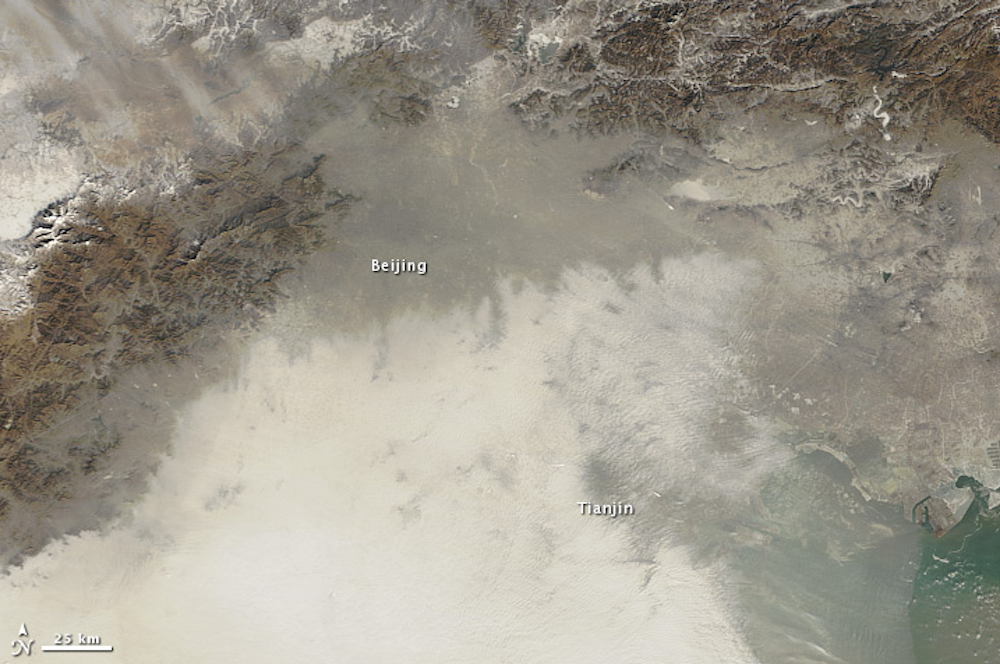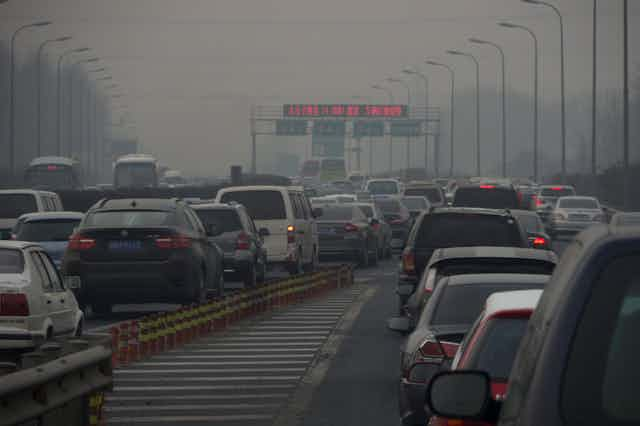

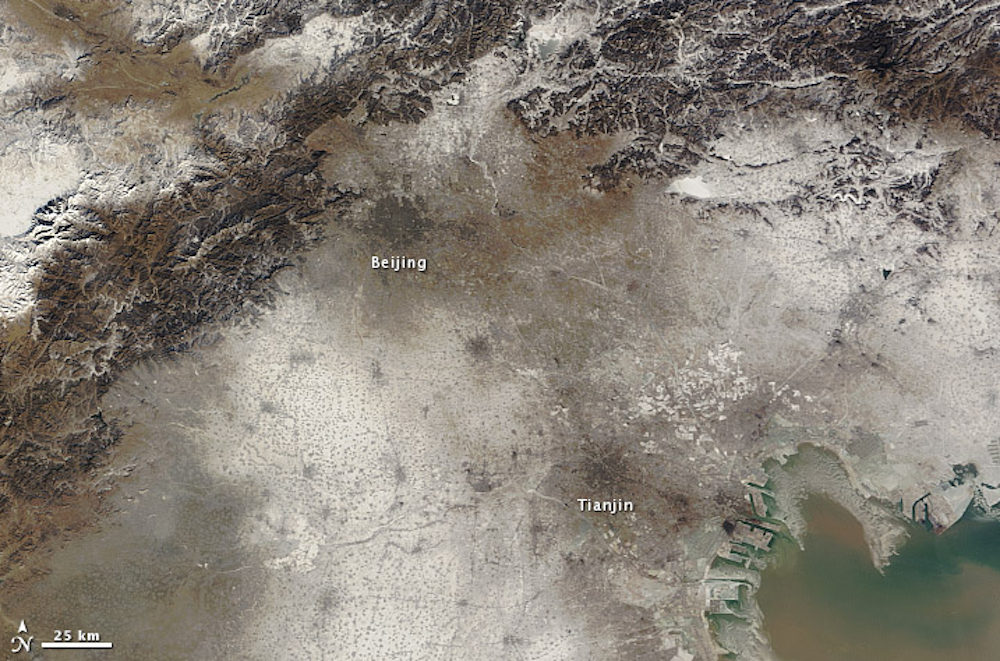
Beijing has been smothered by a dense and dangerous smog this month, which has set new air pollution records over several days.
The World Health Organization advises that the acceptable level of fine particles in the air measuring less than 2.5 microns – known as PM2.5 – should be no more than 25 micrograms per cubic metre. Above 300, and the United States Environmental Protection Agency warns that outdoor activity becomes “hazardous”, even for healthy adults.
On January 12 this year in Beijing, the PM2.5 pollution hit 886 – officially off the charts for dangerous air quality.
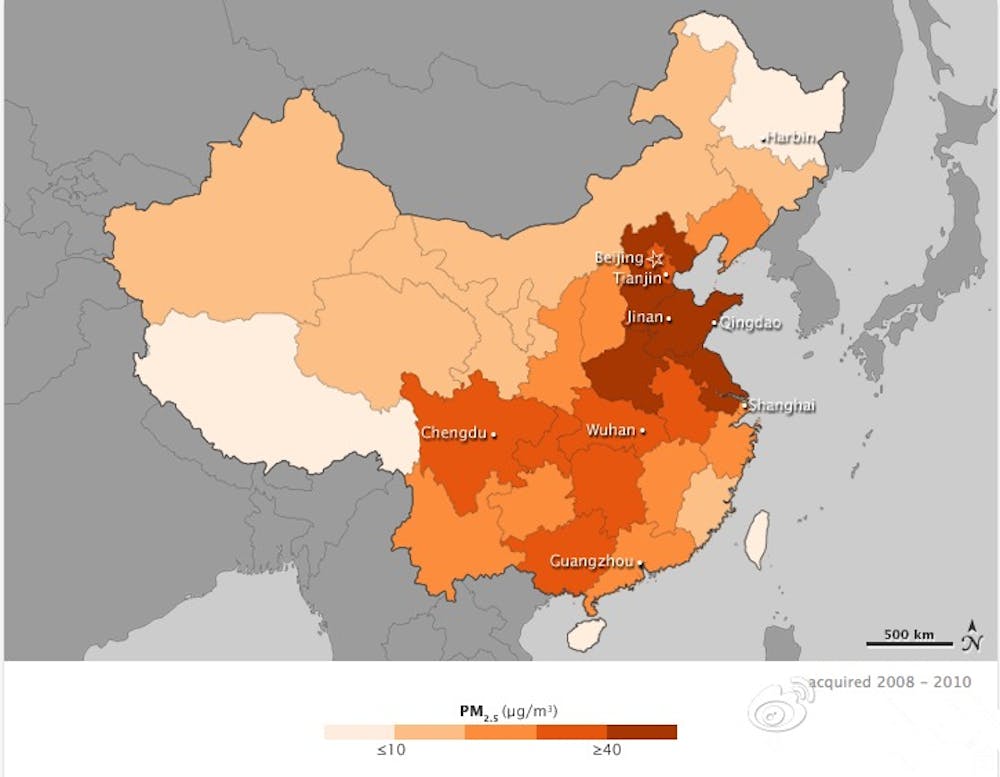
But the problem is not limited to Beijing. Many other cities in China have also been suffering from what is described as the worst air pollution in history.
Gasping for breath
I lived in Beijing for 10 years, long enough to give me chronic bronchitis. For years, I was on antibiotics and codeine phosphate solution; occasionally I also suffered from skin problems. It was only after I moved to Australia that my bronchitis gradually began to get better.
One of my friends, now based in Beijing and working for the national television station, also suffers from chronic diseases like rhinitis. She recently told me that her rhinitis has relapsed due to the smoggy air outside – but she has found that her symptoms miraculously vanish when she travels out of Beijing to cities in southern China.
The hazardous smog has created a surge of paediatric and geriatric outpatients in hospitals for respiratory diseases. Beijing Children’s Hospital, for example, had seen 9000 patients per day, a third of them with respiratory problems.
Air pollution is a deadly problem. A study published last month by Peking University and environmental group Greenpeace estimated that there were 8,572 premature deaths in Shanghai, Guangzhou, Xi’an and Beijing in 2010 that could be linked to PM2.5 air pollution.
In the meantime, face masks are selling fast. The bestseller is the N95 mask, which claims to be able to block tiny PM2.5 particles. Not by choice, a mask has become the must-wear fashion item on the streets of many Chinese cities.
Tiny pollutants sparking national outrage
Particulate matter, or PM, is the term for particles found in the air, including dust, dirt, soot, smoke, and liquid droplets.
PM2.5 particles are about 1/30th the width of a human hair – making them small enough to invade even the narrowest airways. These are referred to as “fine” particles and are believed to pose the greatest health risks.
The PM2.5 level of pollution is held to be a more accurate reflection of air quality than other standards of measurement, but until relatively recently it was not made available to the public in China.
The term PM2.5 in now widely known among ordinary Chinese people, as debate has raged on the front pages of the nation’s newspapers. There have been strong calls even from state-controlled media for the government to publish truthful environmental data, and take stronger action to improve air quality and tackle environmental pollution.
This discussion is not new. The public debate over air quality, and PM2.5 in particular, began in December 2011 on Sina Weibo, China’s most popular microblogging service, when it came to light that air-quality monitoring results released by Beijing’s weather forecast station were often significantly lower than those from the US Embassy in Beijing.
While the results from the embassy often described Beijing’s air quality as “hazardous” or “dangerous”, the Beijing weather forecast station would describe the pollution as “minor”. Both sources defended their stances by saying that the difference resulted from using different measurement standards, but the issue is so sensitive that it caused some diplomatic conflict.
These truth about the differences in these measurements were revealed on Weibo by several celebrities. This caused a public outcry online, with many thousands of people urging the government to apply the tighter PM2.5 standard.
As a result, in February 2012 the Chinese State Council added PM 2.5 to the newly revised National Ambient Air Quality Standard and applied it to dozens of pilot cities.
Green talk versus action
Following the 1992 Rio Earth Summit, the Chinese government published its national strategies for sustainable development in China’s Agenda 21 White Paper, issued on March 1994.
Officially, this marked a shift in direction towards a more sustainable path of national development. Contrary to the previous Marxist and Maoist view of human conquest over nature, the new approach took a stand against the over-exploitation of natural resources, and spoke of the need for public action to protect the environment. However, turning policy into practice has proved difficult as China has rapidly industrialised.
With many Chinese people experiencing the unplanned consequences of industrialisation and urbanisation over the past decade, more environmental protests have begun to pop up.
For example, in 2003, a large campaign was launched by a coalition of Chinese and international environmental groups to stop a proposed dam on the Salween River. The following year, the then-Premier Wen Jiabao intervened and announced the suspension of the plan, saying more careful environmental and social impact assessment was needed.
In June 2007, more than 10,000 people in Xiamen demonstrated against the building of a paraxylene factory by a Taiwanese company. The media in Xiamen were temporarily blocked by the local government and people had to use short text messages and online forums to spread information and organise street protests. The incident was solved smoothly later that year with the government promising to move this project to a remote peninsula.
In July 2012, a protest took place in Qidong, Jiangsu province, against a proposed pipeline for a Japanese paper company, which would have dumped industrial waste into the sea. Thousands of citizens took to the streets calling for the government to cancel the project. The incident was appeased after the local government promised to permanently suspend the project.
Nowadays, new technologies and social media are widely adopted by environment activists and groups. In the current dispute about air pollution in Beijing, for example, the public use mobile applications and Weibo to obtain information, initiate online green talks and mobilise offline activities.
Escalating protests and unrest
Environmental degradation and public protests against are a challenge for most governments worldwide. But in countries where the policy-making process is not transparent, environmental protests are prone to escalating to social unrest, or even becoming threats to the state.
In China, where maintaining stability is still an overriding goal in social management, the situation is complex. As more people realise sustainability is now a matter of life and death to everybody, they are finding more ways to express, and to resist, for the good of themselves as well as the next generation.
Responding to the current pollution crisis, the city of Beijing has just proposed rules that would increase fines for heavy vehicle emissions and force more factory shutdowns when smog reaches dangerous levels.
But China’s leaders must do more to protect the environment nationally, otherwise people may become environmental refugees but find no unpolluted land left where they can go.

Yoron Hamber
Thinking
Well, it seems as a revolution is coming then, ahem. Even though it isn't really ideological, rather practical. Let's hope it works out for all involved.
William Ambrosia
Retired
Having travelled the major cities of western China over 5years ago the experience then was unbearable with limited near distance visibility and air thick with an acidic burning of eyes and burning sensation of nasal, throat area. Strongly discourage anyone with upper respiratory conditions to travel to this part of the world. It's unconscionable that Western corporations are exploiting this region of the world with carbon intensive based industries that offer no concern for the safety for the general health of the Chinese worker or it's citizens. Maybe it's time to rethink the how low can you go business models that are exacerbating this already acute and toxic situation. Unfettered Capitalism in not a sustainable way to conduct business.
Robert Tony Brklje
Robert Tony Brklje is a Friend of The Conversation.
retired
You are only looking at the superficial direct action of extremely high pollution levels, underlying that is all the various forms of cancer.
Travelling in China's major cities is to play Russian roulette with the most deadly of maladies which often strikes years or decades after high risk exposure.
Those extreme levels of pollutions are creating, open air laboratories and turning the population into experimental laboratory animals. No one knows the consequences, as the condition are very different from normal human evolutionary conditions, the likely outcomes will be very negative.
If one country desperately needs to enforce the use of electric vehicles and, to ban all non-natural gas combustion in metropolitan areas it is China.
The real problem of course is corruption and the divergence between what is regulated and what actually occurs.
John Newton
Author Journalist
And recently we have been hearing economists gleefully reporting that the Chinese government is now directing its growth efforts at selling more to its own population. Which means more cars, more air conditioners, more more more. And a relentless gobbling up of finite resources in the name of the grail of growth.
Yoron, would it not be a wonderful irony if the revolution against the cancer of endles growth began in China?
Felix MacNeill
Environmental Manager
I think a partial revolution in China isn't as unlikely as it sounds.
In representative democracies like Oz, we're a bit prone to think of the Chinese system as a monolithic power bloc completely imposing its will on a subjected people, but it's just not as simple as that - there are all sorts of layers of government and administration in a nation as large and complex as China which often end up creating a kind of democracy-in-practice as it's just not possible for any system to completely control all its parts.
maybe it's a bit like imperial Rome - there might be an emperor but if the mob turned against you, Praetorian Guard or not, you could be in serious trouble. bread and curcuses worked to a degree in Rome, and have worked to a degree in contemporary China, but I think it would be foolish to understimate the determination, courage, power and plain common sense of the Chinese people when they're faced with real existential threats like this.
John Holmes
Agronomist - semi retired consultant
In rely to Felix. You are quite right, and China has been there and done that many times. Of course modern communications probably help maintain more cohesion than in the past.
My parents spent considerable time in SW China, and my father used to quote a proverb or two re the country. One was 'China was a plate of sand, you can build castles, but tap the plate and it falls down'. The other was "China is a field of wheat, the wind blows and it all lies down, when the wind stops, it stands up again"
These came from pre- revolutionary China, yet I feel reflected observations that unless a strong central government was in power, people, districts and regions go their own way. Bit like some WA politicos would like to do at times.
Sheena Burnell
logged in via Facebook
I have been living in China for over four years and have watched this all-too-predictable scenario unfold as the Chinese scramble to play catch up economically and socially with the first world. As always the situation here is complex and while there is certainly some reprehensible behaviour in terms of environmental degradation from outside interests such as the Taiwanese and Japanese projects Yanshuang mentioned, the Chinese are undertaking the most gargantuan infrastructure project the world has…
Read moreJane Hunter
Academic
Very interesting - I traveled to China a few years ago for three weeks and was overwhelmed with how poor the air quality was ... and when it rains that is another story! I see this as China's most pressing and urgent issue ... surely all else stems from the quality of the air you breathe? I mentioned this factor to the CEO of a major Australian company who travels regularly to China and was assured that "the authorities" were taking steps to rectify and re-mediate the situation. I was not so sure at the time about his response, and now this article, further confirms my concern.
Xulong Zhi
logged in via Facebook
I hate it when I go back to China, it has been polluted to such dangerous level. This should be a community action to tackle the environmental problem as this has been demonstrated serveral times by people who would potentially impacted by these chemical factories. However, more actions taken should be taken to control the pollution and most of all, not always rely on government policies. In reality, it never worked as what the state expects to be.
Diane Bruhn
ocassional activist
I have been following reports about the catastrophic pollution of recent weeks in China and wondered how the people of China must feel. Professor Qu Geping, an ex Chinese Environment Minister, quoted recently in the South China Morning Post said,
"... pollution had run wild as a result of unchecked economic growth under a "rule of men", as opposed to the rule of law. Their rule imposed no checks on power and allowed governments to ignore environmental protection laws and regulations.
"I would…
Read moreTony Xiao
retired teacher
The smog and pollution in regions of China today is what most of Western Europe experienced from the 19th century on as industrialisation and modernization got into full swing and it took until well into the 20th century for that part of the world to come to grips with the problem with regulations and technology to clean up their acts plus of course outsourcing some of the problem to the developing world.
Nevertheless and although it is of little comfort to the Chinese inhaling the current round of hazardous air particles exacerbated by the increase burning of coal to keep north China warm during a record cold period among other climatic and topographical considerations, it will probably be another 50 years before any significant progress in China regarding clean air will be observed.
As the Doctor said to the dwarf, "You'll just have to be a little patient".
Fan Zhou
Survey Admin
That is explained why I was sick once a month when I was child when I was in China. Also resolve my flu mystery every time I am going back there. Other than rethink the business model, it is also time to look at whether the law system is really in place to regulate and constraint different situations and whether the education system is in place to teach people what is right or wrong... In this case, revolution is just on the way...