


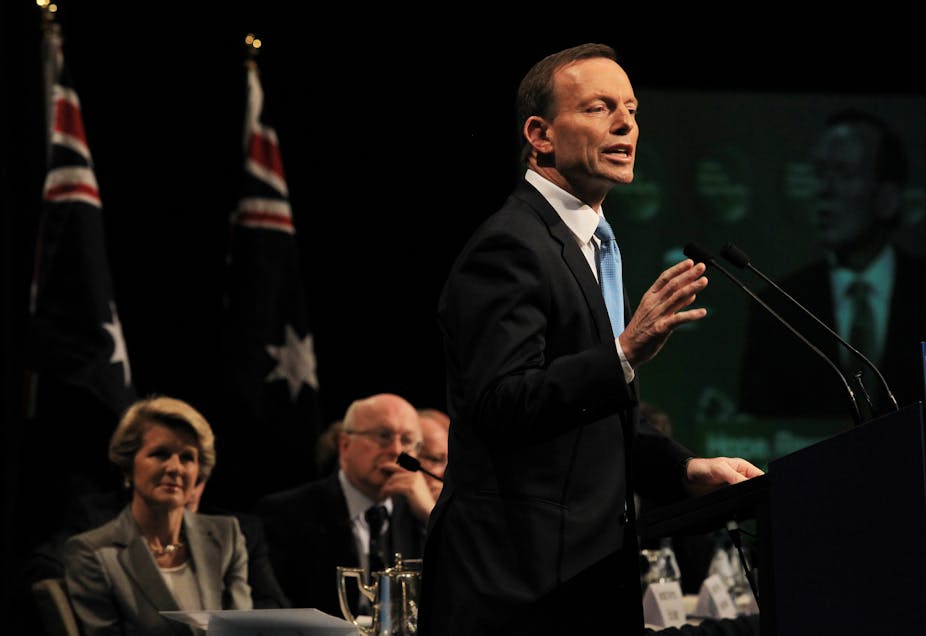
Opposition leader Tony Abbott made headlines recently when during a visit to China, he declared that “it would rarely be in Australia’s national interest to allow a foreign government or its agencies to control an Australian business”.
In other words: foreign direct investment by such entities would not be welcome.
Last week, the Coalition also released a discussion paper on foreign investment in the agricultural sector with a view to forming a policy platform to take to the next election. This document also took aim at foreign investment that comes with government connections attached.
Given the likelihood of the Coalition winning the next federal election, and the fact that the ultimate decision regarding whether a proposed foreign investment passes the “national interest” test resides with the Treasurer, these were significant statements of policy intent.
First things first.
If whether or not proposed foreign investment comes with government connections determines if it is in our national interest, then the overwhelmingly majority of Chinese investment will fail that test. There is no getting around this.
It is not only the investment proposals by China’s sovereign wealth fund or the one hundred odd, large state-owned enterprises controlled by the central government’s State-owned Assets Supervision and Administration Commission (SASAC) that would be affected.
For example, when China began its transition to a market economy three decades ago, the most dynamic group of firms to emerge were the Township and Village Enterprises (TVEs). In most cases, local governments were instrumental in their formation and they remain a continuing presence today. In fact, local government involvement was essential because this connection allowed these firms to access the formal financial system and to negotiate their way through a mixed economy.
Whether or not Australia chooses to embrace Chinese investment is ultimately a political decision. I am not suggesting that economic considerations alone should dictate that choice. But the economic consequences of declining Chinese investment should at least be made clear.
Now to backtrack a bit.
By almost any measure, the standard of living in Australia is one of the highest in the world. Using the default measure, GDP per capita, International Monetary Fund data currently sees Australia ranking 6th (when GDP is expressed in terms of $US).
Economic theory posits that for a given population growth rate, the level of GDP per capita in the long run is essentially a function of the savings rate. The intuition here is straightforward. Investment (additions to the capital stock) does not come out of thin air. It must be funded from savings. Therefore, a higher rate of savings implies a higher level of capital per worker, and in turn, output per worker.
The so-called New Growth Theory further argues that the rate of savings is important not only for the level of GDP per capita, but also for the long-run growth rate. This is because advances in technology, which drive the growth rate, arise from - and indeed require - investment in capital. Cutting-edge research demands more than a pencil and paper. Investment also sometimes results in powerful “external economies”, such as when one firm makes a technological breakthrough and other firms then quickly follow.
World Bank data show that over the past 50 years the domestic savings rate in Australia fell below the investment rate by, on average, 1% of GDP. Given the long time period, this is not a trivial difference. What stopped the domestic savings rate from being a binding constraint for the rate of investment was an inflow of foreign savings.
In short, one of the reasons that Australia’s standard of living is amongst the highest in the world is because it has been open to foreign investment.
Now to tie the discussion together.
China sits poised to be a major supplier of capital to the Australian economy. This is fortuitous given that an inflow of savings from traditional sources such as the US and the UK can no longer be taken for granted. Governments in these countries are running large budget deficits and this reduces the available pool of savings that can be lent abroad. In addition to a large public debt, other countries such as Japan are also in the midst of a demographic transition that will almost certainly lead to a decline in the savings rate.
If China is eschewed as a source of capital, then our rate of investment will inevitably be less than it could be, with capital intensive sectors of the economy such as mining and infrastructure being the most affected. And less investment means a lower standard of living.
This may be viewed as an acceptable trade-off if, for example, it is considered that Chinese investment poses an unacceptable sovereignty risk. Clearly, proposals for foreign investment need to be considered on a case by case basis, but why Chinese investment, which will inevitably come with government connections, would rarely be in our national interest is not clear. The onus is now on Tony Abbott and the Coalition to make that case.