
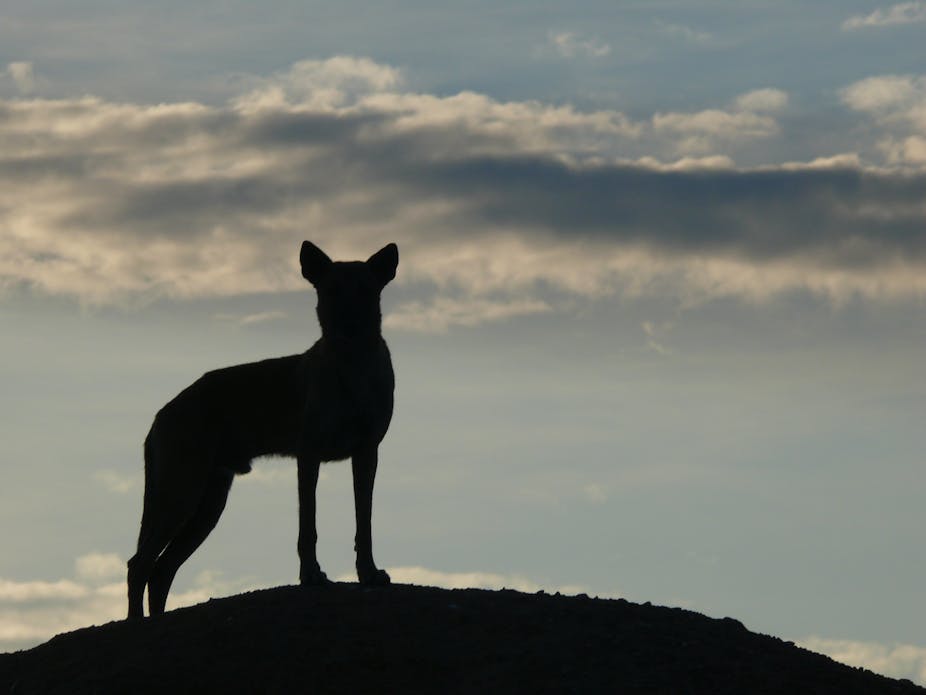
On a stop-over in Thailand, CSIRO scientist Laurie Corbett noticed some familiar-looking, ginger dogs wandering the streets. This encounter set him thinking about the origins of Australia’s dingoes, a subject that has intrigued naturalists since William Dampier first saw the footprints of a “wolf” on the West Australian coast in 1688.
Dingoes are a type of dog. As Terry Pratchett says, “Men made dogs, they took wolves and gave them human things”. Dingoes were probably made by accidental and purposeful selection of tamer grey wolves that scavenged around the camps of people living in southern China less than 16,300 years ago. Corbett showed that they were dingoes he saw in Thailand and that, from morphometric, archaeological and anthropological evidence, they probably arrived in northern Australia with South East Asian seafarers and traders about 3,500 to 5,000 years ago.
Genetic studies conform with this approximate date range, but with broad confidence intervals out to 18,300 years ago. Whatever the mechanism and timeframe, the adaptable, generalist dingo was spread throughout mainland Australia when Dampier first saw its spoor.
Europeans and other immigrants have brought many breeds of dog to Australia over the past 200 or so years. These have not always been restrained or separated from free-ranging dingoes and so genetic intermixing has occurred. Today, we have many free-ranging dogs throughout the country, ranging from “pure” dingoes to various crosses with more modern breeds. The ginger/yellow colour is dominant and so it is impossible to tell a pure dingo from some ginger cross-breeds by looking at them. Some dingoes are black-and-tan but so are many kelpies.
The most recent DNA study shows that most free-ranging dogs in south eastern Australia have some dingo genes but about 95% have domestic genes. The gene-pool of free-ranging dogs is more diverse now because of the crossing of dingoes with a range of dogs previously selected for different characteristics. Whether this broader gene-pool has adverse or beneficial impacts on free-ranging dogs and their roles in different ecosystems remains to be determined. However, even in regions with a high proportion of cross-breeds, there are pure dingoes.
Given that there are more than just dingoes out there, what should we call these animals? “Feral dog”, “wild dog” and “dingo” have different meanings and value weightings to different people. We choose to call them all “free-ranging dogs” because it is the most inclusive and value-neutral descriptive term we can think of.
Whatever their breeding, free-ranging dogs have various known and possible impacts on the environment and agriculture. Attacks on livestock, pets and people (rarely) are known negative impacts. Peter Thomson long ago showed that predation of sheep is inevitable once free-ranging dogs move into an area and will continue until the dogs or the sheep are separated or removed. The relationship with cattle is less straightforward, with some producers preferring to retain free-ranging dogs for control of competition from kangaroos whilst others prefer control to prevent predation on calves.
Preliminary analyses suggest that the annual cost of dog predation and control to Australian livestock industries exceeds $48.5M.
The social impacts of free-ranging dogs are more difficult to measure. What we think and how we feel about free-ranging dogs influences both what we choose to do about them and to what extent we accept others’ management preferences and decisions. This is a particularly vexatious problem because most people regard dogs as “man’s best friend”. That special relationship influences our attitudes and behaviours towards their free-ranging kin. A better understanding of community attitudes and free-ranging dogs’ socio-economic impacts is needed to help make and implement broader policy and local management decisions.
The current debate among scientists about ecological roles of free-ranging dogs, particularly dingoes, influences strongly held views in the community. Some scientists regard the dingo as an essential component of Australian ecosystems, beneficial to faunal biodiversity through suppression of foxes and feral cats. Others are more circumspect about the broadscale application of this idea. The topic is currently undergoing research by a number of different groups, including our own in the temperate environments of north eastern NSW.
Most free-ranging dog populations are left alone, and are only controlled to prevent negative impacts. “Control” and “management” are not synonymous terms. Control of dogs is generally accepted to mean their removal or the prevention of their access to a resource of value to humans. Erecting a fence around a refuse tip, culling problem individuals on Fraser Island and reducing populations by poisoning them in and adjacent to areas with livestock production or bridled nailtail wallabies are all examples of control.
People use exclusion fencing, livestock guarding animals (such as dogs, llamas, and donkeys), shepherding, poisoning, trapping and shooting as control tools. Management is a broader term including all the strategies and tools for control or conservation.
We think it best to manage free-ranging dogs on the basis of their known impacts. Where the welfare of livestock and other domestic animals are affected, reduce the probability of their interaction with free-ranging dogs through integrated population reduction and exclusion. Where biodiversity is proven to benefit from free-ranging dogs or the dingo is valued as a breed and it is appropriate to conserve it without adversely affecting livestock or human health, then enhance its populations and exclude other genetics. In other places, it might be best to do nothing. Regardless, we must seek to identify and carefully address the range of needs for managing free-ranging dogs.
The location, nature and scale of free-ranging dogs’ impacts and the social, economic, environmental and welfare imperatives must be established before proposing a course of action that might impinge upon one or more of them.
Information about distribution of dingo genes across Australia comes from Danielle Stephens’ PhD thesis. Danielle’s research is the broadest genetic study of free-ranging dogs undertaken to date.
Mike Swinbourne
logged in via Facebook
I don't think there is any doubt that dingoes are an important component of the ecosystem, and to exclude them is to fundamentally change the balance in favour of herbivores and - possibly - mesopredators like foxes and cats as suggested.
There is also some evidence to suggest that dingo regulation of kangaroos helps to increase the available pasture for cattle, and there is little evidence that dingoes significantly impact the cattle industry.
David Paxton
Veterinarian
I enjoy reading Conversations and think the idea of combining academic rigour and journalistic flair is great. Therefore I regret to say I was disappointed in this article. I find it tired, recycled and unimaginative. If the dingo came say 5000 years ago and perhaps 18000+ years ago, and the first seafarers came 40000+ years ago, probably on bamboo rafts as Alan Thorne demonstrated, why could not the dog (dingo) have come with them? Wouldn't this be a more naturalistic explanation and place them in as a valid a place in the Australian ecosystem as human beings?
Hugh McColl
Geographer
David Paxton, isn't it the idea of this publication that articles with academic rigour and journalistic flair are evidence-based? So whilst it might have been demonstrated that dingoes COULD have come to Australia say, 40,000 years ago, apparently there is only evidence to show they came much later than that. Making up a story that sort of fits some of the facts does not make it "naturalistic" does it? Or did you mean 'naturistic', as in running around with no clothes (evidence) on?
David Paxton
Veterinarian
Hugh, I guess I asked for that barb. I am not sure that academic rigour and journalistic flair are limited to hard evidence. Quite a lot of things are discussed in TheConversation which are not evidence based in the sense that I think you mean. Even if you don't accept that, I think science can have hypotheses. For example, why do we accept 30000+ year old dogs skulls in caves in Belgium and Siberia, dog tracks in the Chauvet cave 26000 years old and yet refuse to consider dogs in Australia much…
Read morePeter Fleming
Leader, Wild Canid Theme, IACRC at University of New England
Ouch! David, it looks like I missed out on the journalistic flair bit. In my defence, I should be more analytical than imaginative.
My take on the papers I have read and discussions with colleagues and some central Australian indigenous people is that, while your suggestion of earlier entry of dingoes to Australia is a possibility, the current evidence from cave specimens ("Caveus Specus Canus!"), anthropology and DNA studies over the past 10 years does not support this.
As an aside, an Arrente person from Central Australia told my co-author that dingoes "arrived yesterday" and that his peoples' particular dog dreaming was about thylacines.
David Paxton
Veterinarian
Thanks, Peter. Sorry about my knee-jerk reaction. The point I did not make well was that readers would be just as interested in the thylacine dreaming as the policy statement.
Dominic Bromilow
logged in via LinkedIn
Hi Peter, was wondering about Laurie Corbetts concept of isolated islands of dingos to protect gene pools
Peter Fleming
Leader, Wild Canid Theme, IACRC at University of New England
Hello Dominic,
You asked some good questions.
Islands would work, but, as seen at Fraser Island where about 15% of the dogs have domestic genes, only if domestic dog genes are kept out.
Although the AKC has requisite characteristices for registered dingoes, it seems to me that there are some different criteria for free-roaming dingoes in Australia. Some people want "pure" dingoes retained, like those that were here when Europeans came and without any domestic genetics. Other people want a free…
Read moreJulie Fechner
Retired (Grumpy old woman)
Here we go again, more propaganda from those who obtain financial benefit from devising ways to control wild dogs/dingoes. Both authors are funded by the Invasive Animals Cooperative. These arguments are so tired and so predictable.
The notion that wild dog management costs $48.5M is interesting. I have no idea of Australia wide costs, but a few years back I did some research on Victorian figures to find that sheep losses totaled $0.5M and wild dog management cost $6M. I am sure that fiscally…
Read moreIan Gunn
Veterinarianr; Faculty of Medicine, Nursing and Health Services; Project Director of AGSRCA at Monash University
Julie, I totally agree with your comments and wish that we could all reach a scientific definition of the dingo iinstead of the attemp to classiy them all as "Free - range dogs" that is totally useless.
Peter Fleming
Leader, Wild Canid Theme, IACRC at University of New England
Hello Julie,
Thank you for your comments.
With regard to the dietary studies, you might read Lunney et al. (1996) in Wildlife Research vol 23, pages 373-380 and Allen et al. (2012) in The Rangeland Journal 34, 211-217 which show the problems of extrapolating from what predators eat to their impacts on populations of other animals. For example, Appendix 1 of Mitchell and Banks (2005) in Austral Ecology 30, 581-591 and Appendix 2 in Corbett, L. (2001), The dingo in Australalia and Asia list many of the larger dietary studies and these show that dogs rarely eat foxes and cats. Does this mean that dogs have no impact on fox and cat populations?
Julie Fechner
Retired (Grumpy old woman)
Dr Flemming, your reply is so predictable from one who has and continues to obtain financial reward from the control of wild/dogs dingoes at the Vertebrate Pest Research Unit, NSW Department of Primary Industries. As you are possibly well aware dingoes do not have to eat foxes and cats in great numbers to impact on their behavior, populations and diet. Arian Wallach has shown that just the presence of dingoes is sufficient to change cat behavior and therefore their impact on critical weight mammals…
Read morePeter Fleming
Leader, Wild Canid Theme, IACRC at University of New England
I’m sorry Julie, but you seem to be operating under some misconceptions.
Read moreA few points of clarification:
1. As declared, Guy Ballard and I hold adjunct status at UNE (where we co-coordinate a Wild Canid Ecology course and supervise a number of post graduate students). As also indicated in my disclosure, I lead the Wild Dog Theme of the IACRC based at the University of New England. Most of the dog research will be done by staff and students of UNE and Vertebrate Pest Research Unit, including Guy…
Julie Fechner
Retired (Grumpy old woman)
Another predictable response from one of the few environmental scientists that fails to accept the growing body of science that supports the importance of the top order predator in maintaining balance in the ecosystem. As you rightly say, this group of skeptics is becoming smaller by the day.
I am sure you are aware of the positive impact of the return of the Grey wolf (Canis lupus) to Yellowstone National Park. Riparian zones recovered as grazing pressure from over abundance elk was reduced…
Read moreDavid Paxton
Veterinarian
Julie, I share your concern at the way research is premised on attitude, while claiming to be value neutral. I refer to Walter Beilby in The Dog in Australasia (1897) pages 431-2 about dingoes: "... it will be a blessing for the squatters when the brutes are extinct." Policy assumes,too easily in my view, that squatting is a right and this excuses the impacts that flow.
Times are changing. .
Maremmas appear to pay their way, and they and other shepherd dogs have done so for a very long…
Read moreChristine Adams-Hosking
Landscape Ecology and Conservation Group at University of Queensland
I would like to point out that the introduced wild dog or dingo is not always an asset to ecosystems and native wildlife and the notion that these 'free ranging' dogs help native wildlife by controlling foxes and cats is questionable. Wild dogs have become a serious pest in many areas such as the peri-urban areas of southeast Queensland. It is these 'free ranging' dogs, dingos, hybrids or whatever you want to call them that are eliminating koalas and other native animals; unique species that have inhabited Australia for millions of years, not just a few thousand.
Julie Fechner
Retired (Grumpy old woman)
Oh dear, another misguided Queenslander. Christine, the overwhelming evidence suggests strongly that dingoes protect our small native animals including dusky hopping mice, mallee fowl and hare wallabies, by controlling cats and foxes. To suggest that dingoes are a threat to koalas is not based on sound research, and is mischievous to say the least. I note from your bio that you are a koala expert, I would be interested in reading your peer reviewed articles that substantiate your allegations that 'dingoes are eliminating koalas and other native animals'..
Christine Adams-Hosking
Landscape Ecology and Conservation Group at University of Queensland
Dear Julie, I can assure you that my statement regarding the threat from packs of wild dogs to koalas is based on current research involving tagged, radio tracked koalas. When it has been published I will have pleasure in sharing it with you. On another note, I personally have data of fox scats analysed at a study site. They contained bandicoot and possum remains. There are packs of wild dogs present in the same area, yet they do not appear to be controlling the foxes, just adding to the complex problem of the demise of native wildlife.
Julie Fechner
Retired (Grumpy old woman)
Dear Christine, as you clearly state; there is no peer reviewed research indicating that dingoes/wild dogs are a threat to koalas. I have read numerous peer reviewed articles describing dingo diet, and there is minimal if any reference to koalas being present in dingo scats.
Of course there will be bandicoot and possum remains in fox scats. Foxes and cats, the introduced mesopredators, are the major driver of our dreadful record of small to medium mammal extinctions; not dingoes. Bandicoots, possums, koalas and dingoes all lived in harmony before European man introduced the mesopredators.
And, if the dingoes were NOT present in your study area there may have been no bandicoots or possums for the foxes to eat!
I suggest you read some of Professor Chris Johnson's excellent journal articles and his book 'Australia's Mammal Extinctions
A 50,000-Year History'. I am sure you are aware of his work.
Dominic Bromilow
logged in via LinkedIn
Hi Julie, Im interested in your experiences with dingos and wild dogs. What is your definition of a dingo? How do you differentiate between dingos and wild dogs? What are your direct experiences with wild dogs/dingos and or roaming dogs? I am a low carbon footprinter living in the SE ranges and have had a few experiences with dogs of varying backgrounds. Some wild, some domestic and a few indeterminate. I would like to understand how you view humans in relation to the dogs above. A summary would make your points a lot clearer
David Paxton
Veterinarian
Dominic, excuse me butting in. I have just read Deborah Bird Rose's Wild Dog Dreaming (2011, U of Virginia Press) that you might enjoy. It would be in a university library near you. Best wishes.
Julie Fechner
Retired (Grumpy old woman)
Thanks for your comment, David. I have not seen that book. Another great book is Roland Breckwoldt's 'A very elegant animal: The dingo' While this was published in 1988 it is still a great read and was far before its time.
The definition of a dingo is difficult. The late Prof Alan Wilton did some ground breaking DNA analysis back at the beginning of the century. This test is often used as a benchmark, but it has flaws as the sample used was relatively closely related and small, so we now…
Read moreDavid Paxton
Veterinarian
Thanks, Julie. I didn't mean to cut across Dominic's conversation with you. But, now that I have ... I have read Roland Breckwoldt's excellent book, in the early 1990s. As I remember he thought the hybrid strains did better in the southern national parks and the "pure" dingo in savanna. Obviously, hard data collection is important and is the CRC's purpose. The context in which data are collected is also important and one hopes the collectors take a look around, every so often. In that respect…
Read moreDominic Bromilow
logged in via LinkedIn
Hi Julie, So if Im reading correctly, then you feel that any dog in the bush/eco system is acting as a top order predator. Does this include periurban environments, areas around towns, national parks. How do you feel about town dogs and wild dogs co-mingling? Does a town dog become a top order predator when with a dog pack, and then become a pet when it returns to the place of residence? If there are a pack of dogs on properties interfacing with public land should these dogs be handled in specific ways? These are the reasons I was interested in your experiences. You are very out spoken, sometimes derisive, so it would be great to hear how you feel these problems should be handled.
Christine Adams-Hosking
Landscape Ecology and Conservation Group at University of Queensland
Hear, hear Dominic, all good points.
Dominic Bromilow
logged in via LinkedIn
Hi David, feel free to comment on the reply to Julie.
Dominic Bromilow
logged in via LinkedIn
Hi Christine, just from personal experience Ive noted the steep learning curves of foxes when a pack of dogs move onto country. It alters diet and pushes feeding territories wider, but as with any pressure/competition this is not permanent. Dog packs require significantly more amount of prey and so can 'eat out' an area quite quickly. It is the magnification of Human(top predator) interactions with the eco system, including introduced species, that can lead to out of kilter/ unbalanced predator/prey relations. Towns and cities actually breed foxes at a rate that cannot be controlled by any species, human or other, and therefore drives other species to feed outside of what humans consider OK.
David Paxton
Veterinarian
Dominic, you make a very interesting point: town and cities breeding foxes. You may be right, I suggested that human caves may have been ecosystems suitable for the dog, cat and other ancestors of animals including humans in my book. And it may be the built environment in Australia is working the same for foxes now, because dogs and even cats are under increasingly better control thanks to better urban animal management. So in the first say 5 hours of every day, it's free for all for the foxes in the cities. Uncontrolled roaming dogs would presumably have ferreted out the fox lairs in the past. Now, the foxes are ferreting out the backyard chooks and the garbage as we and our dogs sleep, and also seeding the countryside as you suggest. May I invite you to have a look at my website? www.compositeconversationalist.com Best wishes and thanks for the idea.
Huhana Gray
Dog lover and Gardener
There is also no evidence to suggest people who arrive here by boat are a threat to the community. Bit shocked that such an educated person would have such a narrow and ignorant view.
Dominic Bromilow
logged in via LinkedIn
Hi Peter, Laurie Corbett mentions that he feels the dingo population is under threat via hybridisation and that the only way to save the gene pool is to set up conservations zones, islands where there are no other dog populations. Is this a viable process?