
If everyday items were labelled according to the carbon emissions embodied in them, would shoppers change what they buy? And if they did, would it make a difference in the grand scheme of things?
Voluntary reductions in emissions by households do play an important role, and groceries account for a substantial proportion of the environmental burden of the average household through production, transport, and consumption. Indeed, American researchers found that individual household purchasing generates 30-40% of US emissions. But despite much enthusiasm for greenhouse incentives (carbon tax, solar rebates, ceiling insulation), there has been little consideration of the likely consumer response to carbon labelling of groceries, so my students set out to gauge their response.
Their study was completed in a suburban grocery store in the NSW north coast town of Ballina during a 12-week period during mid-2008. They identified five categories of grocery items with a relatively high-turnover and wide product choice, including milk, spreadable butter, canned tomatoes, bottled water, and non-perishable pet foods. These 37 products were categorised according to their CO2 emissions generated right up to the point of sale, and labelled with one of three symbols indicating average (yellow footprint), lower than average (green footprint) and higher than average (black footprint).
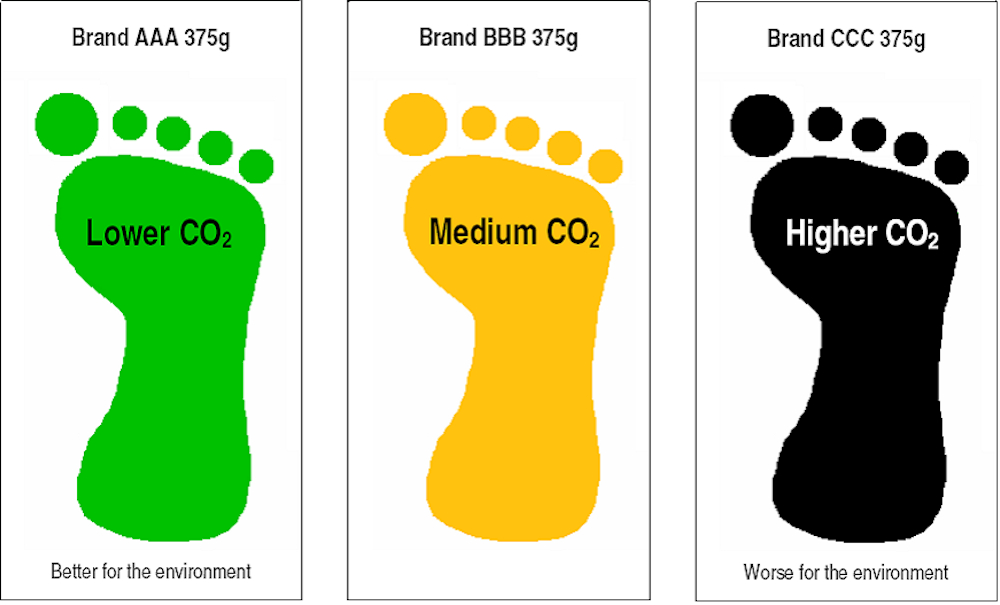
The classification was strongly influenced by the energy used during transport (for example, some bottled water was freighted long distances by road) and by the energy embodied in packaging. But distance did not tell the whole story, because some water bottled abroad and shipped by sea had less embodied carbon than Australian water that had been trucked interstate. Thus “food miles” may be an over-simplistic concept, and it was this realization that led us to use three different coloured footprints.

Labels were in place for 8 weeks and their introduction was communicated via leaflets and media coverage. The media interest was high and, in the first fortnight following the placement of the labels, gross store turnover increased by 12%.
Over the eight weeks, the share of black-labelled sales fell from 32% to 26%, whilst the share of green-labelled sales increased from 53% to 57%. Further analysis revealed three different trends of customer response. When green-labelled products were also the cheapest in the category, there was a strong consumer response and sales increased by about 20%. However, if the green-labelled goods were not the cheapest then the response to labelling was weaker.
Our study also found that other factors may dominate over carbon footprint and price, such as with perishable goods, where labelling appears to have little impact. For example, with fresh milk it appeared consumers had a strong preference for a particular size of package, which appeared to be more important than the footprint associated with this package.

Our research generated strong media interest, and this could have affected consumer choice, if for instance, publicity attracted strongly greenhouse-conscious people to come and shop at this store. However, the changes observed remained evident until the end of the study, even after the media attention diminished. And there was no long-term influence on store turnover, so it seems that any impact of the publicity was short-lived.
Our study provided an interesting insight into carbon labelling in a real-life context and indicated the potential for carbon labelling in a broader context. The strong response of consumers when price difference and carbon footprint are both low indicates that combining a carbon label and price incentive (via a carbon tax or emissions trading system) could be effective in encouraging sustainable consumption.
Comments welcome below.
Dennis Alexander
logged in via LinkedIn
Good article, excellent study. Worth following up in various locations to see if the effect holds across locations, product ranges (food, clothing, hardware, electrical, etc). Also worth estimating the carbon-impact and some potential scaling scenarios based on possible extinction of expensive, high carbon goods - at what point does brand, quality and availability cut into the buy-no buy equation?
More studies along these lines are needed to examine the micro-economic impact of carbon labelling.
Other Side Science
logged in via Twitter
I'd be hesitant about relying on these carbon labels. As the article already mentions, food miles are just one of the carbon sources. So many different variables like agricultural practices, food processing, etc etc. And does the carbon footprint take into account the weight or nutritional value of the product? A heavier product would obviously have a higher carbon footprint as may a product that is more nutritionally satisfying.
It'd be nice to have carbon labels but difficult to know how reliable they will be especially if producers don't disclose where all their food comes from
Dale Bloom
Analyst
Excellent work. Fantastic.
I hope one day to see on the label of each item in a shop an overall environmental rating.
Ian Ashman
Manager
Jerry
Interesting article, thanks.
What do you think would have happened if the 'good' product was labelled black and the 'bad' product was labelled green? (ie were people buying on environmental preference or just colour bias?)
Jerry Vanclay
Dean of Science at Southern Cross University
Good question. We didn't examine that, because we felt that shoppers are inundated with enough information in shops, and we wanted to keep our message as clear and simple as possible.
Tanya Ha
logged in via Twitter
Very interesting study, which demonstrates the power of clear point-of-sale communication. But I would question whether or not the shoppers are responding to the CO2 statement, the colour (similar to traffic light labelling) or the statement 'better/worse for the environment'.
Food sustainability is complex. As well as the carbon emissions, there's the embodied water, land use impacts, etc. These labels have a statement of fact (eg 'lower CO2') AND an interpretation ('better for the environment'). I'm concerned that this might be an over-simplification.
Having said that, carbon labelling can be useful for greater corporate transparency - it can provide a standardised way for food companies to self-declare their efforts to reduce their emissions.
James Jenkin
EFL Teacher Trainer
Interesting - but there are plenty of appalling practices in the world. If we label carbon footprint - why not contribution to torture, political prisoners, corruption.
Maretta Mann
Research Development
What an excellent study and I'd love to see this developed further and implemented across Australia with regulation.
Tania Ivanka
logged in via LinkedIn
A really interesting study, as pointed out my Tanya, it is so much more complex that the label can communicate, but I'm really excited by the students coming to those realisations - that's possibly the most powerful part of the project.
Imagine if we could break down those disciplinary silos and after an initial project such as this allow different students to work together on the problem (eg - perhaps psychology students investigating how people understand such labels etc.) If only more (or all!) students could have these experiences and understandings about the complexity of the issues.
I wonder if we will see any real change without such a broad understanding of complexity - and can a small label ever communicate such a big story?
markus fitzhenry
logged in via LinkedIn
The study was undertaken in a grocery store in East Ballina, a seaside suburb in northern
New South Wales (Australia) and the authors claim it is with a demographic similar to the median for Australia.
Really? Claiming the foregoing without the data to substantiate the claim leaves this study deficient and way below a pass mark. In fact, claiming that the demographics of this area is close to the Australian only in some respects is dishonest.
Without a analytical correlation with other demographics, like say Hurstville in NSW, or Sunshine in Victoria means any conclusion derived by it can not be relied upon and has no place in societal literature.
The fact that it was a undergrad study and they now think that omission is acceptable in a study of this nature leaves me disheartened and fearful of their future in academe.
Jerry Vanclay
Dean of Science at Southern Cross University
If you had read the full journal article (reached by the 'our study' link), you would have seen that the comparison is correctly referenced. The ABS 2006 census indicates that East Ballina is similar to the Australian median in several respects.
markus fitzhenry
logged in via LinkedIn
Jerry, the basic profile of Hurstville differs enormously from the north coast of NSW. Apart from milk, the 37 items cited would rarely be on the shelves in Hurstville. What exactly are the respects the two areas are similar in? Similar income, number of offspring, age, number of pets per household etc, has nothing to do with consumption habits in different areas of Australia.
Arguing that the interest in emissions by treehuggers on the North Coast of NSW represents the greater population of Australia is one of the worst cases of selectivity I've ever seen.
Arguing the consumption habits of those on the north coast of NSW is close to the Australian mean is inherently false.
Jerry Vanclay
Dean of Science at Southern Cross University
Sorry, where did Hurstville come from? We observed that East Ballina is similar to the national median, and made no comment about Hurstville, one way or other.
Our 37 items items were various brands of fresh milk, spreadable butter, canned tomatoes, bottled water, and non-perishable pet foods. Such products are pretty common, and are present in most supermarkets in Australia.
markus fitzhenry
logged in via LinkedIn
Hi Jerry, ABS has little information about shopping habits around the nation.
Would you care to explain what what criteria your observations led to the understanding East Ballina is similar to the national mean of shopping habits, which is central to your study.
What you have done is used a particular circumstance, called it representative and then suggested it is universally relevant. Aristotle could possibly direct you better as to the error in your thinking.
Comment removed by moderator.