



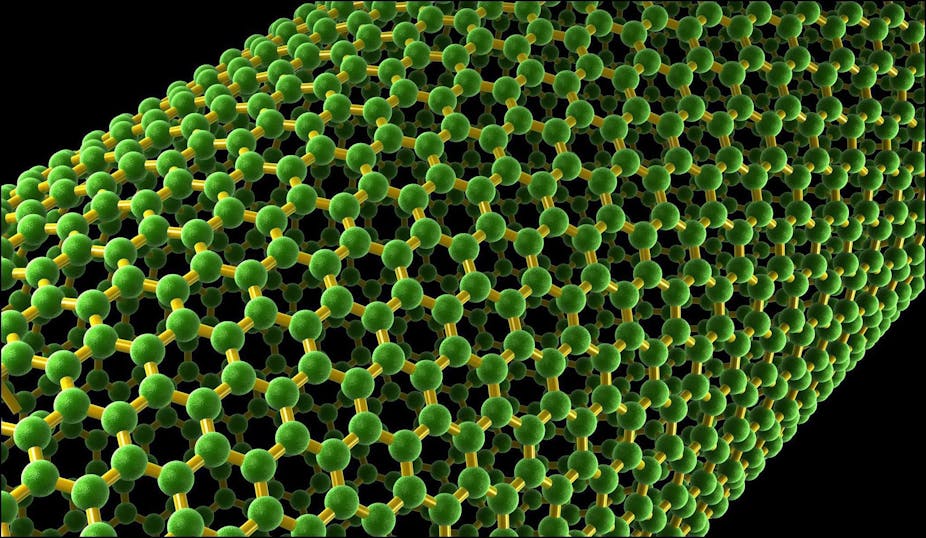
As you read this, researchers around the world are slaving away furiously to develop stronger, smaller and more cost-effective materials for a range of potential uses.
But while there are many “nano-scale” materials in the pipeline, carbon nanotubes (CNTs) remain the “poster child” of the nanotech revolution.
Science of the (very) small
Nanotechnology concerns itself with materials that have one or more dimensions in the range of one to 100 nanometres. To put this in perspective, at the upper limit that’s still 1,000 times thinner than a human hair.
CNTs fall within this range and are made of one or more concentric tubes, or “walls”, of graphitic carbon. They were first introduced to the general and scientific communities by Japanese physicist Sumio Iijima in 1991.
But they had been known and understood for at least 40 years prior to that as a tiresome and damaging product formed in the brickwork of furnaces.
If CNTs live up to expectations, their strength and stiffness will make them, weight for weight, several hundred times stronger and stiffer than steel, with the conductivity of copper and thermal properties of diamond. As an added bonus, they will also be cheap to make.
This impressive list of characteristics has made CNTs susceptible to a certain amount of hyping. Visions of super-light airframes and vehicles have emerged, as have stories of paper-thin antiballistic vests and thin, ultra-high-tension powerlines.
Perhaps the most ambitious speculation, complete with cartoon drawings by NASA, is that CNTs are strong enough to one day build an “elevator” cable into orbit.
We certainly haven’t reached such lofty heights (and may never do so). Maybe as a consequence, those people who bought heavily into the hype around CNTs are now asking what, after two decades of research, has been achieved? Well …
The good side
CNTs have fallen in price from thousands of dollars to just a few cents per gram. At the same time, production has risen from grams-per-day to tonnes-per-day, and quality has increased from 99% impurity to 99% CNT.
Easily-achievable lengths have increased from microns to millimetres – a thousand-fold increase – with the longest reported CNT now spanning 185 millimetres.
There are now half a dozen technologies for producing pure CNT yarns – including a technology known as “Directly Spinnable Carbon Nanotubes” at CSIRO which can also produce ultra-fine webs and ribbons of short fibre, or “staple” CNTs.
Remarkably, the measured strength and stiffness of individual CNTs has reached between 20% and 80% of the predicted values of (very) approximately 100 gigapascals and one Terapascal respectively. (The variability of these numbers in part reflects the great difficulty in conducting measurements on such tiny objects). Electrical, electronic and thermal properties likewise have largely met predictions.
So what have they been used for?
Well, single nanotubes have been used to make radio transmitters and receivers, atomic balances, sensors and nano-motors. We are also able to disperse and deposit CNTs onto silicon wafers for direct incorporation into semiconductor structures such as transistors.
The flip side
The difficulty in achieving nanotube technology’s potential is, at heart, due to CNTs’ current status: simply put, they are neither one thing nor another. CNTs are neither chemicals that can be melted or dissolved and extruded (as we might do with polymers such as Kevlar), nor objects that can be sorted, processed and aligned (as is done with wool fibres).
The dominant force between CNTs is known as the van der Waals interaction, a ghostly attraction that is insignificant for molecules, because they have so few atoms, and for conventional fibres, because they have so little contact surface area.
For CNTs, with a large number of atoms and a high surface area, the van der Waals interaction is particularly strong.
Our poor understanding and control of this mysterious attraction makes utilisation of the strength of CNTs such a challenge.
With greater knowledge will come the ability to manipulate the interaction and alignment of CNTs, and therefore to build larger and more useful CNT materials.
Immense strides have been taken in the last decade, yet it is still very early days in the nano-revolution both for CNTs and for other materials.
As we move further down the road of discovery we might one day fulfill the world-changing expectations being placed on the shoulders of this technology.
For the moment, though, CNTs are merely extraordinary.