
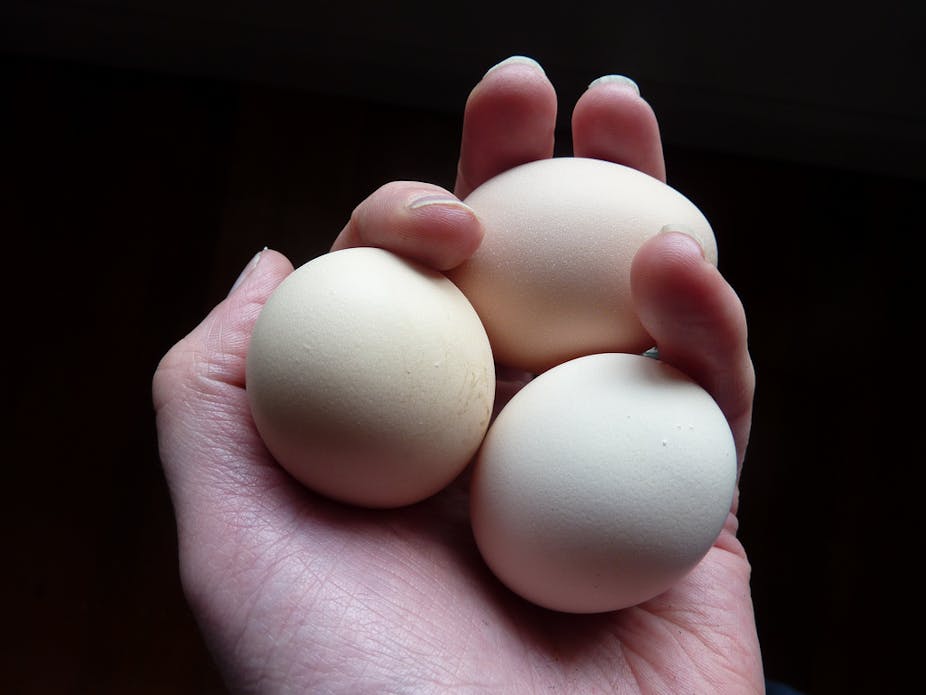
When my mother was a young girl, she – like most families in the country – kept a few chickens in the back yard. Once a day she went out and gave them household scraps, and they rushed over to greet her, flapping their wings, and she would return a few kind words to them. Every morning she collected the fresh eggs from their small shed, which gave them somewhere warm and safe to perch at night and lay their eggs.
Eggs like these were vital in wartime Britain; highly valued for the protein that they provided for the family. In between my mother’s visits, the hens scratched around the yard for insects and seeds, dustbathed in the earth to keep themselves clean and rested under the hedge in the warm sunshine.
Nowadays the eggs that you eat will probably have been produced in large factories, each containing many thousands of birds.
An entire industry has emerged in the space of just over 50 years. This started in the most war-affected countries of Europe, where the risk to food security that occurred in World War 2 had been so great that it led to governments developing “factory farms”. Here, large numbers of animals were kept in a small space and fed on pelleted food brought in from another type of factory, the feed mill.
Chickens were better suited to this process than cattle or sheep, and two types of factories emerged: one for birds that were kept to produce eggs and another for those used for meat.
Agricultural scientists developed new egg-producing strains of chicken which produced an egg almost every day of the year. In the meat strains, the researchers selected for rapid growth, particularly of breast muscle (when taken to excess, this has caused heart and leg problems and increased mortality). Birds now grow to their market weight in just 35 days: their lives are short.
Recently while I was driving along the Great Western Highway in New South Wales, I passed the largest egg production facility in the Southern Hemisphere. It houses 2 million birds and employs 500 people to manage them. The operations include a number of methods of producing eggs, to meet the needs of those consumers who think that when birds have more space their welfare is improved.
There are three main options for the large scale egg producers. The first is barns with rows and rows of cages containing five birds each, which provides about an A4 piece of paper of space per bird.

There are two main problems with this system: the restricted space stops them performing their natural behaviours such as flapping their wings. And the barrenness of the cage provides no possibility to dust bathe or forage in the dirt. The chickens' food is provided automatically by a conveyor belt and their dung is removed equally automatically by another belt, so the bird is just a machine in the middle of the process.
The second option is to have groups of several thousand birds loose in barns. Consumers pay a premium for these type of eggs. This set-up improves the birds’ behavioural freedom because there is more space and variety in the environment, but there is increased fighting and even cannibalism.
This is because chickens are territorial animals with a strict hierarchy, and in such large groups they constantly meet birds that they don’t recognise.
A third alternative is allowing birds to have access to both a house and free range. This gives them the opportunity to go outside, but usually offers little protection from aerial predators or the extremes of weather. As a result the birds often don’t venture outside.
So which eggs should you buy, when presented with a bewildering choice in the supermarkets? We instinctively believe that more space is better for the birds. But space may not be as important as a small group size to the birds. Our anthropomorphic assessment may be wrong from a bird’s eye.
In the tropical jungle where they evolved, chickens existed in groups of 10-15 birds with lots of space. How can we provide both space and a small group size in an economic system of production?
When I lived in the country I kept a few chickens, about a dozen layers. They shared a field with some horses and had access to a garden shed at night, fitted with a raised bar for them to roost on at night (mimicking the tree branches in the jungle), and nest boxes in which they laid their eggs.
The excellent welfare of these birds was borne out by their long lives and wide range of behaviours. And the eggs tasted much better than those from the supermarkets! So maybe the best way to support chicken welfare is to hunt down that backyard producer that sells a few eggs on the side. Even better, if you have a yard buy a few chooks and recycle your vegetable scraps.
In conventional meat chicken systems, birds are kept on the floor of a large barn, usually at more than 20 birds per m². This limits both locomotion and environmental exploration, and the birds spend longer just sleeping and congregating around the feeders. Birds become fearful as they cannot recognise other birds in the large flocks, and their contact with acidic excreta causes dermatitis.

Organic chickens – according to the international NASAA standard – are provided least eight hours continuous darkness every 24 hours, and must have access to natural light and forage areas for at least six hours per day. Farmers have to provide at least one square meter for every five birds.
Nowadays in Australia almost everyone can eat chicken meat every day if they wish, such is the affordability of factory-produced meat. When my mother was growing up it was a rare treat. Now its low cost encourages us to eat more than we need.
We have substituted vegetables in our diet with chicken products of very high nutritive value and this means we have surplus nutrients to store. Fast food outlets offering chicken meat at a fraction of the cost of pre-factory farming chickens must take some of the blame for the current obesity epidemic.
We can all help to reduce chicken welfare problems by not eating factory-farmed birds.
But in many parts of the world decisions on buying chicken meat or eggs are not influenced by the welfare of the birds. Developing countries – especially China, Brazil, Indonesia and Thailand – have copied the Western factory farming model and are now leading the world in chicken meat production.
These countries have no effective legislation governing poultry welfare, they don’t contribute to research to improve welfare, and perhaps most importantly they have been cutting down rainforest to grow the soya and cereals necessary to feed the birds. Economic growth in the developing countries is producing an increased demand for chicken meat, and consideration for the birds’ welfare is a luxury reserved for the wealthiest countries, in Europe, North America and Australia.
The emerging middle class in many developing nations seems guaranteed to increase demand for factory-produced poultry products, despite their questionability on animal welfare and environmental grounds. The main hope lies in agreeing effective international legislation to control this inefficient and unethical way of feeding people.
Monika Merkes
Honorary Associate, Australian Institute for Primary Care & Ageing at La Trobe University
Egg-cellent article, thank you Clive Phillips.
Articles about factory farming also in The Age today, a story about health and safety issues at Baiada http://www.theage.com.au/business/inside-baiada-dire-picture-of-health-safety-20111120-1npeb.html and a story from the US where Target and McDonald's have dropped egg suppliers after they saw shocking footage of animal cruelty http://www.huffingtonpost.com/2011/11/20/target-mcdonalds-egg-supplier_n_1103770.html?ref=food.
Is this the tip of the iceberg?
Allen L. Jasson
Software Engineer/Secondary Teacher/Terrorist Sympathiser
I think we hit the underbelly of the ice-berg long ago.
When you come to look at the bigger dynamic, we have been lazily and complaisantly participating and acquiescing in the development of technologies and processes on a "small" scale that are pernicious to the natural world and now being scaled up massively. Our "small"-scale development has already been shockingly harmful to the planet and now we are making limp efforts to suggest putting up barriers or reforms that we think the developing world should embrace. They obviously are not going to wear it and when this hit's the fan it will be "goodbye lovely world!".
We need a global reformation and it will necessarily require getting rid of this pernicious capitalist system and the taproots of the dandeloins of wealth that infest it.
How do you like our chances?
Vegan Capitalist
logged in via Twitter
So which eggs should you buy? None of them. Besides the the grossness of eating the ovulation of a chicken, eggs are high in artery clogging cholesterol.
Mark Carter
logged in via Facebook
Vegans don't seem to realise how childish they can sound. To call "eating the ovulation of a chicken" gross is to my ears as lame as calling soy sauce 'yukky' because "its just juice from a bunch of rotting beans".
And your cholesterol comment is just plain daft- cholesterol is an essential component of a healthy diet- low cholesterol levels are linked to some cancers and depression. Perhaps thats why vegans are always complaining about something?
Mark Carter
logged in via Facebook
Everyone should care about the plight of farm animals but the solution isn't to ruin your body and your social life by going vegan. In fact by not supporting good practice you condemn the good producers to bankruptcy leaving the whole industry to the factory farmers.
By ethical people demanding animal products made with high standards of welfare and- crucially- being willing to pay more for them we both reward good behaviour and deny our money to the factory farms, creating incentive for producers to improve. If free-range has been undermined by slack standards then the solution is to fight for tighter standards, not just ring our hands and walk away.
I have my own chooks so I rarely need to buy eggs but I am aware that for dozens of reasons not everyone can do this which is why the home coop is not a very practical solution.
Shirley Birney
retiree
Mark, I happen to be acquainted with some very healthy vegans and though I am not one, I'm working on it.
In regard to your "low cholesterol causes depression and cancer" (which is debatable), HDL cholesterol is called the "good cholesterol" because HDL cholesterol particles prevent atherosclerosis by extracting cholesterol from the artery walls and disposing of them through the liver. Thus, high levels of LDL cholesterol and low levels of HDL cholesterol (high LDL/HDL ratios) are risk factors…
Read moreGeoff Russell
Computer Programmer, Author
Well Mark, I can't say I've ever been fond of "Argument by yukky connotation" ... but I think it is logically far ahead of the ignorance or mendacity in asserting that vegans ruin their bodies when there is ample evidence to the contrary. As for our social lives? I've not seen any data, have you? I'm guessing you just made that up.
Monika Merkes
Honorary Associate, Australian Institute for Primary Care & Ageing at La Trobe University
Hi Mark, plant-based diets have many health benefits. Initially, a bit of thought and planning may be required to ensure the diet is balanced. The Better Health Channel has some advice on this http://www.betterhealth.vic.gov.au/bhcv2/bhcarticles.nsf/pages/vegetarian_eating.
Did you know that some top athletes are vegans? This video clip on YouTube shows off the bodies of some vegan/vegetarian body builders and athletes http://www.youtube.com/watch?v=nIcSuA2b_Wc - they look healthy to me, though I wouldn't want the muscle bulk of some of those body builders :-)
Mark Carter
logged in via Facebook
I was vegan for 7 years mate so I draw on that experience and that of my formerly-vegan friends. I suspect the pro-vegan data won't stand up to scrutiny: much of what I've seen was studies of folk who weren't actually vegan but lacto-veggos or who had just gone that way (so the long term erosion of their bodies health hadn't yet begun).
Most vegans end up with an all-vegan social circle basically because eating out or being invited to dinner parties is suddenly a headache when you need to scrutinise the menu for sinful items or have separate meals cooked for them. Whats wrong with an all vegan social life? Well...
Mark Carter
logged in via Facebook
The fact that you can survive on a vegan diet is pretty meaningless. Traditional Inuit survived reasonably well on a diet of mainly animal fats and meat- that doesn't make that the optimum diet either.
Those athletes you refer to have to spend a huge amount of their time and effort selecting and sourcing the exact components of their diet -much of which is heavily processed and flown in from the 4 corners of the earth. If veganism really gave better health results then vegan athletes would be the norm, not the exception.
Mark Carter
logged in via Facebook
'chicken ovulation'/'human ovulation'- it all reads as juvenile lame hyperbole to me.
As for the supposed evil nature of eggs, the British Heart Foundation has this to say on the matter on their website:
"The cholesterol which is found in some foods such as eggs, liver, kidneys and some types of seafood eg. prawns, does not usually make a great contribution to the level of cholesterol in your blood."
On the subject of the eggs and Diabetes paper the phrase 'correlations doesn't equal causation' comes to mind...
Geoff Russell
Computer Programmer, Author
I've been vegan for about 25 years and vegetarian for 15 years before that. Has my
body eroded yet ... at age 57? I did a 120km bike ride recently. Do I air freight food
from all over the planet? No. I eat food ... as defined by Michael Pollan. I take B12.
That's it.
Certainly vegetarian data is much stronger than vegan data. The latest EPIC report
http://www.ajcn.org/content/89/5/1613S.full
didn't separate out vegans because too few vegans had died :). But there are few
reasons to expect vegans and vegetarians to be very different.
Shirley Birney
retiree
Education (and gross irrefutable footage) is what the public needs to shock them into reality so thank you Clive Phillips for your stirling endeavours in advocating for a merciful life for sentient non-humans. The hapless chicken lives a life of abject misery to sate the appetites of the most abusive species on the planet.
For too long trafficking in cruelty has flourished in this "first" world nation because whistleblowers have been ridiculed, charged with trespass (oh ye hypocrites) and/or…
Read moreGeoff Russell
Computer Programmer, Author
Great and timely article, especially with Baiada trucking chickens from Victoria to SA for killing ... but I have a couple of nit-picks. Vegetable consumption has NOT dropped as a result of the rise of the chicken industry. It hasn't dropped at all.
Vegetable consumption (according to FAOstat) has gone from 63 to 97 kg/person per year between 1970 and 2007. The big loser has been sheep meat, down from 37 kg/person/year in 1970 to just 14 kg/person/year in 2007. Chicken isn't particularly
high in "nutritive value" ... most chicken dishes have little or
no B12 and not much iron. Anybody eating chicken for the B12 is much better off with
a supplement ... they work better than natural B12 anyway.
There hasn't been any jump in the Calories in the food supply between 1970 and now, so unless there is evidence that food waste has dramatically DECREASED, the obesity epidemic has to be down to less exercise.
Geoff Russell
Computer Programmer, Author
Ooops. One other nit-pick. Feeding laying hens on food scraps can work if they have plenty of other foraging/insects and the like, but if your hen is from a factory
farm (e.g., "end of lay"), it will have very high nutrient requirements ... a couple of
kilos of laying hen needs as much iron as a 70 kg person. Commercial layer feed is
suitably laced with the right vitamins and is also about 15 percent protein ... this combines with the breeding to produce a very high maintenance bird. "end of lay" hens can still lay for some years, but the rate drops off quickly. The amount of feed
grain required for an egg is about 165 grams (this is Australia's layer feed grain usage divided by eggs produced) ... very roughly equal to
the output of 1 square metre of wheat farm over an entire year.
Ryan Farquharson
Research Officer
Did you kow that the average egg on a supermarket shelf has been in storage for 2 months?
We have backyard chooks for fresh and yummy eggs, animal welfare, and food and garden scrap recycling. Plus we just love our chooks - they're great pets. Remarkable animals when you get to know them - they don't deserve to be in any sort of factory farm situation.