
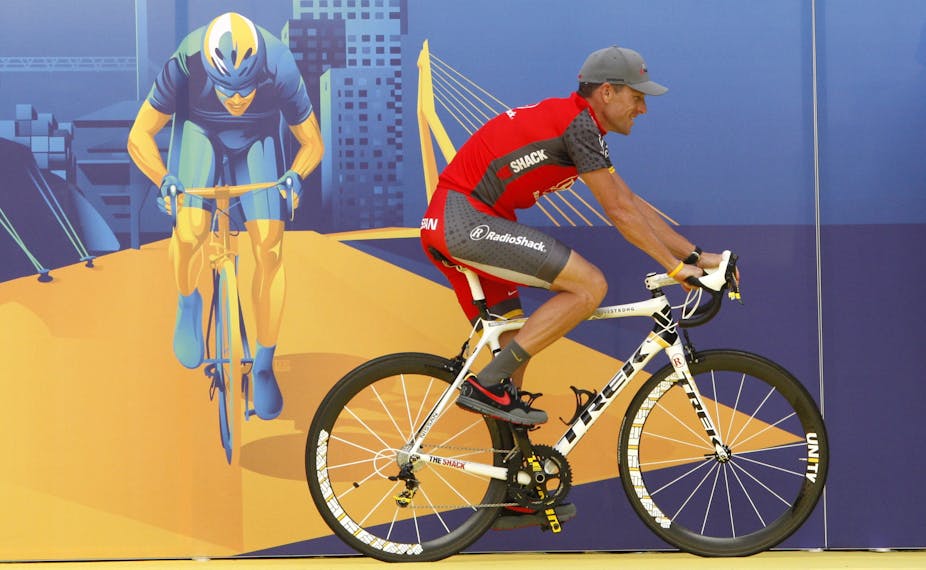
More than a week after the US Anti-Doping Agency (USADA) published 1,000 pages of testimony and anecdotal evidence implicating Lance Armstrong in a controversial doping scandal, the saga is still far from over.
Several long-time Armstrong sponsors, including Nike and bike company Trek, announced overnight (AEST) they would terminate their support for the seven-time Tour de France winner.
In the face of the Armstrong affair, the Union Cycliste Internationale (UCI) – cycling’s governing body – is confronted with the issue of how to proceed with the least damage to the sport of cycling. Quite simply, how can cycling (and sport more generally) move forward from the Armstrong affair?
An endemic problem?
The Armstrong case, perhaps more than any other episode in the past decade, has shone a light on the issue of systematic doping in professional cycling. Former Armstrong teammates – including recently sacked Australian selector Matt White – and prominent cycling greats – such as Michael Barry, Floyd Landis, George Hincapie and Tyler Hamilton – have in recent years also admitting to doping.
Why, then, has the UCI been reluctant to join USADA in punishing Armstrong?
Could it be that the UCI recognised Armstrong as a great athlete who raised the popularity of the sport, and who simply did what everyone else in cycling was doing (doping), only better (systematically and without getting caught)?
On ABC TV’s 4 Corners program on Monday night, Dick Pound, former president of the World Anti-doping Agency (WADA) suggested former UCI president Hein Verbruggen once told him doping in cycling is a necessity because spectators expect thrilling and incredible athletic performances.
Assuming the UCI’s main motivation is to attract fans and protect cycling’s brand, and not to embark on an anti-doping crusade, how should the organisation proceed?
Moving forward
Cycling Australia President Klaus Mueller has suggested there are many options, including criminalising doping offences. Another option, according to Mueller, is to offer an amnesty for athletes “who have cheated in the past to own up to any wrongdoing and have their confessions mitigate any subsequent penalties."
(This, as discussed by Martin Hardie on The Conversation previously, is not the first time Mueller – or other cycling officials – has seemingly taken conflicting stances on anti-doping matters.)
The Australian Sports Commission (ASC) chief executive Simon Hollingsworth has responded to Mueller, arguing that calls for an amnesty are premature and that such a move would undermine the “message that any doping is unacceptable.”
Hollingsworth might be right in that amnesty may at first seem like a soft response to doping. But participants seeking amnesty may provide more robust information about the incentives and networks that contribute to doping.
Benefits of amnesty
Of course, this process has its shortcomings, just as current methods of punishment do. For instance, amnesty alone may not provide enough incentive for those who don’t think they will get caught – arguably like Lance Armstrong – to come forward.
However, if used in the future as part of a clearly articulated and tiered process – that is, one in which more severe punishments and sanctions are used only after other tactics are exhausted – amnesty or another form of reduced punishment could offer a step for regulators to employ before mechanisms applied in the Lance Armstrong case become necessary.
These tactics (or, as Lance Armstrong puts it, a witch hunt) have been criticised as unfair and questionable in motive, not to mention costly.
Including an amnesty-style truth and reconciliation process would provide a way to actively address a doping rider’s – and accomplices' – actions while also eliciting information that could enhance future regulation.
Testimonial evidence could lead to the punishment of repeat offenders and suppliers or even prompt other athletes to come forward. It would also give sport participants the opportunity to come clean rather than being found dirty.
But an amnesty may have a huge impact on the brand of cycling.
Puritanical fans may turn away from the sport in disgust at the tell-all exposé. Hardcore fans hooked on heroic, drug-fuelled performances may not care about the extent of doping, but may leave the sport when those heroic performances become fewer and further between.
Finding a better way?
One way forward may be to look at what other sports have done. In response to the widespread use of performance-enhancing substances and methods (PESM), bodybuilding has developed two streams for athletes: a “natural” camp where athletes are tested for drugs; and another “excellence” camp where athletes are not tested for drugs and are free to use (or not use) any PESM.
Adopting a similar two-stream approach for cycling may appease both camps of cycling fans. A two-stream system may provide athlete peer-pressure for cyclists in the “natural” camp to stay clean. A “don’t-ask, don’t-tell” policy in the “excellence” camp might also result in less damage to the sport’s brand.
There may be many reasons why doping in any sport occurs, from financial factors to spectator expectations to other cultural norms. Regardless, until we have a better understanding of the phenomenon and an evidence-based approach to deal with the issue, the current anti-doping regime is largely inefficient and possibly doomed to fail.
Under current regulation, there are notable and problematic extremes. Sanctioning minor offences – such as inadvertent doping and nonperformance-enhancing recreational drug use – is unfair to well-intending athletes, while expending huge resources on a selected few athletes risks missing many others and is not a judicious use of resources.
Further, while criminalising doping in sport may seem appealing, WADA’s required application of the Strict Liability Standard, whereby a guilty mind (mens rea) is not a necessary component of the guilty act (actus reus), places an unfair burden on the athlete.
If inadvertent doping in sport is a criminal act, imagine the insurance premiums for participating in such high-risk activities!
Benefits of a tailored system
Developing a two-streamed and tiered system for doping regulation is a significant task, but it may be necessary for sports such as cycling.
Regardless of the specific form it takes, a tailored approach could have the capacity to:
- treat athletes as participants in the process
- better address minor offences as distinct from more severe ones
- target a range of actors, including individuals and organisations
- reward offenders’ honesty, and
- provide space to evaluate context and the limitations of scientific testing.
All of these factors would improve regulation.
At this time it may be prudent for everyone to stop and contemplate the larger issues surrounding cycling and sport more generally. Professional sports are fuelled by their entertainment value, and rules exist to enhance sport, not undermine it. When rules are introduced, the reasons need to be carefully considered.
Perhaps it is time to stop focusing on all the smoke around doping and to look more closely at the various forces in the background fanning the flames.
Rebecca Lansing
Artisan
Whilst not an ardent fan of cycling, I've always loved watching le tour. From what has been emerging over the last few years its obvious that there already are two streams. Might as well make it official.
My belief is that a drug-free Armstrong would have beaten all other drug-free riders or that a drug-assisted Armstrong would have beaten all other drug-assisted riders.
Lance Armstrong - first amongst equals.
Matt Stevens
Senior Research Fellow/Statistician/PhD
We will never know!
Comment removed by moderator.
Dennis Alexander
logged in via LinkedIn
The proposed two stream solution ignores one big factor: money. Sponsorship of cyclists, teams, events, and telecasts is what actually fuels the sport. If big Pharma comes in on the "excellence" camp - note the implicit linguistic bias here, we could as easily call it the "cheats" camp - it could serve to pull all money away from the "natural" camp. Then advertising dollars, competing schedules and other means could be used to drive the "natural" camp into oblivion. Why hasn't this happened in bodybuilding might be one question? The reply is 'yet'. Further, there might not be the same range of sponsorship interest in bodybuilding as in cycling - bike and component manufacturers, jerseys, cars, banks, governments, television channels, GPS manufacturers and so forth.
Benjamin Koh
Doctoral Researcher, Complementary and Alternate Medicine at University of Technology, Sydney
I accept your perspective Dennis and your comments have merit.
To clarify a few points (we could not go into details in a word-limited article): The choice of using "excellence" was a conscious one and not an implicit/unconscious bias. We were deliberating on a choice of labels to name the two streams. "Natural" was an easy enough label as this is what the bodybuilders use. There is no specific label for the non-"natural" camp.
In choosing the labels to describe the two streams (for clarity…
Read moreDennis Alexander
logged in via LinkedIn
Thanks Ben. I didn't think the choice of "excellence" was implicit on your part, but it is implicit in common usage and this appeals to advertisers. I think this is where the link is with "popularity". Sponsorship dollars look for a return based on audience size, sophistication and wealth. Cycling is international like motor racing and football (soccer) and generally draws a fairly cosmopolitan and wealthy demographic as followers and participants. The grand tours, especially, appeal to virtual travelers and actual travelers with an interest in the country and/or the sport. If there is a stream where any and all PESMs are acceptable, big Pharma and later probably bioengineering and genetic modification industries will be interested and attracted to the advertising and the broadcast and digital rights. The big money and vested interests will crowd out the competition (naturals).
Ben Koh
Sports Doctor. PhD social Research into Athlete Motivation. ACSM (Health Fitness Instructor and Exercise Specialist). Ex-elite swimmer.
Thanks for that Dennis.
Yes I agree with you that big money and vested interests may eventually crowd out the competition (naturals). But then that is evolution and survival-of-the-fittest at play. And if all PESM use eventually becomes acceptable by every (or most) stakeholder as a social norm for that sport through a market-based mechanism, then there wouldn't be a need for anti-doping measures (and this debate) anymore? :)
Sue Ieraci
Public hospital clinician
In the meantime, Lance Armstrong continues to maintain his innocence and was never directly caught by a test.
What would stop him from joining the "pure" camp and doing what he did with impunity?
Benjamin Koh
Doctoral Researcher, Complementary and Alternate Medicine at University of Technology, Sydney
Hi Sue
I guess there is no way of stopping any athlete from competing in the "natural" stream and continuing to use banned PESM. However, experience in bodybuilding suggests that competitors in the "natural" stream tend to adopt an ethical/ moral stance; self-discipline, pride, and peer pressure seem to provide both push and pull factors to encourage a clean sport. This is not surprising because the impetus for the movement came from a bottom-up (initiated by the athletes) approach rather than…
Read moreRoger Jones
Professorial Research Fellow at Victoria University
I think this article starts at the right place but has not laid out its case properly.
An amnesty would be for past cases, like the RSA Truth and Reconciliation Commission. Therefore the time limit would be prescribed - anyone out of that time limit would be fair game for the full force of anti-doping regs.
The confusion in the section on the benefits of amnesty would be solved by the addition of a whistleblower policy for cases more recent than amnesty.
Cyclists exposed to team pressure in the 90s or early 2000s have a case. Not now. Unless it happens and they blow the whistle.
Benjamin Koh
Doctoral Researcher, Complementary and Alternate Medicine at University of Technology, Sydney
Hi Roger
Thank you for your comments.
I think it is important to note that the environment surrounding a truth and reconciliation (T&R) from a political sphere may be very much different to that in the anti-doping/ sport context.
Firstly, the T&R in RSA occurred in a Zeitgeist where human rights and racial non-discrimination was a global cultural movement seeking change and reform. There were multiple stakeholders committed to the cause: political, financial, social stakeholders. The primary…
Read moreKate Henne
Research Fellow at the Regulatory Institutions Network (RegNet) at Australian National University
Thanks, Roger, for that comment. I think part of your criticism stems from our lack of detail in an attempt to fit the word limit. In an earlier draft, we outlined other possible components of a tiered regulatory process (or "pyramid" to borrow from the literature), but chose not to do so.
Your point about amnesty is worth further comment, though: Yes, you are right about a finite timeline; however, given the period Mueller has mentioned, there will be overlap with more contemporary events/developments…
Read moreMal Adapted
Primate
I remain unconvinced about the safety of performance enhancing drugs especially when presumably hte competitors will start upon this course as adolescent amateur racers.
Until long term trials are established with the safety of HGH, Testosterone, Corticosteroids, EPO, and whatever the latest additions to the performance enhancing pharmacopeia are, how sure are you that you ar enot advocating long term morbidity in athletes?
Whilst these compounds have been tested and used successfully in those patients with a natural deficit I am unaware of safety trials in using these drugs to supplement an individual with naturally normal levels of these hormones.
Jason Mazanov
Senior Lecturer, School of Business, UNSW-Canberra at University of New South Wales
Mal:
Following from yesterday, excellent point. Remember that these are therapeutic substances that have been through Phase 1-4 testing anyway. Off-label use may require retesting safety and effect in new populations, but that is a question of money. However, there has been enough off-label use in the athletic community I think we can have some confidence that the athletes know how to use these substances.
In the BJSM, Harmer reported that there has been no negative effect for use of AAS among adolescents when medically supervised.
With regards to long-term morbidity, elite sport is bad for health anyway. Medical sociologist Ivan Waddington went through the evidence in Sport, Health and Drugs. Most elite athletes end up with joint problems, or concussion. If we really cared about long term morbidity in elite athletes we would fundamentally change the nature of sport.
Best wishes,
Jason
Benjamin Koh
Doctoral Researcher, Complementary and Alternate Medicine at University of Technology, Sydney
Hi Jason,
I just wanted to note the excellent point you made that "...With regards to long-term morbidity, elite sport is bad for health anyway..."
While personally I am not an advocate for harm minimalisation measures, I do objectively recognise that it has its place and is less draconian. I certainly am not a fan of criminalisation of doping.
We should also note that doping does not only apply to substances. Some methods are also considered doping: for example blood infusion in cycling (blood doping). How do we legislate criminal behaviour of blood transfusion when mens rea is not necessary in actus reus?
I agree with you that at the moment, the debate seems to be gripped by those who believe in a particular point of view rather than an informed and careful debate. It is almost religious!
Mal Adapted
Primate
Jason,
Read moreThanks for the reply. I work in health care which probably skews my view in this matter. What seems to be the issue here is that this is a clear advocation of medical intervention without a trial to establish its safety, without ethical guidelines and without clear medical parameters. In short, it appears that you wish to conduct a drug trial without the normal ethical requirements and the athletes are your experimental subjects.
A lassaiz faire attitiude towards pharmaceutical enhancement…
Benjamin Koh
Doctoral Researcher, Complementary and Alternate Medicine at University of Technology, Sydney
Mal:
No drug/substance (or method) is without side effect. The important thing is informed consent and personal choice.
Jason Mazanov
Senior Lecturer, School of Business, UNSW-Canberra at University of New South Wales
Mal:
One of the issues that I am very interested in is how medicine has skewed the doping debate. It is interesting to see how other disciplines handle the doping question. Sport health professionals take a very particular view that is usually a function of their institutionalisation. This is why the public health discourse is so dominant.
Drug development follows protocols with good reason that I have learned about by being on a hospital HREC. Development of data for off-label use is…
Read moreMal Adapted
Primate
Benjamin,
If you are advocating wholesale use of PEDs in a young population are you convinced that the befits outweigh the risk to the individiuals in question?
These are motivated but immature individuals who will trade off future health for short term athletic benefit.
Has a long term trial been established for the efficacy of these combinations of drugs?
Mal Adapted
Primate
Not everyone who disagrees with you is in the grip of a religious fervour. I'd actually just like to see clinical evidence for and ethical guidelines about this advocacy of wholesale pharmaceutical enhancement.
i'd also like to see this explored after the biological passport and other measures sure to be instituted after the 'lance-bomb' are trialled and found to be non-effective.
Ben Koh
Sports Doctor. PhD social Research into Athlete Motivation. ACSM (Health Fitness Instructor and Exercise Specialist). Ex-elite swimmer.
Hi Mal:
To be clear, I am not advocating any form of PESM and/or harm minimalisation. But that is my personal view. I do, however, recognise that harm minimalisation may have a role to play.
In terms of the comment "...trade off future health for short term ... benefit...."
Since you are in the health care, a few parallel scenario to ponder over:
1. Cosmetic surgery and procedures (e.g. Botox)
Read moreIf a drug/ method has been approved at present day (albeit with risks and side effects known…
Mal Adapted
Primate
Interesting,
Read moreYour concern seems to be that drugs are 'locked-up' by medicine, medicine is the gate-keeper and that this is paternalism. My CONCERN (sorry for the caps, italics not available) is that these drugs should not be freely available until their safety is established.
My MEDICO-LEGAL/ETHICAL view is that these are controlled substances and are rightly controlled until their safety in the cohort that you have selected for use is established. This is the subject of clinical trial and under…
Jason Mazanov
Senior Lecturer, School of Business, UNSW-Canberra at University of New South Wales
Mal:
You are truly a gem for this debate. I appreciate your willingness to engage and drive the issues through with depth and candour. You might want to get in touch with me off-line so I can learn more about your point of view.
You have a tipping point - safety is established. Under the current system we are not allowed to establish safety. (An interesting aside is that the development of the EPO test by Parisotto, Ashenden et al involved intentionally doping university students). However, let's say we did.
Would you be opposed to doping on the basis that it has demonstrated medical safety for the purpose enhancing performance?
Best wishes,
Jason
Ben Koh
Sports Doctor. PhD social Research into Athlete Motivation. ACSM (Health Fitness Instructor and Exercise Specialist). Ex-elite swimmer.
I agree that the risk-benefit of any drug or method should be established before use where possible. But no drug/method's long term effects are known until time passes. Even today we are learning about the long term effects of aspirin.
At the present day, pharmaceutical drugs available in the market have actually gone through human trials before being approved. As Jason mentions, therapeutic substances that have been through Phase 1-4 testing anyway.
As to research into various drugs/ methods, it is actually happening in various sports labs around the world. Perhaps these trials into pushing the limits of the human's natural genetic endowment, willpower and response to hard and focused training could help inform medical treatment of patients in the future? We already see this in the exercise science of biomechanics in sports on musculoskeletal rehabilitation.
Mal Adapted
Primate
Hi Jason,
Advocacy for the health of the cohort in question is my main driver.
I remain unconvinced that there is sufficient evidence to establish long term safey for widespread drug use, although in saying that I have not looked deeply at the evidence. That notwithstanding, it is the responsibility of those advocating for PED use to establish this safety, not the other way around. I use the word responsibility quite seriously. One cannot be flippant about advocating the widespread use of…
Read moreMal Adapted
Primate
Hi ben,i believe only your first point above is germane to the issue as it explores the non-therapeutic use of medications. Botox is interesting as, although it is a powerful neurotoxin, it's safety has been established in the highly dilute form required for subcutaneous injection. The safety of multimodal PED therapy has not been established to the same degree that Botox has. I believe the argument ends there in the analogy with botox.
The second question is with the ethics of denying or making…
Read moreBen Koh
Sports Doctor. PhD social Research into Athlete Motivation. ACSM (Health Fitness Instructor and Exercise Specialist). Ex-elite swimmer.
Hi Mal,
Thank you for your further contribution to this discussion. I am really enjoying the exchange of merits and detractions in a multi-perspective discourse.
In the interest of keeping this reply succinct (because really it will take a lot more pages than a blog posting to analyze the whole issue), I will – based on the points you have raised– lay out a few pertinent issues in point form. Please feel free to contact me offline for further elaboration and/or literature references.
1…
Read moreBen Koh
Sports Doctor. PhD social Research into Athlete Motivation. ACSM (Health Fitness Instructor and Exercise Specialist). Ex-elite swimmer.
Not sure why posts are not going through.
Apologies if this is a repeated post.
Related articles:
Bring truth into play by saying yes to drugs in sport
http://www.theage.com.au/opinion/society-and-culture/bring-truth-into-play-by-saying-yes-to-drugs-in-sport-20120628-215cn.html
Why punishing cyclists over drugs is dopey
http://www.smh.com.au/opinion/society-and-culture/why-punishing-cyclists-over-drugs-is-dopey-20121019-27w21.html
Mal Adapted
Primate
Thanks Ben,
I feel that paracetamol and NSAIDS rather supports my case, in that unregulated drug supply is harmful and that some compounds ought to have controlled supply.
The position statement from the AMA should be of interest to you, unless you are PhD not MBBS:
http://ama.com.au/node/453
Regardless of our opinions on the matter, I imagine the final arbiter will be the public and those with a financial interest. Here's a final word from a sponsor:
http://www.cyclingnews.com/news/rabobank-to-end-its-sponsorship-of-professional-cycling-teams
Mal Adapted
Primate
I haven't commented upon the consequences to the cyclist of being caught after doping, as that is a separate debate.
Read moreI would presume that athletes are rational actors in this debate and, as they sign up to various codes of conduct, codes of ethics and professional standards, they should be subject to some form of sanction should they be caught.
The second issue is, of course: what would you do in their situation? Most people would dope... I've only read of two top cyclists who have turned their…
Mal Adapted
Primate
Addit:
I hadn't read Craig Fry's report before commenting, I'm sure I've commented sufficiently on the bioethics of doping anyway to Ben Koh and Jason Mazanov.
Craig's is a well written piece, this paper offers a more balanced response, although it is about human enhancement in general not specifically drugs in sport:
Untangling the Debate: The Ethics of Human Enhancement Patrick Lin & Fritz Allhoff
Michael Bradley
Prof Medicine
Are you advocating a nanny state and that no OTC drugs be available? Afterall, all drugs have side effects. While we are at it, lets ban alcohol, smoking, betadine creams, hydralyte fluids as well. I think personal health is a personal responsibility.
Michael Bradley
Prof Medicine
If athletes are rational actors that they should be included in the discussion into what they want for their sport. So far the process is driven and controlled by everyone but them.
Michael Bradley
Prof Medicine
The final word of a sponsor is only as final as the popularity vote... that fickle thing...
Now what happened to boycott of sponsors of Alan Jones...
Or the suspension of Kyle Sandiland...
Or drug admission by Andrew Johns... oh yes lets make him rugby league's 8th immortal
Michael Bradley
Prof Medicine
The physical enhancement of the athlete is already seen in the paralympic sports. Ancient Greek Olympians have been eating sheep testicles as a performance enhancing technique.
As to genetic potential, no one really knows what that potential is for each athlete... theoretically no amont of PED can push an athlete BEYOND a potential.The maximum of an athlete is a theoretical maximum.
If we want to be puritanical... athletes with myopia should not be allowed spectacles to see better. Afterall…
Read moreMal Adapted
Primate
I find it difficult to believe that you could infer that from my post, especially had you read it in context with the previous ones.
The answer is no to your first two questions.
Mal Adapted
Primate
Fine, Michael- I wonder how much they enjoy having to blood dope to compete? It must be a hoot.
Even if they wanted to dope existence of a drug does not infer right to access.
I also bet the parents of teenage cyclists can't wait for their sons and daughters to become pro so they can be subject to HGH, EPO, Testosterone and blood doping in order to compete. Or you could read about a young neopro and his desire to dope here:
http://www.theage.com.au/sport/cycling/wheels-turn-away-from-big-league-20121019-27wtn.html
Michael Bradley
Prof Medicine
We need to separate issues of illicit drugs and non-illicit drugs. I think any reasonable person will condemm illicit drugs in any context.
It is inaccurate to state that there are no drug trials on "normal" populations. It depends on what the drug in question is.
Your arguments actually support the legalising of PED in sports... at least it can be monitored and carefully (and safely) prescribed by health professionals with informed consent and active freedom of choice by athletes.
Mal Adapted
Primate
Rather than restate my case from this forum and the preceding one, have a look at this article which neatly states both your side and my side of this argument.
Untangling the Debate: The Ethics of Human Enhancement Patrick Lin & Fritz Allhoff
Michael Bradley
Prof Medicine
The article "Untangling the Debate: The Ethics of Human Enhancement by Patrick Lin & Fritz Allhoff" is good but the authors also acknowledges that "...strictly speaking, 'human enhancement' includes any activity by which we improve our bodies, minds, or abilities—things we do to enhance our welfare. So reading a book, eating vegetables, doing homework, and
exercising may count as enhancing ourselves..."
Even if we restrict the argument to ",,,boosting our capabilities beyond the species-typical…
Read moreMal Adapted
Primate
Please quote the longitudinal trials on healthy subjects that establish the safety of combining HGH, EPO, Testosterone and corticosteroids in a young cohort of athletic men and women? Can you establish he safety of he very drugs toe advocate in these populations in the environmental condition these athletes are subject to?
Can you safely assert that allowing a lassaiz faire approach is safer for he athlete than tightening the scrutiny on doping hat the UCI have demonstrably failed to achieve?
Mal Adapted
Primate
Why do a clinical trial to establish any evidence? Why do we need to have PEDs in sport? We do not.
There is no argument from logic or ethics that states that we ought to have athletes dope. The only argument at is cogent is one of harm minimisation. This is better served by tightening existing procedures than exposing both trial subjects and athletes to risk of unnecessary harms from drugs.
Should this fail there is a clearer case for trialling doping.
Michael Bradley
Prof Medicine
See my other reply on this.
Michael Bradley
Prof Medicine
In that same flawed spirit, there is also no argument from logic or ethics that states we ought to let individuals have plastic surgery or cosmetic products of aesthetic reasons.
So you are agreeing to the option of harm minimisation then?
Michael Bradley
Prof Medicine
Your reply shows your obvious lack of insight into the pragmatics of clinical therapy.
A few simple Black swans to your argument:
Please quote the longitudinal trials on patients with bleeding GIT that establishes the safety and efficacy of high dose IV infusion of Omeprazole over 40mg bd doses.
There is no evidence-based trial. It is based on expert consensus recommendation and is a common clinical practice.
Can you establish the safety of the drug to advocate in these populations in the…
Read moreMichael Bradley
Prof Medicine
Mal-
How much do women enjoy having to go through surgery in order to augment their breast size. Must also be a hoot.
Even if women enjoyed having surgical trauma inflicted on their bodies, should we prevent them right to access to breast implants?
I also bet the parents of teenage girls can't wait for their daughters to become of consenting age so they can be subject to the media, the magazines, and peer pressure to have larger breasts in order to exist.
Michael Bradley
Prof Medicine
How else does one infer your position? Your position in the various posts and context is inconsistent and illogical.
Mal Adapted
Primate
They are not black swans, or category mistakes.
Read moreThe decision to describe a new drug to a patient is based upon the therapeutic need of the patient balanced with the risk of the therapy.
There is no therapeutic need in cyclists so why visit a drug therapy upon them with all the attendant harms?
The case for establishing safety with non-therapeutic interventions is greater as there is no requirement in the subject for therapy.
The case of the cancer patient getting an experimental medicine stated…
Mal Adapted
Primate
Please demonstrate where I have been inconsistent or made an error of logic?
Mal Adapted
Primate
Yes, you make a very good point. And the logic of your argument is that we should look again at the cosmetic surgery industry. This has progressed from a genuine need for therapy in a patient being subverted to pandering to a want. Although under the guise of correcting a psychological deficit.
Read moreIn this sense cosmetic surgery is different, also, to doping. The cosmetic surgery industry, like other forms of healthcare is therapeutic. That is, it is about restoring the body to a norm, or correcting…
Mal Adapted
Primate
See my comment above to the poor analogy of cosmetic surgery.
As to your second question, I think the only argument for PEDs that has any ethical or pragmatic grounding is that of harm minimisation. But this is not the argument employed on this forum. The arguments so far are specious references to paternalism and 'rights of supply' which anyone who has studied bioethics 101 can see are a mask for wants to supply not requirements.
As I have already stated, and I don't know how many times I have…
Read moreMichael Bradley
Prof Medicine
We ought not to treat the after-effects of patients who indulge in alcohol or smoking so they can drink and smoke another day but there you go.
We ought not to treat sexually promiscuous patients who contract sexually-transmitted diseases so they can engage another day in casual sex but there you go.
We ought not to give anti-emetics to individuals before a leisure sea cruise, or anti-mountain sickness diuretics for hikers before a holiday mountain climb but there you go.
We ought not to…
Read moreMal Adapted
Primate
I'll only address onr of your statements above as the rest are derivations of the same erroneous concept:
'We ought not treat treat promiscuous patients for STDs'
There is a therapeutic need here as these patients have a health deficit that needs correction, so this is entirely inconsistent with what I have stated.
You have conflated therapeutic need with patient responsibility, or at least moral judgements by the clinician.
Your approach in argumentation here is known as the strawman argument, it does nothing to address my argument.
As to your last point... Read below.
Michael Bradley
Prof Medicine
That is a politician's weak defense to wave everything away as erroneous or a strawman argument. Clarify why it is so.
Activity: casual sex/ finishing final stage tour de France
Impediment to activity: STI/ fatigue
Therapy to impediment: antibiotics/EPO
Mal Adapted
Primate
If you are equating an STI with fatigue there is nothing for me to rebut I have previously stated my case and if you cannot see fit to debate it on its merits contninually restating your case will not help you.
Secondly, If you cannot differentiate pathophysiology from normal physiology what am I to do about that? I cannot force you back to undergraduate medical school to learn again the distinction.
Michael Bradley
Prof Medicine
Fatigue was just a convenient example. You can frame the "impediment" and "normality" in anyway you want. That is just context.
"...contninually restating your case will not help you.." right back at ya.
Is small breast a pathophysiology?
Is homosexuality a pathophysiology?
Which cohort determines the norm?
I cannot force you to take a course in critical thinking or philosophy to accept that there are more than one version of truth in life. And society is not governed by a religious view of what is right and wrong.
Michael Bradley
Prof Medicine
"...The cosmetic surgery industry, like other forms of healthcare is therapeutic. That is, it is about restoring the body to a norm, or correcting a deficit. In this case the deficit is structural beauty, or psychological harm resulting of loss of structural beauty..."
See also other reply on cohort that determines the norm.
What determines the norm of beauty?
Why is normal or abnormal? The determination of pathology and physiology and the norm is as much a social derivation. Homosexuality…
Read moreMichael Bradley
Prof Medicine
Normal "physiological" height is 1.6m (Range 1.4m-1.8m)
Having height 1.4m or 2.0m is pathological and should (or sanctioned to) be corrected to "norm"
Being 1.8m but wanting to be 2.0m is wrong and a zero tolerance for allowing the person to achieve 2.0 m height.
Normal "physiological" breast size is C-cup (range B to D cups)
Having breasts of AA, A, B, DD, E, F, FF, G, GG, H, HH, J, JJ, K, KK, L, LL is pathological and allowed/should be treated.
Being AA cup and wanting to be DD cup is wrong and zero tolerance for allowing the person to achieve that.
Mal Adapted
Primate
'Fatigue was just a convenient example' rather the point I would have thought.
Read moreFatigue is not pathophysiological, your argument rests upon fatigue being e state worthy of medical intervention. Your analogies rest upon the equivalence of fatigue -state and a pathophysiology such as an STI. Fatigue states are not pathophysiological and neither are any of the states of being affected by PEDs.
All these arguments have been discussed by my self in previous posts, unless you can demonstrate that athletes…
Mal Adapted
Primate
Well, you seem to have spun off in a series of rants there. It's clear now that the reason you want PEDs to be administered is about performance not protection of the athlete. If this is the case why not reveal this earlier?
You have used some very flawed argumentation to press you case and its very clear that logic is no impediment to you seeking athlete's access to PEDs.
If potential harm to athletes is no impediment for you either, is actual harm to athletes an impediment I wonder?
Michael Bradley
Prof Medicine
On the most basic note you have equated all human endeavors and issues as directly comparative. They are not. You cannot compare apples with oranges.
You assume that there is a right career and acceptable social pursuit and a bad career or frivolous pursuit. Anything that does not fit into your worldview is rejected as not relevant.
You keep needing to equate "norms" in the general population to the "norms" of a distinct cohort of individuals. It is like the European anthropologist telling…
Read moreMichael Bradley
Prof Medicine
The literature will disagree with your comment that fatigue is not pathophysiological.
I suppose nausea is also not pathophysiological that is not state worthy of medical intervention.
"... neither are any of the states of being affected by PEDs.." that is a convoluted statement. The discussion is using PED/drug FOR a state (fatigue/nausea) not BY a PED/drug.
Unless you can demonstrate that women are required to have breast implants and the dangers attendant, that we have to treat symptoms…
Read moreMichael Bradley
Prof Medicine
I think you are missing the point. The discourse is that there must be other alternative ways of handling the issue at hand (doping). Your hardline approach at the exclusion of all else is the reason for the criticism. I am indifferent to whether we allow a monitored use of PED, the adopting of different codes of sports, OR the zero tolerance of PED. I just reject the idea that there is only one way that is "right" and "normal". I am also indifferent to whatever pursuits each free citizen chooses…
Read moreMichael Bradley
Prof Medicine
While you are at it, Google "Informed Consent".
Michael Bradley
Prof Medicine
What is the physical deficit that needs correcting in pregnant women that is sufficient to warrant abortion in healthy women? Where is the psychological problems that would be corrected by abortion?
The truth is that abortion exists and has become the norm in some societies, even where ethically and bio ethically dubious. The status quo seeks to maintain the norm and Gynecologists, this is my belief not a logical entailment, operating on the extreme edge of their profession were very excited about being involved in this new area of endeavour when abortion became legal.
Mal Adapted
Primate
This is a classic case of special pleading fallacy. You assert the right of athletes to have privileged access to drugs that are restricted to the general population, restricted because of the attendant risks of medicating a healthy individual with no requirement to do so.
You believe athletes have a special right because of their need to excel. I assert the reverse: athletes have no special right to pharmaceutical enhancement. In fact they should rely on their own genetic endowment. If they cannot beat eddy merckx's results without enhancement let it be so.
Michael Bradley
Prof Medicine
That is a selective and biased reply choosing to only recognize illicit drugs and/or prescriptive drugs as PED. If a drug is available OTC to the general population and not restricted (albeit the attendant risks of the medication in a healthy and/or ill individual with/without requirement to medicate) why would it be a special pleading fallacy?
I believe that athletes should have the same rights as any other citizen as a minimum in using/rejecting a drug, in choosing/rejecting a goal.
Even…
Read moreMal Adapted
Primate
Informed consent does not imply carte Blanche access to the pharmacopeia.
Michael Bradley
Prof Medicine
Irrelevant comment
Mal Adapted
Primate
Well let me put it this way, if an athlete came to me and said 'I am fatigued after racing' I would suggest rest as the cure, as it is the safest and most efficacious cure. If an athlete came to me and said 'I want PEDs as rest is inconvenient or insufficient to make me competitive' I would suggest that given the constraints of his training program and his physiology he has reached the limits of his performance. I would not suggest PEDs as an answer to his lament as the potential harm is not commensurate…
Read moreMal Adapted
Primate
So why prescribe a drug that is not required, purely to satisfy the vanity of sports doctors and the wishes of athletes? PEDs are not required, the harms are not balanced by the gains, except for those with vested interests.
Michael Bradley
Prof Medicine
"...if an athlete came to me and said 'I am fatigued after racing' I would suggest rest as the cure, as it is the safest and most efficacious cure..."
Well you are obviously not a sports physician. Neither am I. But I would think that recommendations into nutritional modification and looking high carbohydrate diets may be a more professional response to the presenting issue and desired goals of the athletes. Your response harks back to the good old days where women was just asked to put up with…
Read moreMichael Bradley
Prof Medicine
So why allow elective abortions that is not required (by your standards of what is a legitimate requirement), purely to satisfy the vanity of gynaecologists and the wishes of the patient? Abortions are not required, the harms are not balanced by the gains (by your standards of what is important and of value to a patient), except for those with vested interests.
Public Cynical
Patient Advocate
What a ridiculous response by Mal the health care worker. Sounds like a typical uncaring public hospital triage nurse!
Typist comes to Doctor and complains: Doc my wrist aches when I am at work. It is fine now because it is my day off. I work as a typist during the week and have to work two jobs to make ends meet.
Doc examines patient and cannot find any injury replies: I would suggest rest as it is the safest and most efficacious cure.
Typist explains: I am the sole bread winner for my…
Read morePublic Cynical
Patient Advocate
What a ridiculous response by Mal the health care worker. Sounds like a typical uncaring public hospital triage nurse!
Typist comes to Doctor and complains: Doc my wrist aches when I am at work. It is fine now because it is my day off. I work as a typist during the week and have to work two jobs to make ends meet.
Doc examines patient and cannot find any injury replies: I would suggest rest as it is the safest and most efficacious cure.
Typist explains: I am the sole bread winner for my…
Read moreMal Adapted
Primate
Tu qocque,,and completely misrepresents my argument. Elective abortions benefit the mother. To try and assert this argument trivialises abortions and the decisions that mothers make. What a ridiculous attempt to assert your argument. How about you address my argument directly without resort to inappropriate analogy.
Why prescribe a drug wit no clinical indication? Answer this question.
Mal Adapted
Primate
This statement is completely relevant. Informd consent has nothing at all to do with acceding to a patient's wishes. Tell me why patients should have unfettered access to the pharmacopeia?
Public Cynical
Patient Advocate
What an absolutely stupid response!
If elective abortion benefit the mother, then PED benefit the athlete.
Just because you stamp you feet and throw tamper tantrums alleging tu quoque does not make it so. I think Michael has basically just addressed your question using your arbitrary, inconsistent, and illogical standards!
What is the clinical indication for elective abortions? Pro-choice of mother. What is the clinical indication for PED use in athlete? Pro-choice of athlete.
How you define clinical indication for the mother with a normal but socially-inconvenient pregnancy will apply for the athlete's clinical indication for PED use.
Every argument in favor for elective abortion can be equated to PED use.
I think the others are right (based on their posts in response to you) your position is myopic, inconsistent, and you keep thinking that doping only refers to illicit drugs.
God! I really hope you are not a doctor. Your stupidity astounds me!
Mal Adapted
Primate
When you've stopped and whipped the froth from your mouth:
http://ama.com.au/node/453
Mal Adapted
Primate
http://ama.com.au/node/453
Public Cynical
Patient Advocate
I agree with Michael. Your statement is irrelevant and illogical.
If a patient has a "problem" he seeks the therapist's help.
Therapist has an arsenal of choice.
Every choice has pros and cons.
Therapist explains to patient
patient asks questions and clarifies
Informed consent occurs when patient understand the pros and cons and chooses.
If patient is pregnant woman, then problem is the unwanted pregnancy, therapist is obs and gynae doctor, choices include drugs and surgery.
If patient…
Read morePublic Cynical
Patient Advocate
That's the purpose of this debate. Your quoting of AMA does little in proving a right or wrong for what society wants.
The AMA has a position statement but it does not mean it is infallible or that it is the gospel.
Many position statements from medical associations around the world have often not kept up with the times until public debate and lobbying of legislators occurs. Legalizing abortion was one such issue.
The American Medical Association previously argued that abortion was both…
Read morePublic Cynical
Patient Advocate
Irrelevant post again
Public Cynical
Patient Advocate
MAL:
Jason has responded to you and provided you with research you so crave on the safety of monitored use of AAS and EPO. So now that the "safety" issue is addressed. It leaves your concerns with "natural" and "morality" and "doctor knows best what is an is not a therapy/pathology" (assuming you are a doctor that is and not a admin clerk or something in the health care food chain).
Again, elective abortion is not "natural" or "moral (religious morality)".
Doctors do not have a monopoly of what is important for a patient. Social issues (abortion, PED in sports) are social and psychological phenomenon not just biomedical ones. A policy is a social contract that affects all stakeholders and should be debated by all stakeholders. Again the medical profession does not have a monopoly on what society wants or needs.
Public Cynical
Patient Advocate
Seems everyone here disagrees with you and thinks you are religiously myopic!
Public Cynical
Patient Advocate
Again off topic and going off on your own agenda without reading what people are writing. Irrelevant and illogical.
Public Cynical
Patient Advocate
Oh and if you want to keep accusing others of tu quoque (get the spelling right!), special pleading, argumentum ad hominem and the straw man fallacy:
1. Read first what people are actually writing and the context for which they are written, and not just reply based on your own agenda and a priori script.
2. Understand the etymology and definitions of what those terms actually mean before using it.
3. Looks first in the mirror.
Michael Bradley
Prof Medicine
Yes, last I check using an organization's (like the AMA) statement to prove a point is right qualifies as an ad hominem... :)
O'Well we do need the occasionally (religious) sheeps amongst the (critical thinking) shepherds.
Mal Adapted
Primate
You seem to be conflating the normal physiological response to exercise with pathophysiology here. Lets discuss the problems with the proPED argument in more detail.
Read moreThe argument from analogy, the analogies used are abortion and cosmetic surgery. The argument being that abortion and cosmetic surgery are examples where beneficence is subordinated by patient desire for a therapeutic intervention. The argument then goes 'if this is ok why not extend it to PEDs. There are two reasons why this is…
Michael Bradley
Prof Medicine
"...You seem to be conflating the normal physiological response to exercise with pathophysiology here..."
I think once again you have lost the plot. The discussion is on debating on other measures of handling the present phenomenon. You seem to accept that there is only one and only one way of doing things.
"...A. Abortion and cosmetic surgery are indeed two examples where the principle of beneficence is subordinated. This has come about because in the case of abortion the prospect of a child…
Read morePublic Cynical
Patient Advocate
Hear! Hear!
Jason Mazanov
Senior Lecturer, School of Business, UNSW-Canberra at University of New South Wales
An important development on the criminalisation of doping in Australia has been the MOU between ASADA and the Australian Crime Commission signed earlier this week by the relevant ministers. This is the strongest signal yet that anti-doping in this country may head down this path.
Remember that doping is illegal in Italy and France, and the former has a multi-billion Euro black market in doping. It is a version of anti-doping that has been applied and can work - depsite the flaws in the investigations…
Read moreKate Henne
Research Fellow at the Regulatory Institutions Network (RegNet) at Australian National University
Thanks, Jason, for some reason my earlier response did not load!
Yes, the point about criminalisation is important to mention, although I am still waiting to see what comes out of this piece of news in Australia. You may very well be right in light of other past developments!
That said, there's a forthcoming analysis of doping in Italy and the state's current anti-doping efforts by criminologist Letizia Paoli and a colleague, Sandro Donati. It's a report ASADA officials should read before proceeding down that path. It is not yet published, but the report is being presented to WADA shortly. It's very in depth, and while the research evidences some of shared concerns, it more importantly provides a much more comprehensive examination of the issue in that country.
Best,
Kate
Jason Mazanov
Senior Lecturer, School of Business, UNSW-Canberra at University of New South Wales
Fahey has just announced that WADA had no idea that doping went as deep and was organised as outlined in the USADA report. (Quote from ABC News website).
What does this say about the watchers?
Best wishes,
Jason
Kate Henne
Research Fellow at the Regulatory Institutions Network (RegNet) at Australian National University
That makes for an interesting contrast to Dick Pound, huh?
I take it that you saw this as well: http://www.news.com.au/top-stories/wada-to-consider-global-amnesty-for-drug-cheats/story-e6frfkp9-1226499031517
Benjamin Koh
Doctoral Researcher, Complementary and Alternate Medicine at University of Technology, Sydney
A related article of interest that has just been published:
http://www.smh.com.au/opinion/society-and-culture/why-punishing-cyclists-over-drugs-is-dopey-20121019-27w21.html
Mal Adapted
Primate
Another related article of interest just published
http://www.theage.com.au/sport/cycling/wheels-turn-away-from-big-league-20121019-27wtn.html
Benjamin Koh
Doctoral Researcher, Complementary and Alternate Medicine at University of Technology, Sydney
A new article on idealism versus pragmatism
http://www.smh.com.au/sport/cycling/cheat-declares-clean-team-strategy-doomed-20121020-27y60.html
Mal Adapted
Primate
I don't disagree at all, unrealistic or overly punitive sanctions on athletes will not stop athletes doping, or it least it hasn't in the past.
Cultural change in cycling is required, including leadership from both pro cyclists and the medical fraternity. if the role models are currently lance armstrong and michele ferrari i fear that history will repeat itself.
Stephen hodge, matt white, Johnston gaiters et al should be congratulated for admitting their past. It is a sign of the dreaded omertà in cycling that confessed dopers are suddenly pariahs noth in the sport and in the media.
This needs strong leadership and I am mystified why the current leaders in the sport are reticent, with the exception of 'radio millar' and Andre Greipel.
Where is the leadership in Sports Medicine, too, I wonder?
Benjamin Koh
Doctoral Researcher, Complementary and Alternate Medicine at University of Technology, Sydney
A Satirical look at Sports and the Anti-Doping Phenomenon:
Once upon a time, in a land far far away, there existed a tribe of strong and powerful women, in the village of Amazonia. These brave and courageous women were hardworking and did whatever it took to survive in the harsh environment. Women participated in sexual activity for survival and to propagate the species.
In time, the women managed to gain control over the environment, tame the hazardous elements, and life became better…
Read moreSeamus Gardiner
Citizen
as an aside this is a perspective from an athlete who did not wish to dope but had the fortitude to say no. As George Hincapie intimated: even if you don't want to dope, you have to in order to compete. i htink this is what most people object to. Having a doping peleton seperate to a clean peleton would certainly fix this problem I suppose, raises interesting things about consent though.
http://www.bbc.co.uk/sport/0/cycling/19930514