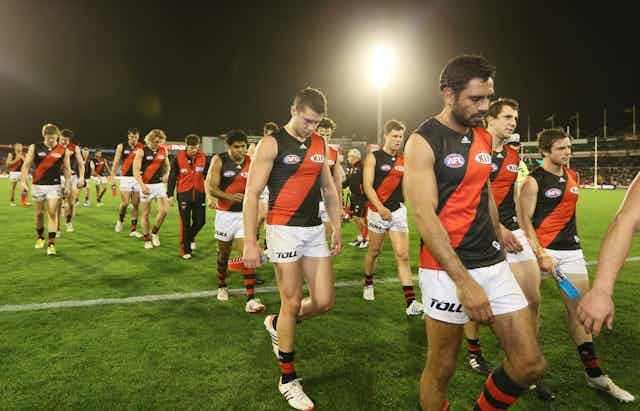
By now you’ll have heard the Australian Sports Anti-Doping Authority (ASADA) is investigating Essendon Football Club. At this stage, there has been speculation about the injection of “peptides” by players in training, without any confirmation that this was the case.
So assuming the speculation has some foundation, what are peptides?
In the literal sense, a peptide is just a very small protein. As might be expected, there are hundreds upon hundreds of known peptides, as many as there can be amino acids combined in short chains. Peptides have a wide range of potential activities, including:
- hormones (insulin and glucagon are both peptide hormones)
- neurotransmitters (such as the endogenous opioid)
There may be no cause for alarm in the case of Essendon, as there are several sports-legitimate and unregulated uses for peptides, per se. Leucine peptides or the hydrolysed protein mixture PeptoPro, for instance, are simply the high-performance cousins of whey protein supplements – essentially, they are “pre-digested” protein fragments designed to aid recovery from vigorous activity.
These substances are no more controversial than ordinary protein supplements. Such peptides can be bought over the counter and require no secrecy.
Certainly, such peptides are never injected.
Worst-case scenario
The ugly and entirely more likely option is that the peptide being speculated about is one from the family of growth-hormone-releasing peptides, of which there are several available: pralmorelin, hexarelin, tesamorelin, or sermorelin, and more.
These various growth hormone-releasing peptides, or secretagogues, stimulate the production of growth hormone by the pituitary gland. This is reminiscent of Lance Armstrong’s drug of choice, erythopoetin (EPO), which stimulates the body to produce red blood cells.
A spike in endogenous growth hormone (which may also be injected directly) is used to aid recovery and muscular growth – and, while not as effective as anabolic steroids for the growth and maintenance of muscle mass, growth hormone has significantly fewer side effects. Significantly, it’s also more difficult to detect.
Suffice to say, these growth hormone-releasing peptides sit squarely in the WADA banned substances list. Much recent research has gone into identifying their patterns of usage, and how the individual drugs might be identified in blood tests.
Where to now?
The current investigation may have broad repercussions. Representatives of the Geelong and Gold Coast football clubs, and rugby league club Manly, have said they employed some of the people who worked for Essendon’s fitness program.
Given ASADA is involved in this case, there is unlikely to be much clemency if any club is found guilty.

Athletes operate under what is known as the “strict liability” clause, which means an athlete is directly responsible at all times for substances that are found in them, regardless of how they got there – and guilty until proven innocent.
The fact Essendon players supposedly signed a consent form or waiver will be of little relevance either way. But it’s unclear what the position is, as so far we are dealing with a report that a program of drug use existed, and not hard evidence of use.
We can assume more information will come to light and, given the high profile accorded to doping cases recently, we certainly haven’t heard the last of this story.
People have been busted for possession and use of growth-hormone releasing peptides before … and that list may be about to get a whole lot longer.
Theo Pertsinidis
Theo Pertsinidis is a Friend of The Conversation.
ALP voter
These type of stories remind me of these type stories...
Ever hear the story of the little dog... has a bone in it's mouth... and it's trodding over a bridge... it looks over and sees a reflection in the water...thinks it's another dog... and that dog has a bone in it's mouth.
The dog wants both bones... so it barks at the little dog in the water trying to scare it.
The bone drops out of it's mouth into the water... loses both bones.
See... don't eat more than you can chew.
While…
Read moreTrevor McGrath
Pharmacist Hobby:climatology
Why would people expect anything other than this, sport is the cheapest crap the media can put to air, all those involved should be in Actors Equity and that’s it. When the modern trend is not even to give teams a location, just as John Doyle would say on ABCRN .. the wankers are playing the tossers, when the players get the least out of it....shock horror, who really cares anyway, just give them bread and circus. Cheers
Tim Traynor
Rocket Surgeon
Is it possible to get growth peptides prescribed legally?
James Heathers
PhD Candidate in Applied Physiology at University of Sydney
Yes, aboslutely. Like most other PEDs, they have a variety of legitimate uses which invariably precede their use by athletes.
GHRH, for instance, forms a very straightforward test for diagnosing growth hormone deficiency - if you inject it and then don't witness an immediate spike in endogenous growth hormone, you've got it.
Tim Traynor
Rocket Surgeon
How do I get a doctor to prescribe them? I want them for bodubuilding purposes. Not sure that's a legitimate medical reason!
Peter Demonte
logged in via email @devnullmail.com
Answer: you ask around the gym till you find a dodgy, usually OTD doctor. I'm indirectly aware of one of these guys, shonky as and uses his licence primarily as a money making venture from what I have heard. He prescribes HGH, which has moderate benefits in building muscle mass, not as potent as anabolic steroids though. No, it's not a legitimate medical reason - these hormones have subtle side effects. It wouldn't surprise if in a few years they finally show that they are oncogenic (cause cancer). If your physique and health is otherwise normal, and you're prepared to inject yourself with hormones to 'improve it', you'd sound a bit body dysmorphic syndromey to me and the only doctor I'd suggest you see is a psychiatrist.
Paul Rogers
logged in via Twitter
"It wouldn't surprise if in a few years they finally show that they are oncogenic (cause cancer). "
Yes, anyone like to speculate on what may have caused or promoted Lance's testicular cancer?
Certainly testosterone, and possibly HGH would be candidates if he took them prior to his disease.
Tim Traynor
Rocket Surgeon
So I can get them from a psychiatrist? Thanks. :-)
Peter Demonte
logged in via email @devnullmail.com
LOL I'll pay that one!
Patrick Boyle
Consultant and Visiting Fellow
I appreciated James Heathers' clear summary of some of the biochemical matters which are part of this more complex issue. His piece is another example of how The Conversation can add value for discussion and learning in the broader community.
James Heathers
PhD Candidate in Applied Physiology at University of Sydney
Well, thank you. Every time a story like this breaks, there's an enormous amount of interest combined with a minimum amount of insight. Every scientist I know has done a lot of 'peptide' jokes today.
Greg Adcock
Scientist
Could the effects on the muscles of such peptides be linked to a greater chance of soft tissue injury?
Paul Rogers
logged in via Twitter
I'm guessing yes. Take a look at what happens to a plant when nitrogen fertiliser is used in excess -- rapid but weak and sappy growth.
Endogenous GH over production might very well result in the same over-growth of human muscle, resulting in muscles that are larger but more susceptible to soft tissue injury.
Speculation on my part, but it seems to fit as a general biological principle.
Peter Demonte
logged in via email @devnullmail.com
I'd suggest it's a real possibility. Over-rapid muscle growth might not give the associated tendons and cartilage a chance to strengthen simultaneusly, givent their slow/non-existent growth. I'm not aware of any science on this, but it's a reasonble postulate. Perhaps Essendon could provide us with data for a retrospective study!
Danderson
logged in via Twitter
Yes and No.
A direct effect of the growth hormone (stimulated by peptide use) is to aid tissue repair. So they can actually help injuries heal quicker. All else being equal a peptide user should have less chance of injuries occurring because their tissues are stronger.
Though being stronger it is feasible that the athlete will work at a higher intensity where injuries are more likely to happen, quite feasible.
With regard to Essendon's soft tissue injuries it's said that their strength coach 'The Weapon' simply had them overtraining.
Tim Scanlon
Debunker
Paul, your analogy is incorrect and your statements about what excess nitrogen does to plants is also false. Speak to a farmer about Flexi N burn.
@Greg, there are a couple of different types of muscular hypertrophy. So when someone gains muscle rapidly it depends on what type of muscle gain it has been, the type that increases the fibre size (myofibrillar) or the type that increases cell size (sarcoplasmic). I'm thinking that the soft tissue injuries resulted from cell size increases without enough strength increase. Either that or a possibly the rapid growth, which has to be encouraged with muscle damage, left microtruma and scar tissue that made the muscles susceptible to tears. Or they could just have had crap trainers who created muscle imbalances, which combined with sudden strength and size gains to tear the weak muscle groups (hammys and groin are common for this).
For a really basic overview have a look at this: http://en.wikipedia.org/wiki/Muscle_hypertrophy
Greg Adcock
Scientist
Sorry to reply to myself. It was the only way I could thank you all for the comments and discussion. As none of you are pointing to a paper which specifically addresses this question I'll assume there is none (I could not find one on WoS).
So the summary that forms in my mind is that putting on bulk via a supplement and then training in a rash manner might combine to increase risk of tears. This sort of thing might happen if the physical training staff are unaware that supplements are being taken.
Paul Rogers
logged in via Twitter
Greg, you would need to re-write the text books on plant nutrition if you believe excess nitrogen does not cause undesirable plant growth (especially with inadequate potassium). But if you're selling N fertilisers, then I understand your position. See here if you like (Rice Knowledge Bank):
http://tinyurl.com/alcxt9q
In any case, what you correctly describe (sarcoplasmic hypertrophy), in which cytoplasmic fluid etc is increased at the expense of sarcomere hypertrophy (and strength), seems to…
Read morePaul Rogers
logged in via Twitter
It seems that GH is not anabolic for sarcomere (myofibrillar) muscle tissue. Therefore, one assumes that any muscle growth is sarcoplasmic in nature. See this abstract from McMaster Uni.
http://www.ncbi.nlm.nih.gov/pubmed/20959702
How that transformed muscle intracellular and extracellular environment might respond to the stresses of AFL movement dynamics is certainly worthy of consideration, and perhaps especially under conditions of overtraining (or overreaching).
Paul Rogers
logged in via Twitter
That would be 'Tim' of course and not Greg in my response. (How could I forget Tim? Answer: 'very easily'.)
Tim Scanlon
Debunker
Paul, you really need to learn to read. You have just created a strawman and then called me a shill, which is just pathetic. It is sad you don't remember my name, I remember you, given how often I find myself correcting your misinformed posts here.
You stated that excess nitrogen causes rapid but weak and sappy growth. This is false. I even told you to ask a farmer about Flexi N burn, but what would anyone who works in food growing know. Initial stages cause a change in the root shoot ratios which…
Read morePaul Rogers
logged in via Twitter
Tim, what surprises me is that for someone supposedly working in agriculture, how much you DON'T know. Thin stems, reduced stem strength, and lodging is a common characteristic of excess nitrogen in plants like rice (see that link from IRRI. Hey mate, that's 'weak and sappy growth'! You need to actually get outside and grow something rather than sit in an office.
I know very well what nitrogen burn is, and that's not the condition I described.
I made a simple speculative analogy about possible reasons for soft tissue injuries in players based on rapid, abnormal growth resulting from possible growth hormone excess. If you don't 'get it', then I'm not surprised. Your rudeness and ignorance is typical.
Tim Scanlon
Debunker
Paul, quite simply you are wrong. Get over it and actually read about root:shoot ratios from excess N applications and how that impacts water and nutrient transport in the plant. Your arrogance on a topic you are not working in is palpable.
Paul Rogers
logged in via Twitter
Okay Tim, let's not bore the readers. It's easy enough to verify who is correct: Google search on "Excess nitrogen and sappy plant growth" will do it for those interested. Jeez, you don't have to be Norman Borlaug to know that.
I'll spell it out. My premise is that excessively stimulated growth with artificially induced or supplied growth factors not under the control of homeostasis can cause unbalanced growth, perhaps weakening the integrity of soft tissue structures like the muscle, ligament…
Read morePaul Rogers
logged in via Twitter
Okay, try this:
Systematic review: the effects of growth hormone on athletic performance. Liu H, Bravata DM, Olkin I, et al. Ann Intern Med. 2008 May 20;148(10):747-58.
http://www.ncbi.nlm.nih.gov/pubmed/18347346
"Growth hormone-treated participants more frequently experienced soft tissue edema and fatigue than did those not treated with growth hormone . . . strength and exercise capacity did not seem to improve."
Note also that carpal tunnel syndrome of the wrist is an acknowledged adverse effect of HGH use. (National Strength and Conditioning Association, 2009)
Tim Scanlon
Debunker
You do realise I'm a plant scientist right?
How about a link to some actual crop production sites and the nitrogen response curve: http://www.agric.wa.gov.au/PC_92452.html
https://www.agronomy.org/publications/aj/abstracts/102/5/1415?access=0&view=article
https://www.soils.org/publications/aj/abstracts/92/4/644?access=0&view=article
http://www.sciencedirect.com/science/article/pii/S0308521X07001357
Paul Rogers
logged in via Twitter
Tim, give it up; you are embarrassing yourself. You are confusing 'excess N' with 'optimum N'.
This is such basic plant nutrition science that I can only believe you are trolling . . . for what purpose I cannot imagine. You need to self-debunk.
(BTW, I am a 30-year life member of a long-established garden club.)
Tim Scanlon
Debunker
So you decided not to read any of the science and information on Nitrogen response and physiological impacts. No wonder you don't learn.
FYI: gardening is not agriculture and agriculture is where the science is done.
Philip Maguire
Journalist
It's all speculation of course but could it be that Essendon decided to involve the AFL and ASADA to completely demolish speculation that the club had used banned substances.
It beggars belief that there could be no record of what the players were given, if it was above board. That being so an investigation should be should a simple matter of checking the legality of the supplements that were used. Obviously, there is not going to be any record of banned substances so it beats me how a case against the club could be prosecuted unless real and substantial evidence was introduced.
I don't think a ban on 80 per cent of Essendon's players is going to fly. Are we now going to convict athletes and sporting clubs on hearsay? The ramifications are too great and legal challenges could go on for years.
You can bet, however, that AFL clubs will be well and truly on the alert as to where sports medicine is taking them in future.
Ahmad Abu-tukit
Plumber
The "easiest" of course was for the AFL and other clubs to actively present to ASADA or a similar body a full list of all substances they give their players FOR APPROVAL (assuming commercial confidentiality) thus transferring the legal responsibility away from them.
James Heathers
PhD Candidate in Applied Physiology at University of Sydney
This is perfectly correct.
We are talking, so far, about entirely hypothetical banned substances. I have literally no idea how you could prove usage now, considering the clearance time of GHRH. It may well be the case that the gentleman involved will simply stick to their story that these were Vitamin B12 / cortisone etc. etc. injections and all of this will blow over.
The risks that people will take now for 1% - and I should qualify, I mean professional risk of becoming involved in a media circus, rather than health risks - is very large.
Benirby Sheller
Student
Hey James,
Curious, what is the legal status of a growth hormone peptide vs a traditional anabolic steroid? I am wondering how their usage will be viewed by the law, as well as the AFL. It's easy for us to condemn them for breaching their rules of employment, but is there another level to this?
If they are not illegal beyond the realm of the AFL (I see they are easily purchased online) it would certainly change my opinion. At the moment I am halfway between "penalise each and every one of them" and "we all make mistakes".
Cheers,
Ben.
Paul Rogers
logged in via Twitter
I certainly would not be punishing any players if they were coerced into taking substances that management (medical, sports or other), claimed were safe and legal to take.
James Heathers
PhD Candidate in Applied Physiology at University of Sydney
Hi Ben,
As far as I'm aware, these aren't legal. They're not even scheduled - they don't have a legitimate pharmaceutical use yet that's passed regulatory testing, they're "research only" drugs. But they are tested for. They are easily purchased online simply because other countries don't share our attitude towards pharmaceuticals. Assuming the sites you've found are actually real, of course.
To the people who say, "Well, if they're being commonly used, and they're being tested for... but they still aren't even basically regulated and are quite poorly understood, then what are scientists doing?" I would say "Can we have some more money, please?"
I find it somewhat distasteful that this issue comes with the fervent call for more testing and more research, considering the overall state of research funding. Sometimes people seem to scream 'know more!' and 'have less!' to science at the time.
Peter Demonte
logged in via email @devnullmail.com
WADA however makes it extremely clear that 100% of responsibiltiy falls to the athlete, regardless of pressure they think they were put under. I think ASADA inherits the same view. Just about every busted athlete claims they ate something they didn't know contained anything prohibited, including hormone treated meat and all sorts of other implausabilities. A few I recall did accidentally ingest something where I though 'that's a bit tough on them', but they still fell.
Michael Block
Idler
Rather than being a dirty outlyer of a sport with a uniquely tainted culture, it seems that professional cycling has actually led the way in recognising and attempting (half-heartedly) to deal with cheating within its ranks
Andrew Remely
logged in via Facebook
Ummm - I don't think the UCI has been doing much in the way leading. Perhaps the best that could be said is now the great unwashed have some insight into the issues in elite male road cycling. Have a read of ‘Bad Blood: The Secret Life of the Tour de France’. The issues have been widely known and for a long time. They just haven’t been part of a media circus.
As they say ‘you could have knocked me over with a feather’ – shock horror - various types of footballers abuse sport drugs. I’m sure the issues in these codes are well known (but not widely reported). I don’t think the crime commission spend 18 months poking around footy on the off chance they’d find something.
Come on even Shane Warne has been caught...
Michael Block
Idler
I agree that the UCI have done merely the minimum that they have been forced to do. Unfortunately I think that this is also likely to preview the response of other sporting codes. The problem occurs when the organisation that polices the sport is also the organisation that promotes the sport
Terry Stavridis
historian
I am glad someone has written something on an AFL club. Last week, the Melbourne media concentrated on vandals who destroyed seats at Etihad Stadium during an A-League football game. Such behavior is unacceptable but whenever something happens at a FOOTBALL (soccer) game, the media goes mad.