Does the Tasmanian Parliament have the power to pass a law permitting same-sex marriage? The short answer is yes. But the more difficult question is whether that law will be effective or whether it will be inoperative because it is inconsistent with a Commonwealth law.
The answer to this question is unclear and unknowable until the High Court decides, but we can take a look at the issues the High Court will confront.
The constitutional meaning of marriage
Assuming that the constitutional validity of the Tasmanian law will be challenged, the High Court will ultimately have to decide two questions.
The first is whether the Commonwealth Parliament’s constitutional power to make laws with respect to “marriage” extends to the marriage of same-sex couples. This would depend upon whether the court took an originalist approach – looking at what “marriage” meant when the Constitution was enacted (which would be likely to exclude same-sex marriage) – or whether it took a non-originalist approach based upon changing contemporary standards and the meaning of the term “marriage” today.
Even if it took the latter course, difficult questions would arise as to how much community support is needed to change the meaning of a word and what evidence this must be based upon. The answer is not cut and dried.
If the court decided that “marriage” in the Constitution did not include same-sex marriage, then there would be no issue of a conflict between State and Commonwealth laws.
While the Commonwealth Parliament can only make laws on specific subjects listed in the Constitution, the states have full legislative power to make laws on any subject as long as it is not taken away from them by the Commonwealth Constitution. So if the Constitution only permitted the Commonwealth to make laws in relation to marriage in its traditional sense, this would not stop the states from making laws about other forms of marriage.
The only question would be whether these other unions could still be described as “marriage” if they are outside the constitutional meaning of that term.
If, on the other hand, the High Court held that the Commonwealth can make laws with respect to both opposite-sex and same-sex marriage, then it would have to decide whether there was an inconsistency between any state law on marriage and the Commonwealth’s marriage law. If there was an inconsistency, then the Commonwealth law would prevail and the state law would be inoperative to the extent of the inconsistency.
Inconsistency between marriage laws
The Commonwealth’s Marriage Act 1961 states in section 5:
“marriage” means the union of a man and a woman to the exclusion of all others, voluntarily entered into for life.
It then sets out the requirements for all marriages solemnised in Australia, the pre-conditions for marriage and the circumstances in which marriages are invalid.
The question would be whether the proposed Tasmanian law would be inconsistent with the Marriage Act. This would depend upon the wording of the Tasmanian law. If the Tasmanian law purported to give to same-sex couples the legal status of being “married” for the purposes of all law across Australia, including Commonwealth law, this would be likely to give rise to a direct inconsistency with the Marriage Act, as it would be purporting to grant people a status which is denied to them by a Commonwealth law. It would therefore be inoperative to the extent of this inconsistency.
If the Tasmanian law was drafted so as to confine its effects to Tasmanian laws, it might still be held to be inconsistent with the Commonwealth’s Marriage Act to the extent that the Commonwealth law was regarded as “covering the field” of marriage.
The Marriage Act confines its definition of marriage to opposite-sex couples, so Tasmania would argue that it left the field open for state legislation with respect to other types of marriage.
Those opposing the Tasmanian law would be likely to argue that it was intended to cover the entire field of marriage within Australia and to prohibit marriage of same-sex couples. For example, section 88EA of the Marriage Act says that a union solemnised in a foreign country between a man and another man or a woman and another woman must not be recognised as a marriage in Australia.
The effect of a Tasmanian marriage law
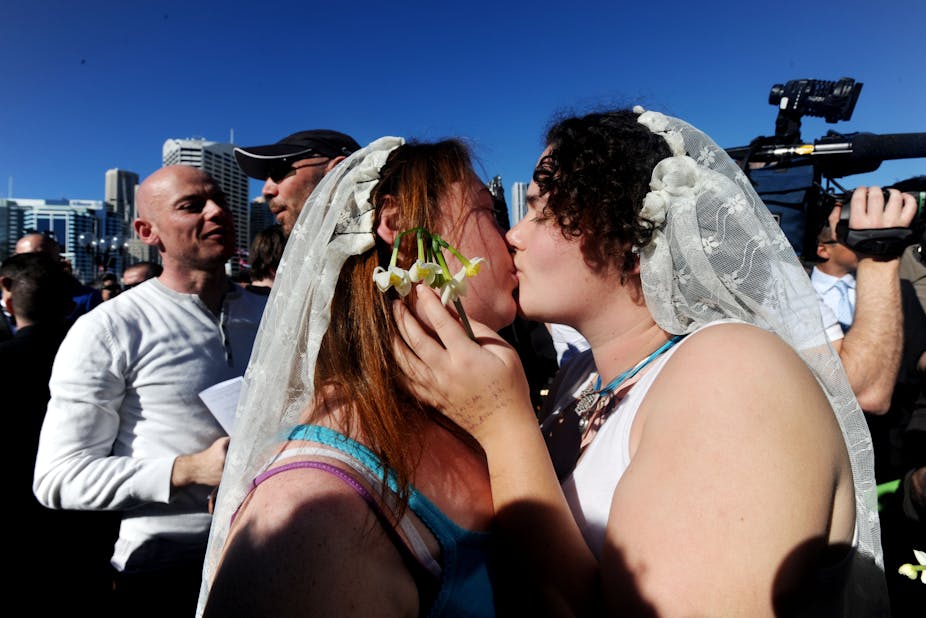
A Tasmanian law permitting same-sex marriage, even if operative, would do little more than facilitate holding a ceremony, drinking champagne and taking photos. It might confer on the parties to a same-sex marriage the status of “married” for the purposes of Tasmanian laws, but it is most unlikely that they would be regarded as legally “married” for the purposes of Commonwealth law or under the law of any other state (unless that state legislated to recognise the status conferred by the Tasmanian law).
It would therefore not attract any legal benefits or status accorded to a married couple outside of those given under Tasmanian law.
There is also a distinct possibility that such a law would be held to be inoperative because it is inconsistent with a valid Commonwealth law. All in all, it is not time for same-sex marriage proponents to crack open the champagne yet.
Sarah Joseph
Director, Castan Centre for Human Rights Law at Monash University
Thanks for this Anne. I'm not sure I agree with the "champagne corks" comment at the end. First, do many legal benefits these days continue to discriminate between same sex couples and married couples? I think most of that discrimination has gone. Second, people do seem to care about SSM in the US States - they haven't been viewed as empty victories.
Your point about the HC's interpretation of "marriage" under s51(xxi) is interesting and scary. A narrow interpretation if marriage would leave any Tasmanian law constitutionally intact. But it would also mean that the Commonwealth lacks power to legislate for same sex marriage unless it can be shoehorned into another head of power. And of course the symbolic & psychological value of the HC finding that "marriage" excludes SSM would be huge (ditto an opposite decision).
Jack Arnold
Director
Thank you Anne for an objective legal opinion of a very emotive topic.
On first reading of the Australian Constitution, Gay "Marriage" in all state jurisdictions would appear to be defeated by ss51(xxi), (xxii) supported by s109.
Proponents are unlikely to found such law on either the Saving Powers of State Constitutions (ss106, 107) or (remarkably) the High Court's original jurisdiction (ss75-77).
An opinion from Kirby J would be valuable even if pecuniary.
A more important issue seems to be the Barrier OFascist NSW Liberal government proposal to abolish Trial by Jury guaranteed by s80.
Jack Arnold
Director
Continuing on ... The High Court "approved" the political decision to grant Senators to the Territories despite politicians having any Constitutional power to do so. The Barwick CJ decision (read apology) makes interesting reading. The proposing government made the promise, the government won the election, so the unconstitutional power was established (or excused).
Dianna Arthur
Dianna Arthur is a Friend of The Conversation.
Environmentalist
Personally, marriage is something of an anachronism. That said my personal choice has no place in dictating the choices of others.
Why gays and lesbians should be discriminated against in this fashion boggles the mind. It is just so petty. Denying the marriage ceremony isn't going to make GLBT's go away - all it achieves is disenfranchising a few people from participating in a ceremony that is available to the majority of human beings. And giving covert license to the homophobes to spew forth their vitriol.
Claims that marriage is strictly between a man and a woman is a construct - along the lines of way back when female public servants were forced to resign from their jobs upon marriage, for no better reason than they happened to be born female.
Rajan Venkataraman
Citizen
Thanks Prof Twomey for another excellent article.
Read moreAs the distinction between married couples and de facto partners diminishes in terms of their status before the law (and eligibility for government benefits), I wonder: what exactly are we fighting for? Is it just the right to apply the word 'marriage' to particular relationships? If Tasmania were to call the legal relationship of same sex couples something other than 'marriage' (say they were to use the spanish word "matrimonio") but otherwise confer…
Gil Hardwick
Anthropologist
Here again, it's only something lawyers seem to be worried about, egged on apparently by their 'clients', as usual, something to do with the 'legality' or otherwise of their intimate relationships.
It still hasn't been explained to me what difference it's going to make, apart from making a few lawyers and their clients with their travelling media roadshow happy, when nobody else really gives a toss.
While I do accept that we live under a discretionary rule of law, specifically based on common…
Read moreDianna Arthur
Dianna Arthur is a Friend of The Conversation.
Environmentalist
"It never ceases to astonish me how far some people will go trying to prove a point that is so quintessentially trivial."
Trivial to you, Gil, trivial to you.
A matter of human dignity to others.
Martin Bonsey
former public servant
Thanks to Anne for this article and to Sarah Joseph for her earlier piece with its link to George Williams's 2005 opinion. It is good to have some discussion of the generally ignored really significant constitutional questions surrounding this issue which seem to have a number of ironic consequences. I had always assumed that opponents of same sex marriage (SSM) would end up challenging any Commonwealth law providing for SSM on the basis that "marriage" in s.51 was limited to opposite sex marriage…
Read morePeter Gerard
Retired medical practitioner
The Constitution explicitly defines marriage as the " ...union of a man and a woman...". I'd suggest to 'same sex marriage ' proponents "hands off." Find some other term to describe your civil unions.
Read moreMarriage, despite its defects and failure rate[ only outdone by same sex relationships] is still the best arrangement for life long companionship and the begetting and raising of children. This is an inconvenient truth to many, but when heterosexual marriage works it is the ideal and it has firm…
Martin Bonsey
former public servant
Well no, not actually Peter. The Constitution uses the word "marriage" just the once identifying it in s.51(xxi) as a subject with respect to which the Commonwealth Parliament may legislate. The Constitution does not include the definition to which you refer. Rather, that definition was added to the Marriage Act during the term of the previous government. It is the absence of any definition in the Constitution - an unsurprising absence given the views on such matters when the Constitution was drafted - which makes the current proposals both in the Commonwealth Parliament and possibly Tasmania so constitutionally fascinating.
Alice Gorman
Lecturer in Archaeology at Flinders University
Interesting to get this take on the issue. Hello Anne!