



Our notion of reality is built on everyday experiences. But wave-particle duality is so strange that we are forced to re-examine our common conceptions.
Wave-particle duality refers to the fundamental property of matter where, at one moment it appears like a wave, and yet at another moment it acts like a particle.
To understand wave-particle duality it’s worth looking at differences between particles and waves.
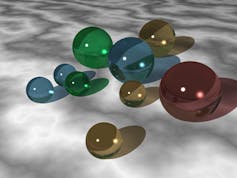
We are all familiar with particles, whether they are marbles, grains of sand, salt in a salt-shaker, atoms, electrons, and so on.
The properties of particles can be demonstrated with a marble. The marble is a spherical lump of glass located at some point in space. If we flick the marble with our finger, we impart energy to it - this is kinetic energy, and the moving marble takes this energy with it. A handful of marbles thrown in the air come crashing down, each marble imparting energy where it strikes the floor.

In contrast, waves are spread out. Examples of waves are the big rollers on the open ocean, ripples in a pond, sound waves and light waves.
If at one moment the wave is localised, some time later it will have spread out over a large region, like the ripples when we drop a pebble in a pond. The wave carries with it energy related to its motion. Unlike the particle the energy is distributed over space because the wave is spread out.
Why waves are so different from particles
Colliding particles will bounce off each other but colliding waves pass through one another and emerge unchanged. But overlapping waves can interfere - where a trough overlaps a crest the wave can disappear altogether.
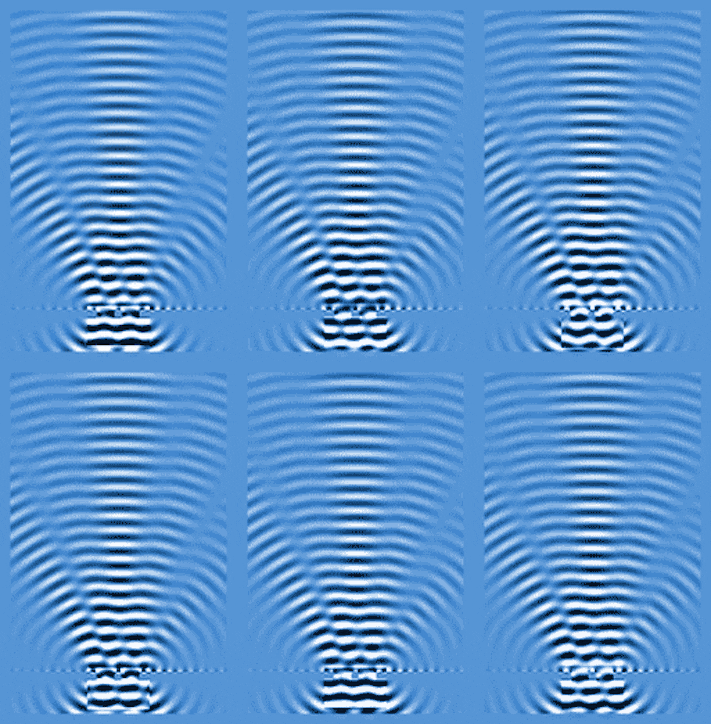
This can be seen when parts of a wave pass through closely spaced holes in a screen. The waves spread out in all directions and interfere, leading to regions in space where the wave disappears and regions where it becomes stronger.
The image on the left shows an example of the double slit experiment invented by English polymath Thomas Young. This phenomenon is called diffraction.
In contrast, a marble thrown at the screen either bounces off or goes straight through one of the holes. On the other side of the screen, the marble will be found travelling in one of two directions, depending on which hole it went through.
Wave goodbye to waves
The phenomenon of diffraction is a well-known property of light waves. But at the beginning of the 20th century, a problem was found with the theories of light waves emitted from hot objects, such as hot coals in a fire or light from the sun.

This light is called black-body radiation. These theories would always predict infinite energy for the light emitted beyond the blue end of the spectrum - the ultraviolet catastrophe.
The answer was to assume the energy of light waves was not continuous but came in fixed amounts, as if it was composed of a large number of particles, like our handful of marbles. So the notion came about that light waves act like particles - these particles are called photons.
If light, that we thought was wave-like, also behaves like a particle, could it be that objects such as electrons and atoms, that are particle-like, can behave like waves?
To explain the structure and behaviour of atoms it was thought necessary to assume that particles have wave-like properties. If this is true, a particle should diffract through a pair of closely spaced holes, just like a wave.
Electron and atom diffraction
Experiments proved atomic particles act just like waves. When we fire electrons at one side of a screen with two closely spaced holes and measure the distribution of electrons on the other side, we don’t see two peaks, one for each hole, but a complete diffraction pattern, just as if we had been using waves.
This is another example of the Young’s slit experiment we showed above, but this time using electron waves. These notions form the basis of quantum theory, perhaps the most successful theory scientists have ever developed.
The bizarre thing about the diffraction experiment is the electron wave doesn’t deposit energy over the entire surface of the detector, as you might expect with a wave crashing on the shore.
The energy of the electron is deposited at a point, just as if it was a particle. So while the electron propagates through space like a wave, it interacts at a point like a particle. This is known as wave-particle duality.
It moves in mysterious waves
If the electron or photon propagates as a wave but deposits its energy at a point, what happens to the rest of the wave?
It disappears, from all over space, never to be seen again! Somehow, those parts of the wave distant from the point of interaction know that the energy has been lost and disappear, instantaneously.

If this happened with ocean waves, one of the surfers on the wave would receive all the energy and at that moment the ocean wave would disappear, all along the length of the beach. One surfer would be shooting along the surface of the water and the rest would be sitting becalmed on the surface.
This is what happens with photons, electrons and even atom waves. Naturally enough, this conundrum upset a lot of scientists, Einstein included. It is usually swept under the carpet and glibly referred to as “the collapse of the wavefunction” on measurement.
Certain uncertainty
As the wave propagates, where is the particle? Well, we don’t know for sure. It is located somewhere in the region of space with a dimension similar to the distribution of wavelengths that define its wave. This is known as Heisenberg’s uncertainty principle.
For common everyday particles, such as marbles, salt and sand, their wavelengths are so small that their location can be accurately measured. For atoms and electrons, this becomes less clear.
In the diffraction experiment the electron wavelength is large so the location of the electron is very uncertain. The electron actually travels through both slits at once, just like a wave. In terms of particles it becomes impossible for us to really imagine this because it conflicts with everyday experience.

Einstein worried about where the particle is actually located and decided information was missing in the quantum theory. In a celebrated paper on hidden variables, Einstein and his colleagues Nathan Rosen and Boris Podolsky derived two alternatives: either quantum theory was wrong or the problem resided in our notion of reality itself.
A series of precise and clever experiments proved that quantum theory was correct and that our notion of reality is at fault (see Bell’s inequality and the Einstein, Rosen and Podolsky paradox).
Ghostly behaviour
But this is not the end of the story. The experiments that disproved our notions of reality involved two particles linked together as a single wave. Measurements on one particle affect the physical properties of the other particle, even though they can be far apart. This is known as “spooky action at a distance” and is a consequence of quantum entanglement.
It is a very subtle concept but is forming the basis of quantum computers and quantum cryptography!
So what’s wrong with reality?
At this point the whole problem gets very difficult to get your mind around. But don’t get too worried about this. As Richard Feynman, Nobel Laureate and truly brilliant man said: “I think I can safely say that nobody understands quantum mechanics.”
Most people working in this field just get used to the concept and get on with their lives, or become philosophers.
And as for reality?
I think Professor Feynman has the last word on that one, too: “ … the paradox is only a conflict between reality and your feeling of what reality ought to be.”
See more Explainer articles on The Conversation.