
They toiled and they fought through the shame of it –
Through wilderness, flood, and drought…
…The miseries suffered, unvoiced, unknown –
And that’s how the land was won.
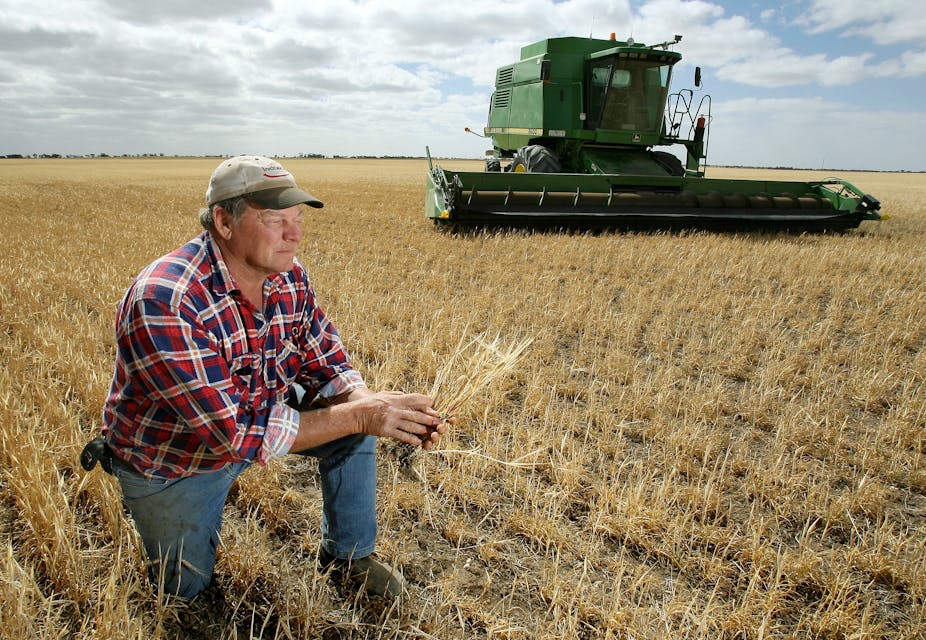
Henry Lawson’s characterisations of colonial Australia have found an enduring place in our social history. His depiction of pioneering men captures what has become a great Australian stereotype: the tough and self-sufficient rural man, isolated, suffering in silence against great personal and environmental adversity.
Moving to the present, Lawson’s Australian rural man – and, particularly, the farmer – has become a subject of concern within health research, policy, and practice. Farmers have a higher rate of suicide than people with other occupations, and reducing suicide rates among farmers and farm workers is an ongoing challenge.
There is considerable speculation about factors influencing farmer suicides. Typically, we hear about stressors such as prolonged drought and natural disasters, financial hardship, changing demand for agricultural commodities and a shift away from rural industries, and decreasing political representation. Long working hours, geographic remoteness, and relationship strain due to financial and other pressures, are often raised.
One of the most commonly proposed contributors to farmer suicide is a lack of access to, or use of, mental health services, along with cultural factors such as stigma and “traditional masculinity.” While the latter concept is not well defined, it generally refers to attributes such as self-reliance, individualism, and stoicism – characteristics we stereotypically associate with farmers.
The theory runs that, over and above the other structural and cultural barriers that prevent farmers seeking help, their propensity to seek help if they are feeling suicidal will be impeded by their notions of masculinity.
Although there are many possible and probable risk factors for farmer suicide, comparatively few are backed by robust evidence. Consequently, there is no clear picture of which factors have the strongest influence on farmer suicide. This makes it very difficult to understand what an effective intervention may look like.
There is a great deal of information about protective factors in the general population, but to date, very little effort has been made to understand what factors are most likely to be protective for farmers. This is perhaps the most important question of all.
It’s all very well to talk about mental health literacy or social support, but the best protective factors for farmers may be practical things like the ability to hire staff to harvest a crop, or being able to get a decent price for livestock and produce. We need to know this.
Adding to this complex situation, it seems many common assumptions about farmers and suicide need to be re-examined. Based on a preliminary investigation into help-seeking behaviour among adult male farmers who died by suicide in Queensland, it appears a sizeable proportion of those men – around 40% – had accessed some type of professional mental health help prior to death.
These findings cast doubt on the assumption that farmers generally avoid seeking formal help. This is true for some, but not as many as the received view suggests.
This prompts us to ask whether the help those farmers received was appropriate for their specific needs. And is it possible that the type of professional help accessed by those farmers was a poor match? A gentleman in his 60s who has always lived on the land may not feel comfortable talking to a 23-year-old female mental health nurse who has just moved to the area.
Untreated mental illness is unlikely to adequately explain farmer suicides; many Queensland farmers who died by suicide had no recorded signs of a psychiatric condition. So what was going on in their lives, before their suicide?
A substantial amount of international evidence suggests that life events and occupational stress play an unusually strong role in farmer suicide. But Australian research into these issues remains scarce. We don’t know why one farmer affected by drought takes his own life, while his neighbour – who is equally affected – does not.
These knowledge gaps impact on our ability to design and implement effective suicide prevention programs in farming communities. Until we can improve the evidence base around farmer suicide, we will continue to have to develop suicide prevention policies and programs in an environment of guesswork and assumption, rather than basing them on high quality evidence.
Farmers put food on our tables. This year – the Australian Year of the Farmer – I hope we researchers can start putting some facts about farmer suicide on the table.
David Thompson
Research Officer In Men's Health at University of Western Sydney
Having just lost a close relative to suicide and working in men's health, I see a trend becoming clear. The oft-promoted advice is to get help and that's good but it carries the implication that if we can just get men to get help, they'll be alright.
What I see is that there is more to it than that. As the author says, many men who take their own lives have in fact accessed help but go on to take their own lives anyway. I think we really have to develop a mindfulness or insights into this feeling…
Read moreGil Hardwick
Anthropologist
My view is that not only farmers but country people generally in Australia suffer an acute and ongoing sense of betrayal by the rest of the country, constrained to clear the country and 'feed the cities' by the state imposed conditions of their land purchase, incomes underwritten by quotas in place of initiative, then when overproduction, environmental degradation, species and biodiversity loss and other harms resulting from the regime became clear, they were the ones blamed for it.
Why then…
Read moreDavid Thompson
Research Officer In Men's Health at University of Western Sydney
Have you been to the National Men's Health Gathering Gil? It was in Perth in 2011. There's your opportunity to get in with the policymakers and community of people who might make a difference. Brisbane Oct 22-25 2013. Submit a presentation, get in front of the one's making a difference.
You might have been in touch with us but probably not in the year I've been there. If you want to get your message heard, it's not us you need to be in touch with. You need to talk to someone in WA like Malcolm McClusker and Julian Krieg through the Wheat Belt Men's Health (also President of the Aust Male Health Forum).
You criticise those who uncover what's happening and label them panoptic, yet you also lament Australians' lack of awareness of the reality of what happens. You can't have it both ways, Gil, and you as a student are part of the system you criticise.
Tim Scanlon
Debunker
Excellent insights again, Gil.
Catriona Nicholls
Agricultural communicator
Oh Gil, how right you are. When media coverage abounds, inlacing articles such as "Think humans are special? Like the animals we eat, we’re meat too", which appeared in The Conversation tis week, it is no wonder farmers are disheartened to the point of despair.
Reading through the comments from this article has me wondering why my family and those that surround us bother to do our best to produce the food and fibre that sustains the very people who demonise our every effort.
Far from being the redneck land degraders with bloodlust in our eyes, tearing tiny creatures limb from limb to eat from their carcases, our families are constantly improving the farming systems in which we live and work. Always with the future in sight, we aim to protect our soil, water and animal resources in every way they can. Yet constant criticism from the comfort of a city-based living can drive you past the point of despair.
Tim Scanlon
Debunker
Very true Catriona. An even more extreme example occurred after I wrote an article for The Drum. The deliberate and direct vitriol from (to quote several friends) "the late sipping set" at farmers was disgusting. Several people contacted me about the article to express their dismay at the comments.
Locally, Wheatbelt Men's Health has been doing a fantastic job. The program has expanded nationally now to be Regional Men's Health. We often have Julian or Owen out to events. We also recently had Glen Mitchell out to talk about his experiences with depression and suicide, and that was very well received, had the whole community talking.
Richard Windsor
Mycologist
In addressing suicide, the issue needs to be reframed in terms of mental "health", meaning wellness, as opposed to the current practice of mental "illness". If one takes a broad overview and looks at the underlying issues , eventually, as repugnant as it might seem to many, there are some fundamentals.
Read moreSee http://www.bsos.umd.edu/media/47583/chronis arch gen psychiatry 2010 ,
where Chronis et al look at the predictors of suicide in children.
Take a leap forward to the Path Through Life study…
Christopher Barnes
Sports Analyst
About 2002 I was responsible for managing drought assessment for the Commonwealth Exceptional Circumstances (EC) program. I visited a number of regional centres to listen to farmers and townsfolk talk about problems caused by drought etc., and, at one of these I experienced considerable "abuse", somewhat legitimately leveled at me from an irate farmer against the Government. When I returned to Canberra, I discovered that the EC program was partly (at times, largely) regarded as an instrument of…
Read moreTim Scanlon
Debunker
This is the thing I don't like about modern government, the top down approach. People who do the work, are on the frontline and understand the issue, are not allowed to voice discontent or enact improvements. There are many, myself included, who have had this problem.
I'm personally not a fan of EC funding. But there are a lot of issues that aren't appreciated by wider society/government, especially since agriculture - and more broadly regional/rural businesses - are open to every uncertainty (the weather, the climate, the government, society, trade, dollar, international trade, markets, etc). Any other business would have the ability to offset some risks. I don't know that EC was/is the answer, but there was definitely a need for some support net.
james rohan
logged in via LinkedIn
Samara,
A very thoughtful piece. I have been researching food insecurity and we often forget the toll our food system takes on the people working in it. Locally, it does not get the media attention it deserves as you point out. I would suggest you consider examples overseas .http://www.indiatribune.com/index.php?option=com_content&view=article&id=5389:every-12-hours-one-farmer-commits-suicide-in-india&catid=106:magazine
Our Australian farmers have to cope with interest rate pressure due to excessive debts,for example listen to podcast of Prof. D'Occhio discussion with Steve Austin on food security issues on 14/9/2012 on ABC radio. This issue may be the root cause and needs investigation by the banking sector. To this end, I have written to our banks to ask them their strategy on food security issues.
Best of luck with your research.