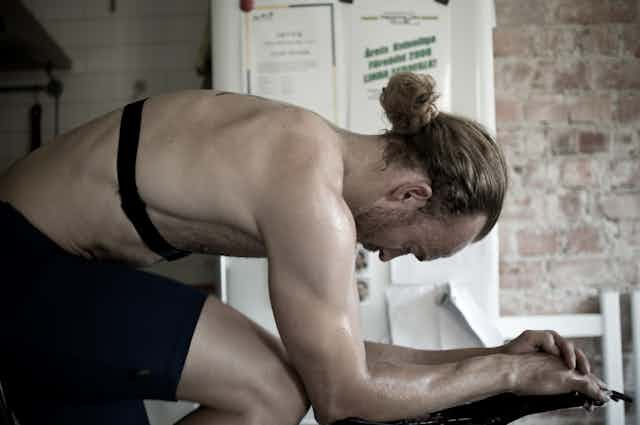

Less than 40% of Australians achieve the minimum amount of physical activity recommended by government and professional organisations. This contributes to the fact 60% of Australians are overweight or obese.
Exercise and Sports Science Australia (and similar organisations overseas) recommend at least 30 minutes of moderate intensity exercise most days of the week, adding up to 150 minutes a week.
The most commonly reported barrier to reaching these targets is a perceived lack of time. So it’s important to maximise the benefits of exercise in what little spare time we have.
But how can we get the most out of our exercise sessions? And is there a way to get enough exercise to stay healthy without spending 150 minutes a week?
HIIT it
Over the past few years, a number of laboratories have shown that High Intensity Interval Training (commonly known as HIIT) can provide similar – if not greater – health and fitness benefits as traditional exercise approaches. HIIT incorporates repeated bursts of intense exercise interspersed with periods of rest.
But it should be pointed out that, while HIIT is likely to improve overall metabolism, when it comes to fat burning and blood glucose control with minimal weight loss, calorie restriction through dieting is still the best way to lose body weight.
Most HIIT studies are performed on a bike, although some of the aerobic studies have been performed on a treadmill. Essentially, from the exerciser’s point of view, it shouldn’t matter, as long as the intensity is achieved.
Research has so far focused on three HIIT variations:
Low-volume supra-maximal HIIT
Low-volume supra-maximal HIIT involves four to six repetitions of 30 seconds of all-out exercise (approximately four times greater than maximum aerobic exercise intensity) with recovery periods of around four minutes.
The advantage of this approach is the small time commitment required. Clear benefits in terms of aerobic fitness and insulin sensitivity have been observed with just nine minutes of exercise a week (or 90 minutes total time commitment when you include rest).
But this method of training typically involves specialised equipment (such as electromagnetically braked stationary lab bikes) and due to the very high exertion and motivation required it may not be feasible for the general population.
Aerobic HIIT
Aerobic HIIT sessions on the other hand typically involve four to six four-minute repetitions of exercise performed at 80-90% of the maximum aerobic exercise intensity. These efforts are interspersed with one to three minutes of recovery with a single session taking up to 38 minutes.
As this is a lower intensity than the supra-maximal HIIT, it is deemed more achievable and has repeatedly been used successfully to treat patients with metabolic syndrome, hypertension and coronary artery disease.
But as the aerobic HIIT sessions are somewhat prolonged it doesn’t offer the same time-saving advantages as supra-maximal HIIT.
Low-volume maximal HIIT
Low-volume maximal HIIT sessions may provide a compromise between the previous two protocols.
This strategy involves eight to ten one-minute bouts performed at maximal aerobic exercise capacity, interspersed with 60-75 seconds of light recovery, therefore offering significant time advantages, with a single session taking around 20 minutes.
Therefore its lower intensity (compared to supra-maximal HIIT) and shorter session duration (compared to aerobic HIIT) may make it suitable for sedentary or obese people, and those with existing metabolic conditions.
This form of HIIT has already been trialled successfully in type 2 diabetes patients, who demonstrated markedly improved blood-sugar control in just two weeks.
How low can you go?
We still don’t really know the minimum amount of exercise required to induce significant health and fitness benefits. But a recent study has cut down the exercise time even further, showing that just six ten-second all-out sprints, spread throughout a week can improve aerobic fitness and blood-sugar control.
Evidence is building that the HIIT approach to exercise can substantially improve aerobic fitness while providing a range of positive health outcomes, including better blood-sugar control, blood pressure and blood vessel function in a range of conditions such as obesity, metabolic syndrome, diabetes and heart disease.
These studies have challenged current thinking regarding how much exercise is needed to produce substantial health benefits. This has important implications for those who decide a 20-minute lunch break is insufficient for worthwhile exercise, or for those looking to make the most of their precious gym time.
Mass participation
Meanwhile, exercise physiologists and healthcare providers are keenly awaiting much-needed, large scale randomised control trials on HIIT to be funded and carried out.
Those studies will give us the evidence to challenge current exercise recommendations and allow the incorporation of HIIT into the standard recommendations needed to treat and prevent chronic metabolic and cardiovascular diseases in the future.
While exercise preferences no doubt vary among individuals, and HIIT may not appeal to everyone, HIIT offers a solution for those with little time to be active.
Jane Rawson
Editor, Energy & Environment at The Conversation
Fascinating article, Nigel and Chris! We've just been having a heated discussion about whether - if increased heart rate is the most important factor - raising your heart rate through methods other than exercise would have the same effect. For example, say you had an extreme anxiety attack that massively increased your heart rate for ten minutes, would it have the same beneficial effect as achieving the same heart rate via exercise?
Paul Rogers
logged in via Twitter
No, because exercise involves movement and muscle contraction and the downstream beneficial effects are manifold, especially over time.
For example, exercise maintains or builds muscle, which improves insulin sensitivity and enhances glucose storage. Exercise also promotes collateral blood supply to muscle, and regulates stress hormones in a way that high heart rates in a panic attack cannot do. It's not just about high heart rates.
Test question: would regular anxiety attacks reduce resting heart rate, a measure of fitness? Answer: no, probably increase resting heart rate.
Chris Shaw
Research Fellow, Institute of Sport, Exercise and Active Living at Victoria University
I would agree with Paul here. Much of the health benefits, and in particular the improvements in blood glucose control, comes from the adaptations within skeletal muscle (more mitochondria, glucose transporters, ability to store and utilise fuel appropriately) and increasing the number of blood vessels supplying the muscle. This is achieved primarily due to the metabolic events that occur in the muscle during contraction. Simply increasing heart rate alone would not have all these benefits. We've recently published some of this work
http://www.ncbi.nlm.nih.gov/pubmed/22946099
http://www.ncbi.nlm.nih.gov/pubmed/23129790
Jane Rawson
Editor, Energy & Environment at The Conversation
Thanks very much Paul and Chris, I'll stop thinking about terrifying things and get on the bike instead. Cheers!
Colin MacGillivray
Retired architect
"the minimum amount of physical activity recommended by government and professional organisations. "
As someone who exercises for several hours a day in an enjoyable way (9 or 18 holes) it's always bothered me that exercise is a late 20th century fad. After all primitive people, men especially, rarely do vigorous exercise. And long lived Japanese aren't often seen sweating on a bike or treadmill either.
None of my parents or grandparents, 5 out of 6 of whom lived to over 80 ever exercised. Are we sure it's necessary?
Murray Webster
Forestry-Ecology Consultant/Contractor
I'm approaching 50 and had a good game of OzTag last night, with several short sprints.
But I do wonder as I age, how far to push it. My brother-in-law was very fit and keen cyclist, but had a massive heart attack and died whilst cycling, trying to compete with men under half his age - Though that is extended high intensity excercise.
Are the authors proposing 75+ yr olds doing HIIT?
Christopher White
PhD candidate
That's my question also, Murray. I'm now 56. I've been reasonably to very fit all of my adult life; I returned to more serious and regular gym attendance (3-4 times a week) about 6 years ago and generally enjoyed it. Late last year I took a short break from training (OS holiday); when I went back to training, I found it significantly more difficult and far less enjoyable and more or less stopped training (though not completely).
In the last six to eight months, I have gone back to more regular…
Read moreMark Dressler
logged in via email @gmail.com
@Christopher White: If you are getting shortness of breath when walking up stairs you should see a medical practitioner. I had that same problem which has since been resolved but exercise formed no part of the solution.
Nigel Stepto
Senior Lecturer, Exercise Physiology at Victoria University
Chris, thanks for your comments and query, but it sounds like you need to visit your doctor for a check-up before embarking of anymore exercise.
You should also consider that if you stopped training hard for six weeks, it can take as long as 18 weeks to regain your previous fitness level, assumming you dont have any underlying medical problems.
Also for your information I just came across this American study just published in Medicine and Science in Sports and Exercise, showing that vigorous exercise (any type) in men aged 40-75 is better than moderate intensity exercise in preventing chronic disease. (http://www.ncbi.nlm.nih.gov/pubmed/22543741).
However I re-iterate a medical checkup is a good idea by the sounds of your situation.
Christopher White
PhD candidate
Nigel; thanks for the response. Actually, I have a full medical every year on or around my birthday in July (I work in a hospital, so it's easy to arrange). Last time, I had the full package; ECG, full bloods, the works. Nothing showed up at all. I should also point out that the train station I mentioned is four full flights of stairs from bottom to top, which I tend to take at a brisk pace, so I may simply be "feeling may age". It has been less than 18 months since I returned to the gym, so I'll give it a bit longer; I also had occasion to visit the doctor yesterday (minor ailment) and found that my blood pressure has gone from a little on the high side to within the normal range, so obviously things are better than I thought.
Michael Donniger
logged in via Facebook
It's worth bearing in mind when calculating the amount of time spent exercising that any HIIT program will need to incorporate a warm-up period encompassing a combination of cardio-vascular warm up (3-10 minutes?) and perhaps some stretches. I'd hate to see casual gym goers launching into HIIT cold.
Nigel Stepto
Senior Lecturer, Exercise Physiology at Victoria University
Murray, thanks for your comments. Your brothers situation is a tragedy, but quite uncommon and is usually due to an undiagnosed, unnoticed medical condition.
In terms of HIIT, anyone even a +75 could do HIIT if they wished to as HIIT is generally recommended to be done at these high intensities relative to your own exercise capacity. However now a days at 75 you may have more time on your hands and a leasurely or brisk walk (or other exercises) for 30-40 minutes each day is probably more achievable, unlike the younger generations trapped in the workforce trying to get that elusive work-life balance.
Ian Clarke
Director, Pacific Strategy Partners
Really interesting. Would be great to see this extended to a real world applications such as O35 football or long weekend bike rides. The need for warm up / stretching to allow muscles to cope the exercise is a good point too.
A really useful output would be a practical guide to exercise options for different age groups & genders.
Michael Duff
Public Servant
This is a very interesting (and long - ~60mins) on the benefits of heavy resistance training: http://startingstrength.com/index.php/site/sss_jonathon_sullivan
I only weight train (heavy squats, deadlifts, presses etc) and have a resting heart rate below 50 and bodyfat at ~10%.
Paul Rogers
logged in via Twitter
NIce work and great numbers, but I'd be inclined to fit in some aerobics as well.Quite a few studies suggest arterial compliance is degraded with heavy lifting. (arterial elasticity/stiffness).
Michael Duff
Public Servant
@Paul, do you have a link to those studies?
I've done all types of exercise - resistance training, HIIT, LSR - but found my preference at heavy lifting so, of course, I have a preferential bias.
So I would be interested in any studies that show the effects on heavy lifting on arterial elasticity.
Paul Rogers
logged in via Twitter
Michael, try this link to a Pubmed search; it has a variety of newer studies. Also see the links in the right pane for older studies. The evidence is a little mixed across gender, type of exercise etc, but the general trend is for less elasticity with HIT weights than for say, aerobics or even low-intensity weights.
http://tinyurl.com/bwelcul
Being as fit as you are, though, it might be inconsequential, and a bit of walking might be all you need.
(Nigel and Chris might have a view as well.)
Gary Cassidy
Interesting article. Couple of thoughts:
1. Exercise time needs to take into account travel to suitable venue, changing clothes, warm up, cool down, and possible shower for sweaty activities.
2. Standing up from your desk and going for a brisk 15 minute walk several times a week is not really time consuming, but this is still not a commonly done thing?
3. What are the injury rates of HIIT compared to other types of exercise.
4. Are people likely to sustain a HITT program long term. Maximal efforts are uncomfortable, just like calorie restricted dieting is uncomfortable.
5. If HIIT is shown to be the most beneficial form of exercise and is publicised as so, is there a possibility of people doing less low intensity exercise (because it's not the "best") and also skipping on the HIIT exercise (because it hurts) and as such would do less beneficial exercise overall?
Michael Duff
Public Servant
This is not a personal comment on the above poster but it is a pity that when it comes to the physical we are always looking at what the minimum we can do to be able to skate through rather than looking how we can excel.
If all I can read is txt language and I am not capable of reading a newspaper or a book, can I really read?
Chris Shaw
Research Fellow, Institute of Sport, Exercise and Active Living at Victoria University
Thanks for the comments. Just a few points in reply…
Even with warm up and cool down, we have sessions lasting less than 20 min and performed 3 times per week. So it still takes less time than other forms of exercise. The majority of studies we have performed are on cycle ergometers and by performing a warm up and making the training programme progressive the risk of injury is low. The benefits to overall health far outweigh the increased risk of injury.
Most of the HIT studies to date are relatively short (2-6 weeks) and we don’t know the longer term effects. I wouldn’t suggest doing HIT and nothing else, HIT in combination with other forms may prove to be the best option. Those studies certainly need to be done.
What we do know is that HIT is effective and therefore gives people another option. This may make the difference between doing a HIT session in 15-20 min or doing nothing at all!
Mark Amey
logged in via Facebook
My solution was to purchase a rowing ergometer (rowing machine) which is in my study, in front of a second computer monitor. I used to row around six to eight kms/day (whilst catching up on missed ABC programmes via iView). Since reading about HIIT traing, here and elsewhere, I've swapped to 40 to 45 second sprints with 75 to 80 second recovery periods.
Time to get changed = nil.
Time to get to 'gym' = a few seconds.
Total time, including warm up and down, plus post exercise stretch = 22 minutes.
I work a rotating roster, half days and half nights, and find/ make time to do this six days/week....easy!
Michael Donniger
logged in via Facebook
I have undertaken exercise regularly since my childhood but six months ago, I adopted the paleo/primal lifestyle (OK it's a fad, I know) and I'm finding the underlying holistic philosophy works for me (as a non-competitive athelete) in terms of how I approach exercise. In that context, HIIT plays an important role (periodically fleeing from, or hunting, wild animals a few days per week in the fresh air and sunshine) which is interspered with other days of low intensity exercise (lots of walking or riding a bike to work) and days of heavy lifting (compound exercises at the gym). With this regimen combined with the diet, I've noticed a healthy reduction in blood-pressure and reduction of body fat together with better sleeping patterns. The problem is that our society and urban environments work against this approach which is why we have issues of obesity and cardiac disease; a reliance on cars, the easy access to highly processed foods etc.
Andrew Remely
logged in via Facebook
This is a great article. The outline approach really offers another way for people like me who are time poor. A couple of observations:
1. This has already been pointed out. Most people won’t do this because it is unpleasant and requires a high level of motivation. Ask anyone who’s ever wanted chuck after intervals what they think about max heart rate training. Also this approach only works if you really do it properly – no half measures.
2. I’d have some concerns about the increase health…
Read moreChris Shaw
Research Fellow, Institute of Sport, Exercise and Active Living at Victoria University
Thanks for the comments. We certainly think it’s a good option for people with little time. In response…
Read more1. You may be surprised. In our experience, even sedentary people actually find the exercise challenging, interesting and often enjoyable. We’re looking at this closer in our ongoing studies to get a clearer picture.
2. Of course, you have to take care before embarking on this type of training and our participants undergo a health screen prior to starting these trials. We would advise people…
Paul Rogers
logged in via Twitter
Andrew, there are some reasonable data on specific fitness measures and longevity and mortality. Fitness activities that are less active may offer benefits as well, but not sure if this has been measured. I can't claim to be absolutely up to date on this, but here are some measures of cardiovascular fitness that seem to relate to good outcomes (Cole et al, and others.)
1. Heart rate recovery after max heart rate exertion; over 40 BPM very good; less than 12, not so good.
2. Resting heart rate
3. Heart rate reserve (difference between max and resting; more the better).
Paul Rogers
Manager
I said: "Heart rate recovery after max heart rate exertion; over 40 BPM very good; less than 12, not so good."
I forgot to state the recovery time before taking pulse again, which is 60 seconds. Difference between max and recovery pulse BPM is the number to record.
Best to use a heart rate monitor. Get a doc's approval if not used to high-intensity work.
Andrew Smith
Education Consultant at Australian & International Education Centre
Most people here are obviously motivated, however for the majority of Australians who are not, our urban design precludes incidental exercise e.g. walking to public transport, the shop etc.. and it is even worse in many country towns (plus throw in over eating, drinking and sedentary entertainment e.g. watching sport).
Jamie Cooper
Public Servant
HIIT may have specific benefits for metabolic disorders and weight management, but other types of exercise also have benefits. For example, weight training increases bone density, yoga increases flexibility and tai chi improves balance. All of these should contribute to decreased injury, particularly for older people.
Social activities also have benefits for mental health, so team sports likely have additional benefits.
Stuart Warmington
Lecturer in Exercise Physiology
I'm sure most people saw this, but FYI, this aired in the UK on BBC early in 2012, but just recently on SBS.
http://www.sbs.com.au/documentary/program/1087
Lorna Jarrett
PhD candidate, science education; Physics teacher
Take the train to work, and cycle or walk/run to and from the station. Exercise done!
George Naumovski
Online Political Activist
I personally think it’s the food we eat rather then not exercising because just living/being alive is a form of exercise!
If you eat foods that are healthy, not junk, then you won’t get fat, it is as simple as that but if you want muscles or to get/be toned then you would need to exercise!
Hugh Barrett
logged in via Facebook
Can the different exercise intensities described above can be interpreted roughly in terms of percentages of maximum heart rate (% HRmax), for training purposes? As a layman, I am having trouble finding out exactly what 'maximum aerobic exercise intensity' is, and how aerobic exercise intensity relates to heart rate.
The authors say that low-volume maximal HIIT involves one-minute bouts at maximum aerobic exercise intensity. The high-intensity bouts used in the (2011) Little et al. paper linked…
Read moreNigel Stepto
Senior Lecturer, Exercise Physiology at Victoria University
Hugh, your question is a good one. You will find maximal aerobic fitness is equivalent to 100% HRmax. This means your maximal aerobic fitness or 100%HRmax is an exercise intensity (workload) that you can sustain for a short period using oxygen to support energy demand of your muscles.
Read moreYour actual/measured HRmax is usually the highest HR you achieve during a graded exercise test in an exercise lab or gym fitness test used to evaluate your maximal aerobic fitness (VO2max) to exercise physiologists…