


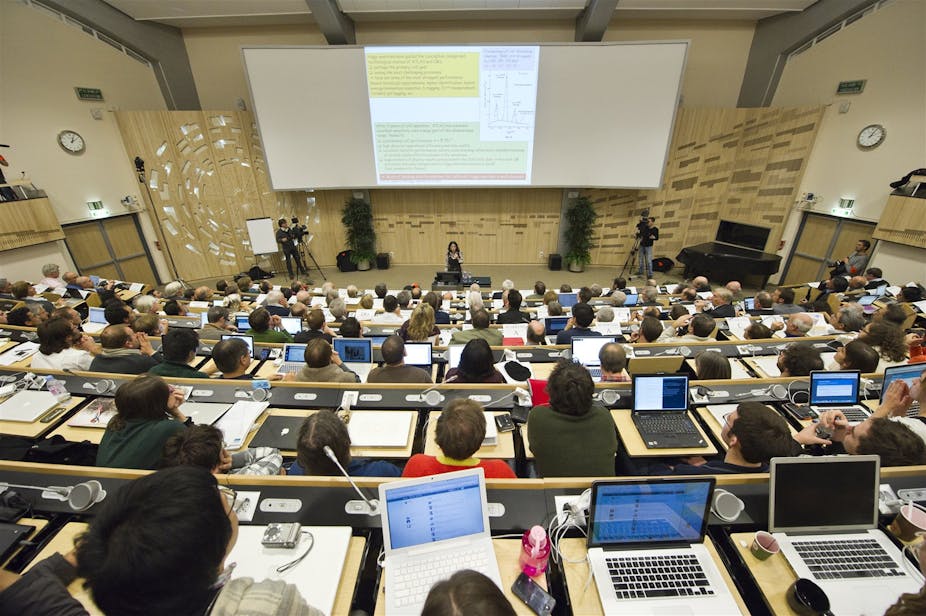
I can guarantee you that some time in the next two weeks, someone at a barbeque I’m attending will ask me about the Higgs boson. I don’t blame them – it’s interesting stuff – but it’s not “answer-in-30-words-or-less” stuff. If you’re that go-to person in your family or circle of friends, but you don’t necessarily have the gory details to respond with, hopefully I can give you the ammunition to fire back with: “Oh, the Higgs, yeah, I know about that.”
We’ve explained what the Higgs boson is, and why it’s important, before, so let’s skip ahead to the announcement from CERN on Tuesday night. The basic summary was that scientists found a peak in their signal from the ATLAS and CMS detectors consistent with a Standard Model Higgs boson of mass 125 giga electron volts (GeV) (or so). An electron volt, in this context, is a unit of energy, which thanks to Einstein’s E=mc2 is also a unit of mass. 1 GeV is one billion electron volts; the equivalent of 0.00000000016 Joules.
That peak wasn’t an easy thing to find. The Large Hadron Collider (LHC) has been slowly ramping up its luminosity (a measure of the amount of data it collects) and is now able to collect more data in a day than it did in all of 2010.
When two beams (each containing hundreds of billions of protons) travelling in opposite directions around the ring collide, about ten protons will interact, spraying particles in all directions. The analysis involves carefully tracing back each of the paths of these created particles to the individual protons that interacted, then analysing what the reaction must have been.
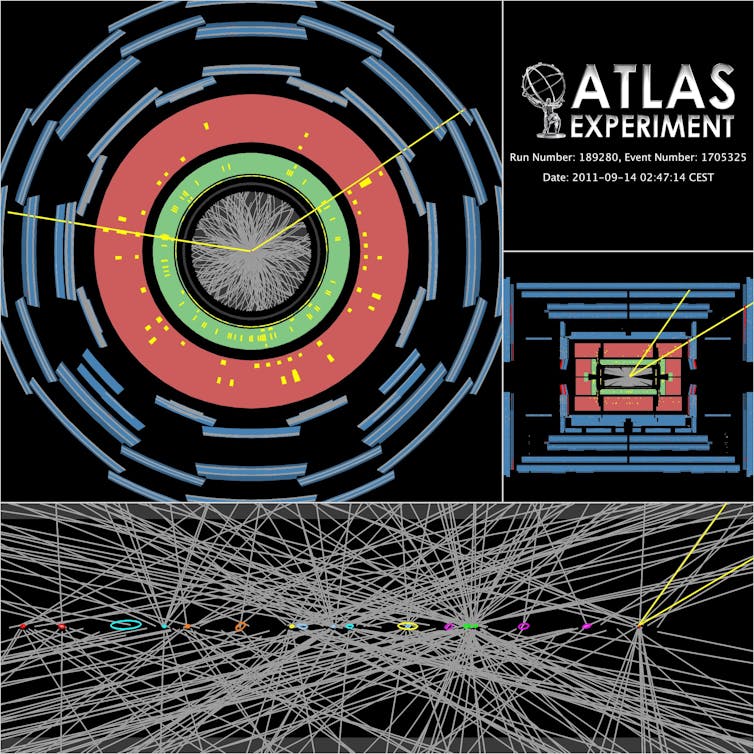
There are certain reactions for which the Standard Model predicts a Higgs boson will be produced, but we can’t detect one directly with the detector. We refer to these reactions as plausible “channels”.
The Higgs does decay into particles we can detect though (say, two muons and two neutrinos, via two W bosons) - we can detect the muons directly, and the neutrinos we can infer by conservation of momentum. By looking at what particles are detected, and tracing them back, we can infer that a Higgs was created. By detecting the relevant energies of the outgoing particles, we can infer what mass the Higgs must have had if it was involved in the reaction.
The hard part in doing this is that a Higgs isn’t the only way to produce two muons with two neutrinos. The “other” ways to produce this we call “background” – basically noise that we want to subtract while looking for the Higgs boson. In order to determine whether we’ve seen something other than background, we need to know how much background to expect.
It’s like reading a Where’s Wally book - you might see a red and white arm sticking out from behind a bush, but until you see more of him, there’s a chance that it’s one of the decoy characters, and you can’t be sure it’s Wally.
There are a few channels in which we have the best chance of seeing a Higgs above the background – that is, channels in which we can best measure and account for the background. Disentangling the mess of particles created from ten protons colliding is one of the most computationally intense parts of these projects, and its getting harder each day as the beam intensity is increased.
What was found by the ATLAS and CMS teams was an excess above background in several of the Higgs decay channels, all around 125 GeV (around 133 times the mass of the proton). While these weren’t huge deviations, we still wouldn’t expect to see deviations of this size, given the amount of data the LHC has made available.
In fact, the predicted deviations from the Standard Model agree very well with what we’ve seen – if we had seen more, we might worry that we hadn’t accounted for backgrounds very well.
Finding this similar result from two experiments – ATLAS and CMS – leads us to believe this might actually be a real signal and sign of the Higgs boson. Had we seen bumps in completely different places we might not have such confidence. Of course, we don’t put any serious weight behind a detection until it’s statistically significant – that is, unlikely to have occurred by chance to better than one in a few hundred. We don’t call a result a “discovery” until it is “5 sigma” significant, or a chance of random error better than one in a million.
So how statistically significant were the ATLAS and CMS results?
In statistical terms, the confidence in these deviations (if we take them at face value) is around 2.6 standard deviations. But what was the likelihood of us finding a signal bump that big, given the wide range of Higgs masses we’ve searched?
You could compare it to the odds of bumping into a school friend, 20 years after your last meeting, in a foreign country. This seems like a very unlikely event, and you would be tempted to give it a high significance. This is misleading though: you don’t want to know the significance of bumping into that particular friend in that particular country; bumping into any old friend, relative, or celebrity in any foreign country, on any of your travels would have been just as surprising.
This is the “look-elsewhere effect” – the fact that, if you search a lot of data, it becomes more and more likely that you’ll see bigger and bigger deviations.
Once the Higgs statistics account for this, the significance drops to about 2 standard deviations. Calculations of how much data will be needed to raise this to a 5 standard deviation “discovery” indicate that the next year or two might yield enough data for this.
But the question we can’t answer just yet is “is this the Standard Model Higgs boson?” There are several models which might predict a Higgs boson at 125 GeV that would look identical to this signal. But until we find something that doesn’t agree with the Standard Model, if you hear hooves, it’s safe to assume “horse” and not “zebra”.
For now, it might just be safer to say that the ATLAS and CMS detectors have ruled out the Higgs below 115 GeV (at 95%) and above 131 GeV (at 99%), leaving only a small window, in which we see common excesses within a couple of GeV.
It’s a tantalising hint that there might be a Higgs boson to be discovered, and that perhaps we do understand the way the Standard Model quarks, (charged) leptons, and W and Z bosons acquire non-zero masses after all.
Wally was never this hard to find.