For efficient energy, do you want solar panels or biofuels?

About 80% of the world’s total energy consumption is derived from fossil fuels, with only 12.5% from renewable resources. Replacing fossil fuels with renewable energy sources derived from sunlight – such as photovoltaic solar panels, wind or biomass – is very challenging because these energy sources…

B56q4kpz-1346897656
Sunlight falls equally on leaves and solar panels, but which does the best job of turning it into useful renewable energy? kincuri/Flickr

About 80% of the world’s total energy consumption is derived from fossil fuels, with only 12.5% from renewable resources. Replacing fossil fuels with renewable energy sources derived from sunlight – such as photovoltaic solar panels, wind or biomass – is very challenging because these energy sources have a lower energy density and are generally more expensive. So if you want to maximise the efficiency of converting solar energy to renewable energy, what should you choose: solar panels or biofuels?

Energy conversion efficiency of solar panels

The total power from sunlight reaching the earth’s surface is about 101,000 terawatts (~2,500,000 EJ). However, solar energy is geographically diffuse – some places are sunnier than others. This makes it important to efficiently convert sunlight, capturing its energy in useful forms.

The maximum conversion efficiency theoretically possible for sunlight is 93% – of all the power generated by sunlight, only 93% can be turned into electricity. Photovoltaic cells in solar panels have efficiencies of around 15–20% for converting sunlight into electricity, but won’t ever reach that theoretical 93%. They are limited to a maximum conversion efficiency of ~30%, largely because we only have technology to convert some parts of the spectrum to electricity. This limit is described by the Shockley-Queisser limit. Recent discoveries may expand this limit somewhat.

Energy conversion efficiency of photosynthesis

Photosynthesis is the source of the world’s food, animal feed, fibre and timber. It is also the source of biomass-based biofuels that can be a source of renewable energy.
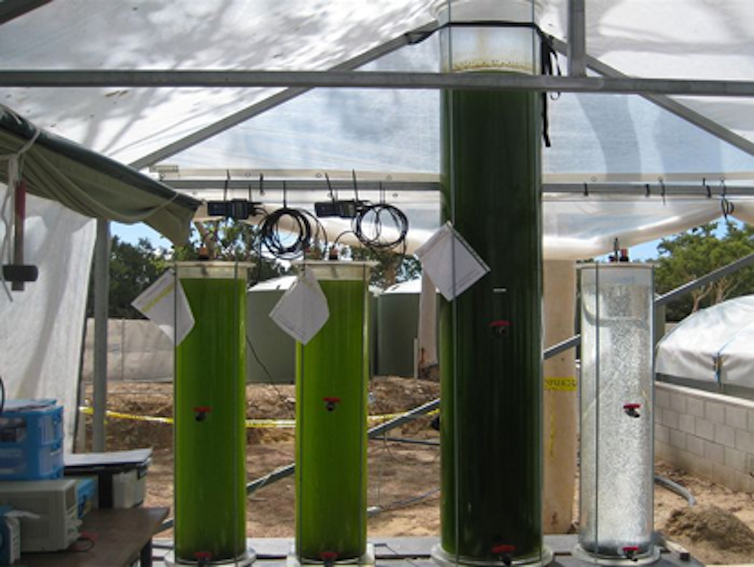
Microalgae being converted to energy in a photobioreactor. Susan Pond

Starch and sucrose are the main products of photosynthesis. Photosynthesis occurs in cyanobacteria, algae, phytoplankton and plants and is summarised by the equation:

CO₂+ H₂O + light energy = [CH₂O] + O₂

The maximum efficiency of converting solar energy to biomass energy is estimated at about:

  • 4.5% for algae
  • 4.3% for C3 land plants (including woody, round-leafed plants; 95% of all plants)
  • 6% for C4 land plants (such as sugarcane, switchgrass, Miscanthus and sweet sorghum).
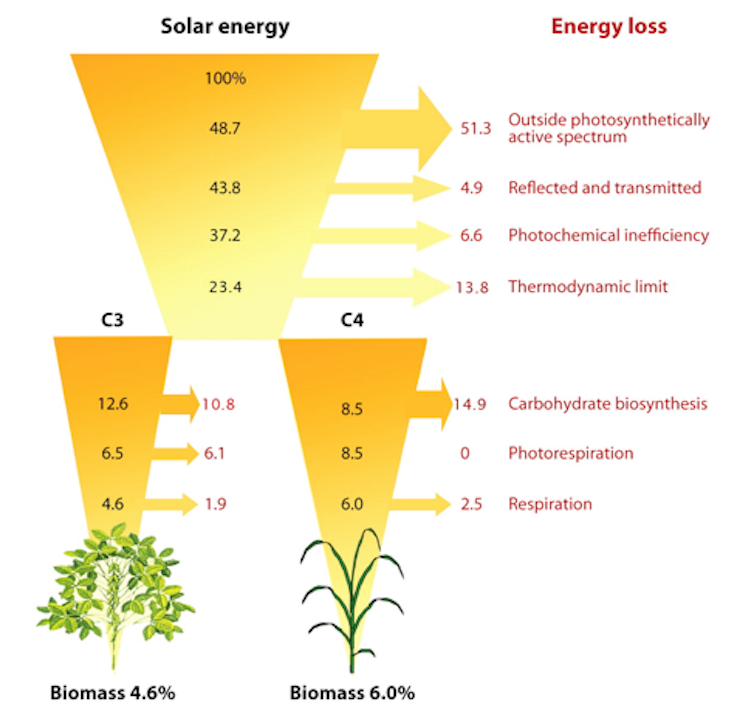
Minimum energy sources associated with biomass production. Zhu et al 2010
This analysis indicates that a theoretical maximal photosynthetic energy conversion efficiency is 4.6% for C3 and 6% for C4 plants.

Plants are limited by their dependence on photons that fall in the approximate waveband 400-700 nm, and by inherent inefficiencies of enzymes and biochemical processes and light saturation under bright conditions. Their respiration consumes 30-60% of the energy they make from photosynthesis, and of course they spend half of each day in the dark and need to use previous carbohydrate stores to keep them growing.

Actual conversion efficiency is generally lower than the calculated potential efficiency. It’s around 3.2% for algae, and 2.4% and 3.7% for the most productive C3 and C4 crops across a full growing season. Efficiency reductions are due to insufficient capacity to use all the radiation that falls on a leaf. Plants' photoprotective mechanisms, evolved to stop leaves oxidising, also reduce efficiency.

Of course, plants are self-regenerating whereas photovoltaic cells are not.

Solar radiation may be the ultimate source of renewable energy, and biofuels will continue to be a major avenue for its use. Solar-energy conversion efficiency by even the most productive plant communities is less than 5%, while photovoltaic cells in solar panels may approach 20%.

Photosynthesis is now used extensively in agriculture to produce food, feed, fibre, and biofuels. But the current biofuels (bioethanol and biodiesel), mainly produced from first generation feedstocks (such as sucrose from sugarcane, carbohydrates from maize seeds, and lipids from rapeseed seeds) constitute only a small fraction (1%) of present transportation energy.

Join the conversation

281 Comments sorted by

Comments on this article are now closed.

  1. Peri Strathearn

    logged in via Facebook

    Solar, please. Solar panels can be installed in deserts, whereas biofuels can only be produced using arable land that could otherwise be growing food for the world's surging population. The latter is a great idea until you think it through. If photovoltaic systems are more efficient, as well, I hope there won't be too much of an argument. (But then, this is the internet.)

    report
    1. Karsten Mohr

      Cat Herder

      In reply to Peri Strathearn

      Biofuel can be made from sewerage, algae and sunlight. In Tassie they are looking at using the waste material of the opium poppies to make biofuel.

      report
    2. Mike Swinbourne

      logged in via Facebook

      In reply to Karsten Mohr

      Good point. And if biofuels could be produced without using any arable land to do so, I would be all in favour of them.

      Unfortunately, at the moment they are not.

      report
    3. Blair Donaldson

      logged in via Twitter

      In reply to Karsten Mohr

      Karsten, I don't know why dairy farmers with large numbers of cows don't use digesters to extract and use the methane from the manure and wastewater. I believe there are farmers in the US and Ireland that have effectively eliminated the need for grid electricity by generating their own and selling the excess.

      I think the Victorian Farmers Federation would better serve its members by promoting the use of renewables rather than whining about increased energy costs.

      report
    4. Greg Boyles

      Lanscaper and former medical scientist

      In reply to Mike Swinbourne

      Consider EROEI of all renewable energy sources compared to fossil fuel energy.

      Energy Returned On Energy Invested

      When oil was first exploited it had an EROEI of some where around 100, or 100 units of energy generated for every unit of energy expended procuring it.
      That has fallen to about 30 as oil has become harder to procure.

      The very best of our renewable energy sources has an EROEI of about 10.

      In short renwable energy source can never supply the same amount of surplus energy (for economic activity other than pricuring the energy) and at the same rate.

      Just as you are forced to downzie your life style when you loose a high pay job and gain a low pay job, we will be forced to down size our economy signficantly.

      And that also means down sizing our population, either in an orderly manner via public policy or through famine, war and genocide etc as food production dwindles.

      report
    5. Alex Cannara

      logged in via LinkedIn

      In reply to Andy Saunders

      Anything done to promote more methane production than would naturally occur, is a net waste. This is what some companies in the US have doen with dumps they were supposed to manage -- pump water into them to foster more bacterial action, thus producing more methane to burn for electrical generation.

      Unfortunately, their greed also produces much more CO2 from the bacterial action as well as from burning the increased methane, and it destabilizes the dump in relation to seepage into groundwater…

      Read more
    6. Blair Donaldson

      logged in via Twitter

      In reply to Andy Saunders

      Andy, can you give a brief explanation of how gasification would work with liquid waste? I don't know much about the process.

      report
    7. David Arthur

      n/a

      In reply to Greg Boyles

      I seem to recall having this discussion with you over on Kenneth McPhail's 11 Sep 2012 "Malaysia’s sustainability agenda reignites debate over food versus fuel", https://theconversation.edu.au/malaysias-sustainability-agenda-reignites-debate-over-food-versus-fuel-9201

      We both learned some Good News courtesy of Roger Crook, namely that EROEI of mallee growing for energy is about 40.

      Regarding population reduction, the methods developed in Japan and western Europe (wealth, health and education) require no deliberate public policy, whereas the US method (poverty, religion, ignorance and health care only for current and returned servicemen) seems somewhat less effective.

      report
  2. Mike Swinbourne

    logged in via Facebook

    This might be valid if it was the only consideration - but it's not.

    The world is running short of arable land, soil quality is degrading, and there are more and more people putting more and more stress on our ability to produce enough food to feed everyone. To use some of our limited arable land to produce bio-fuel severely impacts on this ability.

    And if you want to make this an economic argument, you would need to factor in the lost opportunity costs of using biomas for food. Sunlight is free - losing arable land for fuel production is not.

    report
    1. Bruce Moon

      Bystander!

      In reply to Mike Swinbourne

      Mike

      Your answer is both blunt and correct.

      That said, there is a massive elephant in the room.

      Fact is that society has developed an energy dependent system based on (relatively) inexpensive fossil fuels.

      Now, fossil fuels are becoming more expensive and harder to procure.

      There are no viable backstops; each have considerable cost &/or supply constraints.

      The elephant is that we have to find ways to significantly reduce our energy consumption.

      Cheers

      report
    2. Greg Boyles

      Lanscaper and former medical scientist

      In reply to Bruce Moon

      The elephant in the room is that we need to find ways to signficantly and rapidly reduce our global population.

      report
    3. Tim Scanlon

      Debunker

      In reply to Greg Boyles

      We don't talk about population.

      It's pinko to talk about population control.

      Nothing to see here.

      What a mighty nice elephant.

      report
    4. David Boxall

      logged in via Facebook

      In reply to Bruce Moon

      Give it time Bruce, nature will take care of it if we don't.

      report
    5. Greg Boyles

      Lanscaper and former medical scientist

      In reply to Bruce Moon

      At the very least require family planning driven fertility reduction as a compulsory component of foreign aid. No cooperation on fertility redeuction, then no foreign aid.

      Reductions in the death rate should be offset by a reduction in the birth rate.

      If absolutely necessary use coerscive measures on individuals to reduce their fertility, e.g. compulsory sub-dermal contraceptive in order to receive a food package.

      In Australia abolish all measures that encourage greater than replacement fertility, e.g. the baby bonus and all government welfare payments for the third and greater child.

      We better make all efforts to figure out how to do this as rapidly, humanely and fairly as possible Bruce because the alternative that David is alluding to is unthinkable

      report
    6. Tim Scanlon

      Debunker

      In reply to Greg Boyles

      Or you could just introduce education programs and social justice measures to ensure women have knowledge and rights in other countries....

      report
    7. Greg Boyles

      Lanscaper and former medical scientist

      In reply to Tim Scanlon

      Sounds great in theory Tim, but how would you acheive that in Pakistan where the male muslims don't want their females to exhibit intelligent independant thought.

      Coerscion may be necessary in countries like this.

      report
    8. Tim Scanlon

      Debunker

      In reply to Greg Boyles

      That was what I was implying needs to happen. It has been shown that the best way to control population is educate and empower women.

      I'm not the sort of person that could negotiate this though, as I see these heavily cultural and religiously dominated societies as being archaic. The promotion of ignorance and regressive societies is part of what is wrong with this world and I think it has been treated with kid's gloves for too long.

      report
    9. Greg Boyles

      Lanscaper and former medical scientist

      In reply to Tim Scanlon

      That sort of strategy is going rather well in Afghanistan Tim........NOT.

      Better to coerce the desired behaviour from their society when they want something from you, e.g. food, rather than try to impose it on them from a position of relative weakness.

      report
    10. Alex Cannara

      logged in via LinkedIn

      In reply to Greg Boyles

      Yep, Greg, few have the courage to mention that. A report came out earlier this year that casts an even scarier light on our rapid population growth -- proliferation of defective genes. Humans gain about 2 mutations per year. Living longer and having children later obviously exacerbates the natural mutation rate, so this is a component of the growing problem of simple population growth.

      report
  3. Blair Donaldson

    logged in via Twitter

    Why does the argument have to be framed as a "solar or biofuel" option? It's factually and intellectually bankrupt because the options for both differ around the globe and we should be looking at the best alternatives for a given region.

    The days of cheap, polluting, concentrated petroleum based energy are almost gone. It's time we moved on and recognised the game has changed and a mixed selection of renewables will be our energy future.

    report
  4. Tim Scanlon

    Debunker

    Solar all the way.

    Biofuels have always struck me as a bad idea. You still emit GHGs, the only thing is you can fiddle with the short and long term numbers to say they are neutral. These emissions still have impacts upon the climate in the short term (otherwise no one would bother talking about agricultural emissions), which can cause feedbacks we will still need to deal with. Save these emissions for agriculture and food, energy can come from the other options.

    report
    1. Mark Harrigan

      Dr

      In reply to Tim Scanlon

      Tim, to be fair - isn't the issue with GHGs the burining of geosequestered carbon - laid down over millions of years - and putting them into the atnosphere in a little over a century.

      I think bio fuels have enormous issues, not the least being their efficiency and land use requirements, but my understanding is that the net carbon they emit is genuinely zero. So I do not theing is it a "fiddle" - do you have any data to support this criticism?

      report
    2. Tim Scanlon

      Debunker

      In reply to Mark Harrigan

      Yes, that is the main issue, I agree.

      It is interesting that people want to include agricultural emissions and yet talk about biofuels as neutral. Essentially they have the same issues. The net emissions for both is zero (talking just the plants and animals, as animal and soil emissions are talked about as the large emissions), but the gross, especially in short term cycles, are still positive. Thus the good old peaks and troughs of the GHGs in the atmosphere can be spiked, which then cause feedbacks…

      Read more
    3. Mark Harrigan

      Dr

      In reply to Tim Scanlon

      Thanks for those references - I'll check them out. Prima facie your concerns seem reasonable - but that means renewables alone can't do the job - unless and until someone can point to a credible scenario that doesn't involve spinning gas reserve.

      report
    4. David Boxall

      logged in via Facebook

      In reply to Alan John Hunter

      Alan John Hunter: "How could it be zero? unless at every point in production the energy used to create it was sourced from renewables ...". Now there's a question with no easy answer.

      The answer, of course is: "It depends". With technologies involving algae, for example, carbon out can be less than carbon in; at least, in the short to medium term. Energy inputs are low enough to be satisfied by solar power. Raw materials are algae, water, nutrients (which often come with the water as a stream of what would otherwise be pollution) carbon dioxide and sunlight. Outputs are fuel feedstock and (depending on the type of algae) potential animal feed or soil supplement.

      The calculations are complex; you can probably find someone who'll make the answer anything you (or they) want. I live in hope.

      report
    5. Tim Scanlon

      Debunker

      In reply to Mark Harrigan

      I don't want gas on the table. People in govt and industry keep talking about it as a stepping stone energy source. Great, so instead of shooting ourselves in the foot repeatedly we're going to use a knife instead!

      I think renewables can do the job, but we need a wide portfolio of them and many new power stations. If you also reduce household and business power demands at the user end, household solar being a great example, then the actual energy needs from the grid change. I know this is also the way to deal with the baseload myth (I can't find the video that Peter Sinclair posted on baseload power, it was a US video about managing power stations).

      report
    6. David Boxall

      logged in via Facebook

      In reply to Mark Harrigan

      Mark Harrigan: "... unless and until someone can point to a credible scenario that doesn't involve spinning gas reserve."

      As far as I know, the term "spinning reserve" relates to those that can be brought online within ten minutes. Gas turbines are favoured because they can be spun up within that time limit.

      I know of no plan that proposes gas as a permanent part of the generating mix.

      report
    7. Blair Donaldson

      logged in via Twitter

      In reply to Ludwig Heinrich

      Even better, South Australia is demonstrating it can obtain more electricity from wind energy than coal while demonstrating the need for baseload is a myth.

      report
    8. Alex Cannara

      logged in via LinkedIn

      In reply to Ludwig Heinrich

      That link seems not to work, Ludwig, sort as "no baseload needed" doesn't work.

      report
    9. David Boxall

      logged in via Facebook

      In reply to David Boxall

      I should add that the term derives from the days when furnaces had to be kept fired and boilers pressurised. These days, there's no need for anything to be actually spinning, waiting to fill a need on short notice.

      report
    10. Mark Harrigan

      Dr

      In reply to David Boxall

      David - I agree Gas Turbines can be brought on line within minutes (maybe even less than ten) - but they are still there as 'reserve". I apologise if my term was misleading.

      The Diesendorf plan http://www.ies.unsw.edu.au/docs/diesendorf-simulations.pdf (an excellent study) clearly shows biofuel/gas use almost all the time during a 1 week simulation (see figure 8) - so, with respect, on the evidence you are wrong

      report
    11. David Boxall

      logged in via Facebook

      In reply to Mark Harrigan

      David Boxall: "... a permanent part ...". In response, Mark Harrigan: "... a 1 week simulation ...". Sleight-of-hand?

      report
    12. Luke Weston

      Physicist / electronic engineer

      In reply to David Boxall

      There's no such thing as "renewable" energy in any isolated system. That's the second law.

      The free energy content of any closed system - including the universe itself - is finite.

      report
    13. Mark Harrigan

      Dr

      In reply to David Boxall

      Another idiotic ill informed comment that shows you have NOT read or understood the paper and have no idea what you are talking about.

      The one week simulation IS the plan - and shows that over a representaive week gas is a PERMANENT part of Mr Diesendorf's proposal.

      Just like your misreading of the Scherrining Istitute paper you fail to understand what you are reading.

      You are not only being a fool - but a fool who is contributing to making the problem worse

      report
  5. Benjamin Shepherd

    Researcher in the Food Security Program at the Centre for International Security Studies at University of Sydney

    Blair, good question.

    In addition, I don't think that the article is comparing apples with apples. PV Solar is more likely to be used to replace stationary power gen (e.g. taking a home off the coal-powered electricity grid) while biofuels will never be used to fire a powerstation, but would be used to replace fossil fuels.

    Second, there is a huge opportunity cost with biofuels that is absent for PV solar: the land has other critical uses; especially as others have noted for food production…

    Read more
    1. Blair Donaldson

      logged in via Twitter

      In reply to Benjamin Shepherd

      Benjamin, I suspect the author's intent was honourable but switching from fossil-based energy to renewables is much more complicated than simple comparisons of one renewable versus another.

      I agree with every one of your points, particularly the convenient omission suffered by many writers who discount or ignore the existing subsidies going to fossil fuel generators and the ongoing costs to the community and the environment when burning these fuels.

      I rarely ever see it mentioned that the energy source for renewables is effectively free while fossil-based fuels are an ongoing cost and literally burnt money going up the chimney.

      report
  6. Ian Donald Lowe

    Seeker of Truth

    This is how pollsters operate - limit the choices available to get the desired answers.
    Wind, hydro, wave, geo-thermal, biogas and solar thermal energies and passive solar design are all viable options that should be included in any discussion of energy beyond peak oil. Even cold fusion should get a mention, even if it seems a long way off at this point in time.
    Then we should be discussing our energy usage and how that can be reduced in meaningful ways, without the negative impacts of things like the 'smart' meters.

    report
    1. Michael Shand

      Michael Shand is a Friend of The Conversation.

      Software Tester

      In reply to Ian Donald Lowe

      As Someone who is heavily involved in the implementation of smart meters I can tell you that this type of infrastructure is key to setting the stage for effeciant management of energy use.

      Knowledge is power and empowering the consumer is a great step forward but it doesnt stop there. They also give greater transperancy to the distribution companies and the generators. Currently power cannot be stored effeciantly, it must be used as its generated and this currently results in uneeded wastage.

      There is absolutely no downside to smart meters and many many advantages.

      I would encourage you to be skeptical and look into why we are getting smart meters, its a great step forward for victoria.

      report
    2. Alex Cannara

      logged in via LinkedIn

      In reply to Mark Harrigan

      Right Mark, it's got such a bad rep, the folks now relabel it LENR (low energy nuclear reactions). But still no one has demonstrated anything but chemical heat releases. Cold fussin' about cold fusin'
      ;]

      report
    3. Ian Donald Lowe

      Seeker of Truth

      In reply to Michael Shand

      That's interesting. So energy rationing and discriminate blackouts, along with higher electricity charges for energy used during peak demand periods are all positives with absolutely no downsides?
      A great step forward in the dark can be hazardous.

      report
    4. Ian Donald Lowe

      Seeker of Truth

      In reply to Alex Cannara

      So cold fusion is not here right now, so we should just write it off and not even think about the research being done or think about doing any further research? From my reading of scientific literature, cold fusion is theoretically possible. There are some hurdles in the way that still need to be cleared but this 'never going to happen' attitude is a big one. One has to wonder whatever happened to scientific curiosity?

      report
    5. Mark Harrigan

      Dr

      In reply to Ian Donald Lowe

      Ian - it's not that it's "not here right now" it's that it's similar to the idea of a perpetual motion machine - it's just non-scientific rubbish. There are fundamental physical reasons why it cannot happeen.

      Real fusion, which is possible (after all all stars use it) is realistic - although it is incredibly difficult and is still decades away - because the required temperatures and pressures to sustain fusion are 'astronomical" (you have to dusplicate the temperatures and pressures inside a sun). There have been fusion reactions achieved on this planet - but only either inside a Fusion bomb, or for brief moments in specialised reactors - where the energy output is less than the energy input. But it is not physically impossible - just beyond our technological capabilities today.

      Cold "fusion" on the other hand is just a myth - and a waste of resources and effort.

      report
    6. Alex Cannara

      logged in via LinkedIn

      In reply to Ian Donald Lowe

      One can investigate whatever one wants, Ian. The investigations so far have shown nothing but chemistry, not nuclear reactions, or they've shown fraud.

      We had a 50-year reunion of the Stanford Plasma Physics group last year. In '61, when I was a student in it, fusion (of any sort) was agreed to be about 20 years off. At the reunion in 2011) the consensus was fusion is about 30 years off.
      ;]

      report
  7. Justin R Pearce

    logged in via Facebook

    Algae do not need arable land to grow (see: the sea). They just grow in very low concentrations (ca. 1%) and there are difficulties getting rid of the excess water that they do grow in.

    This is solution is relatively close to carbon neutral as algae take carbon directly from the air and sequester it. Of course at a later time, when burnt, the fuel re-emits that to the atmosphere. Some additional energy is required for processing, but that could of course be in the form of wind/solar/wave etc?

    I'm not sure what the price is now for a litre of biodiesel sourced from algae, but it was definitely far less than an order of magnitude away from diesel from the ground in 2010 when I was working on this project. The technology is definitely not mature and has some way to go. Although it may not be the best solution, it certainly may be part of 'the solution' with a couple of breakthroughs.

    report
  8. Dale Bloom

    Analyst

    The cost effectiveness and environmental advantages or disadvantages of biofuels all depends on the source.

    However, producing biofuels from trash or garbage seems a good idea.

    “Compared with making ethanol from crops, the environmental benefits of making it from waste are clear: It diminishes the demand for landfills and cuts greenhouse gas emissions. And trash-based biofuels need not compete on cost with fuels, as long as they offer a lower cost than their other competitor—landfills.”

    http://www.scientificamerican.com/article.cfm?id=biello-turning-trash-into-biofuel

    report
  9. Gary Tulie

    logged in via LinkedIn

    Well written as far as it goes, however there are substantial gaps in the comparison.

    1. With the exception of solar thermal power with storage, solar power is only available in the daytime, and experiences substantial seasonal and daily variation outside the tropics.

    2. Not all biofuels are cultivated for fuel - as some other comments indicate, resources such as methane from bio-digesters, and residual materials from agriculture and forestry can make a contribution. These materials can be co-fired with coal, burned in biomass power stations, or used for meeting heat loads.

    3. It is important to recognise the fact that different sources of renewable energy are complementary - with wind and solar power deferring the need to use stored hydro power, solar tending to peak with summer peak loads, geothermal potentially offering base load, and biofuel in whatever form having greater dispachability than weather dependent resources such as sun and wind.

    report
  10. Alan John Hunter

    Retired

    OMG bio mass, if you took all the food in your supermarket trolley, and converted it into biofuel, put it in your tank, with a bit of luck you might make to the first traffic light.
    As the world produces slightly more food than it needs, where oh where are we going to find the land and water, to produce any more than a tiny fraction of the worlds energy greeds.
    Solar, thermal, wind and the best one tidal, every 6hrs 45 minutes right around the world the tide is either coming in or going out, water is one of the most powerful forces on earth, and tides never ever stop.
    A combination of all these would supply all our energy needs, and we could use bio-fuels for lubrication and plastics.

    report
  11. David Jones

    Engineer

    Daniel,

    your efficiency limit for photovoltaic cells is for a single junction only. Multi junction cells as used in concentrating PV systems have already achieved in excess of 40% efficiency.

    In comparing the two systems for (presumably) electricity generation the bio fuel must also be converted into electrical energy in some way. This will typically have a conversion efficiency of no more than 50%. So the overall efficiency of the bio system is halved again.

    If you use the two sources as transport fuel there are advantages in having a handy liquid bio fuel but the overall efficiencies are still very very low.

    report
  12. John Robert Davidson

    Retired engineer

    It is also worth considering electro-fuels - Fuels that can be made using electricity without any need for fossil fuels. Ammonia is potentially one of these fuels and can be made with nothing more than electricity, water and air. It can be stored as a liquid at 125 psi and used in conventional internal combustion engines with only minor modifications. See: http://webberenergyblog.wordpress.com/2010/02/21/is-ammonia-the-transportation-fuel-of-the-future/ for some details.

    report
    1. Gerard Dean

      Managing Director

      In reply to John Robert Davidson

      John

      I agree that electro fuels are a far better option than bio fuels, however the sheer volume of liquid fuel energy we use in Australia every year, some 49.5 billion litres, would really tax our existing electricity supplies. If then, we stopped using fossil fuels to make our electricity, then it wouldn't happen.

      Perhaps we will have to wait until, firstly, we run out of low cost oil and secondly, nuclear power provides base load power that can be converted to liquid fuels as you suggest.

      Gerard Dean

      report
    2. David Boxall

      logged in via Facebook

      In reply to John Robert Davidson

      Apart from the fact that ammonia is a toxic gas at atmospheric pressure and temperatures common in Australia, the usual problem with electro-fuels is efficiency. The hydrogen cycle, for example, is about 20% efficient.

      report
    3. Peter Sommerville

      Scientist & Technologist

      In reply to David Boxall

      So are solar cells David. But personally I prefer the biofuel option. Mind you, hydrogen could be classified as an electro fuel. My problem with electro fuels is the huge energy input involved. Biofuels, if engineered appropriately utilise our neighbourly fusion reactor - the sun.

      report
    4. David Boxall

      logged in via Facebook

      In reply to Peter Sommerville

      Peter; electro-fuels are, by definition, fuels made with electricity. Solar cells produce electricity. If we want to conflate the two then making electro-fuels from solar PV electricity would compound the inefficiencies of solar cells and the electro-fuel cycle. I don't really see your point in bringing up solar cell efficiency.

      Agreed though, liquid fuels seem most effective for transport and biology seems the most efficient producer of liquid fuels.

      report
    5. Peter Sommerville

      Scientist & Technologist

      In reply to David Boxall

      David, you chose to cite the efficiency of the hydrogen fuel cycle. I was merely pointing out that the solar cycle is equally inefficient. In fact the efficiency of most energy production systems is rather low - a direct consequence of the laws of thermodynamics. It is a price we have to pay - we live in an environment where thermodynamics places limits on what we can achieve. Ultimately arguments about efficiency are really arguments about relative costs.

      I have to admit to some puzzlement about the antagonism to biofuels that have been exhibited on this thread. Ultimately all our organic fuels are biofuels - that is how they were produced. But at some point, if we still wish to fly, or drive around cars, we will need technologies that replicate nature but more rapidly. I personally believe that is possible.

      report
    6. Mark Harrigan

      Dr

      In reply to Peter Sommerville

      I broadly agree Peter. Rather than the term "biofuels" I really prefer to think in terms of synthetic liquid hydrocarbons. The question is how are they made and what is the economic, land use and emissions cost of their production and use.

      Whilst I can conceive of a future that has domestic personal and public transport powered by EVs (assuming a reliable low emissions power source - like nuclear or, where locally feasible - hydro and geo with some CST) I think it's hard to see how "long distance…

      Read more
    7. Alex Cannara

      logged in via LinkedIn

      In reply to Peter Sommerville

      Peter, the reason any combustible fuels are undesirable is that they a) produce GHG & other emissions, and b) the act of combustion for anything but heat involves thermodynamic reality and thus typical waste of far more than half the energy released in the combustion heat.

      b) is why fuelled vehicles are at best <33% efficient. Only with great, sophisticated efforts do combustion power plants achieve 50% efficiency (combined-cycle, etc.). No vehicle can support the mass of gear needed to do that…

      Read more
    8. David Boxall

      logged in via Facebook

      In reply to Peter Sommerville

      Peter Sommerville: "I have to admit to some puzzlement about the antagonism to biofuels ...". The antagonism from the nuclear lobby may spring, in part, from a perception that electro-fuels increase their potential market. Producing those fuels consumes electricity which, they hope, will be generated by nuclear reactors. More consumption of electricity = more reactors needed.

      The nuclear industry is terrified of renewables. Their first reaction to the ZCA2020 plan was highly instructive.

      report
    9. Peter Sommerville

      Scientist & Technologist

      In reply to David Boxall

      David,

      I am not a conspiracy theorist. None of those commenting on this thread have any real influence on the nuclear lobby. So my puzzlement remains. Maybe the word Luddite is more appropriate.

      report
  13. Ludwig Heinrich

    Generalist

    There are a number of ways to grow algae for bio-fuel — and other uses, that do NOT require using arable land. In the first place algae can be grown on standing bodies of water such as on farm and riverine dams. This serves two purposes, it "cleans" the water of excess nutrients and produces the algae for bio-fuel, stock feed, fertiliser etc.
    Secondly there is a continuous algal production system that is a self contained module. The algae is grown on a rotating "curtain" and, once again this can also be used to remove excess nutrients. This is available as a commercial product.
    Algae can also be grown, as Justin R Pearce mentions above, in the sea and on lakes.
    Aside from that the Either/Or phrasing of the title is not helpful. We need all renewable to be used where they are fit for service. Bio-fuels may be useful and even necessary for air fleets and some other transport needs but various forms of solar and wind will fit most of our other needs much better.

    report
    1. Gerard Dean

      Managing Director

      In reply to Ludwig Heinrich

      Ludwig

      On a practical level, I believe Algaetech commissioned an algae production plant in Nowra a few months ago. It should bear fruit, sorry fuel, soon.

      I have my doubts they can produce the fuel feedstock they claim, but I would be delighted to be proven wrong.

      Thanks

      Gerard Dean

      report
    2. Ludwig Heinrich

      Generalist

      In reply to Gerard Dean

      Australian company Advanced Algal Technologies (http://www.advancedalgal.com/our-tecnology/) has developed a modular conveyor system that produces high oil content algae for use in bio-diesel production and algae-based high protein products.
      AAT’s patented Algae Farming Conveyor Modular System employs conveyor belts to cultivate algae in an insulated modular and temperature-controlled atmosphere.
      It is suggestive of cost effectiveness that AAT has signed a $100m joint venture agreement with Chinese company Fuzhou Xiangli Enterprise Management Consulting, with a 20 year license to produce 500 patented Algae Farming Conveyor Modular Systems per year.
      Meanwhile he Advanced AIgae Inc. (http://www.advancedalgae.com/technology.php) has a scalable automated photosynthetic algae reactor systems designed for efficient consumption of stationary source emissions including CO2, NOx and SOx.

      report
    3. Ludwig Heinrich

      Generalist

      In reply to Ludwig Heinrich

      I should have added that there is also the Austrian company http://www.seealgae.com/ that won the Brazilian Bioenergy Award. This algae production facility will utilize SAT’s proprietary photobioreactors to grow algae using the sugarcane facility’s CO2 waste stream as its primary feedstock.

      report
  14. Gerard Dean

    Managing Director

    Daniel

    A fantastic article that clearly shows the available energy in crops and biomass - not much unfortunately.

    Several months ago I did a 'back of an envelope' calculation to work out the size of the corn crop we would have to grow to make Australia's 49.5 billion litre annual liquid fuel usage. The total acreage required was about 22 million hectares or about 5 million more hectares than we presently crop. If we did it, we could drive our cars for the few days before starvation set in.

    I have a question. Now that you know how much sunlight falls on the earth, and the conversion of that energy to bio mass, and in the knowledge that fossil fuels - oil and coal, were actually created by sunlight falling on the earth over hundreds of millions of years, can you calculate how many years of sunlight we burn in a single day?

    Thanks for a fantastic read.

    Gerard Dean

    report
    1. Daniel Tan

      Senior Lecturer in Agriculture at University of Sydney

      In reply to Gerard Dean

      Gerard,
      In 2009, the world total primary energy supply was about 510 EJ /yr, or the equivalent of 12 150 million Mg of oil per year (Mtoe /yr). This is equivalent to an average global rate of consumption of 16 TW (16 × 1012 W). The total power from sunlight reaching the earth’s surface is about 101 000 TW (~ 2 500 000 EJ), over 6 000 times the global energy consumption of 16 TW.
      Daniel

      report
    2. Mark Harrigan

      Dr

      In reply to Daniel Tan

      Hi Daniel,

      I don't want to rain on your parade but your figures are a bit misleading

      1) World energy demand is forecast by the IEA to increase by a further to 14920 Mtoe by 2035 - even under an increasingly unlikely emissions target of 450ppm CO2 - otherwise it's more likely to be over 18000 Mtoe
      2) So, that's a total of around 20TW
      3) Whilst total solar insolation is around 101000TW as your article points out it's not even and at best only around 30% can be converted. In addition actual…

      Read more
    3. Gerard Dean

      Managing Director

      In reply to Mark Harrigan

      Thanks Daniel and Mark expanding on my question.

      The issue is converting the huge amount of solar into useable energy. The biofuel route of using good agricultural land to create fuel feedstock that converts less than 10% of the sunlight energy is marginal. On the other hand, Mark's 'front of the envelope' calculations indicating we would need to cover 220 million hectares of Australia's 770 million hectares, show the potential problems with massive solar plants.

      One practical problem with very large PV sites is that the ground below becomes a shaded desert. One can imagine the planning issues that will entangle the site selection, especially when the proposed desertification threatens the lesser known, long necked numbat habitat.

      Thanks

      Gerard Dean

      report
    4. David Boxall

      logged in via Facebook

      In reply to Gerard Dean

      Gerard Dean: "The biofuel route of using good agricultural land ...". Gerard, what evidence do you have that "good agricultural land" must be used?

      report
    5. Mark Harrigan

      Dr

      In reply to David Boxall

      As usual, Mr Boxhall you challenge an profer an implied opinion out of ignorance.

      The evidecne that biofuel production is already displacing food production and hence driving up prices, is abundant for anyone who actually looks at the evidence 9something I am aware you have apropensity to avoid if it might challenge your prejudices)

      The evidence is also clear that there is a significant risk in the future posed by biofuels

      http://www.choicesmagazine.org/magazine/pdf/article_41.pdf

      "The…

      Read more
    6. David Boxall

      logged in via Facebook

      In reply to Mark Harrigan

      David Boxall: "... what evidence do you have that "good agricultural land" must be used?" In response, Mark Harrigan: "... biofuel production is already displacing food production ...". The usual sleight-of-hand.

      Where's your evidence that it's necessary (I did say _must_ be used)?

      report
    7. Mark Harrigan

      Dr

      In reply to David Boxall

      Fine David - it's not "necessary" but today is happening - in significant quantities. In the quotes that I provided. try reading them and making, for once, an informed comment.

      The exception is indeed the sort of algae based bio fuels that Peter Sommerville referred to

      http://www.ecosmagazine.com/?paper=EC10041

      They are also, however, subject to the efficiency limits that Alex has pointed out. For them to be useful and economic the total $ and emissions cost of growth, separation, harvesting, refinement and combustion must be neutral. That's not an easy task. Although their carbon capture properties and ability to use "waste" heat and being sited near power stations - to which Peter referred - provides some interesting opportunities perhaps

      report
    8. Mark Harrigan

      Dr

      In reply to David Boxall

      Getting sense and reason out of you is impossible. It is quite clear on the evidence - which you have never acknowledged, that biofuels today represent a significant threat to agricultural land.

      How is it that you wish to acknowledge the future possible viability of one technology (biofuels) and don't reject it based on it's past and current problems but will reject nuclear based on its past problems but won;t consider it based on its future potential?

      Bias? prejudice?

      report
  15. Mark Harrigan

    Dr

    Almost no-one in the renewables bandwagon can countenance the idea - but without nuclear fission taking up a considerable share of the burden we will not avoid serious AGW.

    http://www.smh.com.au/environment/climate-change/nuclear-champions-japan-and-france-drop-their-support-20120915-25z1q.html

    The International Energy Agency (IEA), which represents the energy interests of the industrialised world, said it understood the Japanese and French moves but warned of their consequences.

    "While…

    Read more
    1. Tim Scanlon

      Debunker

      In reply to Mark Harrigan

      I'm not really sold on nuclear as an option. Thorium shows promise to my mind, but rolling out large scale nuclear seems to be unnecessary, when you take the waste disposal into account.

      I think the main reason nuclear has to be on the cards is that markets and governments have failed to invest in new energy technologies in a timely fashion. A diversified energy grid would have been able to be 100% renewables, but time is running out for the massive overhaul that needs to occur for that to be feasible. Various energy reports have shown this to be possible, but the rethink required just isn't going to happen without huge political and market pushes, so it won't happen.

      Of course there is another option, but we don't discuss overpopulation and overconsumption, damn pinko ideas.

      report
    2. Mark Harrigan

      Dr

      In reply to Tim Scanlon

      Hi Tim

      A few points

      1) I would prefer 100% renewables over nuclear but, as I said, there's no evidence they can do (all of) the job
      2) You refer to a 100% renewable grid - but, with respect, that sounds like wishful thinking. Can you point eto any credible plan for such that doesn't involve large amounts of gas - and hence the biofuels problems we've discussed elsewhere) and/or hopelessly optimistic reductions on usage scenarios? I'd truly love to see one but never have (I'm aware of Jacobson and Deluchi, MZE/ZCA and Diesendorf - Diesendorfs seems the most practical but they all have the shortcomings I;ve outlined)
      3) have you studied the waste issue with respect to IFR's? If you have then the waste disposal issue seems a furphy? (I agree Thorium is a way off)

      report
    3. David Boxall

      logged in via Facebook

      In reply to Mark Harrigan

      Mark Harrigan: "... without nuclear fission taking up a considerable share of the burden we will not avoid serious AGW." We will, because we must.

      If we can't live on renewables alone, then we're toast. If we resort to nuclear, then we're French toast (remember le Force de Frappe?). History belies the nuclear industry's hype that: 'this time, we've got it right'.

      report
    4. Tim Scanlon

      Debunker

      In reply to Mark Harrigan

      Can't say I've heard much about IFRs, I'll have to look into them. We're going to need some reactors regardless, just for medicine and the like, so I accept a level of nuclear waste.

      The two plans that I've seen that make sense are the Australian Academy of Sciences' Renewable Energy Futures plan and the Energy Research Institutes' Zero Carbon Australia plan. The former is a very solid plan, but requires an overhaul of the current energy infrastructure, which is growing more unlikely by the day…

      Read more
    5. Tim Scanlon

      Debunker

      In reply to Mark Harrigan

      I see now, IFR are (sort of) part of the Gen 4 reactors that are being talked about. Given that they are essentially theoretical in commercial terms, these sorts of technologies are like some of the tidal power schemes: need work.

      The fast reactors seem like good ideas, I'd like to see research $$ go that way, but I'm not sure they are a fit yet. We still have to look at our power supplies now and be changing our grid now. Maybe by the time we have the AAS and ZCA plans making the changes needed, these Gen4 reactors will have a role in filling the last change over between coal/oil and renewables.

      For others interested in the IFR, some overview links:
      http://bravenewclimate.com/2008/12/13/integral-fast-reactor-ifr-nuclear-power-q-and-a/
      http://en.wikipedia.org/wiki/Generation_IV_reactor
      http://en.wikipedia.org/wiki/Integral_Fast_Reactor

      report
    6. Alex Cannara

      logged in via LinkedIn

      In reply to Tim Scanlon

      Tim, in case anyone's confused, the "fast" in IFR (or any reactor) just relates to neutron speeds. Present water reactors use the water to slow neutrons to a few thousand feet per second from a few thousand miles per second.

      As a result, these slowed (thermal) neutrons do a much better job of fissioning the isotopes we typically use -- U235 ,Pu239, etc. This is because thermal neutrons "see" a target nucleus as about 25 times bigger than fast neutrons would see it.

      Thus, fast reactors need…

      Read more
    7. David Boxall

      logged in via Facebook

      In reply to Alex Cannara

      IFR is nuclear industry speak for "This time, we've got it right. Give us money."

      report
    8. Mark Harrigan

      Dr

      In reply to David Boxall

      More like an ill informed cynic with a cherry picked narrow view of history.

      A cynic, by the way, is someone who refusesto believe anything is true that he does not already believe, regardless of evidence and is therefore irrational.

      report
  16. Peter Lang

    Retired geologist and engineer

    Bio fuels can make little more than a token gesture to meeting our energy needs, and only at huge cost.

    There is insufficient land area to provide the biomass fuel we'd need.

    For example, to provide sufficient biofuel to generate just 13% of eastern Australia's current electricity (from stubble from grain crops), would require

    - twice Australia's total annual grain crop area, and that is in average years (and that includes WA's annual area sown to grain crops)

    - perhaps four times…

    Read more
    1. Gerard Dean

      Managing Director

      In reply to Peter Lang

      Peter

      Your well researched comment that complements Daniels work. His article shows the marginal sunlight conversion performance of biofuels while you graphically illustrate the practical difficulties of implementing biofuel production.

      Summarising biofuels: It is a very poor converter of solar energy to fuel that will require a risky investment on massive infrastructure programs with little prospect of return on investment, and that is without considering the ethical dimension of cutting food production so we can drive our cars.

      This article has drawn out many questions.

      Good stuff

      Gerard Dean

      report
    2. Peter Lang

      Retired geologist and engineer

      In reply to Ludwig Heinrich

      "Are the nuclear shills ever able to stay on topic?"

      Are the renewable energy zealots ever going to realise that pet dreams are never going to work, never be economically viable and your advocacy for your irrational policies is delaying progress. Why are you so irrational?

      Can't you see you and your ilk have been blocking progress for 50 years?

      report
    3. Ludwig Heinrich

      Generalist

      In reply to Peter Lang

      Why are you being a Troll?
      No entirely unexpected with the nuclear shills but disappointing nonetheless.
      This article was about solar vs biofuels and your ill-informed spin does not add to that debate.

      report
    4. David Boxall

      logged in via Facebook

      In reply to Ludwig Heinrich

      Ludwig Heinrich: "How did we get from there to the nuclear lobbying?" Ludwig; in global warming, the nuclear power industry sees opportunities. Whenever the subject comes up, the lobbyists will swarm.

      report
    5. Peter Sommerville

      Scientist & Technologist

      In reply to David Boxall

      It would be great to see you outline a plan to produce "sustainable" energy economy that could be transformed into reality by engineers at a reasonable cost. It is easy to criticise - much more difficult to provide a realisable vision of a new future.

      Over to you.

      report
    6. Alex Cannara

      logged in via LinkedIn

      In reply to Ludwig Heinrich

      Luddy, indeed to actually be 'green' means studying reality. And the reality is that biofuels are wasteful, by any engineering or scientific measures.

      Solar on existing structure is excellent. Evs are excellent, for reasons you may not know. Storage is doing well and will be excellent. So, we only then need high power density 24/7 sources, like advanced nuclear.

      Just because you don't get the science doesn't mean others are "trolls" (whatever that wimpy epithet is supposed to mean).

      report
    7. Alex Cannara

      logged in via LinkedIn

      In reply to Ludwig Heinrich

      "How did we get from there to the nuclear lobbying?" -- Ludwig, the discussion is about what to do now that we've screwed up our descendents future by burning so much stuff.

      Solar on local structures is good because: a) no land is wasted; b) efficiency is now above 20%; c) cost is <$1/W; and grid loss & stability are improved. Given the amount of human structure, it's more than possible to meet all peak daytime loadd with rooftop PV.

      EVs are excellent as both forms of storage and energy capture…

      Read more
    8. James Wookey

      Paramedic

      In reply to Alex Cannara

      Not sure about EV's being much of a soloution for anything really.

      EV's are still seem very limited by batteries, which are heavy (bad for any car) and toxic (bad for the enviroment.

      They're also expensive for something that's very limited (bad affordability/low adoption).

      Bio-fuels appear make more sense in a transport context. ie backward compatiable with existing equipment.

      report
    9. James Wookey

      Paramedic

      In reply to Alex Cannara

      Solar is still limited by the PV panels, they are energy intensive to produce and contain lots of toxic materials.

      Storage either for grid power or EV's is still reliant on batteries which are also energy intensive to produce and toxic.

      Making fuel from bio-mass can be done with a number of different waste materials and need not be as wasteful as you suggest.

      report
    10. James Wookey

      Paramedic

      In reply to Alex Cannara

      Solar is still limited by the PV panels, they are energy intensive to produce and contain lots of toxic materials.

      Storage either for grid power or EV's is still reliant on batteries which are also energy intensive to produce and toxic.

      Making fuel from bio-mass can be done with a number of different waste materials and need not be as wasteful as you suggest.

      report
    11. Ludwig Heinrich

      Generalist

      In reply to Alex Cannara

      My name is Ludwig not Luddy and that you assume I don't "get the science" is no doubt related to the echo chamber you are in.
      You might consider that the take-up of renewables is accelerating worldwide, so the point of the article was to look at the relative merits of biofuels and solar. My take is that each has their place for reasons I, and others have already stated. Read the article before coming into a discussion and trying to hi-jack it with nuclear spin. The same goes for the rest of the nuclear trolls.

      report
    12. Alex Cannara

      logged in via LinkedIn

      In reply to David Boxall

      "Whenever the subject comes up, the lobbyists will swarm" -- indeed, Boxall, sort of as some Nobel winners and a President "swarmed"?

      http://tinyurl.com/6xgpkfa

      You need to get off desperate argumentation, David.

      report
    13. David Boxall

      logged in via Facebook

      In reply to Alex Cannara

      Alex Cannara: "You need to get off desperate argumentation, ...". Says the lobbyist who fears attack by mutant algae. https://theconversation.edu.au/for-efficient-energy-do-you-want-solar-panels-or-biofuels-9160#comment_75555

      http://tinyurl.com/6xgpkfa points to energyfromthorium.com. Now there's a credible, unbiased source. Could that be why you obfuscated the link? It's not as if http://energyfromthorium.com/pdf/CivilianNuclearPower.pdf is long enough to need shortening.

      report
    14. Alex Cannara

      logged in via LinkedIn

      In reply to Ludwig Heinrich

      Well, well, Ludwig, I'm chastened!

      So if you were to read, as you advise, you'd see I started by listing the technologies that are scientifically 'green', and didn't start with the "nuclear" you so naively trash.

      So yes, your lack of science, engineering and even economics is evident in your words, since no biofuel has a significant place in a "grren" world.

      And, when subsidies are removed, no 'renewable' save local solar survives.

      report
    15. Alex Cannara

      logged in via LinkedIn

      In reply to David Boxall

      David, for all your bloggery you don't get why hashed links are a help? Are you so paranoid about lack of knowledge on these subjects that you think someone who shortens a link so another can actually type it from a document that's not clickable is doing something sneaky? Are you that sneaky?
      ;]

      report
    16. Alex Cannara

      logged in via LinkedIn

      In reply to James Wookey

      James, as soon as "fuel" follows "bio", we're talking >50% energy loss in combustion. As soon as crops are the bio, we're talking the photosynthesis cycles, as this article describes -- < 10% efficient. So, any biofuel system nets at absolute best, 5% of solar input.

      Solar PV nets 20% and growing, with no land consumption. The resources are the same as in any electronics industry and very little per Watt. That;'s why PV is now <$`/W. It's also to the fabricator's advantage to minimize materials…

      Read more
    17. Alex Cannara

      logged in via LinkedIn

      In reply to James Wookey

      When ll the resources are added up and the woeful efficiency tallied, biofuels are exposed as a sham.

      Mother Nature didn't devise photosynthesis to make us vehicle power.

      report
    18. Alex Cannara

      logged in via LinkedIn

      In reply to Peter Sommerville

      The Calif. "million solar homes" initiative is a start, as are the new waste-handling initiatives, which include digestion of community organic wastes and use of the methane for power.

      Playing the record again: there's >2% of earth's surface covered with human structure, which at 20% efficiency, can produce more PV power than the world uses on a peak day.

      report
    19. Mark Harrigan

      Dr

      In reply to Alex Cannara

      Hi Alex, help me out. I'm struggling to reproduce your Solar PV figures - or, more properly, my calculations are showing less than 0.02% of the earths surface is theoretically needed to do the job (ignoring night times and lousy days) - which stunned me so I wonder what I am missing?

      I've looked at both "peak" power and annual energy consumption

      1) Projected power generation requirements by the IEA in 2035 are around 20TW. For peak insolation of 1kW/m-2 and a 20% efficiency 1m2 of solar PV…

      Read more
    20. Luke Weston

      Physicist / electronic engineer

      In reply to Ludwig Heinrich

      Ah yes, the preeminent peer-reviewed nuclear engineering journal Independent Australia. What's the impact factor of that one?

      report
    21. Peter Lang

      Retired geologist and engineer

      In reply to Gerard Dean

      Gerard Dean,

      Thank you for that comment.

      It's revealing that yours is one of the few comment that is open to consider the realities, practicalities and costs.

      report
    22. Alex Cannara

      logged in via LinkedIn

      In reply to Mark Harrigan

      Hi Mark, your figuring is good, but the human structure area is >2% ,of land not .02% -- big difference! Since land is <1/3 earth's surface and the sun delivers 86,000,000,000MW to the surface, we get 24 years of our current 17TW generation every day. That's about 8 years worth each day to land. So >2% of that is what structure-based PV could provide, peak. It's about 50 days per day.

      For 20% cells, we get down to >10days per day, if we can distribute the power around to the poor-sun regions…

      Read more
    23. Mark Harrigan

      Dr

      In reply to Alex Cannara

      Thanks Alex - maybe I didn;t explain myself well. My figuring shows that solar PV could provide for peak demand using ONLY 0.02% of total surface area - that jumps to 0.06% of land - still way under the 2% you claim is available for "built" land (a figure I don't dispute).

      Even allowing for lower efficiencies, lousy days, poor sunlight areas etc it suggests Solar PV - if we can tie it to developments in storage technology - could meet all residential and commerical needs - perhaps only large indsutrial requiring something like nuclear.

      I still think synthetic hydrocarbons will be needed for some transport applications though - as I;ve noted in a separate post

      report
    24. Alex Cannara

      logged in via LinkedIn

      In reply to Mark Harrigan

      Got it, Mark. Yes, you're right -- more structure space than we need. If we add in EVs, we add about an equal amount of power per household, but still more than fine.

      In fact, EVs can become part of the grid, perhaps as Betterplace has been trying in Israel & Denmark, where one buys the car, they own the battery and both are 4G online, so they can contract with utilities to use their (your) batteries to absorb or provide power on second-by-second demand, thus lowering utility rates.

      With…

      Read more
    25. James Wookey

      Paramedic

      In reply to Alex Cannara

      Alex, hexafluoroethane, lead, arsenic and polyvinyl fluoride are toxic materials last time I checked.

      They may not be dangerous when happily working away on a roof or solar array but either side of their life cycle (manufacture and waste) these materials can cause serious harm. My points are based on the product lifecycle of both these power sources.

      PV requires panels to be built and installed with all the additional environmental footprint that comes with it.

      where as

      Alge grows on…

      Read more
    26. James Wookey

      Paramedic

      In reply to Alex Cannara

      Alex,

      Please think beyond personal vehicles and consdier that lots (in mant cases most) ships, buses, heaters, trains, excavation equipment, cooking appliances, power tools and generators all run on some form of liquid or gas fuel. We have the infrastructure to manufacture and distribute these fuels all over the planet.

      By changing the fuel we use and using as much of the existing infrastructure and equipment as possible we avoid the cost of having to "Re-Tool" the entire planet and significantly reduce environmental impact both from actual use and the costs avoided from unnecessary replacements.

      report
  17. Alex Cannara

    logged in via LinkedIn

    Very nice to see this accurate represetation of the numbers. Indeed, Ma Nature didn't invent photosynthesis for us to run engines with.

    The subsidized corn-ethanol biz here in the US made $ for a few, while wasting land, water, food material, power and transporation to the tune of >99% of what Ol' Sol basked our cornfields in.

    BioX (X = fuel, mass...) has always been a sham -- a high-emissions one to boot..

    Local solar PV & hot-water on existing structures is more than adequate to meet all peak daytime power loads.

    report
  18. bill parker

    editor wirter

    This isn't an either or question. PV and roof top solar thermal water heaters, biofuels for transport and fuel agriculture ( putting it very simply).

    The use of arable land for this purpose is in conflict with the energy purpose.

    Algae can be grown in locations where there is waste CO2, clean sea water and large areas of flat otherwise derelict or unused land. The coastal Pilbara ( Karratha for e.g.) has all three. Aurora just set-up a plant there and Muradel also has a pilot operation there.

    http://www.adelaide.edu.au/news/news36561.html

    http://media.murdoch.edu.au/suitable-algae-to-biofuel-locations-identified

    Oh and we DO have heat storage for large scale solar thermal plants. And one more thing we cannot drive tractors and headers on nuclear power - we need biodiesel.

    report
    1. Alex Cannara

      logged in via LinkedIn

      In reply to bill parker

      You're right Bill, it's an "and" question, with only a few sources that make the grade -- local solar and EVs and nuclear being three.

      The belief that "biofuels" somehow aere green, hovere, just misunderstands the reality of their inherent inefficiency.

      The fuels we need as liquids for aircraft, etc. can easily be produced via any heat source of 700C or so. That's possible with hi temp combustion plants now, though we don't want their emissions, and it's possible with advanced hi-temp reactors…

      Read more
  19. George Naumovski

    Online Political Activist

    Why not combine/use both for the time being!

    Renewable energy/energy efficiency is poison to the controlling fossil fuels empire. The US greenback is mainly funded by oil and so if fossil fuels were to not be the dominant then the US might lose its power and control over the world’s population, also Australia sells coal and so its massive revenue funds us!

    To change from fossil fuels to renewable is to change the global economy but I think fusion is the answer and that all funding and research go toward that as a permanent solution.

    report
  20. Alan John Hunter

    Retired

    This is a ridiculous debate really,no one renewable can supply all our needs. The question is ,what are our needs and what are greeds?.
    Do we need buildings so hot in winter and so cold in summer? NO we don't.
    Can buildings be better designed for the climate? YES.
    Can buildings be energy neutral or produce energy? YES.
    Can we drive smaller more fuel efficient cars? YES.
    Can we catch public transport instead of driving? YES.
    Given a large proportion of the increase in energy usage has been…

    Read more
    1. Alan John Hunter

      Retired

      In reply to Alan John Hunter

      Really the problem the world faces in any issue, is mismanagement, it is rife in any field of human endeavour, we rarely if ever get it right, i.e. subsidised bio-fuels in the US starving people in Mexico, but did that stop them NO! even when they have been proved to have no environmental benefit whatsoever, it just made agricorps richer and thats all that counts really.
      This whole debate renewables/fossil fuel debate is not about saving the planet, its about saving market share for corporations.
      To burn fossil fuel and mine minerals at present rates, 500 maximum and they will all be gone, that is disgusting mismanagement.
      In England they built a church 500 years ago, and planted an oak tree beside it, so that when the roof needed replacing they would have the timber, now that is forward planning, nowadays anything like that is unthinkable.

      report
    2. In reply to Peter Lang

      Comment removed by moderator.

    3. Alan John Hunter

      Retired

      In reply to Peter Lang

      That is only if we continue on our wasteful path of energy consumption, my latest quarterly power bill for example was just under $400 for 3 adults and a baby, thats with electric hot water, my car uses 5/L per 100 km.
      I am installing PV and solar HW so it should be 1/4 to 1/3 of that.
      Waste and mismanagement are our enemies, we could cut consumption by at least 75%, without nuclear and its inherent dangers, then renewables are clearly a viable option.
      Its pointless even thinking of alternatives without addressing efficiency and waste.
      Our lifestyle and industries are both inefficient and wasteful.
      See my other posts on this subject.

      report
    4. Alex Cannara

      logged in via LinkedIn

      In reply to Alan John Hunter

      Problem is that ocean acidification gives us about a decade more of burning, not 500 years.

      Plant more oaks!

      report
    5. Blair Donaldson

      logged in via Twitter

      In reply to Alex Cannara

      Alex, unlike you I am not pretending to be an expert. I understand the basics of nuclear energy and have heard plenty of proponents and opponents state their case.

      I'm not convinced it's a long-term solution and as much as you wish to ignore the inconveniences associated with nuclear power, when it goes wrong, it causes huge problems and it's also extremely expensive. If nuclear power was really effective, economically sensible and safe, governments wouldn't need to be subsidising it or indemnifying…

      Read more
    6. Mark Harrigan

      Dr

      In reply to Blair Donaldson

      Blair - I think some of your comments, while reasonable, are subject to challenge. And i would like to raise some thical questions as well because I know you reflect on these

      1) In relation to "when nuclear goes wrong" - let's focus on the facts. The two main incidents are Chernobyl and Fukushima Daichi. The first was an old, unsafe reactor design without even a proper containment vessel operated by non-competent staff in the soviet era. Is it valid to extrapolate from that to any proposed…

      Read more
    7. Blair Donaldson

      logged in via Twitter

      In reply to Mark Harrigan

      "The first was an old, unsafe reactor design without even a proper containment vessel operated by non-competent staff in the soviet era."

      All of which may well be true but nevertheless, a disaster occurred. Of course it is relevant to extrapolate to any proposed nuclear plant because we are always refining safety standards and what may appear to be safe today may not be tomorrow.

      I doubt it's true that nobody has died as a result of the Chernobyl reactor failure. Do you have health statistics…

      Read more
    8. Mark Harrigan

      Dr

      In reply to Blair Donaldson

      Balir - I did not claim no one has died as a result of Chernobyl - so you have misunderstood me. I have claimed no one has died as a result of Fukushima.

      At least 50 people died driectly as a result of Chernobyl - and WHO estimates 4000+ following. A terrible outcome. Fukushima is different. But still - you haven't really dealt with the argument. You cannot extrapolate based on those situations - anymore than you can extrapolate all cars based on the Ford Pinto. And shutdowns/issues reported…

      Read more
    9. Blair Donaldson

      logged in via Twitter

      In reply to Mark Harrigan

      Mark, I did not mean to infer that you had claimed nobody died as a result of the Chernobyl accident. Apologies if that's how you read my comments. The point I was perhaps poorly making was that people like to claim nuclear is safe while avoiding the fact that nuclear accidents have caused deaths as best I can determine. The WHO figures are the only ones I have seen.

      I was simply curious as to whether or not you had some relevant, up-to-date figures from another source on any increased cancer…

      Read more
    10. Mark Harrigan

      Dr

      In reply to Blair Donaldson

      Blair - thank you for this reasonable and respectful reply (and I hope you enjoyed the footy - my team, Geelong, has been bundled out so I;ve lost a little interest).

      Your paragraph "I reluctantly accept that it's unlikely we'll replace the existing fossil fuel sources with renewables (as opposed to nuclear alternatives) in the time frame we need which is why I have also said I accept we will likely need nuclear for some time yet (in those countries that are prepared to live with it). Ultimately…

      Read more
    11. Blair Donaldson

      logged in via Twitter

      In reply to Mark Harrigan

      Mark, at least your team can play, my mob (Melbourne) seem to have lost the will to live… *Sigh*

      Thanks for the link regarding safety, I will have a look at it.

      "Becuase Nuclear accidents are so much more "visible" people assume they are more likely."

      No, I don't assume they are more likely but experience does suggest that when something does go wrong, the results are far more detrimental. That is my only point.

      Alex may well be right regarding deaths in relation to nuclear versus wind…

      Read more
    12. Peter Lang

      Retired geologist and engineer

      In reply to Alan John Hunter

      Alan John Hunter,

      "we could cut consumption by at least 75%, without nuclear and its inherent dangers, then renewables are clearly a viable option.

      Its pointless even thinking of alternatives without addressing efficiency and waste."

      The world is not going to cut consumption. Population is growing and we it wants higher standard of living. Energy consumption will continue to increase. That's the reality. Energy efficiency improvements, faster than we are already making, can make only…

      Read more
    13. Mark Harrigan

      Dr

      In reply to Blair Donaldson

      Yes Blair - and Thorium is a very interesting technology - but alas a little far off for my liking which is why IFRs seem preferable in the short term.

      I dont think the dichotomy is false though. I accept you have a balanced approach but many do not so it's a legitimate question.

      As you've probably seen recently there have been many articles suggesting we are at, or close to, or have already passed a number of tipping points with respect to climate - the most obvious "canary: being arctic sea ice

      http://www.brisbanetimes.com.au/environment/climate-change/sea-ice-reduction-at-tipping-point-20120922-26dm6.html

      If this is the case we need URGENT action - that means ALL options to dsiplace fossil fuels need to be actioned NOW.

      Thanks for the little atoms link - will check it out

      report
    14. Blair Donaldson

      logged in via Twitter

      In reply to Mark Harrigan

      Mark, don't worry I've been keeping an eye on the issue of tipping points. The decreasing ice cover at peak summer in the Arctic is a great concern - not that you'd know it listing to the various right-wing echo chambers and their apologists in these forums and elsewhere - as bad as the ice melt is, another great concern is the thawing of the permafrost regions just south of the Arctic ice sheet. Canada, Alaska and Siberia in particular.

      NASA and ESA have over the last few years launched a number of satellites dedicated to monitoring loss of ice cover, changes in atmospheric chemistry and sealevel rise. I suspect the news in the next couple of years will only provide comfort to those who believe in Armageddon. Meanwhile we need to force the crackpot religious right to reconnect with reason, fact and evidence rather than hide behind political expediency and dogma.

      report
    15. Mark Harrigan

      Dr

      In reply to Blair Donaldson

      Blair, you may be aware, many if not most are not.

      I mention Arctic Sea Ice because it is happening now - once it's gone at the summer peak, possibly within just a few years, the associated drop in albedo and increased warming absorption due to greater sea cover paves the way for the next big two - permafrost melting and the concomittant relase of vast amounts of methane and accelerated melting of Greenland ice.

      If these things happen it will make IPCC "alarmist" projections look like head…

      Read more
    16. Alex Cannara

      logged in via LinkedIn

      In reply to Mark Harrigan

      All good comments, Mark.. In a church discussion today, on nuclear power and its documented safety, one fellow just seemed to think it was ok for us to have killed 8 folks and burned more in San Bruno here a couple of years ago, because the poorly maintained 30" gas main that was under their street was "already there". He used the same odd argumentation when someone raised another example of deaths due to coal mining/burning, etc. -- it was already there.

      And, of course, he brought up Chernobyl…

      Read more
    17. Blair Donaldson

      logged in via Twitter

      In reply to Mark Harrigan

      Mark, the definition I have of Armageddon is the end of the human race. The Earth can certainly survive happily enough without mankind messing about on its surface.

      A rapid reduction in the use of fossil fuels has to be a given and I think it's time people stopped arguing about the merits of alternative sources and employed the practical options where best suited. The finessing and fine tuning can be done at a later stage when (or if) the damage we are doing is minimised.

      Unlike nuclear power…

      Read more
    18. Mark Harrigan

      Dr

      In reply to Blair Donaldson

      Hi Blair - accept your definition of Armageddon. I don't think AGW by itself offers the prospect of the end of humanity full stop - although the fights for limited food and water resources under a worst case AGW scenario might be an issue.

      My concern is the impact on our civilisation as we know it.

      I agree with you that a major advantage of wind and solar PV is their ability to deploy in small elements rapidly - but you should not rule out SMRs

      http://www.gizmag.com/small-modular-nuclear-reactors/20860/

      which can also play a more rapid role if we let them

      report
    19. Alex Cannara

      logged in via LinkedIn

      In reply to Blair Donaldson

      Glad to hear you've read Martin's book, Blair.

      However, it may be good to reread some of it and the new Hargraves book as well, since Uranium remains the source of the energy -- Thorium is simply transmuted to Uranium233, which fissions better than the isotopes we use now, and so leaves little waste.

      But the key is molten salt as the reactor fluid, which is what the pebble reactor uses and what the reactors operated in the 1960s at US ORNL used. That's the path to natural safety, high…

      Read more
    20. David Boxall

      logged in via Facebook

      In reply to Peter Lang

      Peter Lang: "The world is not going to cut consumption. Population is growing and we it wants higher standard of living. Energy consumption will continue to increase."

      If so, then we're toast, with or without global warming.

      report
    21. Mark Harrigan

      Dr

      In reply to David Boxall

      We are only toast if ignorance and blind ill informed prejudice prevails - such as you continually exhibit

      report
    22. Blair Donaldson

      logged in via Twitter

      In reply to Mark Harrigan

      Mark, yes it's certainly the knock-on effects of AGW that most concern me and will, I think, cause major havoc around the globe as food and water resources in particular become affected. Then there is the problem of population migration which I suspect will make our so-called illegal immigration issues look petty by comparison.

      Thanks for the interesting link. I've often wondered about small-scale reactors, it answered a lot of my questions - and highlighted neatly the myriad problems with large…

      Read more
  21. David Legge

    Scholar Emeritus in the School of Public Health & Human Biosciences at La Trobe University

    Algae are different from corn. 40% of the US corn crop now goes to ethanol. This has a very significant effect on price of corn as food with implications for global hunger.

    report
    1. In reply to David Legge

      Comment removed by moderator.

  22. Craig Read

    logged in via LinkedIn

    Why does it have to be one or the other?

    Biofuels might be able to drive road vehicles, but I beleive our current aircraft can't run on them. Even then, clean electricity would be signficantly better for road vehicles (once we solve the range issues). Nano-scale capacitors or advanced battery technologies would do it, but we're not there yet and not putting enough money into it.

    Biofuels also aren't a good solution for powering or heating our homes. But if we can develop community level…

    Read more
    1. David Boxall

      logged in via Facebook

      In reply to Craig Read

      Craig Read: "Another (relatively cleaner) alternative for electricity generation is using throrium reactors." History indicates that any form of fission would be a poor allocation of resources. Our backs are already against the wall. We simply don't have time for pie-in-the-sky.

      For the immediate term, our best bet is demand reduction. The planet cannot sustain our current energy intensity. There's also the problem that we (in Australia) consume far more than our fair share. It's a toss-up what will get us first; the environment or the masses who have far less than we do.

      report
    2. David Boxall

      logged in via Facebook

      In reply to Craig Read

      Craig Read: "Biofuels might be able to drive road vehicles, but I beleive our current aircraft can't run on them." Actually, aircraft manufacturers, airlines and the military have found that current gas turbine aircraft operate more efficiently on the right biofuels than on traditional fossil fuels. For the airlines, that means more miles on the same amount of (currently far more expensive) fuel. For the military, it means more power and range from the same engines.

      report
    3. Alex Cannara

      logged in via LinkedIn

      In reply to David Boxall

      Fortunately, our midwestern drought has brought home one major flaw in the "biofuel" concept, and our military may not be renewing their subsidized use of it.

      report
    4. Alex Cannara

      logged in via LinkedIn

      In reply to David Boxall

      "History indicates that any form of fission would be a poor allocation of resources." -- really?

      So it presently costs about $14M to load up a conventional nuke (LWR) with fuel that will last about 5 years and generate about $2.5 billion in electricity from about 50 acres of plant.. That math is why nuclear is so efficiently wise.

      Using Thorium, as demonstrated decades ago, lowers the cost to about $100,000 per year for the same 1/2 billion of sales.

      Fortunately, countries around the world do understand the excellent math nuclear power has always offered us. The combustion industry, of course, has always feared its effect on their business, so have welcomed any naive environmental anti-nuke efforts and misinformation.

      report
    5. David Boxall

      logged in via Facebook

      In reply to Alex Cannara

      Alex Cannara: "... our military may not be renewing their subsidized use of it." The Republicans are fanatically opposed to renewables. The last I heard, the US military were using security legislation to circumvent their obstructionism. That was this week

      report
    6. Blair Donaldson

      logged in via Twitter

      In reply to David Boxall

      The US military, particularly that Navy and Air Force are spending a fortune on developing alternative fuel sources and the Navy is doing a lot of work regarding elevated sea levels and what that will mean to their operations.

      The Republicans are a joke. Little more than a pathetic band of conspiracy theorists, science denialists and right-wing religious crackpots.

      report
    7. Alex Cannara

      logged in via LinkedIn

      In reply to David Boxall

      Guess we up here should check with you down there about our internal energy matters first, eh?
      ;]
      Your points are ____ ?

      report
    8. David Boxall

      logged in via Facebook

      In reply to Alex Cannara

      Alex Cannara: "... we up here should check with you ...". It might be easier to just open your eyes.

      report
    9. Alex Cannara

      logged in via LinkedIn

      In reply to David Boxall

      I do, I do, David, but everywhere my eyes alight I see Boxall spam!
      ;]

      report
  23. Philip Harrington

    Principal Consultant - Climate Change

    Dan - last time I checked, the world record for efficiency of conversion of sunlight to electricity in a PV cell was 50.5%. Held by some lab in California. Where did you get your 30% from?

    This a no-brainer, PV vs biofuels, as others have pointed out. We don't have the land for biomass, and what we do have, we need for food. Move on.

    report
    1. Alex Cannara

      logged in via LinkedIn

      In reply to Philip Harrington

      20% is the nominal, consumer-grade system that's under $1/W today. NREL's graph for 2011 shows more expensive 2-junction systems doing over 30%, while concentrating systems achieve over 40%. Anything now above 30% is expensive and dedicated to military/space applications,, but that will change, as more systems use more of the solar frequency spectrum with cheaper designs.

      Remember, >2% of earth'[s land has human structure on it, so even at 20% it's easily possible to meet all peak daytime loads -- no land consumed. Even NYC was recently laser scanned and judged able to meet 1/2 its peak summer day loads with just rooftop solar PV.

      This is why solar/wind 'farms' are meaningless wastes of natural spaces. Solar thermal is even worse because it drives a heat engine, thus loses most of the solar input.

      report
    2. David Boxall

      logged in via Facebook

      In reply to Alex Cannara

      Alex Cannara: "Solar thermal is even worse because it drives a heat engine, ...". Nuclear power generation doesn't involve any heat engines, does it, Alex?

      report
    3. Alex Cannara

      logged in via LinkedIn

      In reply to David Boxall

      Went for the bait, eh David?
      ;]
      Yes, all nuclear yields heat -- have you between studying on the sly, mate?

      If so, you should know the operating temperature is key to minimizing waste heat and maximizing efficiency. Solar thermal can only reach efficient temps when the Sun is on. Otherwise, any stored heat energy fades into inefficient generation. so, here in Calif. some solar thermal sites actually have gas mains, to allow efficient generation when the Sun is off. Too bad they also produce CO2, eh? Also too bad that any solar thermal, as you know, must waste considerable power in distant transmission and conversion.

      report
    4. David Boxall

      logged in via Facebook

      In reply to Alex Cannara

      Alex Cannara: "... waste considerable power in distant transmission and conversion." So you propose a nuclear reactor in every backyard? That'll go down well.

      report
    5. Mark Harrigan

      Dr

      In reply to David Boxall

      If you actually read and understood the comments (and links to papers) instead of indulging in peurile ill-informed "sound bite" criticisms, you would know

      1) Alex (and others including myslef) has been a strong proponent of Solar PV in domestic and office applications (so called backyards)
      2) He was focusing on sources of large centralised power and heat generation - for which nuclear is well suited and
      3) CST - Concentraed Solar Thermal - by its nature must be located remotely in areas of…

      Read more
  24. Peter Sommerville

    Scientist & Technologist

    The thing that pisses me off about these discussions is the narrow visions of the protagonists.

    Let me declare some interests. I have investments in solar energy. I also have investments in biofuels. Let me place that on the table.

    The problem with the debate that is going on here is that you are all looking for perfect ultimate solutions. Well, grow up, they don't exist.

    Innovation is incremental - it is not a waterfall.

    If you are really serious about reducing greenhouse gas emissions…

    Read more
    1. Ludwig Heinrich

      Generalist

      In reply to Peter Sommerville

      No egos were stroked in the writing of your post?

      You say: "In the short term that means you cannot rule out nuclear - a point that has been well argued elsewhere."
      Well two things about that: The article was not about all energy options but rather solar vs biofuels.
      Secondly, even if it is legitimate to broaden the scope of discussion - which it isn't, that statement of yours is just an affirmation. It is not ideologues or greenies that have slowed the roll-out of nuclear power plants, it…

      Read more
    2. Peter Sommerville

      Scientist & Technologist

      In reply to Ludwig Heinrich

      Ludwig,

      It is totally legitimate to broaden the scope of the discussion, You. cannot consider an energy economy within the narrow bounds of this discussion. It has to be a broader discussion.

      What is so clear from your post is that you are blindly committed to opposing a nuclear option. I am happy to accept that but it is incumbant on you then to propose a energy solution that wil meet the requirements of a modern industrial society, whilst at the same time reducing GHE.

      Tell me how you…

      Read more
    3. Mark Harrigan

      Dr

      In reply to Ludwig Heinrich

      Ludiwg (and others of the same ilk) It's a convenient, but intellectually dishonest, tactic, to call anyone who suggests rational consideration of nuclear is a "troll".

      So far, Ludwig (and others), you've offered no evidence or logic to support your anti-nuclear position. Just name calling and evidence free assertions. That is exactly the sort of tactic climate science deniers use - have you ever reflected on that?

      I understand, and even empathize, with the view that renewables are ideally…

      Read more
    4. Ludwig Heinrich

      Generalist

      In reply to Mark Harrigan

      You, and the other nuclear shills commenting on this page are trolls. You enter into a discussion of a topic and then derail the conversation with the mindless chants from your echo chamber.
      Selectively quoting from a handful of sources, many - like BNC totally compromised, does not constitute any sort of compelling argument for nuclear much less does it provide any insight into the topic under discussion.
      You have been free with your insults which all boil down to you saying that anyone who does…

      Read more
    5. Mark Harrigan

      Dr

      In reply to Ludwig Heinrich

      Ludwig - all you've done here is further name calling. I am familiar with UCS and I understand their concerns about nuclear. I have posted many times that nuclear is not an unambiguously good option. The question is, on the evidence, do the risks/negatives out weight te benefits - particularly where avoiding AGW is concerned.

      Personal attacks on Barry Brook and his site don't make a valid argument. He's a person genuinely concerned about AGW who advocates nuclear as an option to deal with…

      Read more
    6. Alex Cannara

      logged in via LinkedIn

      In reply to Peter Sommerville

      Peter, I generally agree with your concerns, but will make two points:

      a) "biofuel" by definition is inefficiency in spades. This is reality. No step-by-step improvements to be had,

      b) The emissions problem is not simply GHGs and we don't have 30 years to get things right. Even sea rise is peanuts compared to ocean acidification, which few talk about. In the last 50 years, because we did not effectively address combustion power, we've moved the pH of the world's oceans more than half way…

      Read more
    7. Peter Sommerville

      Scientist & Technologist

      In reply to Alex Cannara

      Hi Alex,
      I read your posts regularly - you do cop a lot of red ticks, but that is meaningless.

      But I am a little puzzled by your comments on the effect of ocean acidification.

      By way of background I am a specialist in the carbonate chemistry of aqueous systems. The first 11 years of my working life was researching this area, as an employee of a major water supply authority. The pH of natural water systems has enormous implications for the corrosion of distribution systems. Carbonate chemistry…

      Read more
    8. Peter Sommerville

      Scientist & Technologist

      In reply to Alex Cannara

      And I didn't address your comment about biofuels.

      Very few energy cycles are all that efficient. That is a reality of thermodynamics. But there is a considerable investment in biofuels from sources other than food crops. Little of this is driven by governments. It is almost entirely driven by commercial enterprises.

      Personally I don't think these technologies will be a total solution to our liquid fuel requirements. But the do afford an incremental improvement. As yo may have gathered I am all about incremental improvement.

      Which is one reason why I am prepared to consider nuclear energy.

      report
    9. Mark Harrigan

      Dr

      In reply to Peter Sommerville

      Peter - I'm sure you know more about acqueous chemistry than I do - but isn't it true that CO2 will dissolve more readily in sea water than in surface fresh water because the higher concentrations of carbonate ions in sea water mean the dissolving reaction of CO2 + Carbonate + H20 will go faster?

      http://www.atmosphere.mpg.de/enid/1vd.html

      If that's true I would not expect to see as big an effect in Victorian surface fresh water?

      I don't think the oceanic pH drop is in dispute. But I agree…

      Read more
    10. Peter Sommerville

      Scientist & Technologist

      In reply to Mark Harrigan

      Hi Mark,

      The answer to your first question is a simple no. On the contrary, I would expect CO2 to dissolve more rapidly in fresh water than sea water if it was simply a diffusion process dominated by Henry's Law - which it isn't.

      One of the things that does distinguish fresh water from sea water is numbers of algae they can support. Algae are a very important component in aqueous carbon chemistry - a factor that is frequently overlooked. Compared with surface waters sea water is generally more deficient in nutrients. However localised variations in the nutrient levels in sea water do occur largely due to inputs from land masses, which explains fisheries that exist in particular areas.

      My point is that the carbon cycle in aqueous environments is much more complex than the simple equilibrium models used by the references you cited.

      Cheers

      report
    11. Mark Harrigan

      Dr

      In reply to Peter Sommerville

      Interesting - I will do some more desk research. Do the Algae alter the water chemistry (i.e. increase dissolution of the CO2) or do they uptake the CO2 directly via photosynthesis? If it's the latter wouldn't that explain why the victorian surface water pH is not dropping but could still account for CO2 absorption?

      It's a fascinating topic. Regardless I think the current research on oceanic pH can be fairly summariosed as

      (1) Oceans absorb a lot of the excess atmospheric CO2
      (2) It is lowering the Oceanic pH - so far by a small amount (0.1) but could be projected to be larger (0.3) by the turn of the century
      (3) Such a chemistry change represents a risk that science cannot yet reliably quantify to shell forming biota at the bottom of the food chain
      (4) Some evidence suggests the adapatability to such changes across the diversity of such biota is more robust than at first feared
      (5) A risk area to watch and study more

      report
    12. Peter Sommerville

      Scientist & Technologist

      In reply to Mark Harrigan

      Algae are plants Mark. They are like land based plants. They use photosynthesis to produce cells from CO2. There are many varieties each of which depend upon other nutrients. For example green algae thrive where sufficient nitrogen and phosphorous are present. But if the nitrogen available is too low ( in the form of nitrate) then the dominant population can switch very quickly to nitrogen fixing species such as the blue green algae (which are often brown). Blue green algae are responsible for the…

      Read more
    13. Mark Harrigan

      Dr

      In reply to Peter Sommerville

      Hi Peter - yes, I fully understand they are plants. I even gather that their photosynthetic capabilities exceed those of land based plants by a wide margin - so they are more efficient at CO2 absorption and sunlight conversion than, say, corn or trees (alternative sources of biomass for synthetic fuel).

      I've seen several studies investigating algae use as an excellent form of carbon sequestration.

      What I haven't seen, and you havent elaborated, is how their photosynthetic chemistry in fresh…

      Read more
    14. Peter Sommerville

      Scientist & Technologist

      In reply to Mark Harrigan

      Algae can create significant biomass much more rapidly than land based plants. Also, in terms of their biochemistry they are mostly lipids which is why they are so interesting with respect to biofuel production. Likewise they can be cultured - another attraction for biofuel production. The land areas required are not excessive and also such systems can be built alongside power stations and sewage plants to utilise their effluents for nutrients. It is a promising area and there is some serious R&D…

      Read more
    15. Alex Cannara

      logged in via LinkedIn

      In reply to Peter Sommerville

      But, a really big but (no pun), photosynthesis, even in best algae is no better than 10%. 20% solar PV can be put existing structures with no further processing or combustion loss.

      Running the US peak demand for vehicles takes no land via PV, but more land in equivalent area for any photosynthesizing organisms,

      And, algae are mostly water, making extraction energy an additional loss. And, combustion in engines adds a horrendous loss on top iof all that.

      The biology, physics & environmental impacts make biofuels of any kind unrealistic.

      These are the facts, inconvenient as they may be.

      report
    16. Alex Cannara

      logged in via LinkedIn

      In reply to Peter Sommerville

      Thanks Peter, but the problem is, anything that's burned (combusted) produces GHG emissions, and if used for anything but heat, loses most of its meager chemical energy to exhaust and thus to thermodynamic reality.

      Adding in the biofuel concept of growong stuff to burn makes the situation far worse, because of photosynthesis being under 10% efficient in using sunlight. Forget the water, tillage/harvest/transport/processing losses, biofuels aggravate problems, even forcing more ozone-killing emissions.

      .

      report
    17. Alex Cannara

      logged in via LinkedIn

      In reply to Peter Sommerville

      Hi Peter, the issue is with seawater, not fresh water bodies. The Carbonate Cycle depends indeed on CO2 from the air, but as you likely know, living creatures of the sea that form carbonate shells/skeletons cannot do so at pH levels around 8 or below.

      The N. Atlantic is now about 8.1pH. It has been moved from >8.2 in less than 100 years. It has 0.1 left to go before the bulk of the base food-chain animals cannot live. Nordic fisheries already see these effects and there have been many recent…

      Read more
    18. Mark Harrigan

      Dr

      In reply to Peter Sommerville

      Hi Peter - I understand metrology quite well, having headed the Kodak R&D metrology group in Australia for a number of years.

      Enormous amounts of data do not, in of themselves, make small differences appear statistically different. They do enable you, within limits, to increase your precision and proper ANOVA tests on the various data sets should tell you whether or not differences are real.

      In the case of world wide oceanic pH - if the differences over time measured were not real, but due…

      Read more
    19. Peter Sommerville

      Scientist & Technologist

      In reply to Alex Cannara

      Alex I think you are oversimplifying - as stated elsewhere efficiency and cost have to be weighed together.

      report
    20. Peter Sommerville

      Scientist & Technologist

      In reply to Mark Harrigan

      Hi Mark,

      I am curious. Have you actually read the references you cited? If not I suggest you take the time to do so. I would love to discuss this with you over a cup of coffee.

      I am happy to defend my scepticism concerning the postulated 0.1 reduction in ocean pH. And I disagree - enormous amounts of data can suggest significant differences where none exist. You simply have to look at the mathematics to appreciate this.

      But this forum is really not suited to such a complex discussion.

      report
    21. Peter Sommerville

      Scientist & Technologist

      In reply to Alex Cannara

      Alex,

      I will email you - this is a discussion that needs to be taken off-line where it is not disrupted by extraneous comments.

      I am interested in pursuing your sources. You have made some comments that I think are alarmist and in fact very wrong. I will be in touch shortly.

      report
    22. Mark Harrigan

      Dr

      In reply to Peter Sommerville

      Agree this is not a forum. I confess I have only skimmed the papers. And I think you have misunderstood me (or I have not communicated well or both). I agree that enormous amounts of data CAN suggest differences where none exist - I;ve seen it myself. The question is whether or not they do in this instance. I believe that if the variance was there it would be randomly distribued over the global geography. Based on the final presented analysis in the global graphs (Fig 4 in the royal society…

      Read more
    23. Peter Sommerville

      Scientist & Technologist

      In reply to Mark Harrigan

      Perhaps we really should discuss this over a cup of coffee and a bagel. My invitation remains open.

      It is not really about the tolerances of the organisms - what is more important is their evolution and exactly how they produce calcareous structures. There is a heap of predictions based on rather shonky science - this is but one example. I would love the opportunity to discuss this further. But not here

      report
    24. Alex Cannara

      logged in via LinkedIn

      In reply to Peter Sommerville

      Peter, you can peruse the past year of AAAS Science papers & articles on real observations of ocean pH and its effects. There have been extensive ocean surveys around the world as well.

      report
    25. Alex Cannara

      logged in via LinkedIn

      In reply to Peter Sommerville

      No kidding!? The + - is so greyed out on my screen that I never noticed!

      Well, the nice thing about age & experience is that you learn not to care about what others think of you.

      report
    26. Alex Cannara

      logged in via LinkedIn

      In reply to Peter Sommerville

      Peter, my father was Chief Cost Accountant for a large company and he taught me how selective accounting can be! After all, he had to figure a way of assigning the costs of the President's NYC apartment for his girlfriend and his leather office waste basket.
      ;]

      report
  25. Peter Sommerville

    Scientist & Technologist

    Much of this discussion is totally irrelevant. Our societies depend upon liquid or gaseous fuels. The only way to replace petroleum or coal based fuels is by biofuels. Without organic fuels planes don't fly, nor will our road transport move. There is hare some exciting things happening in the biofuels area. (Personal disclaimer - I have investments in this area). There are technologies that don't impact upon the food chain. They deserve to be encouraged - put your money where your mouth is.

    report
    1. Alex Cannara

      logged in via LinkedIn

      In reply to Peter Sommerville

      "The only way to replace petroleum or coal based fuels is by biofuels." -- false. As the Germans did in WWII, any source of heat at 700C or more can break CO2, H2O and other organics apart to allow any desired fuel to be synthesized.

      The question is how best to get that temperature. That's one benefit of advanced nuclear -- generate electricity, desalinate water and make carbon-neutral fuels from CO2 and water.

      Biofuels start out at less than 10% efficient in use of soar energy, and descend from there, so why waste the land, water, nutrients, cropping, processing, etc. on plants that were never designed to produce combustion fuels.?

      report
    2. Peter Sommerville

      Scientist & Technologist

      In reply to Alex Cannara

      I am a chemist Alex, so production of synthetic fuels is not foreign territory. Ultimately it is not the efficiency of a process that matters. It is the total cost - which I am sure you understand. Right now,using existing technology, we could produce all the liquid fuels we need,from coal. You know that too. But the efficiency of that process is also low. I think nuclear power has to be on the table - but other technologies should be too.

      report
  26. James Wookey

    Paramedic

    I think it's been said a few times already but it stands to reason that we need both.

    Wind, Tidal, Solar, etc for electricity generation. They can be done in a large scale format or "domestically". It makes sense for every house to have at least one solar set up or wind powered generator. I prefer the wind generation option as solar panels appear have limited useful life and are enviromentally costly to produce.

    Biofuel for transport and industry. Largely compatable with existing vehicles and liquid fuel infrastructure. It can be made from Alge, sewage and waste products (of which we have heaps!) so as not to waste farm land. Liquid biofuel is also far easier (and less costly in all regards) to store than electricity.

    report
    1. Greg Boyles

      Lanscaper and former medical scientist

      In reply to James Wookey

      Given that it seems to be largely agreed that the EROEI ratio of all current renewable energy sources is 10 or less, your are effictively arguing, in my household income analogy, that getting 10 $1 per hour jobs and working double hours in each will allow us to afford to live a life style equivalent to of Bill Gates.

      The fact is that current renewable energy sources cannot sustain our current population and level of economic activity and consumption in the absense of fossil fuel energy.

      report
    2. David Boxall

      logged in via Facebook

      In reply to Greg Boyles

      Greg Boyles: "The fact is that current renewable energy sources cannot sustain our current population and level of economic activity and consumption in the absense of fossil fuel energy." The environment is showing us pretty clearly that it cannot sustain our current consumption of fossil fuels.

      I definitely seems that we're not sustainable. If we don't do something about it - well - something will be done about it. The only question is whether we exercise any control over whatever the 'something' is.

      report
    3. Alex Cannara

      logged in via LinkedIn

      In reply to James Wookey

      James, it's a bit backwards -- windmills consume about 700 tons of fossil-fuel-processed materials per installed peak MW. That's coal, fuel oil, gas, etc. all used to make steal l from ore, concrete from kilned limestone & crushed aggregate, etc.

      The spec sheets for windmills in wind farms are enlightening to read. Solar PV is far less demanding of materials and fab energy. I don't know where you get your PV life numbers, but windmills need regular maintenance for gears, blades,generator, etc. The large units in wind farms require climbers to rope themselves across blades for inspection & cleaning at regular intervals. Solar PV needs washing if there;s dust, etc. Our two neighbors with 6kW rooftop panels have done nothing for the years they've had them, not even washing.

      And, all but local solar on structures need land and interfere with species on those lands. Here's a church in central Calif. -- watch the sun come up in a few hours... http://tinyurl.com/3znad4b

      report
  27. Luke Weston

    Physicist / electronic engineer

    Solar photovoltaic cells are a very inefficient source of energy - and they're even more very inefficient if their electrical energy output needs to be turned into some other form of energy for its end use.

    Photovoltaics generating electrical energy for end-use as electrical energy is one thing, but generating electrical energy which is then converted into stored chemical energy, say by water electrolysis, is even more inefficient. That's an exceedingly inefficient, exceedingly low-density means…

    Read more
    1. Alex Cannara

      logged in via LinkedIn

      In reply to Luke Weston

      Don't know where you get solar PV is about as inefficient as algae making oils at <10% efficiency, which are then burned at less than 40% efficiency in vehicles, Luke.

      With PV, we're dealing with physics in all its glories -- quantum, electronic, optical...

      With algae, we're dealing with trying to use some that was never intended to provide us power, and to do it via the most inefficient energy-conversion method -- combustion in an engine.

      Solar PV is now 20% efficient on roofs at <$1/Watt, and thus 0 land costs. Algae is inefficient before the first harvest is made, from some dedicated space. unusable for anything else, with unrecoverable processing energy unusable for anything else, and waste heat in combustion, unusable for anything but planetary warming.
      .

      report
  28. Alex Cannara

    logged in via LinkedIn

    Interestingly, my experience is that the elderly and our young are the most interested in actually doing something for our futures. Here's an example of a wise kid, as compared to some adults, who may shoot first and aim later...

    www.youtube.com/watch?v=a2M81SYQXjI&feature=plcp
    www.youtube.com/watch?v=tmCP9ABLGwM&feature=plcp
    www.youtube.com/watch?v=t0hgO-iUVGU&feature=plcp

    And, more wise kids our official deciders ignored, starting 2 decades ago...

    www.youtube.com/watch?v=TQmz6Rbpnu0 (1992, UN)
    www.youtube.com/watch?v=Ko3e6G_7GY4&feature=channel_video_title (Durban South Africa)

    Time to 'man up', gang!

    report
  29. Mark Harrigan

    Dr

    I have been following the debate on this thread for some time - and the various arguments pro and con in relation to the articles original question - Solar or Bio?

    I have come to the conclusion that it is a meaningless question (though it has sparked much useful thinking and debate for which I thank the author).

    I suggest it is comparing apples and oranges.

    It has also encouraged much comparison of different measures -conversion efficiency from the sun, EROEI, cost and so on.

    I suggest…

    Read more
    1. Alex Cannara

      logged in via LinkedIn

      In reply to Mark Harrigan

      Mark, it indeed depends on "what you want to do". However, we're talking energy and environmental effects (emissions, land/resource use, etc.)

      So, there are indeed valid comparisons which may be apples & oranges to some, but remember, both are fruit, food, plant reproductive organs...

      Yes, liquid fuels that we burn are convenient. But, burning them for power is wasteful, thermodynamically. A car with a gas engine & an electric drive has 2 modes of operation: 1) low efficiency, high waste…

      Read more