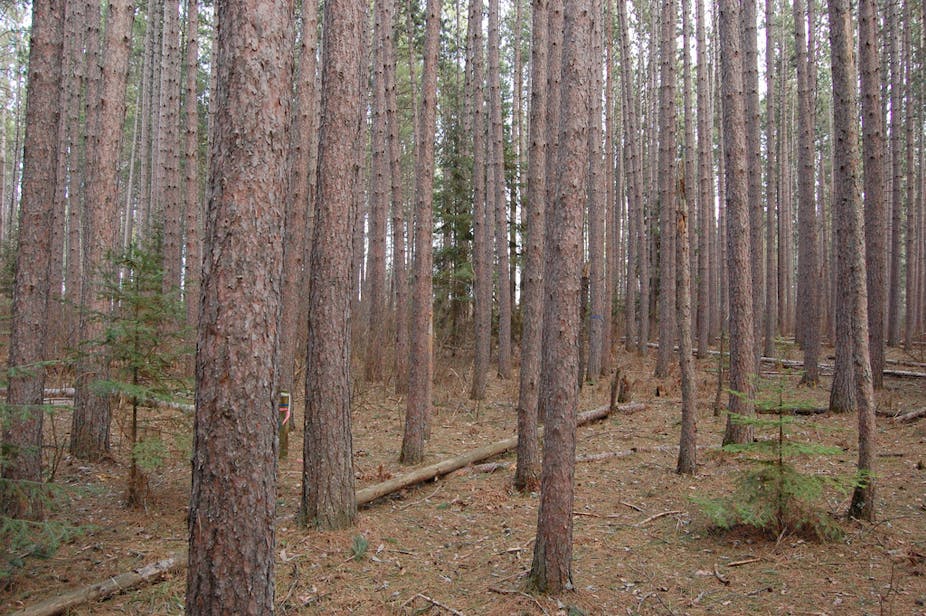
Forest carbon and the Durban climate conference

DURBAN CLIMATE CHANGE CONFERENCE: One of the topics under discussion at Durban is the role carbon farming and other forestry measures could have in reducing emissions. With the possibility that negotiations will not bring about an agreement to replace the Kyoto Protocol, delegates are working on measures…

7ed79c6f11d03100-1323128830
Could more plantations help reduce emissions? It depends if they’re done right. esagor

DURBAN CLIMATE CHANGE CONFERENCE: One of the topics under discussion at Durban is the role carbon farming and other forestry measures could have in reducing emissions. With the possibility that negotiations will not bring about an agreement to replace the Kyoto Protocol, delegates are working on measures that could take place outside a climate agreement. The Conversation asked Dr Tim Cadman from the University of South Queensland about how much difference these measures could make.

Why are deforestation and forest degradation being discussed at the Durban conference?

With the phase out of the Kyoto Protocol commitment period in 2013, countries have been looking for alternative ways of reducing carbon emissions, methods that don’t rely on a new protocol.

One proposal is to reduce emissions from deforestation and forest degradation in developing countries (REDD+), and allow developed countries to count these as “offsets”.

Developed countries have so far pledged tens of millions of dollars to fund offset programmes, and are encouraging the investment of millions more to stimulate trade and investment in “forest carbon”. Developing countries that generally emit far less greenhouse gasses (with the notable exceptions of China and India) can benefit financially from this investment, and thus gain economically from market-driven sustainable development.

What approaches are being proposed at Durban? Will they work?

REDD+ works by “incentivising” forest conservation and the sustainable management of existing natural forests by funding development projects aimed at reducing forest degradation and deforestation. The focus is on maintaining carbon stocks in existing forests by reducing the impacts of logging. More importantly, it emphasises managing forests for non-timber products – such as water or tourism – or simply not logging the forests at all. This is sometimes known as “payment for ecosystem services”.

Another proposed approach is to create new “carbon” plantations. Here the timber would be removed, but carbon accounting (so the theory goes) keeps track of the carbon stored in the trees and released through logging. Other means of storing carbon include the maintenance of grasslands (soil carbon), and rotation cropping of non-timber products such as the castor oil plant.

Carbon plantations rely on being able to effectively count and allocate emissions saved. But carbon accounting is the subject of intense debate around what should and should not be counted, and has the potential to be abused.

Rather than entering into complicated accounting arrangements, it makes much more sense to protect natural forests from logging, than create more plantations (often established on cleared forest). Old growth forests and other natural ecosystems such as wetlands store far larger amounts of carbon than short-rotation crops of trees, which never reach maturity.

Non-extractive, “green” carbon, as this is sometimes called, is also far less open to abuse, as conserving forests from logging does not require such complex accounting to deal with the trees being put into (planting) and taken out of (logging) the system. There are also problems with the “just plant more trees” argument, as these trees are often planted on other precious ecosystems, such as tropical forests, or on land already being used for traditional purposes (such as subsistence farming or hunting) by local people.

What are the benefits and drawbacks of plantation forestry?

When done well, plantations can increase ecosystem services (such as water and soil); done badly they can lead to desertification, soil degradation and social disruption. Mixed species plantations of local tree species (rather than moncultures of exotic trees), well-managed and with the agreement of local communities, have the potential to contribute to sustainable development.

Are there benefits for biodiversity, or for communities, or are most approaches only concerned with carbon?

Many academics and commentators consider that emissions trading has created an “empire” of carbon management and control, whereby local communities and indigenous people are heavily impacted. Stories are emerging of tribal lands being cleared of people so trees can be planted for offset programmes, and in some instances people have been shot and killed trying to gain access. In other cases, threatened ecosystems such as wetlands have been cleared to make way for carbon plantations.

There can be benefits, however, especially when local communities are encouraged to develop regionally appropriate solutions to the loss of natural forests. These can involve community forestry and the establishment of fuelwood plantations, for example.

But it is essential to get good governance in place first. Carbon investment projects should not just land in a local community from “outer space” without first working with all stakeholders, landholders and rights-holders.

Simply leaving forests and other ecosystems alone, and paying local communities not to log or clear these areas, also helps protect bio-diversity, while new well-managed plantations on degraded lands can also have some positive impacts on bio-diversity.

Do you see any downsides to proposals coming out of Durban?

It all depends on the extent to which civil society, science and other social stakeholders – such as indigenous people – play a part in developing the governance systems under which emissions trading take place: not just business, banks and government. All players are needed for effective solutions to climate change.

Sign in to Favourite

Want to follow The Conversation?

Sign up to our free newsletter to get the day's top stories in your inbox each morning, with a special wrap on Saturday.

Help us have better conversations — donate

Join the conversation

23 Comments sorted by

  1. Gideon Polya

    Sessional Lecturer in Biochemistry for Agricultural Science at La Trobe University

    Key comment in the article: "Rather than entering into complicated accounting arrangements, it makes much more sense to protect natural forests from logging, than create more plantations (often established on cleared forest). Old growth forests and other natural ecosystems such as wetlands store far larger amounts of carbon than short-rotation crops of trees, which never reach maturity." 3 key points below.

    1. SE Australian native forests are the world's best forest carbon sinks.

    A key paper…

    Read more
  2. Tim Scanlon

    Author and Scientist

    The problem I have with a lot of the carbon sequestration talks is that there are a lot of red herrings, white elephants and blue sky dreaming. A lot of the talks of offsets gets away from the fact that it doesn't stop emissions.

    Sequestration shouldn't be about minimising current and future emission impacts, that is unrealistic. What sequestration needs to be about is reducing GHG that have already been emitted over the last 250 years.

    report
  3. Timothy Curtin

    Economic adviser

    Re Polya and link to Keith Mackey et al in PNAS:

    In general, like Glikson, Polya and Keith Mackey et al appear to be of the view that all commercial forestry should be terminated, oblivious as they are to the nearly permanent storage of Carbon in most forest products (including books and bookshelves).

    Polya also accepts uncritically the arrant - and arrogant - nonsense in Nick Stern "arguing for an international programme to combat deforestation, which contributes 15-20% of greenhouse gas emissions…

    Read more
    1. Tim Scanlon

      Author and Scientist

      In reply to Timothy Curtin

      And you're ignoring the fact that 250ppm is the level plants and animals are happy with, not the artificially high levels we currently have and are working towards in the future.

      report
  4. Alex Cannara

    logged in via Facebook

    Just for reference, our US scientists in the 1960s, wishing to offset what was viewed as wasteful burning of fossil hydrocarbons, suggested that we could offset then current CO2 emissions by planting 1 trillion trees -- each year. That was about 200 trees per capita per year.
    We're a bit behind.
    ;]

    report
  5. Timothy Curtin

    Economic adviser

    Tim Scanlon: You must be joking. Show me your field evidence that plants do best at 250 ppm., and for each one I will give you a dozen that show 560 good, 680 better, and 800++ best.

    report
    1. Tim Scanlon

      Author and Scientist

      In reply to Timothy Curtin

      You are clearly not a plant scientist. For every increase in CO2 you need an increase in the other nutrients for plant photosynthesis and growth. High CO2 has been shown to cause all sorts of issues with the laying down of lignin (meaning crops plants especially have trouble standing up and resisting disease).

      You have missed the point between tolerate and my "best" statement. "Best" being the amount that plants have evolved under, or what I was mostly referring to which was the agricultural plants upon which we rely for food, which have been bred for the past 10,000 years under specific circumstances. These conditions have seen plants like wheat needing crossing to wild-type genomes in order to add adaptive traits to deal with productivity losses. So far breeders have kept ahead, but a sped up warming will make this impossible.

      report
  6. Doug Cotton

    IT Manager

    It seems this paper (which only uses data to 2010) could have been published before Durban rather than on Monday this week.

    It shows temperatures are not increasing in line with IPCC estimates which projected to another 3 or more degrees by 2100.

    http://iopscience.iop.org/1748-9326/6/4/044022/pdf/1748-9326_6_4_044022.pdf

    The published range of increase in this paper was 0.014 to 0.018 deg.C per year. I constructed my own trend on the plot in Fig.8 and deduced my own rates from such, because I feel the upper end of the range they quote is a little high.

    My reading of the graph (Fig 8) led to an estimate of an extra 1.3 deg.C of additional warming (on top of current temperatures) for the 89 years until 2100. This would be at the rate of 1.3 / 89 = 0.0146 deg.C per year which is within the published range.

    report
    1. Doug Cotton

      IT Manager

      In reply to Doug Cotton

      I have made a slightly more accurate prediction here and actually use a slightly higher figure than 0.016 degrees per year which is the median of their range 0.014 to 0.018 degrees C per year. So I will modify my estimate to 1.47 degrees extra by 2100.

      http://theconversation.homestead.com/1979-2010.jpg

      report
    2. Tim Scanlon

      Author and Scientist

      In reply to Doug Cotton

      Wow. You haven't understood that paper at all.

      You do realise it completely supports Climate Change, the rate of change, that it is human climate change, that the temperature change (in Kelvin not Celcius as you quote) is in line with modeled and predicted increases........ You also realise they aren't making a prediction of future warming where you have to do ranges of emission scenarios?

      Doug, please do us a favour and stop with this climate change denial.

      report
  7. Bernie Masters

    environmental consultant at FIA Technology Pty Ltd, B K Masters and Associates

    There's a bit of fuzzy thinking here.

    1. From the original article: "Rather than entering into complicated accounting arrangements, it makes much more sense to protect natural forests from logging, than create more plantations (often established on cleared forest). Old growth forests and other natural ecosystems such as wetlands store far larger amounts of carbon than short-rotation crops of trees, which never reach maturity."
    I would have thought that it makes much more sense to protect natural…

    Read more
  8. Timothy Curtin

    Economic adviser

    Scanlon: I find it hard to believe you are working in Agronomic Extension, given your evident abject ignorance of everything to do with plant growth. Google Graham Farquhar's publications and you might just learn something. My own peer-reviewed paper on Climate Change & Food Production (available at www.timcurtin.com) provides statistics and references that totally refute your tosh.

    report
    1. Tim Scanlon

      Author and Scientist

      In reply to Timothy Curtin

      Oh you can not be serious!? Energy and Environment? Peer reviewed??

      Curtin: you clearly have not done any study on basic plant physiology to understand nutrient demand and limitations. Trying to call CO2 "plant food" completely ignores limiting factors to plant growth, especially base nutrition and water. This is even more important if we talk about rain fed systems in soil mediums.

      Please read the studies that have been done on increased CO2 for crop plants and the limitation this imposes on growth…

      Read more
  9. Timothy Curtin

    Economic adviser

    Scanlon, just as you dimiss all papers in E&E even if peer reviewed, I dismiss all papers on this subject in PNAS because they have all been pal reviewed by Schellnhuber and Ralph Macoronni (the Pooh Bah of PNAS).

    Just show HERE that higher [CO2] rather than lower does NOT result in higher yields. Try the sources cited in my paper, or do my citations ipso facto rule out their relevance?

    report
    1. Tim Scanlon

      Author and Scientist

      In reply to Timothy Curtin

      You're dismissing 4 papers I cited because one was published in PNAS - which has an impact factor of 9.77 and an Eigen of 1.66, meaning it is a real journal of high repute that you are casting unfounded accusation against (unlike my claim against E&E, a lowly journal, which has been called into question for over a decade).

      Okay, ignore my references. Go and read any plant science text book on limiting factors of plant growth. Actually read the CO2 studies and see the limitations noted (water requirements…

      Read more
  10. Timothy Curtin

    Economic adviser

    Tim Scanlon: Your comments are absurd. Of course plants won't grow without water. Nor will they grow without CO2.

    PNAS has high impact because of its articles in a wide range of fields; its climate papers are a joke because Schellnhuber, the lead editor, is a politician, not a scientist. Peer review is either nil or by one of The Team.

    What is relevant in all papers is not the publisher, but the content.
    I look foward to yours proving (1) that plants do not require CO2 as a a necessary condition, and (2) that cet. par., more CO2 is better than less.

    But I fear that logical sequence may stretch you!

    report
    1. Tim Scanlon

      Author and Scientist

      In reply to Timothy Curtin

      As I suspected you are not a plant scientist. Being an economist you clearly don't understand the role that you are assigning to CO2. As I have explained in my posts, CO2 is at levels of ppm, yet a plant concentrates that very effectively, the higher rates mean less energy expended to concentrate, thus other things becoming limiting. These factors are already the major limiters and become more so under these conditions!!

      I've asked you several times to go and read any basic plant science text book…

      Read more
  11. Timothy Curtin

    Economic adviser

    Tim Scanlon: The last point in my previous should read "(2) that cet. par., more CO2 is NOT better than less."

    report
  12. Timothy Curtin

    Economic adviser

    Scanlon: I am still awaiting your demonstration that cet.par, extra CO2 is not beneficial, not least because most of your linked papers (for which I am most grateful, except for the PNAS one which is course a bad joke like all climate papers in PNAS) show that it is beneficial even with rising temperatures.

    As I expected the paper by Peng et al in PNAS is tripe. They state “simulated yield potential in the major
    rice-growing regions of Asia with PRESENT atmospheric CO2 concentration decreased…

    Read more
  13. Douglas Cotton

    logged in via Facebook

    It really is time to stop worrying and realise there is no greenhouse effect whatsoever.

    "World leading scientist slams the greenhouse gas effect and endorses the work of a rising group of independent climate analysts. Move signals further collapse of cornerstone of man-made global warming among top tier of world scientists.

    Will Alexander is Emeritus Professor of Civil and Biosystems Engineering at the University of Pretoria, South Africa. He has come out to issue an unequivocal statement endorsing a new paper published by a think tank of independent climate analysts known as the ‘Slayers.’"

    http://slayingtheskydragon.com/en/blog/178-top-african-scientist-backs-team-debunking-greenhouse-gas-fraud

    Go argue with people like this, but first read http://climate-change-theory.com/CaseAgainst.html

    report
  14. Tim Cadman

    Postdoctoral Research/Teaching Fellow at Griffith University

    Dear All,

    I have been very reluctant to comment on the feedback to my own work, but I feel I must speak out regarding some comments that seem to be contaminating this discussion.

    The objective of The Conversation is to promote academic rigour, not engage in polemics.

    I feel like I am having to provide "Introduction to research methods 101", but here goes:

    In order to obtain acceptance, recognition and credibility, academic research must be submitted to intellectual peer-review by qualified…

    Read more
  15. Timothy Curtin

    Economic adviser

    Tim Scanlon,

    Compliements of the season, although I note you have yet to respond to my comments on the papers you linked to, including those by Howson & Crimp who report the opposite of what you claim they said.

    You also made various derogatory comments on E&E, the journal that published my peer-reviewed paper on "Food Production and Climate Change", whilst extolling PNAS and Science et al. with their "high" impact factors. But both of those have also published a very high proportion of all…

    Read more
  16. Alex Cannara

    logged in via Facebook

    Biomass combustion power has long been discredited on very basic grounds, beyond even unnatural CO2 emissions. There are the realities of water consumption, erosion, soil nutrient depletion, species threats, and sulphur, nitrate &other combustion emissions. Then there's the emissions produced in access-way construction, harvesting, chipping, etc. And, of course, the absurdly low thermal efficiency of wood/biomass combustion plants, and the transmission losses due to their necessarily remote siting. MA Nature doesn't care, of course, how dumb we are.

    By the way, I see Mr. Cotton is trolling here, selling his misinformation on climate while ignoring other things he's no answer for, such as sea rise & ocean acidification. He does have some youth creams & health pills to sell though -- ask him.
    ;]

    report