



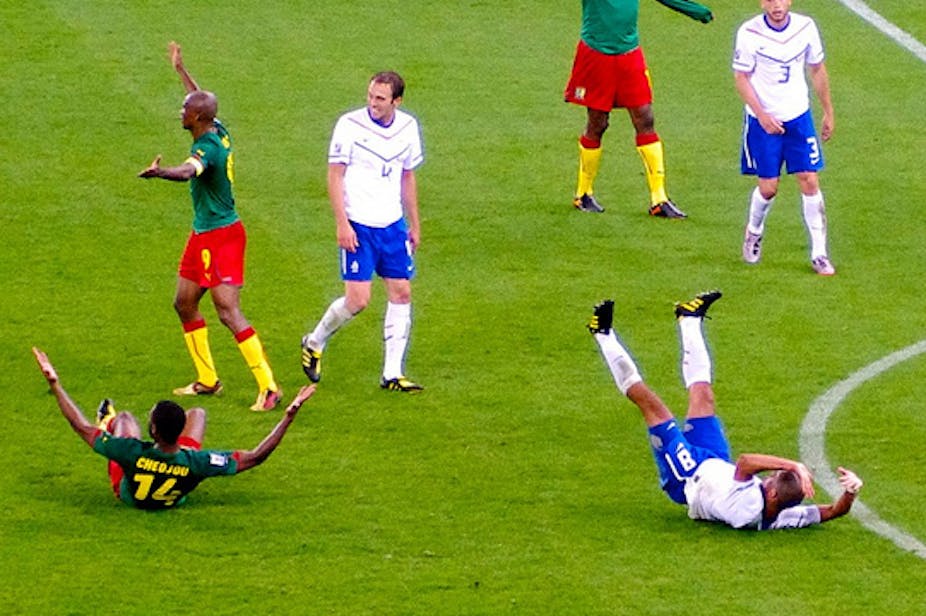
The year is 1990. For 85 grueling minutes, Italian crowds have watched West Germany battle Argentina in the World Cup Final.
The score is tied, 0-0. The collective breath is held.
Suddenly, the Germans take possession … the ball is passed to forward Rudi Völler, sprinting into the penalty box in front of the Argentinian goal … his foot touches the ball …
And he dives.
Down he goes, in what is one of the most famous simulated fouls in football history. West Germany is awarded the penalty, they score, and win football’s greatest prize.
If you think this anecdote is a bit of a let-down, imagine how the fans felt.
This particular dive – or “simulation” as those at the Fédération Internationale de Football Association (FIFA) call it – exemplifies the reason diving is prevalent in soccer even today.
Why dive?
According to a new behavioural study published in PLoS ONE, the potential pay offs are just too great.
The study, by PhD student Gwendolyn David and her colleagues at the University of Queensland (including author of this article Robbie Wilson), believed that when and where diving occurs could be predicted using theories of animal signalling.
Importantly, this could help identify a way to control diving, which is considered an embarrassment to the sport.
At its essence, diving is a signal between a player and an official.
The player signals (dishonestly) that he or she has been fouled; the official must see the signal, interpret it, and decide whether or not to administer punishment.

Signalling theory predicts that if deceptions become more and more common, they’re more likely to be detected and punished. David wanted to find out why deception was so prevalent in a sport she plays and loves – football.
Based on signalling theory, David expected to find that when diving was more frequent, it would be detected and punished at higher rates; thus, in order to be successful, deception should only occur infrequently.
And diving should occur more when the potential pay-off was higher – namely, near the offensive goal or when the match was tied.
To test these predictions, David analysed more than 2800 falls in 60 professional soccer matches across 10 professional leagues. And what she found was surprising.
In some leagues, diving was more prevalent. According to signalling theory, if cheating behaviour (in this case diving) becomes more common, the comparative advantages of performing it should decrease. The more diving there is, the less frequently it should be rewarded as referees cotton on to the strategy.
Surprisingly, this is not the case. In those leagues where players were found to dive more often, referees were actually more likely to reward dives (with free-kicks or penalties).
It’s unclear whether it’s the officials or the players that cause this pattern. Are the officials in some leagues poorer at detecting simulations? Or is it that players in these leagues are better actors?
And what about where and when diving occurs? It turns out that diving is more common when there’s more to gain by it: in the offensive half of the field – specifically, in or near the penalty box – and when scores between the teams are tied.
Giving diving the boot
Diving, like most behaviours, occurs when the potential benefits outweigh the costs – and that’s where the problem lies in soccer.
What are the costs of diving? In some cases, possession is awarded to the opposition. A yellow card may be given; and certainly, a player can gain a reputation for diving.
But overall in important matches (like World Cup Finals), there are few costs that would outweigh the potential benefits – the prospective glory, the financial gain, the win.
So how to tackle the problem of diving?
First, by improving detection. Increasing the number of officials on the field – particularly near the goals, where most dives occur – would make it easier to detect diving.
Second, we can increase the costs associated with diving. Punishment needs to be appropriately severe to counter the obvious benefits of cheating.
Progressive football leagues like the Australian A-League and the American MLS are using post-match video analysis to assign retrospective punishment to cheating players.
In these countries, there’s strong competition from more physical footballing codes (such as rugby, or American football) for the sporting public’s attention, and there’s little patience for play-acting.
But until these methods are adopted universally, you’ll just have to keep shouting at the television.
Read posts about our soccer research at soccerscience.net and on our general lab blog Inside Our Lab.