

Four years of falling electricity demand: can this continue?

In 2012, National Electricity Market electricity consumption continued its four-year decline. Everyone seems surprised that electricity demand continues to decline despite population and the economy growing. This highlights the limits of economic forecasting and the lack of “bottom-up” modelling based…

75xb73xk-1357700910
New technology – among other things – means our estimates of electricity consumption are based on old ideas. Meg Lessard

In 2012, National Electricity Market electricity consumption continued its four-year decline. Everyone seems surprised that electricity demand continues to decline despite population and the economy growing. This highlights the limits of economic forecasting and the lack of “bottom-up” modelling based on real activity.

Changes in technology mean the energy implications of new appliances have changed. For example, a household that bought a new TV in 2009 typically increased its TV energy usage significantly relative to their old TV. Today, the same decision can lead to a reduction in TV energy usage of up to 60%. This kind of change is occurring across business, industry, households and transport.

Decision-making and behaviour change are also evolving. On average, people are buying smaller houses. They are doing more to cut energy waste by switching things off and using energy more efficiently. Around 10% of Australian households are now solar electricity generators. New office equipment and lighting are much more efficient. And so on.

Analysts who look at historical energy consumption trends are really using a “lagging” indicator. The impacts of new investment decisions are swamped by the (poor) performance of the existing stock, while major behaviour changes are not modelled in detail.

We need to model behaviour in more detail. We need to focus energy forecasting on “leading” indicators, especially the performance of buildings and equipment being added to the stock, and the performance of the equipment that is being replaced.
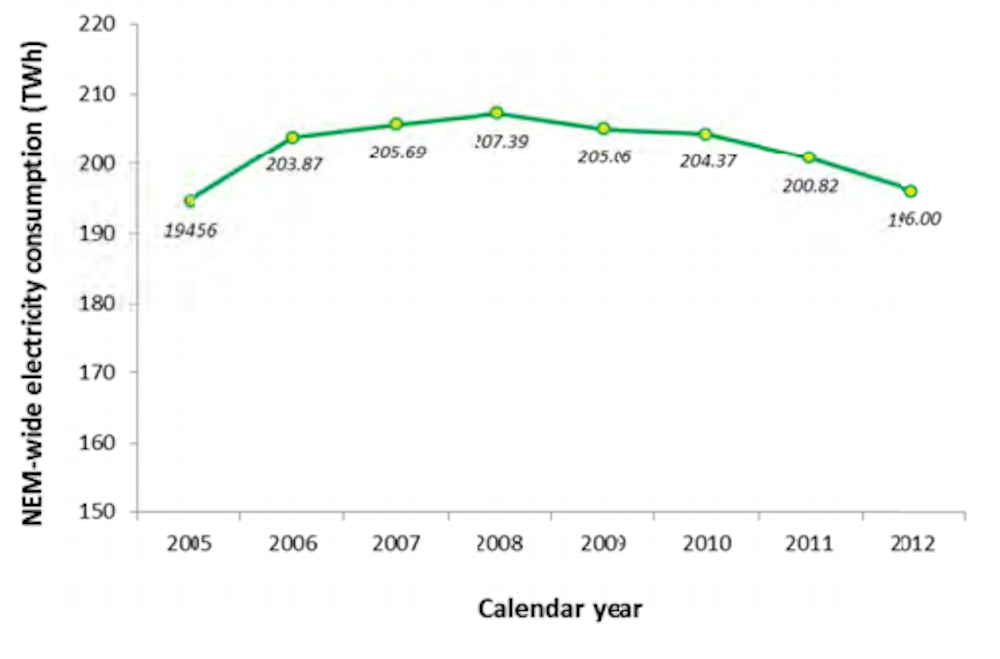
Total NEM electricity consumption. AEMO data; graph courtesy of greenmarkets.com.au

The nature of change involves a wide range of effects. Many modellers focus on factors such as the “rebound” effect, but ignore the effects that can amplify savings. These are technical, social and institutional. Consider some examples:

  • When efficient lighting and equipment is installed in an office building or house, cooling energy use (and peak demand) are reduced, because less heat is generated inside the building.

  • When water efficiency is improved, it often saves energy through reduced heating of water, or less pumping.

  • When markets for energy efficient products grow, economies of scale and “learning effects” drive cost reduction and further product performance improvement. The efficiency of delivery, installation and sale mechanisms increases. If consumers like the results, they tell others, who are then more likely to invest, driving a virtuous cycle.

  • When governments make regulations, such as requirements for more energy efficient buildings, innovation is accelerated, supply chains made more efficient, and profit margins reduced: these reduce the cost of compliance. Since Australia is well behind the leading countries, this innovation (and some of the innovators) may be imported from overseas, so it may happen very fast.

  • Redefining services and shifting the way they are provided can have profound effects on energy use. Physical stores are being replaced by on-line retailing. Low power devices such as tablets and advanced mobile phones are replacing computers. And so on.

However, complex factors can limit savings from individual changes. This can reinforce scepticism about the value of energy saving measures. For example, in many industrial sites, reducing steam usage may achieve unexpectedly low savings. This is often because other losses are unaffected and are large. But when enough savings accumulate to shut down a boiler, or to close off a length of steam distribution pipe, savings may suddenly increase because these “invisible losses” are avoided.

Systems can be very complex. For example, in many office buildings energy consumption by the fans and pumps used to distribute warm or cool air and water exceed the amount of energy actually used to cool or heat the building. Inflexible fans and pumps, losses from ducts and pipes and poor controls can undermine savings from improving the building fabric – until that equipment is replaced, when higher than expected savings can appear.

Indeed, analysis of industrial plants, commercial buildings and homes shows that often the “fixed energy overheads” can comprise a quarter to two thirds of total energy use. These are often overlooked but, when they are addressed, surprisingly large savings can appear.

One example in households is the trend away from gas storage hot water units to instantaneous (often called continuous) units. If a five star storage gas unit is replaced by an instantaneous unit with the same rating, in most cases there will be an energy saving. The storage unit has a fixed heat loss from the tank and a continuous pilot light: the amount of gas used is equivalent to supplying an extra 60 litres or more of hot water each day. The more water-efficient the household, the more significant is this fixed energy loss. Many small households use only 30 to 40 litres per day of hot water, so 60% or more of their gas usage is due to losses from their hot water unit. The instantaneous unit largely avoids these losses.

The human factor is also very important. There are many anecdotal stories about people who install solar electricity systems and suddenly become much more interested in energy efficiency. This can be attributed to improved information and the financial incentive of saving money. But it can also reflect a desire to assert control, and to “get back at” the energy companies!

Of course, it must also be acknowledged that many other factors may contribute to reduced electricity and energy demand, such as industrial restructuring being driven by the high exchange rate and changing industrial scale.

It seems that many complex factors are at work, delivering unexpectedly large energy savings. But we lack the data and analysis of these effects. So we may well continue to be surprised as energy use keeps declining.

Join the conversation

29 Comments sorted by

  1. Ketan Joshi

    Research and Communications Officer at Infigen Energy

    Curious - How would one go about acquiring the data that would be required to analyse the human and technological factors that affect long-term trends in electricity demand?

    Would NMI-resolution data be sufficient? Or, would be need to go down to the appliance level to get a true picture of electricity demand?

    report
    1. Ketan Joshi

      Research and Communications Officer at Infigen Energy

      In reply to Kevin Cox

      Agreed - I'm also interested in how much that concept has been coupled to the philosophy of open-source data-acquisition, and free, de-identified consumption data available to researchers, academics and the general public.

      I'm excited to see how it all pans out. My understanding is that, already, retailers are resistant to the idea of making resident's own metered data available to them.

      report
  2. John Newlands

    tree changer

    There must be a crossover point between savings from voluntary efficiency gains and reduced consumption due to hardship. In other words the utility or enjoyment from lower energy use is also less. An example is refraining from air conditioning in 40C weather. Some can tough it out but others put their health at risk.

    The other big question is whether these modest achievements can translate into eventual large emissions cuts. Climate scientists tell us we'll need to cut CO2 by 80% and in any case gas coal and gas will be very expensive as reserves deplete. I suggest around 2030 will be crunch time. If low carbon electricity sources are say 40% missing in action but voluntary efficiency gains were just say 10% there is going to be a problem. If we were on track for this the recent cuts should be more impressive.

    report
    1. John Harland

      bicycle technician

      In reply to John Newlands

      Big changes in a group result from small changes. Whether those changes can add up or multiply to become "enough" depends on how we leverage them. As Alan points out, many of the savings allow or even create other savings. Efficient computers or office lighting leading to less need for air-conditioning, for instance.

      If you look only at the big savings, you defeat yourself. Helping 200 people cut their consumption by 1% has four times the initial impact of cutting your own usage by 50%, but it…

      Read more
    2. phil k

      logged in via email @bigpond.com.au

      In reply to John Harland

      "Space without air conditioning " .. John... That should definitely be a mandatory subject, for the "built environment " / architecture students, who may go on to be our architects and town planners..
      My early experience of this concept, was growing up in the city of Brisbane. A place dominated by grand, (and not so grand), old queenslanders. ( the design , not the people :) ... Houses... spaced adequately... and raised to let the prevailing north east sea breeze provide natural cooling.. Admittedly…

      Read more
    3. John Harland

      bicycle technician

      In reply to phil k

      Fascinating as a reflection of what we felt about the people who migrated to Queensland, particularly during the Bjelke-Petersen years.

      That is not to knock Queensland, but the kinds of reasons they were moving there.

      report
  3. Liam J

    logged in via email @gmail.com

    Thanks for article, this is a mysteriously under-celebrated phenomenon. Declines in US industrial energy consumption & vehicle miles travelled since 08 are pretty clearly a consequence of their recession, but thats not us.. or is it? I wonder if aluminium smelting here has declined along with world price, be great to get some numbers for that and other forms of de-industrialising.

    One certainty: special pleading by generators will only increase.. "the growth in demand we said was inevitable hasn't happened, we need a bailout!".

    report
  4. phil k

    logged in via email @bigpond.com.au

    Perhaps, we are just seeing empirical evidence of the government's policy of letting our manufacturing industry collapse. Perhaps, we should be realising that it just confirms that the cargoes of those giant coal, LNG and ore ships, that are leaving our ports and being "valued added" in other countries, confirms Paul Keating's banana republic. Perhaps, we are seeing the impact of the few remaining struggling manufacturing facilities, utilising the natural gas, that is being conveniently piped to…

    Read more
    1. David Arthur

      n/a

      In reply to phil k

      I think Phil is partially on the money here, but perhaps not entirely.

      Oxford Professor of Energy Policy Dieter Helm's "The Carbon Crunch - How We're Getting Climate Change Wrong - and How to Fix It" describes how the large emission reductions achieved in the EU have been partially at the expense of vastly increased CO2 emissions in China, and in shipping goods from China to Europe.

      From this fact, Prof Helm points out that countries cutting their emissions production is a waste of time if…

      Read more
  5. Dave McRae

    logged in via Twitter

    Thanks for the interesting article.

    There's probably a fair bit to go in reductions - our antiquated and expensive (compared to Iceland geothermal, China 3Gorges, more modern Russian and Sth African) Aluminium smeltering operations using 10-15% of eastern states total power demand.

    But also the simple price demand curve as consumers are charged more and oddly the increases are mostly due to infrastructure built to accommodate expected increase in power demand. I think that highlights that maybe power is too cheap and not valued enough.

    Looking forward to the new power saving LED lights also.

    report
    1. Robert McDougall

      Small Business Owner

      In reply to Dave McRae

      my understanding is that the utility operators are guaranteed a rate of return on their investment in infrastructure, i.e. they get more money over expanding the network than actually meeting needs.

      This costs money as is reflected in increasing prices, leading people to reduce their consumption, leading to less demand, leading to higher prices etc etc.

      So the utilities get a bonus for increasing the network, have to buy less fuel and get more money for the same effort.

      report
    2. Dave McRae

      logged in via Twitter

      In reply to Robert McDougall

      Not quite Robert. It's true some infrastructure operators get guaranteed returns on the "poles and wires" they build/upgrade and, because return is above RBA set bond rate, it is perverse in that it encourages over-investment purely for investment sake.

      The generators fortunately are not so blessed. They compete on the National Energy Market (NEM) who set the demand in 5 minute blocks with generators bidding to supply - the dispatch price determined from the highest bidder that satisfies demand…

      Read more
  6. Peter Evans

    Retired

    The article discusses the many things that are being done to reduce demand and the technologies that make these possible but the motivation for demand dropping is probably the increases we have seen in price. While demand was once considered to be sticky, in other words it responded little to price movements, with the technologies today demand can be adjusted fairly significantly when people can make the investment. On top of that many of these technologies are compulsory in new dwellings and offices or are being adopted as part of the big renovations market.

    Of course it was this influence of price that led to the introduction of the carbon tax. Much can be done but you need a motivator and there is nothing better in the market than price as it allows people to choose while regulation compels.

    report
  7. Spiro Vlachos

    AL

    Thanks for the article. You have outlined many factors that may be considered determinants in the consumption of electricity. While I would not doubt that they have an effect on consumption, they would be close to useless in attempting to forecast electricity demand. Using a bottom up approach would add extra terms that are only spuriously significant, at the cost of explanatory power.

    For energy series, the only variable necessary to obtain an accurate near term forecast are past values of…

    Read more
  8. Henry Verberne

    Former IT Professional

    Clearly there is an absence of hard data to really pinpoint the factors involved in this reduction. Personally, I can say I have reduced our house's demands very substantially AND increased out comfort level at the same time.
    This, I hasten to admit, was not exactly cheap: we replaced our single-glazed windows with double glazed, added to the insulation in the ceiling, tracked down and fixed the many sources of air leakage in the house (whilst not detrimentally affecting ventilation), removed two old gas wall furnaces and replaced with high efficiency ducted gas and replaced the old ducted reverse cycle AC with evaporative cooling when it failed.
    Our bills have come down substantially. We may look at solar panels but do see any urgency as our power bill savings are already low that any savings-with reduced feed-in prices-are likely to be too modest to make the exercise worthwhile, at this stage.

    report
  9. Eddy Schmid

    Retired

    Can't believe what I'm reading here, and the fact, that Australians are so stupid and gullible.
    Twenty years ago, when West Australia's water problems first raised their heads with the serious continual drought, our water Corp introduced heavy water restrictions, to ensure sufficent water resources were available to see us through.
    The result of those restrictions, meant that folks actually got on board, did the right thing, (so they thought) and conserved water.
    This caused a massive problem…

    Read more
    1. Liam J

      logged in via email @gmail.com

      In reply to Eddy Schmid

      Whats the point in reducing consumption?!! heres a few..
      1. you learn to live with less, reducing your personal impact on other species. Oh, and save money for fewer kwh.
      2. you model lower-consuming behaviour, making it easier for other monkeys to learn how.
      3. you signal to el.suppliers and govt that you maybe don't need new infrastructure, saving money.

      Also, did you know that elec prices are regulated in most states?

      report
  10. Ivan Quail

    maverick

    reply to Eddy Schmid
    As David Suzuki pointed out last year (Legacy) We westerners consume 20 times more per person than the average Chinese and 60 times more than the average Bangladeshi! If the third world developing countries get to our level of consumption and Co2 emissions then we need another 3 planets just like this one to support and sustain that.

    Our whole Economy is built on exponential growth. What we call a standard of living is in fact a standard of wastage.

    If the rest of the…

    Read more
    1. Eddy Schmid

      Retired

      In reply to Ivan Quail

      Liam J,

      It would seem, you have missed the point entirely, of my post. Your points 1 thru to three, really are a joke, right.

      No 1. Point out to me, where I've actually saved any money. From where I sit, I HAVE reduced my foot print, BUT am paying MORE then I ever have. So how the hell have I gained ?

      2. Now I know your joking, lower consumer behaviour ? others follow suit ?Do you really believe this ? I ask again, what's the point, if my costs keep increasing despite lowering my useage…

      Read more
    2. Henry Verberne

      Former IT Professional

      In reply to Eddy Schmid

      Eddie,

      I can only record my own experience. I have reduced our electricity usage from about 12kW a day to about 83kW a day. And my power bills ARE lower. Granted, recent increases have eaten away some of the lower bills but if I had nothing to cut usage my bills would be much higher.

      In another post I outlined how I achieved reductions.

      report
    3. Felix MacNeill

      Environmental Manager

      In reply to Eddy Schmid

      Eddy, there's a confusion in your comment about Point 1 - even if you still end up paying a higher power bill despite reducing electricity use, given that price rises happened independently of your personal usage, your bill would have been even higher had you not made the usage reductions.

      Surely, though undeniably irritating, it would be better to pay only $50 a month more, rather than $100 a month?

      report
  11. Peter Hewson

    Citizen

    An interesting and timely article that raises so many side issues Just a couple of points:

    -many solar installations were taxpayer subsidised (for the social good, I'll admit) both for the capital cost and feed-in tariffs (without there thne being a tax on the return on their investment). Following from this is: the equity issue of the poor subsidising the wealthy (those who could afford the balance of the cost). So what happens when replacement time comes around will users be so willing (I think…

    Read more
    1. Eddy Schmid

      Retired

      In reply to Peter Hewson

      Peter,
      Your assertion that the poor subsidise the rich with the uptake of solar panels is WRONG .
      In W.A. this has been proven to be WRONG.
      In fact the affluent suburbs are the lowest uptakers of the solar scheme.
      The highest are the blue collar suburbs, not what I'd call affluent suburbs at all.
      Direct your research to the West Australian Newspaper and the W.A. Sundaytimes which covere the survey that resulted in these findings.

      report
    2. Felix MacNeill

      Environmental Manager

      In reply to Eddy Schmid

      Eddy, couldn't agree more and I believe the same pattern shows across the whole country. I'd also add that most people fail to properly analyse the nature of most feed-in tarriff arrangements. I'm more familiar with the system that operated in the ACT, but I think the principle applies more broadly.

      Slightly simplified/generalised,I believe the basic pattern is this:
      1. you sign a 20 year contract for a set feed-in rate per kWh that your PV system generates,
      2. at the time of signing, this tends…

      Read more
    3. Robert McDougall

      Small Business Owner

      In reply to Peter Hewson

      also, the poorer you are, the less electricity you are likely to use as you don't live in a mcmansion, don't have all the latest goodies and gadgets and tend to get by without.

      report
  12. Miles Park

    Industrial Design

    Thanks for the discussion. Is this what is really occurring at the household level? The National Electricity Market (NEM) data is aggregated as total energy demand by state and then totalled for Australia. What is actually happening the household level with electricity use? If we looked at disaggregated (industrial, intuitional, infrastructural, commercial and household) data available would it paint a different picture? Additionally if household electrical space and water heating is removed from…

    Read more