
From dust bowls to food bowls: Australia’s conservation farming revolution

The misconception of Australian agriculture being inefficient and unsustainable is deeply concerning for me. Images of dusty ploughed fields and dying sheep and trees are misleading. On the contrary, if there was an Olympics for conservation agriculture Australian farmers would win gold! Far from being…

6nzn26k8-1333419061
Working with farmers, Australian researchers have come up with technology and methods to make farming kinder to the environment. Chesapeake Bay Program

The misconception of Australian agriculture being inefficient and unsustainable is deeply concerning for me. Images of dusty ploughed fields and dying sheep and trees are misleading. On the contrary, if there was an Olympics for conservation agriculture Australian farmers would win gold!

Far from being inefficient and unsustainable, Australia is leading the world in conservation agriculture techniques. Conservation agriculture which emerged from the “dustbowl” years of the 1930s is based on three key principles – minimal soil disturbance, permanent soil cover, and a diversity of plant species. I call it the three R’s – reduce tillage, retain crop residues, rotate crops.

Three developments brought Australian farming from the tillage-based agriculture that dominated from the 1800s up to the 1980s to the conservation farming revolution:

  • The development of herbicides. These chemicals have been refined and are now effective at targeting specific weeds with minimal environmental impact. Before herbicides, farmers' only option for weed control was ploughing the soil to kill the weeds and to prepare a seedbed for planting. Soils had to be ploughed repeatedly because every time it rained new weeds emerged.

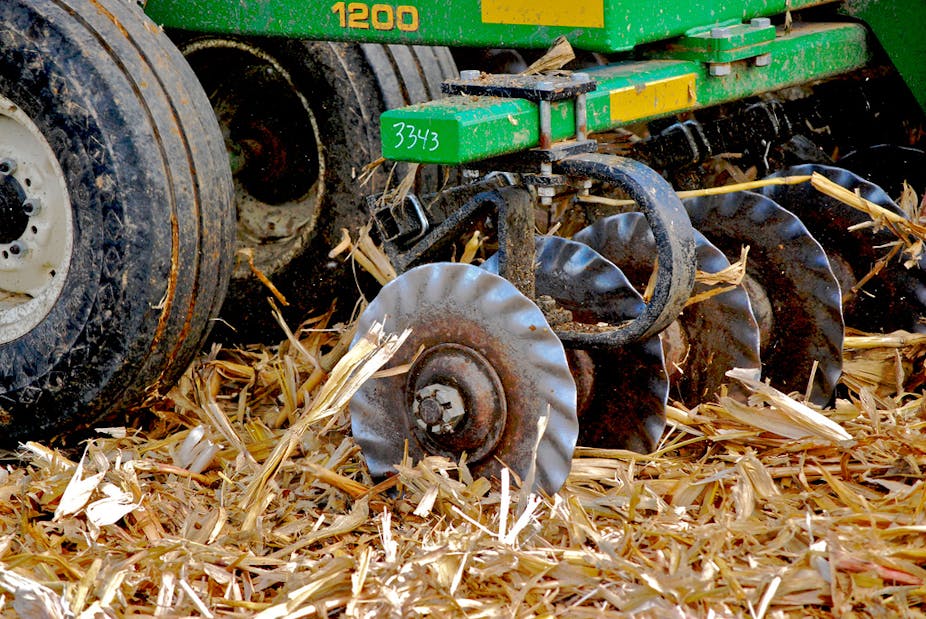
  • The evolution of more effective and efficient machinery to sow through crop residue into undisturbed soil. Herbicides allowed crops to be grown without ploughing, but machinery designed to sow into soft, bare, cultivated soil had to be redesigned to sow into undisturbed soil and through a mulch of residue left from the previous crop. Farmers led the innovations in machinery to make this happen.

  • The introduction of broadleaf rotation crops (lupins, peas, canola) to underpin weed and disease control in conservation agriculture systems. Rotating crops is necessary for conservation agriculture. Weeds and diseases will build up in the residue and be carried from one crop to the next if the same crop is grown year after year. In addition, weeds soon become resistant to herbicides if the same herbicide is used repeatedly. By rotating the types of crop that grow, the diseases of one crop cannot build up and the types of herbicides used for the weeds can be changed each year. Legume rotation crops (peas and lupins) also make their own nitrogen which reduces the need for fertiliser.

Not a dustbowl: Australia has made great advances in improving farming to be more sustainable and higher yielding. Howard Russell

But we didn’t stop in the 1980s.

Farmers can now manage their fields down to centimetre accuracy. Precision agriculture is continuing the revolution, introducing controlled traffic, zone management and in-crop sensing to improve farming systems’ efficiency and sustainability.

Controlled traffic is where farmers keep all of the machinery on the same tracks in the field (up and back instead of round and around) so that only those areas are compacted by the wheels. This reduces compaction on the field, reduces wasted spray and fertiliser due to overlaps, and makes the tractor much more fuel efficient because it is driving on harder soil. Better growth of crops in the un-compacted area compensates for the narrow tracks.

Harvesters can also stay on these tracks – with GPS guidance and an ability to measure crop yield on the run – can produce yield maps to show the farmer which parts of the field are performing better than others. Different amounts of fertiliser or other inputs can then be applied to the different zones, further increasing efficiency. Colour sensing monitors fitted to tractors can even sense how green the crop is and adjust the amount or fertiliser that is applied as the tractor is passing over the crop.

No-till agriculture isn’t just the preserve of hippies – it has great applicability in everyday farming. tiny pig/Flickr

So it is now possible with GPS and optical sensing for farmers to deliver nutrients or herbicides exactly where they are needed in the paddock within a 2cm margin of error. This not only reduces costs to the farmer but reduces the impact of these chemicals and residues on the environment.

There are still many challenges for the future. These include managing herbicide resistant weeds that can emerge when the same herbicides are used repeatedly as the only form of weed control. Rye-grass is one of the most challenging weeds for no-till systems in Australia. Careful management – including rotating the types of herbicides that are used, destroying the seeds through collection at harvest time and growing vigorous crops that can out-compete the weeds – are all part of the integrated management required. Diseases that can be carried on crops residues and roots can also create problems, but selecting resistant varieties, rotating crops and judicious use of fungicides provide good control options.

Crop yield has doubled in the last 30 years under conservation agriculture systems. But there is still more scope to improve yields as there remains a considerable gap of 30-50% between the potential yield in experimental plots and what is being achieved on farms. Though some of this difference relates to pure economics and risk that farmers have to consider, new innovations to increase yield without higher risk are emerging.

We are breeding new varieties to take advantage of the conservation farming techniques, such as wheat varieties with longer coleoptiles to emerge through the mulch of stubble and vigorous shoots and roots to compete better with weeds. New rapid real-time environment and crop sensing technology will provide quicker analysis of soil and crop conditions and allow farmers to make more timely decisions about fertiliser and other inputs.

As much of the change to farming with conservation agriculture is in the soil, a new focus on root-soil biology research rather than on the above-ground parts of the plant may provide new ways to improve crop performance under these new conservation systems. Though soil improvements such as earthworms and organic matter are welcome, not all of the organisms that build-up are “crop-friendly”. We need to understand how to avoid the effects of the disease and inhibitory organisms while capturing the benefits of better soil.

Broadleaf rotation crops like canola help control pests. ngarkat/Flickr

Finally the “Holy Grail” for farmers – improving accuracy of weather and seasonal forecasting – is being made possible by information being gathered internationally about the ocean temperatures and how they influence our climate. Better forecasts allow farmers to better match crops and inputs to the seasonal condition. They can grow better crops with less input and reduce their financial risks as well as those to the environment.

Much of my research success can be attributed to the strong relationships I have developed over the years with farmers and farm consultants who are often first to alert us to interesting factors affecting their crops and the difficulties encountered when introducing conservation farming techniques. They are genuinely committed to preserving and improving their land and providing safe and nutritious food and we should be aware and proud of the world-leading revolution in conservation agriculture they have achieved in 30 years.

If you want to know more you can watch the public lecture I gave at the Academy of Sciences here or explore my work at CSIRO here.

Sign in to Favourite

Want to follow The Conversation?

Sign up to our free newsletter to get the day's top stories in your inbox each morning, with a special wrap on Saturday.

Spinner
Help us have better conversations — donate

Join the conversation

30 Comments sorted by

  1. Felix MacNeill

    Environmental Manager

    This is a great article - thanks John - good to see what the intellifent application of the full spectrum of scientific knowledge and technologies can achieve in practice.

    I'm curious, however, that you didn't mention genetically modified crops - apparently the one 'missing' technique available. I'm still puzzled by the extent to which GM is actually vital to improving crop yields when so much seems to be achievable with other techniques, such as those mentioned.

    report
    1. Tim Scanlon

      Author and Scientist

      In reply to Felix MacNeill

      Have a look at the grazing programs such as Prograze, Pastures from Space, feed management calculators, and search for some of the terms like "strip grazing" "cell grazing" and the like.

      There has been plenty of work done on animal production, you just have to look into the industry extension and science itself as they have registered producers and target their members rather than the broader public.

      report
    2. Tim Scanlon

      Author and Scientist

      In reply to Tim Scanlon

      Sorry, that was meant to be in reply to Ben Heard's question.

      report
  2. Ben Heard

    Director, ThinkClimate Consulting

    I enjoyed a good lecture as part of a series arranged by Barry Brook that discussed how climate change is pressuring Goyder's line south, but adaptation of agriculture pressure's it north, the net result being that it has not moved much. I am impressed with what our farmers can do.

    I am interested that this article is uniquely focussed on vegetable agriculture, rather than the farming of animals. i would be interested as to whether an apparently well informed author has an opinion on these environmental impacts?

    report
  3. Garry Claridge

    Systems Analyst

    Thank you John :)

    What scares me is that the new Queensland Government intend to increase the production of remaining cropping land (left-over from mining allocations) by the use of "technology".

    I'm concerned by the possible types of technology that may be promoted to achieve this "increase".

    report
    1. Tim Scanlon

      Author and Scientist

      In reply to Eric Ireland

      Targeted spraying, minimising drift, timed applications, correct dosage rates, etc, mean that the impacts are minimised. It stops the runoff or drift of chemical away from crops and thus waterways aren't impacted like they were when chemicals were first developed.

      Also in field water management (water harvesting with press wheels) means less surface runoff, thus less chemical movement. The only instance of chemical movement I've heard of recently was from cotton plantations for a long lived herbicide that was washed out to sea during the Queensland floods.

      I should also point out that there is always environmental damage from producing crops or livestock. We have massively reduced these impacts, but there will always be some e.g. soil acidity.

      report
    2. Shirley Birney

      retiree

      In reply to Tim Scanlon

      In December 2009, the Western Australia Department of Water published their findings from a study of the Swan Canning River system which revealed contaminants were detected in surface water in all of the sub-catchments.

      “Twenty five pesticides (including insectides and herbicides) were detected in total, of which simazine, diuron and atrazine were the most prevalent, being detected in every drain during almost every sampling event. Diazinon, trifluralin and metachlor were also detected in several…

      Read more
    3. Tim Scanlon

      Author and Scientist

      In reply to Shirley Birney

      Shirley, your comment isn't without merit, but you have tried to imply that any and every chemical is bad and is used poorly.

      First of all, the areas that you are referring to are fed by horticulture, not the broadacre farming that was generally being discussed by the article and by my comments.

      Secondly, the high use areas of horticulture are rife with bad practices of chemical usage. Don't blame the tool, blame the person using it. Education campaigns are slowly working, but there is a lack…

      Read more
    4. Shirley Birney

      retiree

      In reply to Tim Scanlon

      @ Tim Scanlon: “Secondly, the high use areas of horticulture are rife with bad practices of chemical usage. Don't blame the tool, blame the person using it.”

      Thank you Tim for confirming what I had already implied. Your comments confirms that the horticultural industry is a self-regulator and that it, state and federal departments of agriculture are more interested in economics than the environment, human and animal health.

      Australia’s horticulture industry comprises fruit, vegetables…

      Read more
    5. Tim Scanlon

      Author and Scientist

      In reply to Shirley Birney

      Shirley, you appear to have missed the larger point I was making. You are casting aspersions against the majority based upon the actions of a few.

      I didn't want to comment upon the horticulture industry and the bad use of sprays. I will hint that there are cultural and language barriers associated with it and that Australian farmers are generally pretty good at their sprays. If anything, the resistance research indicates that the Aussie farmers cut rates more frequently than anything.

      report
    6. Graham Finlayson

      logged in via LinkedIn

      In reply to Tim Scanlon

      Tim, I'm inclined to take issue with your comment that there will always be 'environmental damage with cropping or livestock', as I've spent the last ten years using livestock as my primary tool for regenerating our landscape, & and believe they are the only way to achieve that aim that is economically effective in the dryer areas at least. And the future of cropping should see us replacing the need for chemicals completely with 'pasture cropping' such as guys like Colin Seis have developed, or the development of perennial grain crops. Having to rely on always producing a newer / better chemical with scant regard for nutritional quality of he food we are meant to be producing is hardly a truly sustainable way forward in the long term.

      report
    7. Tim Scanlon

      Author and Scientist

      In reply to Graham Finlayson

      Graham, I still disagree. "Chemicals" is a very broad term, I assume you mean herbicides and pesticides, but do you also include soil ameilorants (e.g. lime) and fertilisers? When you establish productive enterprises, which tend to be monocultures, then you need to control issues such as pests, diseases and weeds (some weeds can be controlled with correct grazing management). Without these chemicals your productivity goes backwards or crashes. I did my PhD on pasture decline, it is amazing the number…

      Read more
    8. John Holmes

      Agronomist - semi retired consultant

      In reply to Graham Finlayson

      I would take issue with the concept of going back to a pre chemical time. How much more do you want to pay for your food?

      Weeds had adapted to our farming systems then, and repeated cultivations did not always work as well as destroying the soil structure/and lowering organic matter content..

      I grew up on a pasture/cereals grains farm, we cultivated to control weeds prior to planting the crop. We used crash grazing to control grass weeds in the year prior to planting cereals. Most of…

      Read more
    9. Graham Finlayson

      logged in via LinkedIn

      In reply to Tim Scanlon

      Was it Einstein who once stated that "We cannot expect to fix a problem with the same level of thinking that created it"? I don't mean to seem rude but I think you and John are falling into this trap. I'll confess to knowing very little about cropping, but I know several producers that have gone from being heavily reliant on herbicides, pesticides & fertilisers to now using very little with the admiral goal of eventually getting to none and still maintain yield. Or more importantly, profit. Biological…

      Read more
    10. Tim Scanlon

      Author and Scientist

      In reply to Graham Finlayson

      Incorrect Graham. I was never stating that chemicals were the answer, I was stating that the more productive a system becomes the more tools are needed to make it work properly. Chemicals are part of the toolbox that are needed.

      I'd also say that the claims you make are largely unmeasured. I find it very hard to believe that weeds and worms have not been an issue and would love to see your worm egg counts throughout the season and the weed seedbank numbers, I have a feeling they are high. I've…

      Read more
    11. Graham Finlayson

      logged in via LinkedIn

      In reply to Tim Scanlon

      Tim, chemicals are not 'needed' by everybody so maybe they really fall into the 'wanted' category instead. We may have had a production increase with the green revolution but it has been at a massive environmental, economic and social cost & I just think we have the knowledge and ability to be doing a lot better.
      And we will need to.
      I'm not trying to drag you to my way of looking at things because I'm aware of how difficult that chore is from experience. However, I've come a long way in my thinking…

      Read more
    12. Tim Scanlon

      Author and Scientist

      In reply to Graham Finlayson

      Um, my weed scientist wife wanted me to clarify your weeds statement. Whilst correct, crops and pastures are early succession plants too. Thus they are a competitive antagonist in any farming system.

      The 35% figure comes from the research into "organic" systems that don't use chemicals. No one part gives that reduction in productivity, it is the sum of pressures from all vectors that aren't controlled appropriately, as done with chemicals.

      Next point is that I'm not skeptical of soil biology…

      Read more
    13. Graham Finlayson

      logged in via LinkedIn

      In reply to Tim Scanlon

      Sounds good Tim, but if you make the long trip from WA I'd get you to grab a bottle of one of those great Margaret River Reds...

      Hmmm... the 'ol weed debate.

      A weed is just a plant growing where you don't want it to. A lot of the problems in agriculture seem to revolve around people trying to grow things that want to die, and trying to kill things that want to live! You would think we may occasionally step back and think a little about why we choose to do this. I don't consider any plant to…

      Read more
    14. John Holmes

      Agronomist - semi retired consultant

      In reply to Graham Finlayson

      "A weed is just a plant growing where you don't want it to. A lot of the problems in agriculture seem to revolve around people trying to grow things that want to die, and trying to kill things that want to live! "

      Ah; the trap for young researchers. Just try growing some of these unwanted plants for trials etc. When you want them to perform on cue, you soon develop a respect for their ecology, soon find out that they always not that obliging. Even some which seem to be fairly domesticated…

      Read more
  4. Tim Scanlon

    Author and Scientist

    Great article John.

    The agriculture industry has made massive improvements in production and sustainability (although I'd call real sustainability a white elephant) and working with farmers I've seen some of the progress that has happened in just 5 years. I'm personally working on Yield Prophet here in WA to get the modelling right for our soils, the interest in it is phenomenal.

    My main concern is the lack of industry understanding and trust from the broader community. We have such a great wealth of science and innovation backing our work, yet it is largely assumed that we still farm like we did 40 years ago.

    report
  5. Yoron Hamber

    Thinking

    A very interesting article :)

    Good on you, and concerning those 'dead' genetically manipulated seeds that you need to buy anew each year doesn't seem the answer to to me? better to carefully use the seeds that fit where you are as it seems to me?

    report
    1. John Holmes

      Agronomist - semi retired consultant

      In reply to Yoron Hamber

      Reference please. Re 'dead seeds', I am not aware of any use of the so called terminator gene in varieties grown in Australia despite much publicity.

      We know that using seed from harvested from hybrids is not a good idea as there is considerable variability in the performance such seed, as well as loss of hybrid vigor. Hence the loss of the advance of having hybrid seed.

      In Canola oil quality will 'drift' and seed will need to be purchased from time to time farm from those who are keeping the quality up to standard. Poor quality oil is not good for us.

      report
    2. Yoron Hamber

      Thinking

      In reply to John Holmes

      Well, that was the seeds I was thinking off, the 'self terminating variant'.

      There are examples of it in East Europe that use it and get locked up to using it after a while. And I don't like that sort of thinking. To me that is like lifting up a dead end and presenting it as the future. I also think there are some stated in Africa that use it? But it's been some time since I looked into that so I'm not sure. And no, I didn't mean that I knew you using it in Australia, just that I hoped you didn't consider it.

      report
  6. Shirley Birney

    retiree

    The author's glowing report on “Australia’s conservation farming revolution” is in contrast to the notes filed in my archives. The author’s assurance of “safe and nutritious food” is of little comfort when the APVMA permits the use of pesticides which have been banned in many nations for “failing to satisfy the requirement of protection of human and animal health.”

    One example is Paraquat which has been linked to Parkinson’s Disease. In addition, major weeds are becoming resistant to Paraquat…

    Read more
    1. Yoron Hamber

      Thinking

      In reply to Shirley Birney

      If the Australian farmers are depending on Monsanto I think they are gambling with their future. Sterile GM seeds are not the way to go, and to be ignoramus enough to think that we in some decades understand the genetics nature has been undertaking for millions of years, enough to safely go inside and change genes seems rather presumptuous to me. And they do not have a very clean record as far as I've seen.

      report
  7. Derek Bolton

    Retired s/w engineer

    I'm aware that some renewable energy schemes call for the use of wheat straw waste as a biofuel - up to 10% of total created. Would this conflict with the new best practice farming?

    report
  8. Eclipse Now

    Manager of design firm

    Thank you for a well written, concise, and encouraging article. While loving the measures you have described, I still have some major objections to describing our agriculture as 'sustainable' though. There is much to be applauded in what you have written. I would also love to hear whether you have considered biochar for the below ground soil biology measures you are discussing. The International Biochar Initiative has many Phd's in soil science, and is not just some new hippy movement. It's state…

    Read more
  9. Jim Wright

    Retired Civil/Structural Engineer, IT Consultant/Contractor

    I am somewhat of an outsider (although as a small child, I did spend time on my uncle's farm in UK during WWII!) and my interest is in food production generally as part of a study into Australia's absolute maximum population carrying capacity (see my blog reengineeringaustralia.com if anyone is interested). I just want to say that I am enormously encouraged by the positive attitudes of the farming community to increasing the efficiency and wellbeing of agricultural practices. My grand-daughter's…

    Read more
  10. mark feltrin

    Renewable Energy and Resources

    I have some trouble with this article as it portrays only one component of the agricultural landscape (food production).
    These efficiencies come through intensification of cropping types that have WORSE environmental attributes then other agricultural land systems even though pound for pound they do produce more food -no argument.
    But recognize the picture of the canola with a single tree is indicative of a barren biodiversity landscape (and I’m not talking about FOA's twisted and incorrect version…

    Read more