From grassroots to gold: the role of school sport in Olympic success

The post-mortem of Australia’s performance at the Olympics is in full swing. Indeed the knives were being sharpened as early as day two of compeition when the men bombed out of the men’s 4x100m swimming relay. Prior to the London Olympics, I had predicted we would finish tenth and that success in Rio…

Byy28ykb-1345005872
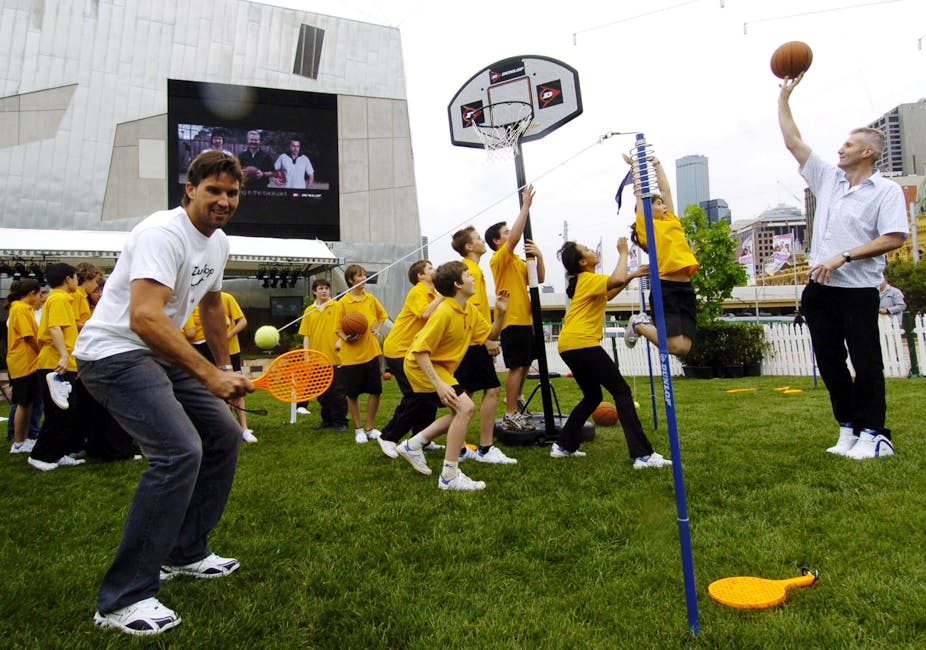
If we want to keep producing great Olympians, we need to keep sport in schools. AAP Image/Julian Smith

The post-mortem of Australia’s performance at the Olympics is in full swing. Indeed the knives were being sharpened as early as day two of compeition when the men bombed out of the men’s 4x100m swimming relay.

Prior to the London Olympics, I had predicted we would finish tenth and that success in Rio in 2016 would be harder, as more and more countries invested in Olympic competition.

The picture would have been even more depressing had Australia not had the services of the Ukrainian-born sailing coach Victor “medal-maker” Kovalenko – we may have ended up somewhere above the Islamic Republic of Iran (17th) and below the Kiwis (15th).

The discussions have already focused on issues associated with funding models, building another AIS, pumping more money into elite sport, and developing better talent identification methods. What has been neglected in the discussions is the role grassroots-level sport should play in the hunt for Olympic medals.

It is well-established and documented that our success at the Sydney 2000, Athens 2004 and Beijing 2008 Olympic Games was based on supporting elite sport development. That is, talented youths were identified and supported to achieve success. A number of sports – including swimming, rowing and hockey – were also targeted in an attempt to improve our chances of medal success. Nobody questioned the ethics of this policy until the recent London Olympics.

Inevitability, this policy had been replicated by other nations; especially in Asia. While South Korea and Japan targeted certain sports, the Chinese were keen to gain medals in all sports.

Britain were always going to continue funding sport – after all, they are a nation with a fine and long sporting tradition. Many forget that at the 1996 Atlanta Olympic Games they gained just one gold medal. At London they finished third with 28 gold medals.

Australian elite sport policy and privileging meant serious issues at the grassroots-level were able to be swept under the carpet. It would seem that in the world of elite sport, nobody was interested in issues such as the slow demise of Australian school sport, rising levels of youth obesity and the increase of youth physical inactivity.

The Crawford Report, published in 2009, identified the problems in youth sport (school and community) but policy-makers were keen to push the line of “top-five finish, 46 medals” and neglect Crawford’s recommendations. In particular, Crawford had noted that grassroots-level sport had been a central feature of the Australian way of life, but also of Australia being a nursery of Olympic success.

Nobody took notice … until now.

Commenting on the London Olympics marathon last week, former marathon icon and Australian Insitute of Sport head Robert De Castella suggested the problem with Australia’s performance is linked to what’s happening in schools.

The problems with school sport and physical education are not with the teachers. Debates have focused on “giving it more time in the curriculum” or “we need more specialised physical education teachers”. The overwhelming majority of teachers love sport and are keen to be involved in its promotion. The NSW Department of Education School Sport Unit are tireless in their pursuit of the promotion of school sport.

The issue is more related to the fact sport and physical education are no longer institutionalised in many school and educational systems.

Australian educationalists did not see sport and physical education as a priority and there was no lobby to argue for its inclusion; not even the Australian Olympic Committee.

This all came to a head when the Australian National Curriculum was devised. When the curriculum is introduced in 2014, school sport will no longer be mandated. Schools have the option to include it – in a 10% free time allocation which they will control.

But why would a principal include sport? It is not mandated, it is costly, there are legal liability issues, teachers need to be trained, you cannot use it as a promotional tool and the focus on high-stakes testing (such as NAPLAN) has exacerbated the problem.

In my work at the University of Sydney, I ask pre-service teachers to discuss their school sport and physical education experiences. Many talk about never having jumped over a hurdle, throwing a shot put, jumping into a pool to compete in a race, and only competing in a narrow range of sports. Many of these would-be teachers have had a negative experience with sport.

Even if government school students were motivated to sail, after the magnificent exploits of our Olympic sailors, who would give them this opportunity? Statistics tells us 40% of school-aged youth do not take part in any organised sport.

This, coupled with limited and poor experiences in schools, highlights some of the problems which will face future sporting success. Regardless, we should focus on grassroots-level sport and in particular on school sport, because of the educational, social and psychological benefits it can achieve. That is achieving positive health outcomes for Australia’s youth.

We don’t want to be a nation besotted by “gold medal fever” with high rates of youth obesity and physical inactivity.

Perhaps there can be positives to come out of Australia’s so-called “poor performance” at the London 2012 Olympic Games – a renewed focus on the place of sport in Australian education, for a start.

This would build on a tradition which not only promoted mass participation for all students but was also responsible for being a nursery of Australian gold.

Articles also by This Author

Sign in to Favourite

Want to follow The Conversation?

Sign up to our free newsletter to get the day's top stories in your inbox each morning, with a special wrap on Saturday.

Help evidence based journalism become the norm and donate

Join the conversation

14 Comments sorted by

  1. Robert Nelson

    Associate Director Student Experience at Monash University

    The case for more sport in schools is unconvincing. The problem with physical education in schools is precisely that it concentrates on competitive sport, which is unsustainable for individuals and hardly inclusive in spirit. Given that sustainable patterns of exercise are seldom taught in schools, you wonder why we have sport education at all, other than being some wishful incubator for gold medals and fantasy. Where is the school that teaches and cultivates useful physical habits, like walking and commuter cycling? By concentrating on competition sport, the syllabus is anachronistic. The problem, which has emerged in other articles on these wonderful pages, is not that we don't have enough PE in schools but that we have the wrong ambitions within it.

    report
  2. Rajan Venkataraman

    Citizen

    There seems to be a lot of pressure for schools to deliver a range of education and training programs for all that ails our society while at the same time we hear that there is a crisis in basic literacy and that our ranking on maths and science education is falling compared to other OECD countries. Thus we bemoan that our teachers aren't qualified nutritionists, aren't trained to recognise various psychological conditions, have limited training to give instruction in sexual health, aren't trained…

    Read more
  3. Paul Rogers

    logged in via Twitter

    I can't see why the model for physical activity in schools that I went through, admittedly many years ago at high school cannot be replicated or continued.

    That model was of one or two PE session(s) each week, which did 'not' emphasise competitive sport, and one afternoon each week for competitive, inter-school sport, or intra-school sport which was much less competitive and more recreational.

    It seems to me Mr Nelson's "sustainable patterns of exercise" could well be taught in the PE sessions or the intra-school sessions, if the curriculum designers were so inclined, while continuing to lay the foundation for our more elite sporting goals.

    report
  4. Richard Helmer

    REsearch Engineer

    whilst i cant claim to be an expert at anything i can see that it normally takes a lot of sustained focused effort to be the best in the world...and rarely one person can do it all on their own without any help... this takes some planning and flexibility

    in my experience learning requires engagement, and as the wonderfully diverse population we are, we are engaged in many and varied ways...sport is part of this. ...we also need space to express ourselves and clear the clatter and baggage from…

    Read more
    1. Rajan Venkataraman

      Citizen

      In reply to Richard Helmer

      Good to see you on this site Richard. "Can't claim to be an expert" indeed! I too reckon the school-kids will love your talk on science in sport. Wish I could attend it!

      report
  5. Kate Hughes

    Lecturer at Liverpool John Moores University

    Interesting debate and one we are having in the UK too. See article by Sir Steve Redgrave in the Telegraph http://www.telegraph.co.uk/sport/olympics/9475959/Sir-Steve-Redgrave-Competitive-sport-is-all-very-well-but-helping-every-child-reach-their-potential-must-be-Britains-Olympic-legacy.html
    I started my working career as a PE teacher and have no doubt that, although all children should be offered the chance to experience competitive sport, it is as important that children are introduced to activities they might keep doing post school. For girls, particularly, this is more likely to be something like, yoga, zumba,pilates or boxercise.
    We also need more traffic free cycling areas, better maintained public sport facilities, oh I could go on and on and on.....

    report
  6. John Harland

    bicycle technician

    Having been through the same pattern of sport and PE at school as Paul Rogers did, I think we are well rid of it.

    The sport was good for those who were good at sport. The Phys Ed seemed mostly the vicarious imposition of the exercises the chainsmoking teacher thought he should be doing himself, but wasn't.

    The biggest problem of inactivity in schools would seem to be the obsession with safety and liability. Children simply cannot do a lot of the incidental high-level exertion we got to do when…

    Read more
    1. Paul Rogers

      logged in via Twitter

      In reply to John Harland

      John, I agree PE (or PT in those days) was robotic stuff -- calisthenics and some running around the oval or hall for the most part.

      What I was suggesting was that similar time could be better spent with more allocation to lifestyle health, with perhaps some broad nutrition, weight management, and emphasis on 'exercise for life'. The sports parts could continue, but broaden the PE goals.

      I must admit I don't know 'exactly' what the PE curriculum is at present, but from the sound of complaints, this aspect is not being addressed adequately.

      report
  7. Dianna Arthur

    Dianna Arthur is a Friend of The Conversation.

    Environmentalist

    Ah yes, Sports Day at school - I remember it well. Those were the days when I could expect the bullying to ramp up from verbal to including a big lump of physical.

    I was crap at sport - especially competitive. This was due to having missed most of primary school due to illness. Ironically I did discover in my 20's that I was rather good at sport such as running, skiing and 10 pin bowling(!).

    As for topic; I didn't watch any of the Olympics nor care how many medals Australia won. Never been…

    Read more
  8. Steve Georgakis

    Senior lecturer of pedagogy and sports studies at University of Sydney

    Dear Robert, Rajan, Richard, Kate, Paul, John and Dianna
    Sorry for the late response and thank you all for commenting on the article. Most of your concerns though support my general thesis that it is because sport is ‘delivered’ badly that creates all the problems. Yes, if it marginalises students and is not inclusive and is not educational – it shouldn’t be a part of the education system. I totally agree with this. The problem is, there is nothing wrong with sport. For example, even competitive…

    Read more
    1. John Harland

      bicycle technician

      In reply to Steve Georgakis

      On a State-wide basis HSC is competitive in that results are standardised. That is not the experience of people at a particular school community, however, where it is more a standard to attain than a competition. Within a school HSC scores can be, to some degree, a collaborative achievement.

      The activities I have seen as working best for the widest range of young people have been primarily-collaborative, goal-based exertions such as camping, bushwalking, bicycle touring and the like, rather than competition.

      Competition and collaboration are a constant interplay within a community. Both sporting bodies in general, and the ACCC, could do far more social good by understanding that interplay rather than worshipping competition as a goal in it

      report
    2. John Harland

      bicycle technician

      In reply to John Harland

      "as a goal in itself"

      Apologies for the software sending the comment prematurely.

      report
    3. Dianna Arthur

      Dianna Arthur is a Friend of The Conversation.

      Environmentalist

      In reply to John Harland

      Thanks to Steve for your article - great to be able to present the 'non-sporting' school-child point of view.

      John Harland

      Agree with your points. Would suggest we need an greater emphasis on collaboration - we already have a plethora of competition. Not that I am anti-competition - on a personal level I can be very competitive, however that is usually due to a visceral reaction to people who demand authority.

      Put simply, I have issues with authority as power tends to attract bullies and I am allergic to bullies.

      And I know I am not alone in this.

      Many more children respond to inclusion and encouragement to gain some skill in an activity, be it sport or anything else. When a level of skill has been achieved, competition is useful in honing those skills - particularly for the more introverted personalities.

      report
  9. Kate Hughes

    Lecturer at Liverpool John Moores University

    Hey Steve - are you in touch with my friend Jorge out there in Sydney? He's at Uni of Western Australia I think.
    Here's his response to my letter to the PM - which sort of brings the two articles together.........
    And I fully agree what we need is a balnce between competitive and non-competitive - so very child finds something they are keen to particiapte in when they leave school.....

    From Jorge.....
    Last Saturday I woke up at 6:30. It was freezing. The day before, there was a cyclone in…

    Read more