Gallop: ALP reform is a must for social democracy

There are always two challenges that face a political party operating in a democratic system such as ours – public trust and public policy. When I was elected leader of the Western Australian Parliamentary Labor Party in 1996, the trust factor was pre-eminent. The public had invested much in the Labor…

Xw937j7w-1355183768
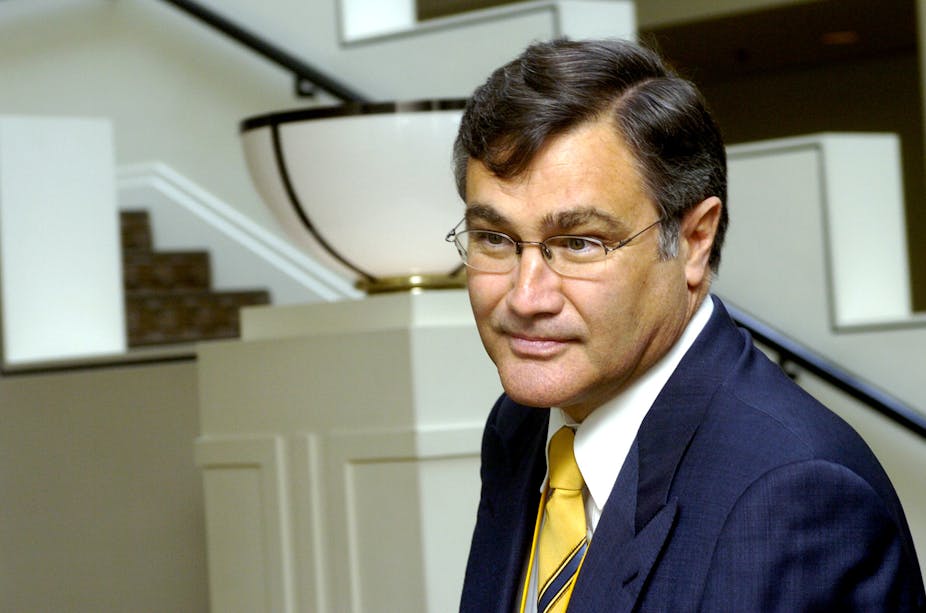
Former Premier Geoff Gallop helped reform the Western Australian Labor Party. But can it be done federally? AAP/Alan Porritt

There are always two challenges that face a political party operating in a democratic system such as ours – public trust and public policy.

When I was elected leader of the Western Australian Parliamentary Labor Party in 1996, the trust factor was pre-eminent. The public had invested much in the Labor Government of the 1980s, only to be disillusioned by the corruption revealed in WA Inc. Royal Commission.

Senior Labor figures both inside and outside parliament were found wanting. Some were criticised, some charged with offences and some went to jail. It wasn’t a pretty picture.

Strangely enough, however, it provided Labor with an opportunity to become the party of political reform, as the Coalition government was lukewarm about some of the commission’s recommendations. This created space which we were only too happy to occupy. Indeed, the recommendations were consistent with what many of us saw as core values, such as one-vote, one-value democracy, accountability and the public interest.

This helped Labor re-position itself but was never going to be enough. Would the public believe in Labor and trust it to deliver? Had the party learned the lessons from the 1980s?

We succeeded but it required disciplined effort around three objectives: trimming the edges of factionalism; ensuring all communities throughout the state knew that Labor was active and listening; and keeping vested interests well away from caucus deliberations. Some sections of the party resented this style of politics but they were in a minority, except on the question of organisational renewal.

It needs to be said, however, that the organisational renewal question was not as important as it is today. There was energy within the party and robust political debate over important issues such as market reform, forest conservation and native title. My commitment to a reformist approach wasn’t ticked off before there had been widespread consideration in all party forums – from committee, to executive, to conference, to caucus.

None of this was perfect – it never is – but we did look and feel like an accountable organisation in which the common good had a better than even chance of winning.

This brings us to New South Wales Labor today, and indeed to the ALP more generally. The case for serious reform in the organisation has become crucial. The party has too few members, too few supporters and too few voters. What may have been an acceptable mix of tradition and change in the late 1990s won’t be enough now.

There are lots of ideas about how the ALP can be changed and how those changes can be managed – equality of votes, membership selection of leaders, primaries and better scrutiny and training of candidates. There are, of course, many variations on a theme when it comes to the best “package” required to make a difference. However, one question stands out amongst all others: what role should unions play?

Two features of the party stand out. It has a corporatist structure but lives in an era of participating democracy, and it is based on 50% union affiliation, though unions now play less of a role in the consciousness of the working class.

In other words, too few individuals from too narrow a political base are in the dominant position and will need to be convinced that change is needed.

The argument isn’t easy, as particular unions with their particular interests will be on a level playing field. Candidates too will find the going tougher as they are more closely questioned on their politics and their aspirations. Leaders will enjoy more authority but will be tested more thoroughly before being given the right to lead.

However, it’s only a reformed Labor Party that will have the capacity to break the back of the populist right and the green left. Both of these currents have a constituency which is damaging Labor, but not an acceptable philosophy for government.

Social democrats and their main opposition, liberal conservatives, do provide such a philosophy. Indeed, they compete for the right to govern. They do this, however, by way of political parties and they need supporters and members, connections and networks, and activists with energy.

There’s still life in the ALP but without reform will it be enough to meet the challenge of contemporary democracy? What’s at stake here is social democracy: is it an idea that has the potential to define government, or is it just one idea amongst many which seeks influence but not power?

Join the conversation

24 Comments sorted by

  1. Fran Barlow

    logged in via Twitter

    "However, it’s only a reformed Labor Party that will have the capacity to break the back of the populist right and the green left. Both of these currents have a constituency which is damaging Labor, but not an acceptable philosophy for government. Social democrats and their main opposition, liberal conservatives, do provide such a philosophy."

    Here's your basic problem. The perspective of the two parties is focused around managing and tweaking a system based on class privilege, which by definition…

    Read more
  2. Eric Ireland

    logged in via Facebook

    I think part of the reason the ALP has trouble attracting members is that members don't appear to have much influence on actual policy. The policy on asylum seekers is an example... I'm not totally up on the details, but according to my understanding the national conference decided that on shore processing was the official policy, but caucas just ignored it and decided to pursue a race to the bottom against the liberals. Say what you will about the "faceless men" of yesteryear, but at least they ensured rank and file members had some kind of influence on policy, albeit indirectly.

    report
    1. John Harland

      bicycle technician

      In reply to Eric Ireland

      During the two decades I was active in the Labor Party we generated considerable change at branch level.

      Not least the reforms of the Victorian branch in the late 1960s. That was driven entirely by the branches in the first instance.

      Since the mid-1980s it has seemed pointless. A member is a number, no longer a participant.

      report
  3. Comment removed by moderator.

  4. Craig Minns

    Self-employed

    Firstly, I'll endorse Fran's excellent comment. Both parties draw on candidates from the same social and educational background, who have often been playing the game against each other since school debates or student politics. Gallop himself is an excellent example of such a person, as are the incumbent leaders in all of the federal parties. Additionally, there is now a strong trend toward family dynasties, whereby the children of long-term politicians are parachuted into seats with little chance…

    Read more
    1. Tony P Grant

      Neo-Mort

      In reply to Craig Minns

      A great reply Craig.

      I am in the middle of attempting to get a "local' to run in Dobell. All the so-called "big hitters" are out "injured'..."heart problem" and there is a reluctance by the branches up on the central coast to go against "Sussex St"...oh, I am a ALP member, I rejoined 15 months ago after many decades out of the loop..for all the reasons you have mentioned and "others".

      Yes, the informal vote was up around 2% in the 2010 election. I think the Abbott factor will reduce this number…

      Read more
    2. Fran Barlow

      logged in via Twitter

      In reply to Craig Minns

      While I welcome your general support Craig, I certainly wouldn't endorse the following observation:

      {The other factor that I thought Dr Gallop made too little of is the fact that unions have lost the support of working men, with the Union movement now largely dominated by white-collar women, in the form of bureaucrats, nurses and teachers, none of which groups should have any right to regard themselves as entitled to Union support in my view. }

      I strongly believe that union representation is…

      Read more
    3. Craig Minns

      Self-employed

      In reply to Craig Minns

      Best of luck Tony. Is Thomson going to contest? The mind boggles...

      Fran, let's look on the positive side; at least we have some common ground. The devil is, as always, in the details of the differences.

      Firstly, there is no doubt that the union movement has become dominated by the white collar (mostly female) unions.
      http://www.theaustralian.com.au/opinion/columnists/membership-fall-crisis-for-unions/story-fnbkvnk7-1226343081983

      "The overall figure of 18 per cent was made up of a small…

      Read more
    4. Craig Minns

      Self-employed

      In reply to Craig Minns

      Fran:"I don't at all agree that the occupations represented by the Law Society and the AMA are comparable to those advocating for nurses, clerical workers or teachers."

      I'd be very interested as to your reasoning. Discussing this yesterday, a good friend supported your view and in doing so made the point that the difference is to do with the level of personal autonomy and responsibility that applies. He suggested that bureaucracy, teaching and nursing are essentially skilled labour following direction…

      Read more
  5. lucian weyland

    One who serves the people

    35 years ago the Labor caucus made the decisions for the Labor Party whilst Fraser made the decisions for the Liberals.
    Then Labor was for a nuclear-free Pacific, the right to take industrial action, land rights, refugee rights, free comprehensive health care ( including dental) free tertiary education, banning Uranium mining and opposition to Apartheid South Africa and Rhodesia.
    What does Gillard's party stand for today?
    No right to strike, Additional US bases in Australia, US war in Afghanistan, forced return of refugees to places of danger, expensive university and tafe studies, export of Uranium to nuclear weapon nations, and Apartheid Israel.

    Labor, however, does not need reform - it needs replacement.

    report
  6. Peter Ormonde

    Peter Ormonde is a Friend of The Conversation.

    Farmer

    Jings - now there's an interesting notion - "social democrats" on one side of the house and "liberal conservatives" on the other. Now I wonder how we're going to be spotting the difference. Hairstyle?

    Is Labor's policy on say gay marriage a social democratic viewpoint or a liberal conservative cop-out? Is Christmas Island a monument to social democrat reformist zeal? What do these words mean?

    Short answer is bugger all.

    Not unless the actual base of the social democrats drives the…

    Read more
  7. wilma western

    logged in via email @bigpond.com

    Everyone seems to agree the ALP needs to reform but it also needs to retain national government in order to get at least some steps going towards reducing green house gas emissions , more equitable funding of schools , a national disability insurance scheme etc.It is rather outlandish to suggest that a government with a handful of capable women in Cabinet is totally dominated by "Emily's List". Gillard herself had 3 goes I believe before getting endorsed for a winnable seat. There has been agreement…

    Read more
    1. Peter Ormonde

      Peter Ormonde is a Friend of The Conversation.

      Farmer

      In reply to wilma western

      Excellent comments Wilma.

      To be honest I'm not sure what makes a good reformist politician - at least in the CV sense goes. Some of the best (eg Keating) have been little else than political apparatchiks, while at least in NSW here have simply inherited their seats. They are amongst the worst of them.

      It's interesting though the role that talented and committed women are playing in this government - I suspect it's largely because they are coming from outside the dominant boys' club and union…

      Read more
    2. Craig Minns

      Self-employed

      In reply to wilma western

      Wilma, it's far from bizarre to suggest that the Government of one of the founder's of Emily's List (who has never belonged to a union) is dominated by the policies of that organisation. I'm sure you see no problem in the suggestion that an Abbott Government would be dominated by policy informed by Abbott's Jesuitical background, so why are you in denial about the Gillard/Emily's list policy nexus?

      Giillard owes her job to the support of both Left and Right factions, and her Emily's List organisation…

      Read more
  8. John Harland

    bicycle technician

    Not all change is reform. The concept of reform, as I understand it, centres on reinterpreting the existing culture to work in new ways.

    Much so-called reform consists of imposing foreign concepts, particularly those of groups such as the Harvard School, without respect for the existing culture(s) of a people.

    Change within the Labor Party in recent decades leaves many older or previous members feeling that the culture they cherished has been trashed, not developed or built upon.

    report
    1. Craig Minns

      Self-employed

      In reply to Peter Ormonde

      Peter, the observation that there is a formalised gender-based female organisation that is being destructive does not demonstrate the existence of a "boy's club".

      I'm afraid your comment is typically fatuous.

      report
  9. Peter Ormonde

    Peter Ormonde is a Friend of The Conversation.

    Farmer

    OH dear ... it's like trying to go back in time isn't it? Back to the days when it was "blue collar worklers", union members and awards... back to Labor's roots".

    Trouble is those roots are barely there - like the labor movement has been bonsaied - we've had our roots trimmed and we're stuck in a pot.

    To illustrate:

    1999, the percentage of Australian employees who were members of unions = 25.7%. 2010 (latest available) 18.3%. In 1966 it was just under 50%. Th

    In 2000, some 23.1…

    Read more
    1. Craig Minns

      Self-employed

      In reply to Peter Ormonde

      Peter, I'm well aware of the decline in the traditional blue-collar sectors, whatever the ABS might like to call them. It isn't necessary or desirable, it seems to me and has been driven by factors that are not all intrinsic, although some are consequential on changes in technology and on the structural changes brought about by globalisation.

      However, the fact that these industries are in decline does not lessen their need for good representation - if anything it greatly increases that need…

      Read more
  10. lucian weyland

    One who serves the people

    Progressive parties need to decide whether they want equality, liberty, fraternity, independance, democracy, public infrastrcture, etc? Or do they want economic and political power left in the hands of ever fewer people? The Socialists and, to an extent the Greens have chosen the former, whilst the ALP has ever increasingly chosen the latter course of action.

    report
  11. wilma western

    logged in via email @bigpond.com

    Funny, Craig I thought the prime instigator of Emily's List was past Vic Premier Joan Kirner . And do you think that most of the carers for nursing home elderlies are middle class women? How do you define middle class?And there are some males working there too you know - and male nurses - even members of the nurses'union.

    report
    1. Craig Minns

      Self-employed

      In reply to wilma western

      Here it is from the horse's mouth, Wilma

      "The EMILY's List journey began in 1994, when the ALP National Conference passed an Affirmative Action Rule requiring women be preselected in 35 per cent of winnable seats at all elections by 2002. Among the progressive women who drove this change were Julia Gillard, Deputy Prime Minister, former Premiers Joan Kirner and Carmen Lawrence along with Helen Creed, Candy Broad MP, Kay Setches, Leonie Morgan, Judy Spence, Meredith Burgmann, Jan Burnswoods, Carolyn…

      Read more