


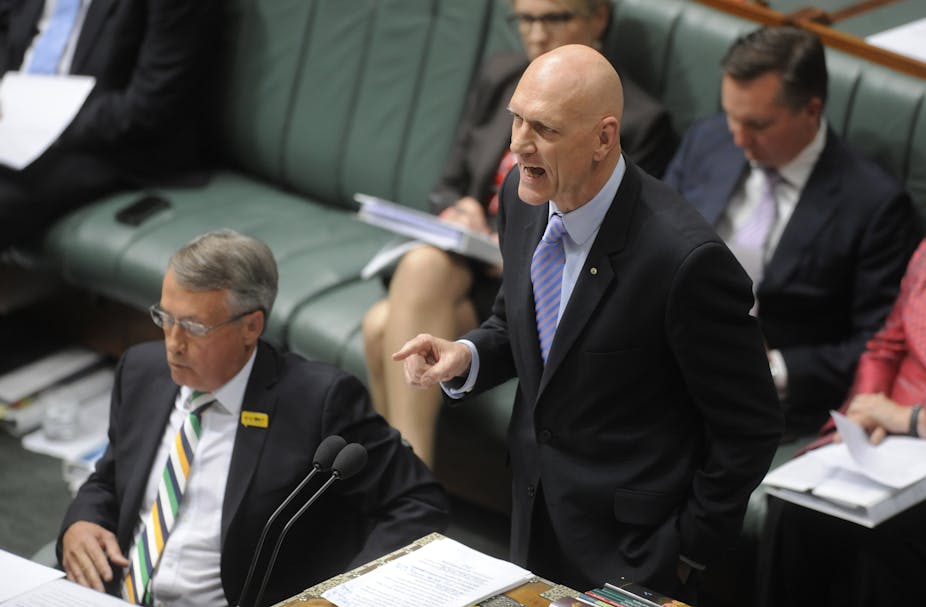
Today the Australia Education Bill – the legislation following on from the Gonski review into school funding – was introduced into parliament.
In September this year, the government responded to the review and promised legislation that would set up a new funding framework and enshrine the government’s goal of having Australia in the top five schooling systems in the world by 2025.
This bill does just that and links funding to benchmarks and measuring educational performance. But these measures are not aimed at enriching the lives of Australians or enhancing equity; instead they focus on the economic imperatives of competition, productivity and prosperity.
This legislation is about competing with other countries, not improving on our own terms – and this is where it falls down.
While Prime Minister Julia Gillard has said the bill is about providing a “quality education for every Australian child”, it’s unlikely to get us there. And in fact, we’re at risk of copying the mistakes made in other education systems.
Learning the lesson
Australia has been privileged this year to host two of the most outstanding education thinkers of our time – Dr Pasi Sahlberg Director General, Ministry for Education, Finland and American Professor of Education Michael Apple. Both were scheduled to talk with education department officials and – both had to reschedule discussions due to the “unpalatable” nature of their messages.
But the warning from them, and the example set by their two very different countries is clear. We should be cautious about the experiments underway in some education systems and take a closer look at what Sahlberg calls the GERM – the global educational reform movement.
This movement favours increased competition, spurious school choice, use of data from standardised tests to determine teacher pay and funding, more curriculum prescription, and stronger bureaucratic oversight through so-called accountability measures. Measures that are at the core of the Australian Education bill.
At the moment, these ideas are like an epidemic, infecting education systems. It travels with its neo-liberal advocates, an unquestioning media and politicians who are all too prepared to use education as a political football.
Australia too, is infected. With the publication of NAPLAN data and the league tables made possible in MySchool, our schools have indeed become ill, our teachers and students don’t feel well, and the net result is the exact opposite of the intended improvement. These measures mean our children end up learning less, not more.
Change for the worse
This Australian Education Act 2012 serves to only further reinforce this movement and its ill-effects on our school education by legislating for the first time in our history that all schools, whether they are public or private, will receive public funds.
The legislation states that the funds are dependent on improving the performance of schools and school students and developing benchmarks. These performance benchmarks would then notionally foster “increased transparency in relation to schools, assessing and improving school performance; gathering and sharing evidence about the most effective methods of improving the performance of schools and school students”.
The Bill suggests that all this will be accomplished through an emphasis on quality teaching and quality learning, empowered school leadership, transparency and accountability and meeting student need.
The implication is Australia does not have quality teaching and learning; that it has a disempowered leadership, lacks transparency or accountability and is not meeting the needs of students.
But this is, by and large, untrue. And the problems that are there are unlikely to be fixed by performance pay raises, achievement scores, and standardised national testing.
There is robust evidence that these do not make curriculum better, prevent school drop outs, or enhance student achievement – in fact, it is exactly the opposite.
In her speech to Parliament Julia Gillard stated that “we now have clear evidence about how disadvantage holds many students back” and repeated a fallacy that teachers are the biggest factor in student performance.
Once again the blame is being shifted downwards – shifting responsibility to those who can have little or no impact on the lives of students and families in their care.
In fact all the evidence shows that the greatest variable in student performance is the socio-economic status of their parents.
An unlikely path to success
The Bill’s claim is that every school student will have the same opportunity to have the best possible education; every school will be funded according to a formula that accounts for the costs of providing a high quality education; every school will be funded in recognition of the characteristics of the school students at that school.
If this were true, then we should expect to see at the very minimum no public funds being made available to the already over-resourced, over-funded elite private schools around the country.
What we can expect unfortunately from this legislation is more competition through bogus school choice – where schools compete against each other, principals compete against each other, teachers compete against each other.
As the Prime Minister states in her speech, “we test the reading, writing and mathematics of our children and publish the results of those tests”.
And if achievement as measured by these standardised test scores do not rise then teachers and principals’ jobs will be on the line.
The task for public schools and their teachers as a result of this legislation will now be to provide evidence that they are now starting to act more like a corporation – and if that is the case, the product will no longer be children’s educational advancement- but only higher test scores.