
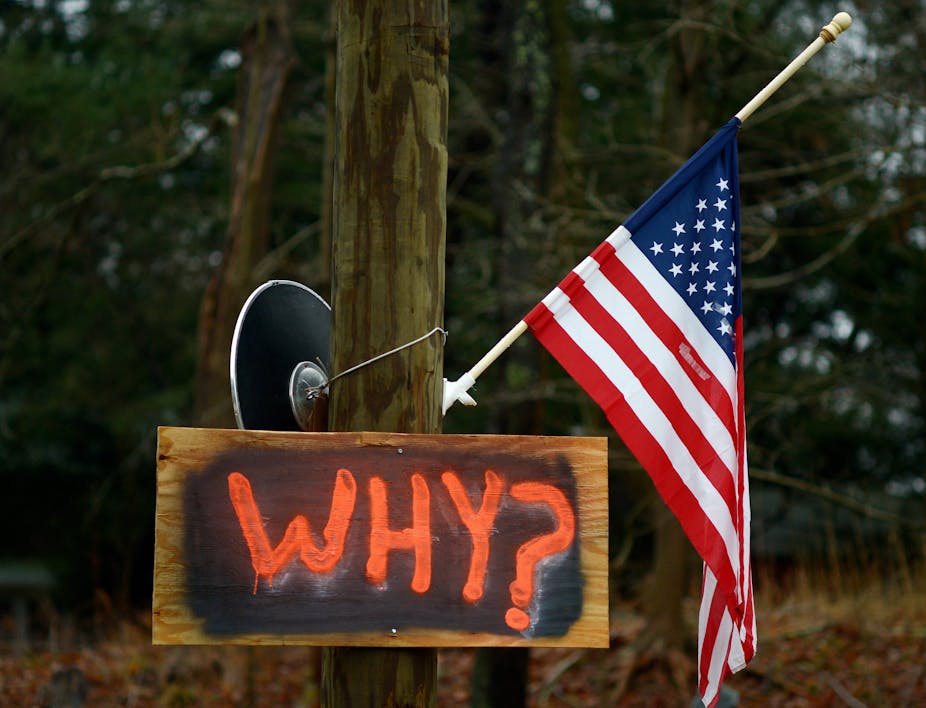
I have been asked a number of barely concealed variations on the question “What’s wrong with you Yanks?” this week.
Lacking anything better, my answer to the American thanatos with guns has been our national mythology of armed struggle for liberty, first against the British, then other nations in North America, and ultimately on a global scale.
But opposition to gun control is not a universal American value. Indeed, there is as distinct a red/blue divide on this as there is on virtually every other political and cultural issue in the country today. Tim Lynch has provided an excellent analysis of how gun control, along with abortion and virtually every other policy debate in America, has become part of the left-right ideological divide over the scope of government rather than a genuine technocratic discussion about reducing firearms violence.
Divided nation
Increased ideological polarisation means that gun control measures – which enjoyed the support of nearly three quarters of Americans 20 years ago, and despite a decline in the proportion of Americans who actually own guns – are now no better than at 50-50, even in the wake of this atrocity. In fact, New York Times data guru Nate Silver has reported that the decline in gun ownership since the 1960s has come almost entirely from Democrats.

The National Rifle Association, the most prominent but not the only gun lobbying group in the country, issues voting guides for its members using the American education system scale of A-F. Republicans in Congress – nearly all of them – have A ratings. Democrats – nearly all of them – have F ratings.
There are two victims of mass shootings in the House of Representatives, both Democrats. Carolyn McCarthy of New York was a suburban Republican voter until her husband was killed and son seriously injured by an assault weapon-wielding gunman on the Long Island Railroad in 1994. When her congressman refused to support gun restrictions she was recruited by Democrats to unseat him. Ron Barber of Arizona was himself shot while serving as an aide to Representative Gabrielle Giffords in a January 2011 attack at a public event at a supermarket and won Giffords’ seat after her injuries forced her resignation.
Today it is almost impossible to imagine a strong Republican supporter of gun control, with the most prominent example, New York Mayor Rudy Giuliani, attempting to discard his position when he sought the GOP presidential nomination. To conservatives today, guns continue to represent liberty – the ability to defend family and home against criminals or, in the fevered imaginings of the far right, against the United Nations or the American Federal government itself.
Gun control from Johnson to Clinton
Increasingly since the mid-1960s, being a conservative has meant being a Republican, and it has been mostly Democrats who have championed gun restrictions.
President Lyndon B. Johnson campaigned throughout his term for firearms restrictions in the wake of the most high-profile shooting in American history, the assassination of President John F. Kennedy. Even with the assassinations of Robert Kennedy and Martin Luther King prompting further action, he was bitterly disappointed with the Gun Control Act of 1968, passed with difficulty by Congress, which did little more than ban interstate gun sales and prohibit some convicted criminals from owning guns.
The shooting of President Ronald Reagan in 1981 sparked the next major piece of gun control legislation in the United States. This one taking even longer to come to fruition. Reagan’s would-be assassin, a mentally ill individual who hoped to win the favour of actress Jodie Foster by emulating her “saviour” in the movie Taxi Driver who planned to kill a presidential candidate, critically wounded Reagan Press Secretary James Brady, leaving him wheelchair-bound with a degree of cognitive impairment. Legislation named for Brady that would require criminal and psychiatric background checks before permitting gun purchases was introduced in Congress in 1987 but defeated in the face of concerted gun lobby opposition.
In 1989, President George H.W. Bush issued an executive order banning temporarily (later permanently) the importation of semi-automatic and automatic weapons. This was in response to a shooting at a primary school in Stockton, California, where a mentally ill man with an assault rifle killed five children and wounded nearly thirty others. But Bush opposed legislation banning assault weapons and actually vetoed the Brady Bill in 1991, claiming that the crime legislation within which it was contained was “too soft” on criminals. A number of conservative or rural Democrats (there were still a number at the time) also opposed the legislation, including House Speaker Tom Foley.
The following year, Bill Clinton displayed his innate talent for reaching out to the aspirational middle class while running for the White House by accusing Bush of being “soft on crime” in failing to protect suburban school children from gun massacres. The strategy was intended to counter decades of Republicans successfully framing Democrats as being more concerned with the civil rights of urban racial minorities than the security of white middle class voters.
The Brady Act
President Clinton succeeded in passing the Brady Handgun Violence Prevention Act in late 1993, probably only because he arranged for Congress to vote on it at the same time as the North American Free Trade Agreement and was able to muster sufficient quid pro quo votes for each. The act instituted a mandatory six-day background check conducted by state governments before allowing individuals to purchase guns from licensed dealers. The Supreme Court later found that delay to be unconstitutional, but by then it had largely been obviated by electronic instant checks by the Federal government.
The following year, Clinton’s Crime Bill, authored by then Senator Joe Biden, which contained an assault weapons ban, faced unanticipated difficulty in Congress and was defeated on its initial vote by the Democrat-controlled House. A cost of passage was the inclusion of a “sunset provision” that would end the ban after ten years unless Congress voted to renew it. The 1994 Crime Bill contained other measures intended to reduce violent crime, such as funding for after-school programs in areas dominated by street gangs. Republicans returned to their successful playbook by charging that Clinton was out of touch with middle America, taking away the self-defence capacity of “average” Americans while spending their tax dollars on “midnight basketball” in the inner cities. The National Rifle Association vowed revenge.

The 1994 elections that followed were a Republican wave. Although the GOP did not win as many House seats as it did in 2010, it gained control of both chambers of Congress for the first time in 40 years, as well as the majority of governorships. While it is impossible to know the extent to which resentment over gun control contributed to this, the fact that Democrats finally lost their hold on the conservative rural and Southern states where they had enjoyed dominance since the Civil War made it conventional wisdom that it would be political suicide to take on guns again. Neither Al Gore, John Kerry, nor Barack Obama pushed for new gun laws in their campaigns, despite high profile shootings such as the one at Columbine High School that temporarily built national support for new restrictions.
The assault weapons ban expired in 2004 with President George W. Bush and the Republican congressional leadership announcing that they had no interest in maintaining it. During their four years of unified control of Congress after the 2006 elections, Democrats passed no major new crime legislation related to guns.
The opportunity to change
Strangely enough, it was the Democratic drubbing in 2010 that again wiped out representation in pro-gun districts that may have broken the logjam of the past 20 years. Following these losses was the Democratic success in winning in 2012 with a new electoral coalition of groups that support tougher gun restrictions. Polls show that the only demographics of the population that now strongly oppose gun control are those that Democrats are going to lose anyway and no longer need to win: older, conservative white men. Democratic strategists are now saying that they have nothing to lose by pushing forward.
Most pro-gun Republicans have been silent in the first week after the Connecticut massacre. The NRA went so far as to suspend its Facebook and Twitter accounts for days before it broke its silence. It is possible that this will be the first time in decades that gun control will not be a partisan issue. The early signs are that prominent southern and rural Democrats now favour an assault weapons ban.
President Obama has signaled his support for the permanent ban on assault weapons and high capacity ammunition clips proposed by Senator Dianne Feinstein, a California Democrat. (Feinsten became mayor of San Francisco after a 1978 gun double homicide). Without concerted conservative opposition, it seems reasonable that Feinstein’s bill can pass the GOP-controlled House with the support of suburban Republicans.
But Feinstein points out that her bill would only renew the previous ban; it would not require the elimination of the thousands of assault weapons already scattered across America, many in the arsenals stockpiled by survivalists such as the shooter’s mother. There is no plan being publicly mooted in Congress at the moment to buy such weapons back and, let’s face it, the survivalists would never give them up anyway.
Reducing the number of automatic weapons and high capacity magazines out there is certainly a good thing. But it seems as though the most aggressive measure being contemplated against gun violence in America represents only a continued halting evolution, and not a fundamental shift.
John Coochey
Mr
Am I the only person in Australia who has not written an article about the recent US tragedy? Why any more, is there no other news? What I would like to know is the source for a decline in gun ownership that is claimed. Is that registered guns or does it include those not registered? If it is based on a survey or surveys it should be treated with caution because a 1989 survey found one in five Australian households had a gun for personal protection which means one in five were breaking the law because you cannot own a firearm for personal protection and the actual number of households with a firearm was probably a tenth of that (based on ACT figures where registration has always been compulsory.).
Dennis Alexander
logged in via LinkedIn
Mr Coochey, just in case you haven't yet realized, the dark blue text in Conversation articles is indicative of a link to a source - in the case of your question, and article by Nate Silver (identified in line in the article text) based on the US General Social Survey. That answers several of your points and if you had read carefully they would not have been necessary. the remainder of your comment, hinging on your interpretation of an uncited survey (which may have had optional multiple reasons for owning a gun including personal protection but it is uncited so I cannot check your assertion) and uncited ACT figures, tends to suggest that surveys might overestimate gun ownership in Australia.
John Coochey
Mr
The ACT figures are from the census and act firearms registration which may be available from the AIC. The one in five was from the 1989 international crime survey not the 91 which had widely different figures in some areas. Both surveys were criticised for having inconsistent collection methods but I remember Patricia Easteal now of the University of Canberra to say how disgraceful the sexual assault figures were for Australia when the 89 figures were released causing one commentator to ask why she continued to live her (she is American) but when the 91 figures were released with an average rate for an indusrialised country she remained silent. It would appear the one in five figure was strategic answering with a view to not encouraging home invasion.
John Coochey
Mr
Thanks to Dennis for drawing my attention to a secondary or tertiary source in the form of a press article. The subsequent link seems to be firewalled or at least only available on password but from the summary it appears it suffers from the same uncertainty as the International Crime Survey. What it does point out is that according to an electoral exit pole about half of voters claimed they had a firearm in the house which is different from a broadcast on ABC Canberra this morning which claimed a third. Can anyone throw any light on this anomoly?
Peter Kelly
logged in via Twitter
@ John Coochey "...according to an electoral exit pole about half of voters claimed they had a firearm in the house...."
How you extrapolate "about half" from 42% is a quandry; however without knowing the ABC source, the 2008 National Exit Poll (conducted by Edison Media Research/Mitofsky International) would be authoritative.
The 1992 International Crime Victim Survey reported that 15% of Australian households owned a firearm. The 2000 ICVS reported 8%. The UN Office on Drugs and Crime publication…
Read moreDennis Alexander
logged in via LinkedIn
Thank you David. the history is useful to our understanding of a culture that we think we know but perhaps do not know as well as we think. Lucy Ferriss, writing for the Chronicle of Higher Educations Lingua Franca (http://chronicle.com/blogs/linguafranca/2012/12/17/speaking-of-guns/) talked about the linguistic framing of the debate in the US as being about 'gun rights' and the 'Second Amendment' for the gun lobby and those who agree with it. Apparently, according to Ferriss, attempts by opponents…
Read morePeter Kelly
logged in via Twitter
I would like to join Dennis is thanking David for this useful synopsis of gun control legislation and political debate in the US.
Nate Silver's excellent blog was interesting.
I'd also like to thank Dennis for pointing out the article from the Chronicle of Higher Education, a great read.
John Coochey
Mr
Thanks to Peter for pulling up some sources and showing the variation. I would not trust any survey on this or most other issues but go for administrative data which should be available for both the US and Australia. I do not know if it is on the web but I spent some hours in the ABS library reading their own investigation about how survey data is at variance sometimes huge variance with survey data. Here are some quotes from the article cited in the original article above and another source. One…
Read moreColin MacGillivray
Retired architect
Good article.
The USA needs to start the process of aligning its policy on guns with those of its ancestors- Europeans. It could take generations. Start with prohibiting weapons better found in the armed forces and over time stigmatize gun glorification. The USA might catch up with Europe in 50 years.
Firozali A.Mulla
PhD
Michel Bloomberg was very clear on this. He said there are many guns out there get them but the question remain how do we get all of these when the guns don kill , people do so are we back to square number one ? I wonder I thank you Firozali A.Mulla DBA
Justin Idea
Part-time ponderer
It may be impossible to retrieve inappropriate firearms but surely taxing (punitively?) regulating and restricting ammunition is doable?
There is likely to be a future increase the ability to manufacture your own firearm via 3D printing - http://techcrunch.com/2012/12/06/im-not-afraid-of-3d-printed-guns/ . Stricter regulation (licensing and volume limitation) of commercially produced ammunition and components (particularly primers and powder) may be a practical way to reduce the problem over time.
Bruce Tabor
Research Scientist at CSIRO
It seems to me that too many Americans love their guns more than their children.
Anthony Nolan
Ruminant
David Malet: the truly alarming element of this article is your approving link to an article on the same issue by Tim Lynch in which the latter argues that the 'left/right' divide on guns and abortion is based on some sort of genuine moral equivalence. Lynch states:
"In response, pro-gun and pro-abortion lobbies both argue a variation of “so what?” and “who cares?” The holding of the right is more important than the consequences of its holding."
(readers are urged to read the linked article…
Read morePeter Ormonde
Peter Ormonde is a Friend of The Conversation.
Farmer
Great piece David, many thanks.
One of the things I find so confounding about the history of the US is the chronic fear that lies under this gun culture. Seems to be a rather recent development, beginning in the post WW2 era and the Cold War. John Wayne and Clint Eastwood probably played a part, but prior to the 1960s there was virtually no public discussion of guns, no 2nd amendment agitation and from what I can find, relatively low levels of gun ownership - certainly below Canada and Australia.
I'd be most interested if anyone has found any history of the gun culture that gives some insight into where and when this contagion infected the place.
While common sense and humanity would suggest restrictions on high kill rate weaponry are long overdue, it is this climate of fear - of everything - that underlies the problem and that seems a most intractable problem.
Margo Saunders
Public Health Policy Researcher
Peter, I grew up in the suburbs of a major US city in the '50s and '60s, and the 'climate of fear' was there then. For us, it meant not going downtown, always keeping the car doors locked to prevent someone jumping in and assaulting us when stopped at an intersection, and my father always keeping a French bayonet next to him in the car in case he needed to defend himself in such a situation. Crime and gun violence were associated with blacks, the poor, and with gangs. Not venturing out of a 'nice' neighbourhood was considered to be the best protection. If you did hear strange noises outside your home at night, the man of the house would typically grab something like a hunting rifle and stomp around outside to scare the intruder away. Major culture shock, indeed, when I moved to the UK in 1972,only to find that police officers didn't carry guns!
Peter Ormonde
Peter Ormonde is a Friend of The Conversation.
Farmer
Sorry Margo I have to reply to myself up here because this silly new system won't let me do the obvious.
I've spent the last few days trying to get a grip on this from a few angles in which I have some experience - and I keep coming back to history and race. The latter is the big one.
The increase of serious weaponry - high capacity magazines and automatics and semi-automatics (crowd killers) seems to coincide with the Kennedys and Lyndon Johnson and the civil rights movement. Perhaps it…
Read moreRichard Ure
logged in via Facebook
This historical account is a good foundation for trying to understand this conundrum. Despite a good attempt by US citizen Lionel Shriver to explain, she does not have all the answers either. http://www.bbc.co.uk/news/world-us-canada-20762510
Margo Saunders
Public Health Policy Researcher
@ Peter O: Here are some stats on gun ownership by race: http://www.statisticbrain.com/gun-ownership-statistics-demographics/
Also, this may be of interest (written in 1991):
‘From the mid-1960's to the mid-1980's, scattered evidence strongly suggests that, while gun ownership increased in general, it did so even more among criminals and violence-prone people than it did among the nonviolent majority of the population. Because these "high-risk" groups are largely unrepresented in national surveys, this would partially account for the fact that household gun prevalence in national surveys remained fairly constant during this period, despite huge additions to the total stock of privately owned guns. … Only since the mid-1960s has a large share of gun ownership been attributable to concerns about crime.’
[http://www.catb.org/esr/guns/point-blank-summary.html]
Peter Ormonde
Peter Ormonde is a Friend of The Conversation.
Farmer
Thanks very much for those Margo.
I've come across the Gallop polling figures elsewhere but tended to opt for other sources given Gallop's rather appaling strke rates on predicting election results. I have a deep possibly irrational suspicion of polling - perhaps I was bitten by a market researcher as a child = but the methodology is often dodgy anmd the analysis even worse. Also phone polling tends to get a very low response rate (approx 10%) and systematically underreport minorities and low…
Read moreMargo Saunders
Public Health Policy Researcher
And here is a reasonable article by a couple of grad students, whose info and analysis are pretty consistent with my own experience & understanding: http://edition.cnn.com/2012/12/26/opinion/breland-gergi-gun-victims/index.html?hpt=hp_c1
Gil Hardwick
Anthropologist
Sorry, but this article reverberates to me less on moral principle and practical utility that on 'why pick on us'.
Who cares what happens elsewhere, that's no excuse.
My view on 'evolutionary change' is nothing more than failure of governance, an inability of decision-makers to make decisions.
My justifaction is the sheer numbers of children killed in American schools, over far too many years now, when any sensible priority for any government anywhere is higher education not freedom to bear…
Read moreFirozali A.Mulla
PhD
Some want cash form all the sources and we are seeing this now? The family of Noah Pozner was mourning the 6-year-old, killed in the Newtown school massacre, when outrage compounded their sorrow. Someone they didn't know was soliciting donations in Noah's memory, claiming that they'd send any cards, packages and money collected to his parents and siblings. An official-looking website had been set up, with Noah's name as the address, even including petitions on gun control. Noah's uncle, Alexis Haller…
Read moreZvyozdochka
logged in via Twitter
Another interesting take here;
Guns: Down With Big Gun - @Gawker http://gawker.com/5968807/down-with-big-gun
Peter Ormonde
Peter Ormonde is a Friend of The Conversation.
Farmer
Thanks Z ... a very impassioned piece and spot on the money I think - particulalry the recommendations.
Let's hope there's some hope.... a virtuous circle.
But it is terrible to be reading the gun-toter press and blogs. 12 hours after the Connecticut news broke is the earliest "WATCH OUT!! THERE (sic) COMING TO TAKE YOUR GUNS" post I've found so far.
Perhaps because of the extreme insensitivity required, the discussion so soon after the event was extreme - in language and ideas (madness…
Read moreMargo Saunders
Public Health Policy Researcher
PR Daily has run a commentary on the NRA's take on the whole thing, entitled, 'Social media users skewer NRA’s press conference'. See: http://www.prdaily.com/Main/Articles/13464.aspx#
Peter Ormonde
Peter Ormonde is a Friend of The Conversation.
Farmer
Thanks Margo.
The NRA's really shot itself in the foot I think ... the tighter the circle gets the more the future promised by these fear-mongers becomes apparent. Connecticut itself is sympotmatic, as is their response - even more distinct perhaps.
The NRA comments have been widely reported here - generally in a stunned disbelief. On-line comments have been invariably incredulous. He's the best advocate for gun control you've got I reckon. Get him lots of press. Interviews. Pay for…
Read moreMargo Saunders
Public Health Policy Researcher
And here's another interesting commentary on the gun-owning rationale ('Why I taught my 13 year old daughter to shoot' - Washington Post): http://www.washingtonpost.com/opinions/why-i-taught-my-13-year-old-daughter-to-shoot/2012/12/21/ac61c386-4a0b-11e2-820e-17eefac2f939_story_1.html
This reminded me that, according to my husband, there was nothing extraordinary about a teenage boy walking down the main street of small towns in NSW in the 1960s with a hunting rifle.
Firozali A.Mulla
PhD
I am surprised that we are still on this issue where by the new issue ought to be and daily things change the FISCLA CLI FF I thank you Firozali A.Mulla DBA
Firozali A.Mulla
PhD
The lateas today UK Paper FOUR more Americans died in a shooting yesterday — as pro-gun campaigners demanded weapons for every school following the Sandy Hook massacre.
The gunman — named in local reports as Jeffrey Lee Michael, 44 — shot dead two men and a woman.
He struck after driving wildly up and down a country road near Altoona, Pennsylvania.
Kimberly Scott, 58, was shot as she decorated a church hall for a kids’ Christmas party. The second victim was killed outside a nearby home and the third was blasted after the gunman’s pick-up truck hit him. I thank you Firozali A.Mulla DBA
Daryl Deal
retired
"The only man who needs a gun, is the one who uses one!" - Marshall 'Wistful' McClintock, a closing statement of fact in a 1947 western.
As we all know, there is a very fine line between that which is normal, and an obsessive compulsive mental illness disorder. Many gun owners, fall into the latter category, with the exclusion of a very few.
As for the "National Rifle Association" or 'NRA' as it is widely known as.. A simple analysis of their daily output of propaganda, clearly show us, that it is identical in every aspect, to that which was first crafted by the notorious 'Hill & Knowlton' for the 'Tobacco Industry' in 1950, to defend that which is indefensible and swamp all relevant facts of reality with complete nonsense, to create the illusion of a fictional non existent debate.
“To sin by silence, when they should protest, makes cowards of men.” ― Abraham Lincoln
Such is life.
Margo Saunders
Public Health Policy Researcher
Just read about the latest gun tragedy in which a teenage boy murdered his parents and 3 siblings with a rifle kept in his parents' closet. Why? Because he was 'annoyed with his mother'. [http://www.smh.com.au/world/annoyed-with-his-mother-teen-allegedly-shoots-parents-and-siblings-dead-20130122-2d4xo.html] I am sure that my two sons were extremely annoyed with me during their teenage years, and they could have inflicted serious harm by means of various weapons such as kitchen knives, Stanley knives or workshop tools, as well as various poisons. But having guns in the house would obviously have made it just sooo much easier.
Gil Hardwick
Anthropologist
Here I do agree with arguments separating gun ownership and access to firearms with wanting to kill people, especially parents and siblings. This relates directly back to other discussion here.
I am not at all sure that the boy concerned is happy with what he did, liked what he did, made a career of it, yet driven to that point picked up whatever was readily at hand and 'lost it', as we say in the trade.
Yes, certainly, a kitchen or stanley knife would not have inflicted so much damage as a…
Read moreMargo Saunders
Public Health Policy Researcher
Teenagers are annoyed with their parents because...we are their parents and they are teenagers. Pretty normal, I would have thought. My sons, when they were teenagers, were annoyed with me because they didn't agree with the rules of behaviour and expectations of accountability that I sought to impose. 'It's my life, it's nothing to do with you,' etc., etc. They had a release valve: they could storm out of the house and go to their father's house (if they hadn't done that, they would have gone to a friend's place). I don't for a minute believe that they would have physically harmed me -- but the verbal abuse sometimes got pretty intense!
Another story: Male friend who was a teen in a small regional NSW town in the early 1970s, where access to guns was normal, tells of sticking a shotgun in his step-dad's face to reinforce a threat. He didn't pull the trigger, though.
Gil Hardwick
Anthropologist
My first question is, what is a teenager? That's what I am getting at. The idea was invented in the US, of literary origin a la Steinbeck and his idea of the disturbed adolescent. When I was young there was no such thing. Past puberty one was a young man, or a young lady.
What is a parent likewise? Having children is suddenly a licence to tyranny?
Second question, which follows, of course; on what grounds do you presume to impose your own ideas of behaviour and expectations of accountability…
Read moreGil Hardwick
Anthropologist
Just to keep things in perspective, Margo, and to clarify my intention here, when I was 13 it was not me pointing a shotgun at either of my parents, but my mother on valium and alcohol pointing a shotgun at me, obsessed from what I can gather with the idea that I might "turn out like my father."
Over the 50 years since I have personally witnessed and accumulated statements from boys especially who faced such abuse from their mother, still today they come to see me about it. We know without doubt…
Read more