
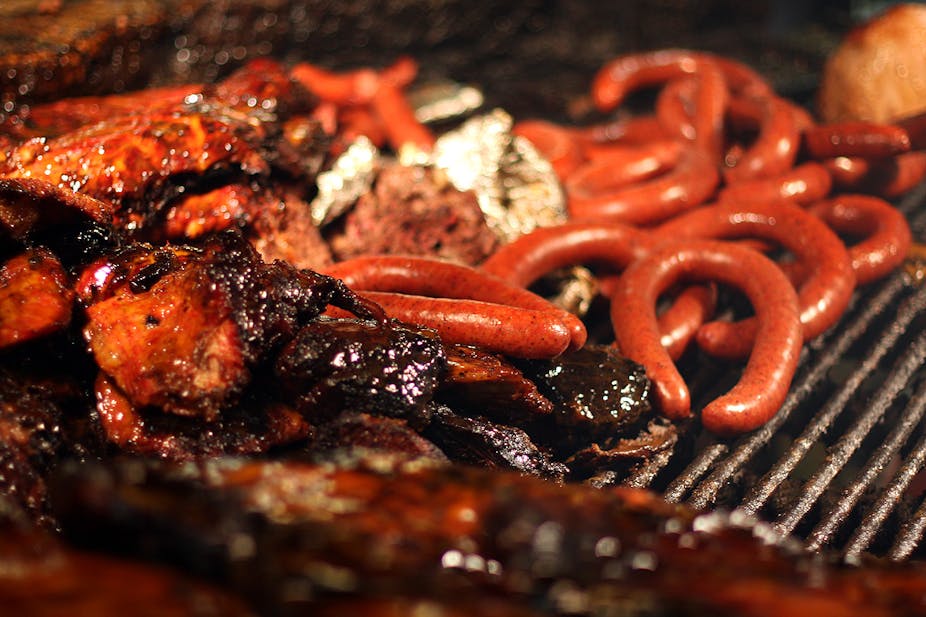
As we settle into the barbecue season, it’s time to consider whether the meat on your grill is harming your health. Conflicting messages in the media certainly don’t help. On one hand are advertisements with Sam Neill claiming red meat is the reason that humans are smarter than orangutans.
On the other, the prestigious World Cancer Research Fund reports that red meat may cause colorectal cancer. Whom to believe?
The good bits, and bad
Some red meat does contain fats our brains need. Omega-3 fats form part of the structure of brains and eyes, and may also help reduce blood pressure and modify inflammation. But meat isn’t the only food containing omega-3 fats. In fact, the richest sources are oily fish.
And if you buy grain-fed steak, you may be getting hardly any omega-3 fats at all. Grass-fed meat (and wild meats, such as kangaroo) is not only better for the environment, but better nutritionally, containing healthier fats and a lower fat content overall.
Red meat also contains decent amounts of zinc and protein, as well as iron, which is one of its big nutritional selling points. Indeed, the iron in red meat is in a form that our bodies absorb easily – “haem” iron.
Meat producers are fond of producing colourful ads that equate the iron content of a bucket-load of spinach with that of a small juicy-looking nugget of lean beef. And iron deficiency is an important issue – but that same haem iron may be harmful in fatty processed meat as you will see.
As well as beneficial nutrients, meat also contains saturated fat, the kind that promotes increased cholesterol levels in the blood and blocks blood vessels that the heart relies on to keep working.
The fat content of meat varies markedly with species and cut. If you buy untrimmed brisket, chuck or shoulder, or luxury marbled meat, such as wagyu or kobe beef, your meat will be around 10% to 20% fat. Ribs, neck, pork belly, and the cheapest minced meat can be up to 50% fat. You can get down to 3% to 5% fat if you trim your meat well of all visible fat and choose leaner cuts, such as loin and round steak, flank and shanks.
Meat and cancer

The cancer risk associated with high consumption of red meat, particularly processed red meat, is definitely cause for concern. In 2007, the World Cancer Research Fund (WCRF) produced an expert report that assessed the evidence for causal links between food, lifestyle and cancer, based on data from all studies that met quality standards.
In the report, the WCRF concluded that there was “convincing” evidence (that is, evidence of both the mechanism and the effect) for a link between colorectal cancer and high intakes of red meat. The link was strongest for processed red meat – bacon, salami, sausages and hot dogs, which contain curing agents such as nitrates and nitrites.
The studies’ data indicated that cancer risk continued to rise with higher meat intakes. This rise appears to start once red meat consumption exceeds 300 grams in a week. The WCRF’s recommendation is that people who eat red meat should consume less than 500 grams a week, including very little if any processed meat products. There was no data to indicate that any level of processed meat intake was free of risk.
Eating fish may help reduce colorectal cancer risk, and some studies indicate that a high fibre intake, and eating lots of fruits and vegetables, are associated with reduced cancer risk.

How it works
How red meat causes the increase in cancer risk is still a question in search of a complete answer. Many different components of meat have been suggested as a mechanism, including the curing agents nitrate and nitrite that are present in processed meat; the fat or the haem iron in meat; the excess protein load that big meat eaters might often consume; and the carcinogens, such as heterocyclic amines (HCAs)and polycyclic aromatic hydrocarbons (PAHs), that can be formed during the cooking of meat.
Protein doesn’t appear to be the culprit, despite the fact that the end products of excess protein intake are quite toxic (these are excreted if the kidneys are working normally). Unlike high-protein diets, high-fat diets have been shown in animal studies to increase cancer risk, apparently promoting gut cancers through their damaging effects in the gut as well as contributing to obesity, which itself is a cancer risk factor.
But studies of low-fat diets haven’t shown a reduction in risk, so other factors may also be involved. The problem with processed meat seems mainly to stem from its salt content (associated with risk of stomach cancer) and its content of nitrates and nitrites, which are added as part of the curing process and can be converted to carcinogens.

And unlike the iron in plant foods, the haem iron in meat seems to help produce mutagens and carcinogens in the meat and in the gut by reacting with the fat in the meat, and by helping to convert nitrates and nitrites to their carcinogenic form.
There are a lot of studies showing that the carcinogenic substances HCAs and PAHs are produced when you cook your meat at a high temperature or on an open flame, and that colorectal cancer risk increases when you consume a lot of these. Some people have a genetic sensitivity to HCAs and they’re at even higher risk.
Mysteriously, although barbecuing chicken and seafood produces large amounts of HCAs, these don’t seem to be associated with increased cancer risk, perhaps because they are different types from the ones that red meats produce. And perhaps their lower iron content has something to do with it.
Cooking for shorter times, or at lower temperatures, produces smaller amounts of HCAs and PAHs. Raw meat, surprisingly, is no less digestible than meat cooked briefly either at high or low temperatures. What really makes a difference in digestibility is overcooking until meat is tough. This reduces digestibility significantly but that increases again in long, slow cooking.

The magic of marinades
Interestingly, marinating meat may be a good idea for health as much as for flavour. A Portuguese study found that several hours’ marinating in beer or red wine significantly reduced the production of HCAs in beef, perhaps by reducing movement of precursor substances to the surface of the meat, or by adding antioxidants that inhibit the reaction.
Other studies have successfully used garlic, rosemary, thyme and sage, and olive oil with garlic and lemon. Cooking with extra-virgin olive oil had a similar effect. But adding sugar or fruit to marinades appears to increase the risk of burning and forming more carcinogens.
So, as you wheel out your barbecue this summer, consider serving sustainable seafood or organic chicken some of the time instead of red meat; stick to smaller serves of grass-fed lean meat, marinated without sugar or salt and cooked to a juicy medium-rare, away from a bare flame; and have plenty of salad with your meal. Food for thought?
Luc Brien
logged in via Facebook
Even better would be to forgo animal flesh and secretions entirely and have a cruelty-free BBQ. There is almost no nutrient we can only get in animal-based food. The one exception to that is possibly B12.
A vegan lifestyle is not only healthier for us, but better for the planet, and definitely better for the animals.
John Newton
Author Journalist
Not possibly Luc, definitely - as a vegetarian you need to get your B12 somewhere.
Joe Gartner
Tilter
Better for sanctimony too.
Luc Brien
logged in via Facebook
To John: The argument, "as an X, you need to get Y from somewhere" is ridiculous. We all need to get B12 from somewhere.
B12 come from a bacteria called cyanocobalamine, which lives on decomposing organic materials. Organic, homegrown fruits and vegetables, fertalised with compost and prepared with minimal sterilisation has B12. There are also a heap of foods that are fortified with B12: plant milks and proteins, nut butters, yeast spreads, breads. The major source of contention is how readily absorbable and usable the B12 in these sources are. If in doubt, we can supplement. I don't, and my last blood test showed healthy levels of everything except Vitamin D, which most people are low in.
Tim Scanlon
Debunker
Vegan diets are not healthier, nor are they better for the planet, nor are they better for the animals.
At best, the vegan diet has different problems, at worst it is nutritionally deficient. Compare a healthy omnivore with an average vegan and the omnivore is healthier. Compare averages with averages and the vegan will be healthier because the average person as an omnivore, doesn't eat enough vegetables, doesn't exercise, drinks too much, is more likely to smoke and eats far too many calories…
Read moreLuc Brien
logged in via Facebook
@Tim,
Sure, a vegan lifestyle has different problems to an omnivorous one. Generally speaking, though, the rates of heart disease, diabetes, high cholesterol, and obesity are far lower in vegans than in omnivorous populations. Is it possible to be an unhealthy vegan? Absolutely! Just as it's possible to be an unhealthy omnivore.
Most of the rest of your response makes almost no sense: "Compare apples with apples and the omnivore is healthier because they have a wider dietary intake, obtain…
Read moreDennis Murray
Senior Honorary Fellow
What of the ameliorating effect of red wine, if any?
mark gardner
just a humble person
I find it has a lovely ameliorating effect on me after one glass...
Joe Gartner
Tilter
I thought this article was quite good until I read this:
'... consider serving...organic chicken...instead of red meat"
What are the health differences between consuming 'organic' chicken and, er, 'non-organic' chicken?
Reema Rattan
Editor at The Conversation
Possibly an editorial oversight on my part, Joe. I think we meant chemical-free by organic and I thought that was apparent enough. I should have anticipated a comment like yours and spelt it out.
Suzie Ferrie
Clinical Affiliate at University of Sydney
Hi Joe,
to be called organic, the chicken has to be produced in a system that is free-range (so the meat should be a bit leaner and the feed should be more varied, although many 'free-range' setups don't guarantee this) and also doesn't use antibiotics. The health benefits of varied feed include more omega-3 in the fat. The main health benefit of avoiding antibiotic use in meat production is in avoiding contributing to antibiotic resistance; obviously this is not a nutritional benefit that an individual will derive from consuming the chicken, but a general health benefit that the whole population derives in the longer term.
Joe Gartner
Tilter
Reema/Suzie,
my point is that all food is organic and contains chemicals. The distinction should be made between 'organic/chemical free' as a marketing/philosophical concept and an actual statement about the physical properties of the food.
i completely accept that free range chooks fed food without antibiotics should be a healthier option (as well as more humane - and in fact tastier) but I would also point out that free range animals may still harbour pathogens and 'chemicals' before, during and after processing.
I think the argument should be less about absolutes, rather than a discussion about the relative ranges of healthfulness or safety attached to different farming, production and consumption approaches.
Geoff Russell
Computer Programmer, Author
Thanks Suzie. There are so many causal pathways by which red and processed meat can cause cancer, that the problem is assigning weights to explain the well demonstrated association. Suzie has mentioned most of them and personally, my money is on heme iron as the biggest culprit, but she missed one new kid on the causal block that might end up trumping the others. Sialic acid is widely distributed in red meat and our flesh, but the form we make is a little different from the form other mammals make. In particular they can make Neu5Gc, which we don't. When this is incorporated in our tissues by eating red meat, our body mounts an immune response to it and this may be the root cause of more than a few diseases linked to red meat.
You can read the gory details here,
http://www.pnas.org/content/107/suppl.2/8939.full
but the short form is "we have been allergic to red meat for about 3 million years ... which is when we lost the ability to make neu5Gc":
Steve Brown
logged in via email @yahoo.com.au
"There are so many causal pathways by which red and processed meat can cause cancer"
So why haven't we seen any of this evidence? All we continue to read is (cherry picked) observational studies not clinical trials or experimental data.
The highest red meat consumers in the world actually have sharply lower rates of colorectal cancer than some of the lowest consumers
http://www.indexmundi.com/agriculture/?commodity=beef-and-veal-meat&graph=domestic-consumption
http://globocan.iarc.fr/factsheets/cancers/colorectal.asp
The idea that red meat is allergenic is absurd.
Lorna Jarrett
PhD candidate, science education; Physics teacher
Steve Brown:
"The idea that red meat is allergenic is absurd."
Bet you a million dollars?
http://www.ncbi.nlm.nih.gov/pmc/articles/PMC3324851/
http://journals.lww.com/co-allergy/Abstract/2009/06000/Meat_allergy.16.aspx
Geoff Russell
Computer Programmer, Author
Steve. There's no shortage of experimental studies, here's one:
http://www.ncbi.nlm.nih.gov/pubmed/16452248
Feed people red meat and measure the DNA damage in colon cells in the feces. It took about a decade to work out how to do this, but there are plenty of simpler studies in rats. CSIRO has done a heap of them, which is why their scientists told the board of the CSIRO that high red meat diets increase bowel cancer risk (this information was obtained using Freedom of Information legislation after CSIRO launched its high red meat diet). Here's a sample:
http://carcin.oxfordjournals.org/content/28/11/2355.short
Here's another looking at pathways from damaged DNA to full blown cancer:
http://www.ncbi.nlm.nih.gov/pubmed/20432166
Just claiming something is absurd is rather typical of most meat apologists. Thanks Lorna for some more information.
Davd Mitchell
Hydrologist
Interesting article but I wonder if you could provide any evidence for this statement "Grass-fed meat (and wild meats, such as kangaroo) is not only better for the environment". Overgrazing can be highly detrimental to soils and vegetation and in the end water qulaity in catchments, regardless of the animal undertaking the grazing.
Suzie Ferrie
Clinical Affiliate at University of Sydney
Yes, you are absolutely right about the overuse of grazing land. But soft-footed animals like kangaroo contribute less to soil erosion than hooved animals; and wild animals ideally are grazing over much larger areas of land, reducing the risk of overuse of any one area (unfortunately this becomes less true as human development encroaches on their habitat). Compared to any of these, grain-fed meat animals have a greater total land and water use and bigger carbon footprint (to grow and transport the feed grain - even if some of it is waste from other industries - as well as the land and water used in keeping the animals) as well as more potential for water pollution by their waste.
Davd Mitchell
Hydrologist
Point taken, except most/nearly all meat eaten in Australia is from hard footed animals. My point is that statements like ."... is better for the environment" are usually very hard to justify.
For instance is grazing better than feedlotting? As you point out feed lotting has high energy and water footprints and can be sources of point pollution. Is that better or worse than spreading grazing over large areas with subsequent knock on detremental effects to biodiversity, soil quality, eco system function? What about the cummulative temporal and spatial impacts of these action?
I don't know the answer, but my point is motherhood statements like "Grass-fed meat (and wild meats, such as kangaroo) is not only better for the environment" need to be challanged for not only for veracity but also evidence to support these statements
Mark Dressler
logged in via email @gmail.com
This article is mischievous nonsense; a pseudo-scientific masquerade appearing under the umbrella of an academic newsletter used vainly to support the author's underlying personal beliefs.
James Dalmau
logged in via Facebook
Should I just take your word for it, or do you want to back that up with arguments and evidence?
Misha Ketchell
Managing Editor at The Conversation
Yes. Some particulars from N Sabin might be helpful.
Steve Brown
logged in via email @yahoo.com.au
I agree.
Nothing personal Suzie but your article is mainly a recital of diet and health cliches which aren't supported by the literature (I'm thinking primarily in regards to the claims about saturated fats, red meat, cholesterol and omega 3s)
It would be nice to read some more 'Monday's medical myth' type articles which take a more critical view of established truths in the field of nutrition and health.
mark gardner
just a humble person
Hi all
Another great conversation....
Could I float the possibility that there is more to food than the label that it sits under?
For example "organic" means no applied artificial chemicals/additives which is terrific. However, it doesnt necessarily mean that it is produced in an ecologically sound (or ethical) way...it just means that the inputs are "non artificial".
There are many farmer brands now that talk about "regeneratively produced" that is the food produced is done in a way that is ethical, measurably builds up the ecosystem and is based on grass...no grain additives. The tested results from this regeneratively produced food can be quite remarkable, and far more healthy than grain fed.
While organic is terrific, its only describes a small potion of the underlying production techniques. "Regenerative" is a phrase that might better describe the production values many consumers aspire to.
Best wishes and respect to all....
Philip Lindsay
Biologist
When consuming food one should put in practice the ancient Greek saying, "moderation in all things."
Edward John Fearn
Edward John Fearn is a Friend of The Conversation.
Hypnotherapist and Naturopath
An excellent article on Vitamin B12 and vegetarian diets can be found here.
https://www.mja.com.au/open/2012/1/2/vitamin-b12-and-vegetarian-diets
Margo Saunders
Public Health Policy Researcher
I have always found it quite extraordinary that the standard way to raise money for deserving causes in Australia is to hold a 'sausage-sizzle'. It's as if schools, charities, sporting groups and even health-based organisations continued to provide cigarettes at their events after the Surgeon-General's report firmly linked smoking with lung cancer and other diseases. Wait -- they did? So have we learned anything?
People can be incredibly defensive about cultural practices, even in the face of strong evidence which challenges those practices, such as the findings by international cancer authorities about the risks posed by processed meat. If anything, this is yet another example of the urgent need for (a) a strong, coordinated national initiative to address health literacy at the individual and the community levels; (b) initiatives which encourage the adoption of practical, healthy food alternatives which can be easily integrated into existing practices; and (c) food reformulation.
Gary Cassidy
Great comment Margo.
As the parents of 3 young children this is something my wife and I are also frustrated about.
Other parents, friends and family members often think it strange when we limit our kids to one or two sausages at BBQ's and very rarely buy sausages from sausage sizzles. We see many parents encouraging their children to eat sausages at BBQ as if they're a high quality meat source, and meat is good. We are quite happy to see a half eaten sausage left being by our kids. A good trick to not culturally separate the kids from their peers is a sauce sandwich and some other healthy alternative later on if they get hungry.
Sharon Hutchings
logged in via Facebook
Agree on the school sausage sizzle point Gary.
My boys hate the smell of meat cooking, but love the bbq'd onion smell.
We've have always told our children the truth, in a gentle non-confrontational way, and we always make sure they are well fed before any of these events. When I've asked them if they feel they are missing out or if they'd like to try some meat they respond with a horrified "no way". Interesting that even the mere smell of it turns them off.
Sheri Mills
Secondary School Home Economics Coordinator
One concern with Australia (and other rich countries') obsession with red meat consumption is that it is not environmentally sustainable. Producing meat (and dairy products) is energy intensive and we all create demand on resources with our daily food choices.
Unfortunately not many people consider the environment when choosing food. Perhaps some will change their eating behaviours in fear of cancer, although it would be naive to expect that there would be a sharp decrease in sales of meat even if the cancer link was well publicised.
Perhaps we need to start taxing all food which has an established link to disease- to curb consumption and help pay for the health costs associated with those diseases. Like tobacco and alcohol, when a substance has an established link with disease, it is only fair that those consuming those products have a greater tax burden to pay for the possible health effects.
mark gardner
just a humble person
Hi Sheri
Thanks for your comment. Just with the comment "One concern with Australia (and other rich countries') obsession with red meat consumption is that it is not environmentally sustainable. Producing meat (and dairy products) is energy intensive"
This depends on HOW the red meat is produced. I agree with you on feedlot beef, lamb and intensive chooks/pigs.
More contemporary approaches to beef and lamb production from perennial grass based pastures have been shown to be able to regenerate run down grasslands, providing contemporary land management techniques are used.
I think a positive development of recent times is the number of farmers selling a quality grass fed product, regenerative in production, direct to consumers.
All meat is NOT the same.
Margo Saunders
Public Health Policy Researcher
Re 'taxing all food which has an established link to disease- to curb consumption and help pay for the health costs associated with those diseases': If a food has an established link to disease, why, exactly, is it still allowed to be sold? The problem with many foods is that it's only consumption at certain levels that creates the health risks. However, if I recall correctly, the advice of cancer authorities with respect to processed meats was that people should avoid them, as there is no known 'safe' level of consumption. Processed meats are not exactly a fundamental requirement for human life, so why are these products still allowed to be sold? We know that if cigarettes were invented today, they would not be allowed to be sold as a legal product. Would the same be true of processed meats?
Geoff Russell
Computer Programmer, Author
Sure Mark, all meat isn't the same. From a climate and biodiversity viewpoint the worst meat is grass fed beef. Why? Far more methane per kilo than feedlot beef and far more wildlife habitat destruction per kilo. Here's a US perspective, and the land clearing here is even worse ... http://reut.rs/QbG0Yr
But there's a second even bigger problem. Most of the clearing in Australia over the past 200 years has been for cattle and sheep. We could reforest that land and draw down plenty of CO2. But we don't. This is "foregone sequestration" and isn't part of Kyoto reporting. According to NASA climate modellers, we can not get back to a stable level of CO2 in the atmosphere by energy reform alone. We (globally) must roll back about 200 years of deforestation. This isn't an optional extra but essential.
http://arxiv.org/abs/0804.1126
Michael Croft
logged in via LinkedIn
@ Geoff Russell " From a climate and biodiversity viewpoint the worst meat is grass fed beef. Why? Far more methane per kilo than feedlot beef and far more wildlife habitat destruction per kilo."
The repeating of such linear reductionist rubbish cannot go unchallenged. Grass fed meat is part of a symbiotic ecological cycle of production - or should be. Some of the herds of Bison and Wildebeest were two million in size and had the herds a symbiotic relationship with the pasture that lasted thousands…
Read moreNeville Mattick
Grazier: Biodiversity is the key.
Of course if we shut these grazing businesses down what will happen to the landscape in that scenario?
Let me tell you of the giant mining offset parcels as an example of de-population, no one to; fight a fire, kill a weed, kill a feral, have a sporting club, school bus and so on.
Who wins?
The ferals of course, "vertebrate pests" on a vast scale in a "festival of weeds" fence to fence.
Another strong point in promotion of grass fed livestock in a humane setting is that the final product carries omega 3 fatty acids, known to naturally reduce the risk of a wide range of diseases of the modern age.
The choice is clear to me.
Sheri Mills
Secondary School Home Economics Coordinator
@ Margo Saunders, I agree with you about the overwhelming health benefits of banning processed meats. I myself are very careful to minimise them in my diet (although I do have a liking for smoked salmon!)
Processed meats are no recent arrival in our diets though, as people have been applying preserving methods such as curing/ salting and smoking since ancient times. You could argue that these foods are as embedded in our culture as tobacco and alcohol.
Paul A Whitelaw
Senior Lecturer in Hospitality Operations
A slightly oblique point, but is that Orange Roughy fish in the BBQ? Which could be problematic if it is, given that it is an endangered fish due to its very long life and slow breeding cycle and some rampant overfishing in the 1990s.
cheers
Paul
Andrew Smith
Education Consultant at Australian & International Education Centre
Quite alarming was a survey conducted by health faculty at University of Sydney(?) that majority of GPs did not know what a healthy diet entailed.......
Sharon Hutchings
logged in via Facebook
My father was diagnosed with high blood pressure a few years ago and when I asked him if the GP advised anything re diet/lifestyle, like reducing salt (which my dad overdoses on every day), meat saturated fats or anything else, the answer was "no, he said nothing about any of that, just told me to take the pills!!!!"
Sharon Hutchings
logged in via Facebook
Thanks for the article Suzie, I've been aware of the health warnings about bbq, processed and red meat for several years now, but it seems our meat-bbq-centric culture and economy has a tendency to shun such warnings. Perhaps one day we will look back on this issue in the same way we now look at cigarettes or asbestos?
I went vegetarian about 18 years ago (after meeting my now husband who had been vego for several years) and have been vegan for the past 12. My health has been absolutely fantastic…
Read moreMargo Saunders
Public Health Policy Researcher
One thing that can serve as a useful reality-check is to open an uncooked sausage along its length and let children have a good look. Despite the fact that you can’t see the chemicals, the globs of fat, etc., will look pretty gross.
A couple of years ago, ‘Fast Ed’ from Better Homes & Gardens did a BBQ demo at our local Bunnings where he showed how to cook healthier foods on the BBQ, including individual pizzas on Lebanese flatbread bases, which were very tasty and quick. Need to bear in mind, in terms of alternatives, that meat-based BBQ foods are also easy to pick up and eat, so alternatives also need to be 'convenient' in terms of easy to handle and non-messy.
@Sharon, re salt: this is an example of (a) poor health communication; (b) male ideas about food (saltless = tasteless); and, quite often (c) habits passed down from father to son.
Sharon Hutchings
logged in via Facebook
Agree .... on the reality check point I'd actually like to see school tours of abattoirs and meat processing plants. If we're all OK with the whole sowing, nurturing and harvesting process via the school gardens, why avoid being honest about the whole shed/paddock to plate process for meat and animal products? I think I know the answer.
Tom Hennessy
Retired
I don't think it is necessarily HOW you cook it , it is WHAT you cook.
"Iron over-nutrition is proposed as a risk factor"
"Dietary intake of iron may be associated with a higher risk"
"Elevated risk of colon cancer in men with increasing intake of heme iron"
"Iron levels are directly linked to presence of colon polyps"
"Heme iron from meat and risk of colorectal cancer"
John Newton
Author Journalist
In response to Geoff Russell, not too sure who Gidon Eshel is - rthe jpunralist whose article you linked us to - but he sure throws around some fairly whacky factoids.
The relationship between cattle grazing and the environment is complex, but not all bad news for grazing. There are many ways that cattle farmers can actually improve the land. If you're serious about finding out about this problem and not just an omnivore basher, here are a couple of things you can read
Firstly a very good…
Read moremark gardner
just a humble person
Hi John
Thats a very balanced comment. With some well thought through management, current research has shown that in commercial settings animals can be beneficial to the ecosystem, if the pattern of the grazing changes.
Its important that people understand the distinction between "industrial and non industrial" forms of food production and don't assume all food is produced the same way. It isn't.
Meat produced from more ecologically focused grazing is of a different quality than feedlot beef too.
Joel Salatin is a leader in this field, there are hundreds of Australian farmers who follow his approaches.
John Newton
Author Journalist
Apologies - that link to Mark Whittaker's story doesn't work. Go to your search engine and look for Mark Whittaker what's your beef?
Tim Scanlon
Debunker
I'd just like to point out the WHO health report recommendations were as follows:
Read more"Modifying and avoiding risk factors
More than 30% of cancer deaths could be prevented by modifying or avoiding key risk factors, including:
tobacco use
being overweight or obese
unhealthy diet with low fruit and vegetable intake
lack of physical activity
alcohol use
sexually transmitted HPV-infection
urban air pollution
indoor smoke from household use of solid fuels.
Tobacco use is the single most important…
Paul Rogers
logged in via Twitter
Two recent studies also associate red and processed meat consumption with increased mortality; and ischaemic stroke. (In comparison, fibre consumption is inversely related to stroke.)
http://archinte.jamanetwork.com/article.aspx?articleid=1134845
http://www.ncbi.nlm.nih.gov/pubmed/23169473
theperfectnose
logged in via Twitter
My mind is blank now. Thanks to the freaky staring fish eye stuck between the grill. XP
Pera Lozac
Heat management assistant
....and no one was contemplating looking at red meet preservatives and chemicals used in animal feed as causes of cancers?
Petra Maria Scheid
logged in via Facebook
http://youtu.be/ojPkFt2fWbE?t=1m11s