History of suicide is worthwhile, whatever the Coalition says

How do we feel about death, suffering, and struggle, and how do we react to those around us as they deal with these issues? These questions shape and are shaped by society. They guide individual choices, communities, and national and international policies. Emotions are so integral to these questions…

Zqsm7mbd-1352428176
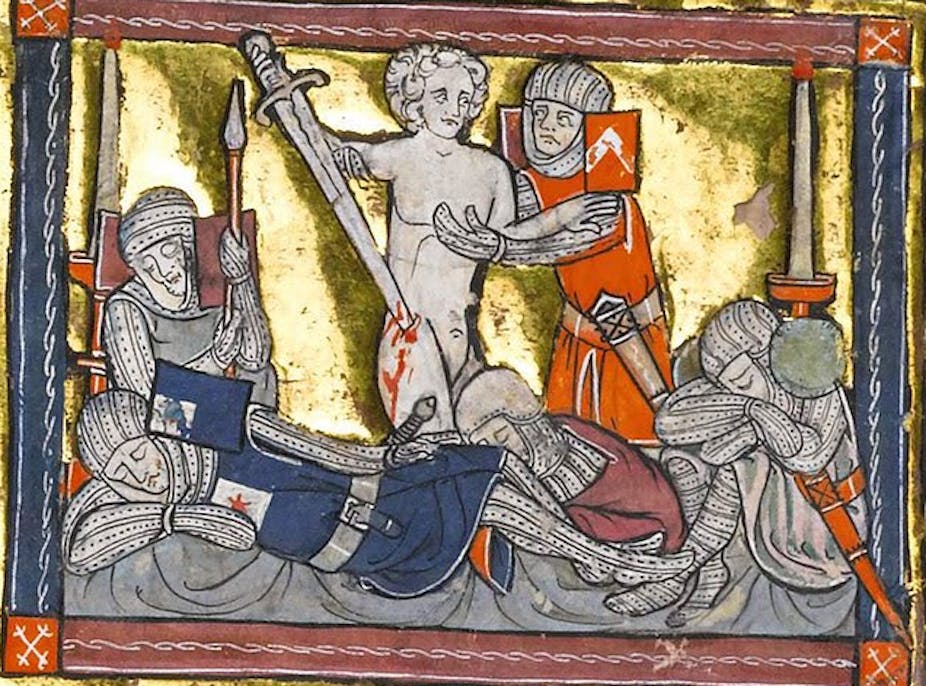
Research into history of emotions related to suicide is just as important as research which bolsters innovation. The Rochefoucauld Grail

How do we feel about death, suffering, and struggle, and how do we react to those around us as they deal with these issues?

These questions shape and are shaped by society. They guide individual choices, communities, and national and international policies. Emotions are so integral to these questions that we rarely pause to tease them out and find out how and why they work. But emotions are key.

I am a postdoctoral researcher for the Australian Research Council’s Centre of Excellence for the History of Emotions (Europe 1100-1800), or CHE. My project, carried out with CHE Chief Investigator Dr Juanita Ruys, considers emotions related to suicide in medieval Europe.

It is one of dozens of research projects funded through the CHE that asks how emotions were formulated, how they operated in the past, and how they have shaped the present.

ARC-funded research from our centre was deemed by the Coalition to be of “limited value” this week – the kind of research that in a tight fiscal environment should have its funding pulled.

But this view is shortsighted and superficial, and here’s why.

Though I research people who killed themselves hundreds of years ago, there are continuities in the ways that humans deal with struggle and change.

A person who drowns him or herself after suffering from disease, isolated at home and delirious with pain, a widow who hangs herself in her bakery after working to support herself and her children, a suspected criminal who kills himself in fear that he will be shackled with torture, imprisonment, and shame: these scenarios are lifted directly from medieval coroners’ rolls, but they could equally be used to explain suicide today.

How were people’s emotions in the past understood to lead to these self-destructive situations, and how did family, community, and the state respond to their suicides? Though the cultural settings, geography, and time period are different, we are asking the same questions now in Australia.

One in three Australians participated in R U OK? Day on September 13th this year according to R U OK’s scientific advisory group.

This event and other organisations such as Lifeline, Beyond Blue, Headspace, and ReachOut.com are working to ensure that Australians check in on each other and themselves. They provide services that help people to cope with and overcome depression, bullying, the oppression of chronic sickness or ill mental health, and other factors that can trigger suicide.

My research project on emotions related to suicide in medieval Europe is historical, but it has impact on Australia today. If hearing about this project causes one person to reassess their suicidal thoughts, or prompts someone to ask a loved one or colleague how they are doing, if it piques the interest of policy makers and furthers the work of those in organisations who help suicidal people, then it has done something incredible.

The advancement of the humanities is my academic goal. I also talk about suicide in the public sphere, liaise with medical practitioners and counsellors, and reach out to those who need us to recognise and help them before it’s too late. These things transcend the traditional view of what humanities scholarship does, yet they are part of my project.

Research in the history of emotions necessarily involves the big issues, and the CHE is committed to publicising this groundbreaking historical research and showing how it is relevant to Australia today.

Through this project and others, the CHE is helping to articulate how Australian universities are relevant beyond the walls of their sandstone quadrangles. This is the cutting edge of the academy.

Devoting Australian Research Council funding to create jobs in the intellectual culture of this country and further high quality research — while addressing the significant issues of modern society — is something that the government and the people of Australia should not only support, but of which they should be exceptionally proud.

Sign in to Favourite

Want to follow The Conversation?

Sign up to our free newsletter to get the day's top stories in your inbox each morning, with a special wrap on Saturday.

Spinner
Help us have better conversations — donate

Join the conversation

15 Comments sorted by

  1. Linus Bowden

    management consultant

    The Coalition are philistines and hypocrites beyond contempt. As if most of the world's Roman Catholic bishops don't have PhDs written on topics involving historical and cultural attitudes to death, and emotions more generally. Think of how much intellectual and legal energy the Catholics have invested in the proper ritual for adult baptism, let alone administering last rites. I'll eat my hat if there aren't dozens of PhD theses on 'death and love among the French peasantry in the 13th century', and other such arcana. Or in the case of George Pell's Oxford PhD - 'Attitudes to Authority in the 2nd and 3rd centuries AD'. Unfortunately, this latest cretinous outburst once again highlights the Faustian pact of having the government so smotheringly involved in higher education, especially research.

    report
  2. Linus Bowden

    management consultant

    In fact, Rebecca, one strategy you could adopt is to open up a dialogue with somebody like George Pell on these issues. You both wrote your doctoral dissertations on emotions/attitudes to authority as gleaned from ancient/medieval literature. And both from Oxford to boot! Once George Pell shows is excitement that will shut up the bovine Coalition.

    report
  3. Murfomurf

    logged in via Twitter

    I'm at the stage where I couldn't care less which side of politics gets the message- but if someone gave me some research work to do, I might think less about my OWN suicide. I'd gladly do a PhD on what might stop me- a sort of auto-recursive document!

    report
    1. Tim Scanlon

      Debunker

      In reply to Tim Pitman

      Actually I would have said the main difference is that science research is more consistent with its standards of evidence and observation.

      report
    2. Tim Pitman

      Tim Pitman is a Friend of The Conversation.

      Researcher in higher education policy at University of Western Australia

      In reply to Tim Scanlon

      I think researchers should always be cautious of critiquing methodologies oustide their field(s). That's why funding agencies, like the ARC, have discipline-specific assessment panels. Any non-'science' research funded through a competitive scheme, or published in a high-quality journal, undergoes the same rigorous peer-review as other disciplines.

      report
    3. Tim Scanlon

      Debunker

      In reply to Tim Pitman

      I could name several fields that are laughable in their standards of research and peer review, in science and social sciences (arts).

      That's why I used the phrase "more consistent" rather than superior or the like. We knew several arts PhD candidates who were studying at the same time as us, our literature reviews were more comprehensive and better reasoned in the sciences. I know this is just one example from one university, but you can also see this in the standard of non-fiction books that are published from postgraduate theses.

      Actually, you'd be able to take a walk down to the library and have a look at some of the theses on file. I read some for guidance on how to prepare mine. Let's just say that sports sciences aren't as consistently high a standard as you would like, and that newspaper clippings need a bit of verification before being taken as factual evidence for a political history thesis.

      report
  4. Sean Lamb

    Science Denier

    " If hearing about this project causes one person to reassess their suicidal thoughts, or prompts someone to ask a loved one or colleague how they are doing, if it piques the interest of policy makers and furthers the work of those in organisations who help suicidal people, then it has done something incredible."

    If the justification of the centre is based on public health grounds, then I suspect there are more effective ways to achieve these goals.

    report
  5. Mat Hardy

    Lecturer in Middle East Studies at Deakin University

    I don't think that 'pointless' research is discipline specific. There is a lot of it out there and plenty of academics who make their career out of self-perpetuating grant-ism.

    report
  6. Glenn McLaren

    Philosopher/Lecturer

    Good on you Rebecca. I teach philosophy of culture and philosophy of science and research in process philosophy which transcends the abstract division in the sciences and humanities. I believe this is the future for you and those enlightened enough to transcend polarised thinking. What I 've realised through studying history however is that the humanities are primary. Humans were storytellers before they became analysts and this is still how both scientists and historians make sense of temporal existence. The problem you face is with positivism, the belief promoted by Saint-Simon, Comte and Helmholz that the modern scientific method is the only way to gain knowledge of anything. This view which dominates thinking in today's universities is a form of epistemological imperialism and impoverishes us all. Universities now churn out a plethora of decontextualised facts without any understanding of why. Your article is an important contribution to resisting this oppression.

    report
  7. Philip Dowling

    IT teacher

    Rebecca, To say that I am underwhelmed with your article is an understatement. Such a self-centred attempted justification of a complete waste of taxpayers is breath-taking in its intellectual arrogance. Masturbation is a much productive and intellectually challenging activity than what you describe.
    In ascribing relevance, may I humbly point out that while you chose to study European history - Europe a mere Western peninsula of the Asian continent - and ignored Asia , both sections of the American…

    Read more
    1. Mister A

      Mental Health Advocate

      In reply to Philip Dowling

      I think Mr Dowling's words are pretty harsh, but essentially I would agree. "Underwhelmed" is the word I would use to describe my experience of reading your article.

      I work in mental health, have done so for 20 years. I also speak publicy to audiences about suicide awareness and prevention. I do a lot of work with schools too.

      I can't think of any presentation I would do where I would quote your research. I'm not convinced at all that it is relevent, interesting, sure, but relevent, no…

      Read more
  8. John Harland

    bicycle technician

    You make no mention of suicide as a public apology for misjudgement or wrongdoing. This appears to be an important element of Japanese culture and the culture of Classical Rome, for instance.

    report
  9. Stephen Prowse

    CEO at Wound CRC

    It is a mistake in my view to try to justify the relevance of research in the arts and humanities (and basic science for that matter). It is a very brave person to make predictions about the value that this type of research delivers. However it does seem to be an important part of the fabric of our society and important to understand and learn from the past as we seem to keep on making the same mistakes over again.

    Very few politicians understand research and even fewer understand innovation and the pathways of taking research to impact. We do need a new model of funding translational research and stop trying to pretend that the ARC and NH&MRC processes support innovation.

    Finally, it is totally inappropriate for politicians to be making decisions about what research should and should not be funded. They set the big picture policy frameworks and should not be imposing their own ideology, prejudice and bias on the research and innovation community.

    report