


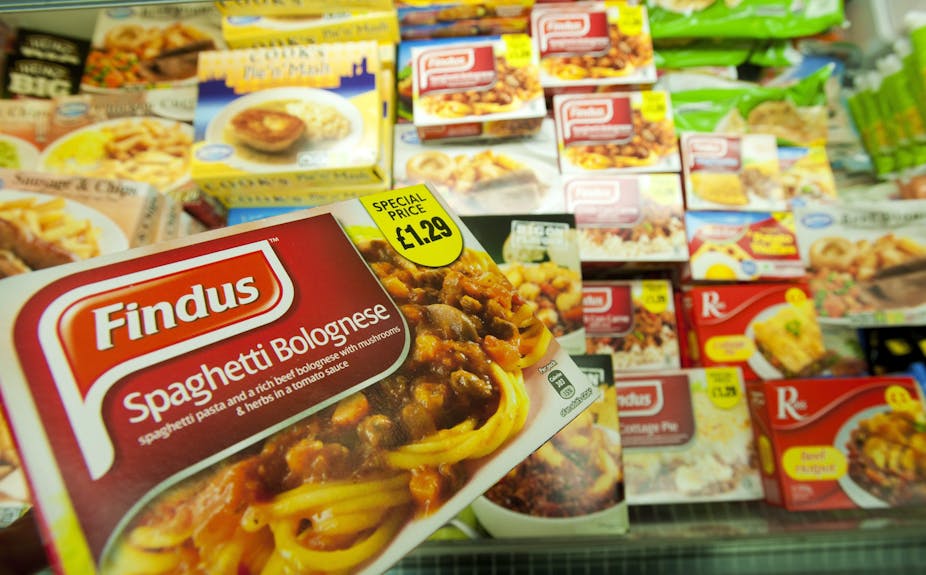
Back in September 2012, an Irish food safety inspector noticed some discrepancies in the labelling and packaging of some frozen meat brought in by a small import-export company. By January 2013, the scandal had become public: almost 30% of the mince beef meat sold in Ireland and in the UK through giant retailing chains such as Tesco, Aldi and Lidl is, in fact, horse meat. Its origin: Poland.
The news forced the largely self-regulated European food industry to launch a series of controls on a variety of frozen meat products. By the end of January, the French food processor Comigel (which also manufactures Tesco, Aldi, Lidl, and Carrefour’s home-brand frozen meat products) advised the frozen food brand Findus that its line of beef lasagne is adulterated with horse meat coming from Romania.
Shortly after the story broke, Findus withdrew most of its meat-based prepared dishes from the retail shelves in most of its European markets. In its wake, other international food manufacturers like Birds Eye and Nestle have had also to withdraw their meat products off the market.
The complexity of the food supply chain is outstanding. Between the French supermarket shelf and the Romanian meat producer (the abattoir) there have been four other intermediaries: the food brand (Findus), the food manufacturer (Comigel), the meat processor (Spanghero), and the trader (a Cypriot and Dutch trader).
Central to the scandal are the meat processor and possibly the trader, who himself had spent nine months in jail for unlawfully selling horse meat from South America as halal beef. It was where the horse meat was re-labelled as being beef meat, for an estimated profit of €550,000.
The scandal is far-reaching in many parts of Europe, from Ireland to the UK, France, Sweden, Germany, Spain and Italy.
There are two key elements to the story.
The first one is to do with an oversupply of inexpensive horse meat. Over-zealous equine breeding programs to cater for the demand of status symbols or playthings have flooded the markets of now cash-strapped owners since the start of the 2008 recession. In Ireland alone, 25,000 animals were sent to slaughter houses in 2012. In the United Kingdom, the number is closer to 9,000.
The cause is different in Eastern Europe. In Romania, legislation forbidding horse carriages on roads has led to many of these animals being sent to the abattoirs.
Today, European meat markets value horse meat at half the value of beef meat. More than 60,000 tonnes of horse meat were traded by European countries in 2012 and this includes “horse-like” animals, such as donkeys, mules, and asses.
The other key element to the story is to understand how the food supply chain falls victim to opportunistic behaviours. The food industry, mostly concerned with costs and “just on time” management, has developed very long supply chains to facilitate the purchase of ingredients for processed foods at the cheapest prices, and to provide flexibility by outsourcing the processing activities to small or medium size operators. The longer the chain, the higher is the risk of integrity break-down.
The recent push for self-regulation in the food industry has considerably changed the food safety operational structures. In the UK, for instance, food safety controls are now outsourced by UK Food Standards Agency to the private sector. At the height of the bovine spongiform encephalopathy (BSE) crisis the FSA employed 1700 inspectors; today there are only 800. The reduction in enforcement powers has been justified by claims of greater transparency and traceability, claims that are hardly sustainable in light of recent events.
The squeeze on prices for “economy lines” of processed foods from supermarket chains and brand names is pivotal to explaining the breakdown. When UK Tesco retails 450 grams of spaghetti bolognese for only £1 (AU$1.50) it implicitly accepts that these low-cost meat products are of mitigated quality. Under current European legislation, food companies are under no obligation to disclose the provenance of the meat contained in these prepared meals.
Changing meat consumption patterns can partly explain the magnitude of the public reaction to the fraud. Not only has horse meat been abandoned by continental European meat eaters in recent years, but consumers are increasingly relying on the convenience of ready (and processed) meals.
Could this happen in Australia? Most probably.
As in Europe, too many horses are being bred in Australia, creating an oversupply of inexpensive horse meat coming out of abattoirs and knackeries. The Australian food supply chain shows the same level of complexity as its European counterpart.
The highly concentrated meat processing sector, in the hands of three major international companies (the American Cargill, the Brazilian JBS, and the Japanese Nippon Meat Packers) is also subject to aggressive pricing forces from traders, food companies and retailers.
Industry self-regulation is extensively practised in Australia as a complement to government regulation. In NSW, the NSW Food Authority has implemented a system whereby food businesses with a satisfactory compliance history moved to a self-regulated auditing model for which the frequency is to be determined on a case by case basis by an appointed external auditor (FSANZ Standard 3.2.1).
How safe is it to eat horse meat? At a nutritional level, horse meat can be an excellent lean source of protein and iron when bred for human consumption. However, most horses are routinely treated with an anti-inflammatory drug (phenylbutazone or “bute”), which can cause a potentially life-threatening illness to humans. Horse passports are supposed to record “bute” treatment and therefore prevent human consumption, but fake passports are circulating and prevent proper control.
Every day we make food choices. Sometimes these choices are informed. More often than not, and especially when purchasing processed food, these choices are based on trust. It would be regrettable if we had to bring a DNA tester along every time we visit our local supermarket.