
The construction industry is a major part of the Australian economy. Construction sites are everywhere. Some of them are recognisable from kilometres away due to their impressive tower cranes.
You may stop and watch these enormous beasts tamed by a human operator sitting in a small cabin. However, construction sites are not always safe and these beasts are not always tamed.
While you hear about fatal incidents in the news all the time – shootings, fatal car accidents, knife attacks, construction work-related deaths are more rarely reported.
Here’s one incident recorded in the National Coronial Information System (NCIS) involving a mini excavator. Surely, you have seen these machines. Pretty handy, they can do anything in small scale. If your house required a landscaping job, you would probably need one of these.
“The operator was engaged in the removal of vegetation and the construction of a sand pad for building foundations using a mini excavator. At the time of the incident, he was undertaking final spreading, compacting and levelling of the sand pad. He switched off the engine with the bucket in the raised position, alighted from the cabin, stood in front of the bucket and began to undo the chains attaching a railway line to the bucket. In doing so he was working directly under the raised bucket. The bucket and boom fell, trapping him between the boom and body of the mini-excavator.”
As simple as that, one life was lost and a family devastated.
According to Safe Work Australia, 123 construction workers died and 13,640 were seriously injured because of work related causes from 2008-9 to 2010-11. This is on average 41 deaths and 4,546 injuries per year. A considerable proportion of these deaths were related to mobile plants.
This was the main motivation for me and RMIT colleagues Prof Helen Lingard and Tracy Cooke to investigate, 81 cases of plant related deaths in the Australian construction industry, using the NCIS.
The study found that in more than 50% of cases, the decedent was not the operator of the plant. Further, as expected, 79 out of 81 of them were male.
The number of cases peaked between 10.00 and 10.59 am, with nine cases (11.1%) occurring in this time frame. A further 13 cases (16.1%) occurred between three and five o’clock in the afternoon. These peaks coincide with the period immediately prior to the mid-morning break and end of the workday, suggesting that fatigue may be a causal issue.
Most of these people – 27 out of 81 – were run over by a construction plant while working on site. 23 of them were struck by a moving object and the rest were either in a plant overturning, electrocuted, fallen from plant, been crushed between mobile plant and another object, entangled or engulfed.
Although the immediate circumstances around the incidents are usually the focal points of investigations, these circumstances have underlying causes that if not properly addressed, the incidents would be inevitable. Causes such as site constraints (19 cases), inadequate supervision (18 cases), plant design (17 cases), safety culture (13 cases) and construction process design (13 cases).
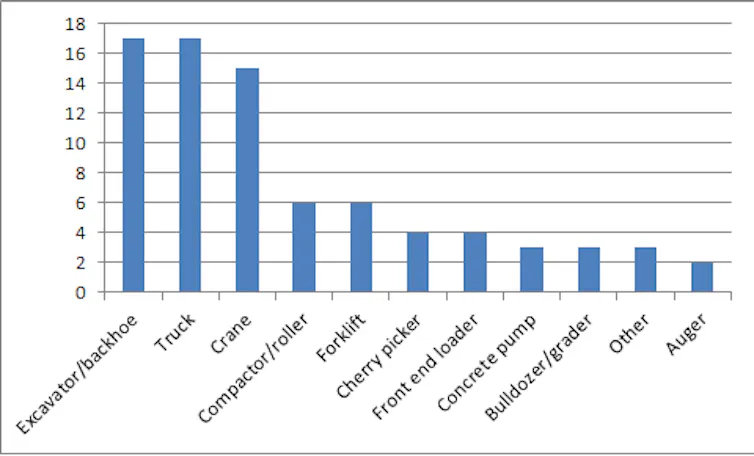
We also found that the frequency of the incidents varied by the type of plant. The most frequent items of plant involved in these incidents were trucks and excavators/backhoes. Crane fatalities were also quite frequent accounting for 15 deaths.
The next time that you pass a construction site with these machines, be careful and keep a safe distance. These impressive and sophisticated human inventions can be deadly.
Moreover, plant operators and workers on site as well as managers, designers and client organisations must take safety very seriously.
Colin MacGillivray
Retired architect
I worked in SE Asia for 12 years on high rise projects and I can't recall a death. On one site in 1986 there was no barrier around the perimeter of the (ultimately) 15 storey footprint as it rose. I tried to insist on the installation of a continuous perimeter barrier and the main contractor's boss's reply was convincing.
With no barrier workers knew there was no barrier and were very careful working at the edge. With a barrier it was possible it would not be faulty and a worker could rely on it and it would fail and the worker would suffer.
Awful logic, unthinkable in Oz, but there were no deaths on that job.
Craig Minns
Self-employed
As someone who has worked in construction-related industries for most of my life, I don't find any of that terribly surprising. When things go wrong with machinery it happens very quickly and with great force, usually.
I do wonder whether the stringent safety rules and regulations imposed by many firms aren't having something of a negative impact in some ways though. There is a real sense of nannyism in a great deal of the regulation, that people may rebel against. An oft-heard phrase around construction sites is "safety bullshit", for example, in relation to PPE, work practises and inductions. In my own case, I estimate I've sat through around 200 site inductions over the years, as well as having to obtain a blue card and having to get certified in various ways, all of which was essentially repetition of the same things. It's the story of the boy who cried wolf writ large.
Nev Norton
Farmer
I have over 30 years experience in the construction, mining and ag sector, the simplest way to identify the problem is that some people are intuitively better at continually evaluating and acting on risk than others.
In my experience all the inductions, morning safety talks, toolbox meetings, JSA's, and "Take 5" type solutions, have little impact on the way many people go about their work. In fact the sheer volume and repetiveness of these measures quite often see's many eyes just glaze over, coupled with the fact that everything is dumbed down to the lowest common denominator tends to get the more experienced and capable people's back up, nobody likes being treated like a 5 year old.
Couple the above to long shift hours, poor working conditions and general distractions and it's clear that where humans are involved there will always be accidents.
You just can't legislate against stupidity.
Craig Minns
Self-employed
Nev, I'd agree entirely with that comment and I'll also add the fact that the time-cost of these various bum-covering exercises is enormous.
Yesterday on the job I had a minor accident - a foot went out from under me on a slight batter with some loose surface material and in the process of falling, I managed to hyperextend my ankle and sprain it. That minor incident, which has no instructive or cautionary value to anyone, consumed nearly 3 hours of the time of 5 people - me, the person I was working…
Read moreDale Bloom
Analyst
I am somewhat surprised to find that most of the deaths related to mobile plant, but that is a problem that could be overcome with proper barriers, or by placing a safety ring around the machine, such as placing safety cones in a ring around the machine.
No one can go into that ring unless they get agreement from the operator.
Similarly, the operator cannot step out of the machine and into the ring, unless they leave the machine in a safe position.
Will this increase costs?
Maybe and maybe not, as a safety first policy makes people think about the job, and also plan the job.
This usually makes the job more efficient.
Nev Norton
Farmer
Hi Dale, All those measures and more are already in existence, however they are not always implemented by small contractors working on small sites.
There are also accepted ways of approaching plant, these are laid down in workcover guides.
Mining is the most stringent of all, and with Elevated Work Platforms (EWP) a barrier has to be placed around the drop zone of the machine, and there must be a spotter on the ground, who also has to have a high risk work licence endorsed EWP (same as the operator of the EWP), I have however observed spotters playing games on their phones, having a chat to bystanders as well as asleep. I have also seen people just ignore the exclusion zones and walk on through, sometimes not even challenged by the spotter.
As you can see all the best intentions and rules sometimes mean diddly squat.
Dale Bloom
Analyst
Nev Norton,
I would agree with guidlines or SWP's not being implemented.
I regularly work in larger scale projects with B double side-tippers, truck and dogs, excavators, backhoes, 16 ft blade graders, and just about everything else.
I have seen spotters, but never once seen an exclusion zone set up with barricades or safety cones around a machine.
Craig Minns
Self-employed
Dale, in my experience there are always exclusion zones implemented around mobile plant operations. The trouble is, as Nev says, that people have a sense of bravado, or are distracted, or are simple bullheaded and don't like being told not to do something and they ignore them.
I've witnessed 2 serious incidents in my time. One cost a man his life, the other left someone in hospital for months and crippled afterwards. The death involved a scraper operator who ignored the traffic control system…
Read more