


Australia finished the London Olympics of 2012 with a total count of 35 medals of which 7 were gold, 16 were silver and 12 were bronze. This placed us 10th in terms of gold medal winners and 7th in terms of overall medal count. This performance was considered to be something of a national disappointment, particularly when compared to the 2008 Beijing Olympics where we ranked 6th on medal counts and won 14 gold, 15 silver and 17 bronze medals.
This Olympic Games performance triggered a wave of chatter throughout the media calling for various remedies. These solutions ranged from the spending of more money on sports development, through to the requirement for a greater emphasis to be placed on sport in our schools.
Global Innovation Index
It is interesting to compare this response to the rather more muted reaction to how Australia has performed on the 2012 Global Innovation Index (GII). The GII is an initiative of the French Business School INSEAD and the World Intellectual Property Organization (WIPO), an agency of the United Nations.
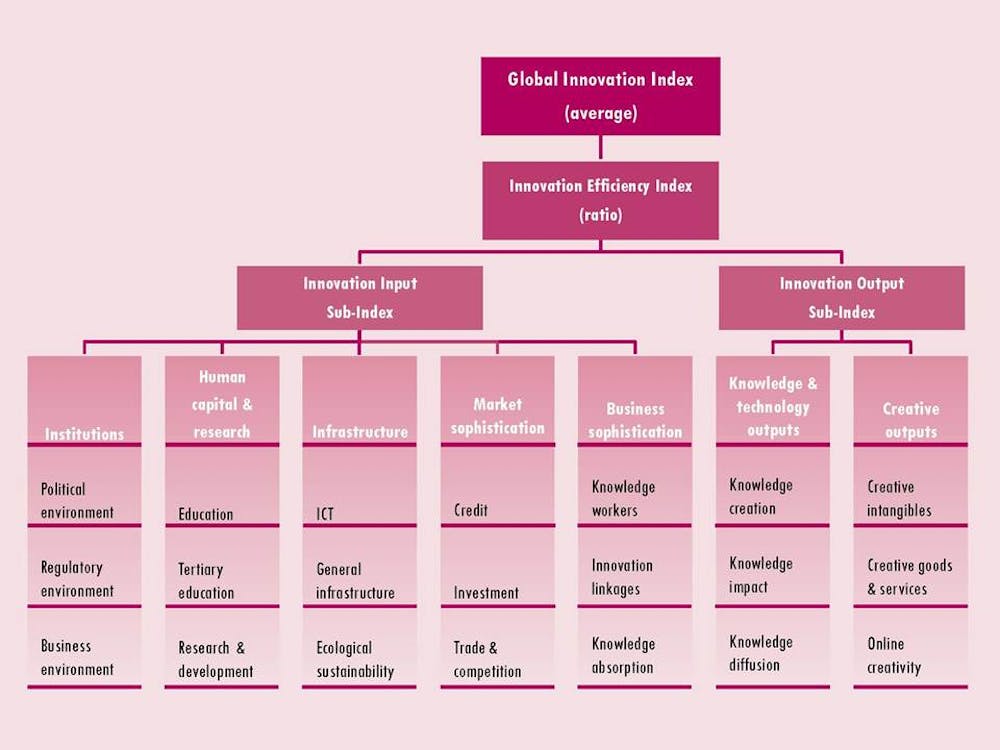
The GII is based on a complex analysis of inputs and outputs that are then compiled into the final index. The model illustrated in the diagram below represents the GII framework. As shown there are five input factors, each of which has three sub-categories. These comprise institutions, human capital and research, infrastructure, market sophistication and business sophistication. There are two output factors, each of which also has three sub-categories. The two output factors are knowledge & technology and creative outputs.
The GII finds Australia ranked 23rd overall. This places us well behind Canada in 12th place and New Zealand in 13th place. The Top-10 countries in order of ranking are:
- Switzerland
- Sweden
- Singapore
- Finland
- United Kingdom
- Netherlands
- Denmark
- Hong Kong
- Ireland
- United States
Australia’s innovation performance on inputs is better than its outputs. In terms of inputs Australia ranks 13th overall, but in terms of outputs the ranking is only 31st out of 141 countries. However, our measure of innovation efficiency within other high income economies is a dismal 107th place.
Australia’s GII performance
The diagram below shows Australia’s GII performance on all the inputs and outputs. As can be seen the worst area of our performance in terms of inputs was found in our knowledge absorption, which was ranked 61st. This is a measure of the way in which our business community invests in R&D, whether it is a net importer or exporter of high technology, and its ability to generate royalty and licence fees from its intellectual property.
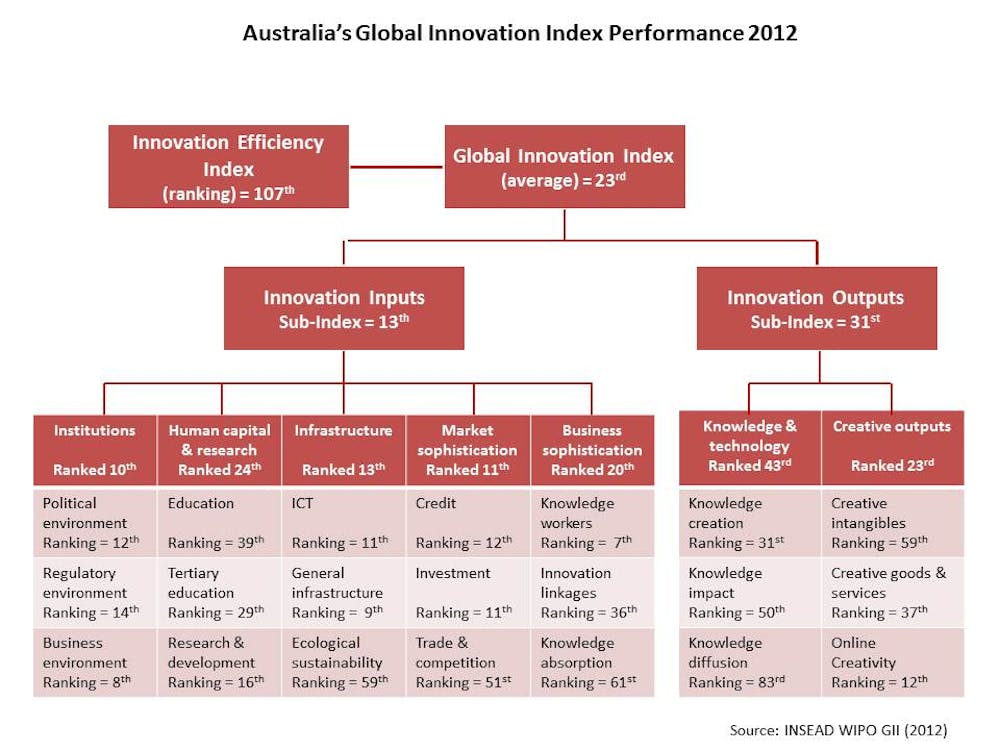
The next worst of our inputs was our ecological sustainability (ranked 59th), which is a measure of how well our industry engages with environmentally sustainable investments and its energy efficiencies. Other weak areas of input were our innovation linkages, and our education and tertiary education sectors. The innovation linkages area encompasses collaboration between our universities and industry, the creation of industry clusters, joint ventures, patent filings and level of offshore R&D financing. In terms of education some of the worst performance was in terms of public expenditure on our students, and the number of science and engineering graduates our universities are producing.
In terms of outputs the worst performing area was knowledge diffusion (ranked 83rd), which is a measure of our exporting of high technologies and the royalties and license fees generated from our intellectual property. Other weak areas were knowledge impact (ranked 50th ) and knowledge creation (ranked 31st ).
Knowledge impact measures worker productivity, quality assurances, expenditure on computing software and new business formation. Worker productivity was the worst performing area. Knowledge creation measures the registration of patents and the publication of scientific papers. It is interesting to note that while our ranking for scientific article publication was 10th, our ranking for patenting was 46th.
Australia also ranked poorly in terms of creative intangibles (ranking 59th ) and creative goods and services (ranked 37th ). The first of these is a measure of how well our industries generate registered trademarks and whether these trademarks are registered as international brands. It also looks at ICT and business model creation. The second area measures such things as our production of feature films, newspaper circulation and exports of creative goods and services. Here the worst performances were found in the areas of creative goods exports, national feature film production and the registration of domestic trademarks.
Australia an inefficient leader
Australia’s overall GII ranking has fallen since 2011 and the analysis undertaken by the team that creates this index view us as an inefficient leading nation. As illustrated in the figure below Australia lies within the leader nations, but it is classified as inefficient due to its poor innovation efficiency ranking.
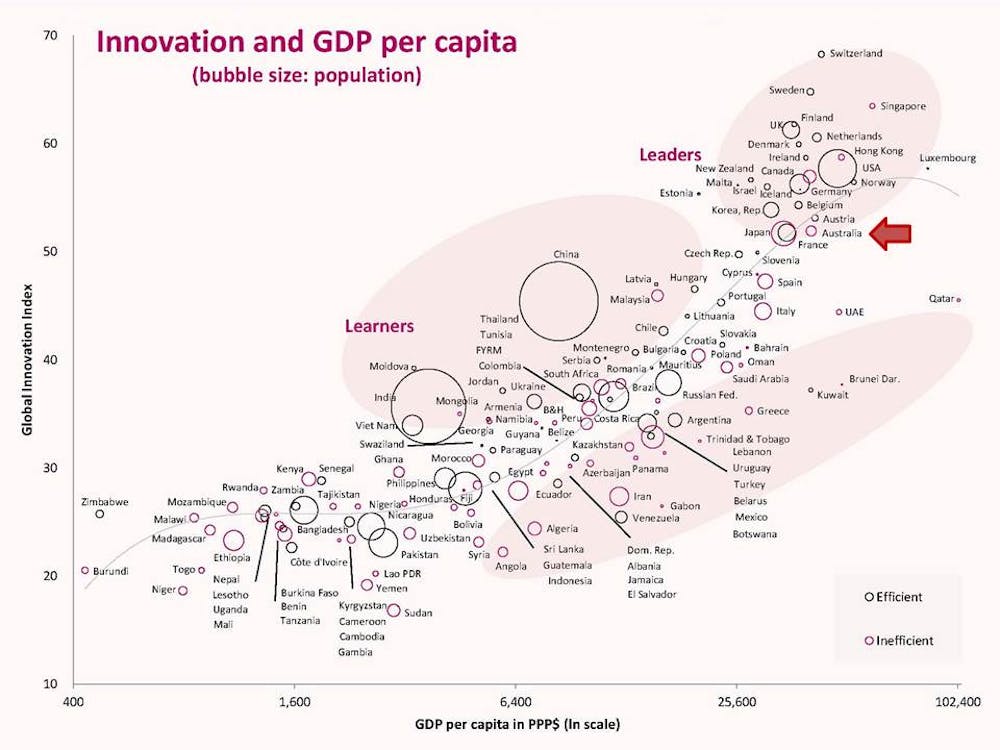
Within our region Singapore is the highest ranked economy and it can be seen that there are several learner countries, particularly China, that are likely to move quickly towards the leadership group over the coming decades.
If this performance was replicated in the pool or on the playing field at the Olympics Australia would be concerned and there would be a call for a national effort to ensure that the decline was arrested. However, we have heard little about this from either the media or the government.
Perhaps we need an Innovation Olympics to get Australia’s national innovation system kick started in the right direction?