
If we’re going to win the Innovation Olympics where should we start?

In my previous article I reported on the findings from the Global Innovation Index (GII) for 2012. They put Australia in 23rd place overall, well outside the Top-10. This top ranked group comprised (in order of ranking) Switzerland, Sweden, Singapore, Finland, the United Kingdom, the Netherlands, Denmark, Hong Kong, Ireland and the United States.

The performance ranking measures a combination of inputs and outputs. In broad terms they provide a snapshot of the overall health of a country’s national innovation system. How well a country is ranking is important given that economies seem to evolve from low-cost factor driven ones, through efficiency-driven and onto innovation-driven systems.

For a country that cannot compete on low costs of production, the only long term salvation is to build an innovation-driven economy. This type of economy is primarily based on value adding through the commercial application of intellectual property. Industries are mostly knowledge intensive with high levels of R&D investment.

Australia is clearly unable to compete on lower costs of production and has succeeded largely due to its internationally competitive mining and energy sector. However, if the resources boom ends, as some are now predicting, what opportunities would be left to maintain an internationally competitive economy?

So if we are going to try win a better placing in the Innovation Olympics where should we start to focus our attention?

To help address this question I have compared Australia’s performance against the top ranked nations plus the United States (which ranked 10th). America’s inclusion is due to the importance of the USA as an economy and its relationship with Australia. As shown in the figure below Australia’s overall performance in terms of its innovation inputs and outputs is well below that of these other countries.

Global Innovation Index (GII) Innovation Inputs versus Outputs – Australia compared to the leading innovator nations INSEAD and WIPO 2012

Education is the foundation

Of all the inputs needed to build a globally competitive innovation-driven economy education is amongst the most important. Sadly Australia ranks rather poorly against the top ranked nations. This is illustrated in the figure below, which shows the overall expenditure on education by the public expenditure on education per student. It can be seen that Australia performs relatively poorly on these two measures while Sweden is the best performing nation. Finland also performs quite well and Switzerland does well in terms of expenditure per student.
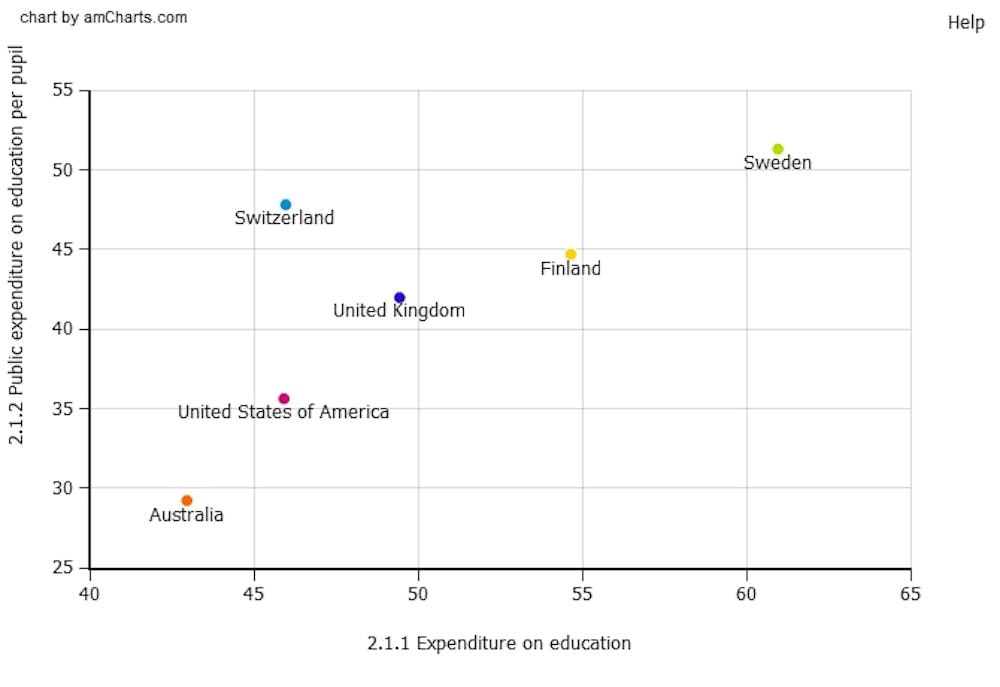
Global Innovation Index (GII) Expenditure on Education by Public expenditure on education per student – Australia compared to the leading innovator nations INSEAD & WIPO (2012)

The recent debate over the Gonski Report into funding for Australia’s schools highlights the underlying causes of the problem. David Gonski’s findings indicated that the performance of Australia’s school students has declined at all levels over the past decade. In 2000 Australia was outperformed in reading and scientific literacy by only one country, and by only two other nations in terms of mathematics. However, by 2009 we were surpassed by 6 nations in reading and science, and 12 nations in maths.

Gonski also pointed to the insidious widening gap between the top and bottom students. There was a clear link between educational performance and low socioeconomic status. Students of indigenous ethnic background were likely to be amongst the lower performing cohort due to low socioeconomic status and language issues. The report recommended additional funding worth around $5 billion per annum across all school sectors, with at least one third to come from the federal government.

The Gonski report was well received by the federal government and most commentators have agreed with its findings and recommendations. Despite this there have been few concrete commitments by either the federal government or the opposition to implementing any of the recommendations. Instead the report has been converted into something of a political battlefield.

This is not helpful.

Building innovation clusters

Another important area within the development of a national innovation system (NIS) is the ability to build industry clusters and link industry more closely with universities and other publicly funded research centres. In earlier articles I have sought to explain the background to this discussing the importance of R&D investment the NIS, and also overviewing how South Korea built its NIS.

Clustering becomes important due to the ability to generate concentrations of businesses within specific industry sectors. This allows for the creation of a critical mass of activity with the potential to generate valuable spill-over effects. These can include enhanced knowledge exchange, increased innovation from rivalry, the attraction of skilled labour and managerial teams, and the fostering of entrepreneurs to lead new business opportunities.

Universities play a potentially important role in these clusters by training up new graduates, and also undertaking research that may result in technology transfer out to industry partners. This linkage between basic and applied research leading to tech transfer and commercialisation is a fundamental plank in the design of many of the world’s most dynamic innovation-driven economies.

Sadly, as with our performance in education, Australia ranks poorly in this area. The following diagram shows the correlation of the state of cluster development and the level of university to industry collaboration. It can be seen that Australia is significantly behind the leading innovator nations in this regard.
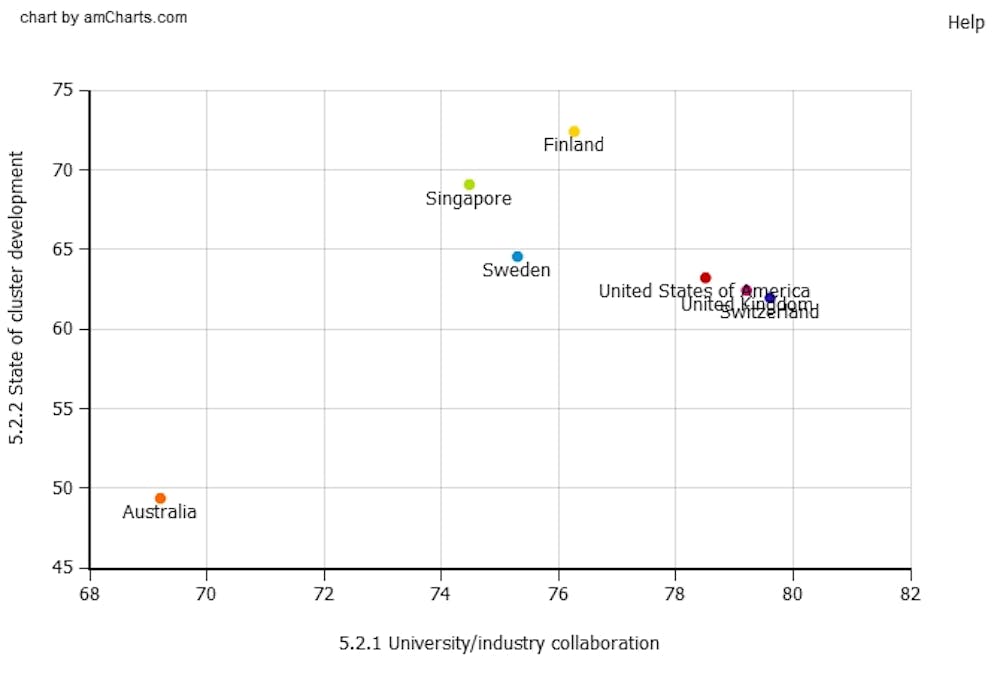
Global Innovation Index (GII): university/industry collaboration by state of cluster development – Australia compared with leading innovator nations INSEAD & WIPO (2012)

We don’t have a Gonski report into this area but the recently released report from the non-government members of the Prime Minister’s Manufacturing Task Force does provide a useful proxy. This report recommended that a committee be formed to examine how the Australian university sector and various other publicly funded research organisations such as the CSIRO undertake applied innovation and technology transfer.

There are also issues associated with the way in which applied research and industry collaboration are rewarded within the Australian university sector. The decision by the Australian Research Council (ARC) to reduce the number of Linkage Grant rounds from two to only one per year is a retrograde step in terms of trying to encourage greater university-industry collaboration.

As other research undertaken by the OECD has shown, business to business collaboration is relatively good amongst small to medium enterprises (SMEs) in Australia (ranked 5th in the OECD), but quite poor amongst large firms (ranked 23rd in the OECD). This is an area for concern and one that requires additional attention and policy action.

R&D inputs and high tech outputs

As a final review of Australia’s performance as a competitive innovation-driven economy we can look at the relationship between gross expenditure on R&D (GERD) and three key outputs: patent applications, royalty and licence fee receipts and high tech exports. These are illustrated in the following diagrams.

First, let us look at the relationship between GERD and national patent office applications. As can be seen from the figure below, Australia is close to Singapore’s performance in this and both nations are well behind Switzerland, Finland, Sweden and the United States. This should be a concern. Not only does Australia spend less than all these benchmark countries with the exception of the UK, but it seems to generate relatively few patents.
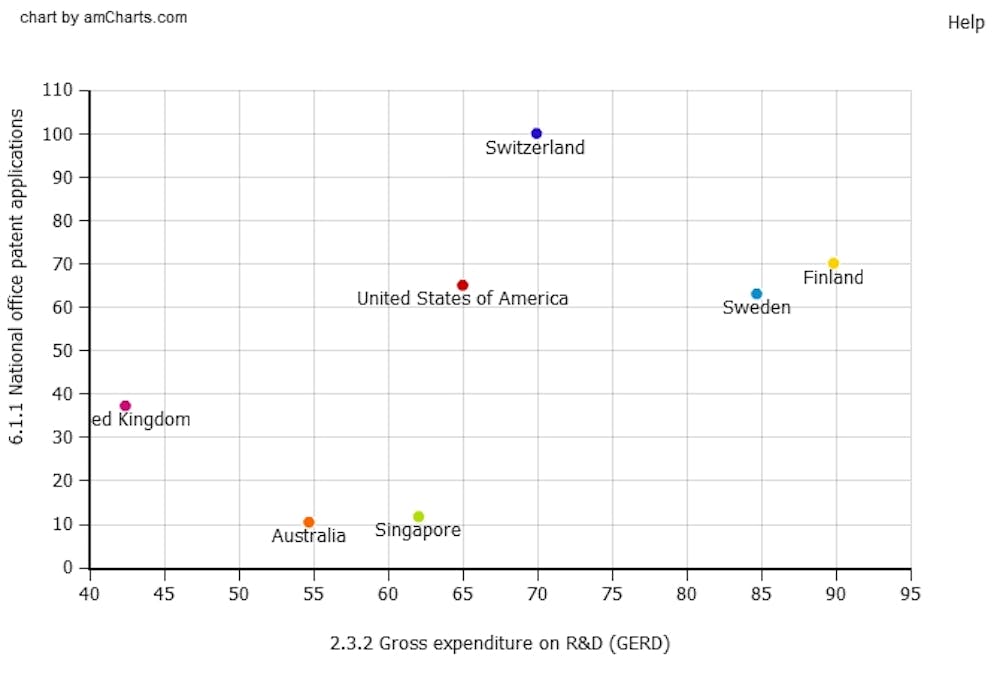
Global Innovation Index (GII): Gross R&D Expenditure (GERD) and national office patent applications – Australia compared to leading innovator nations INSEAD & WIPO (2012)

The second relationship worth attention is that of GERD and the income received from royalties and licence fees. While not all R&D investment is likely to result in commercialisation outcomes that can generate license fees, the use of licensing has now become a major opportunity for the generation of revenues. It can be seen from the figure below that Australia has a relatively poor performance in relation to our ability to secure royalty and licence fees. This is particularly when we are compared with Finland and Sweden, and also Singapore and the United States.
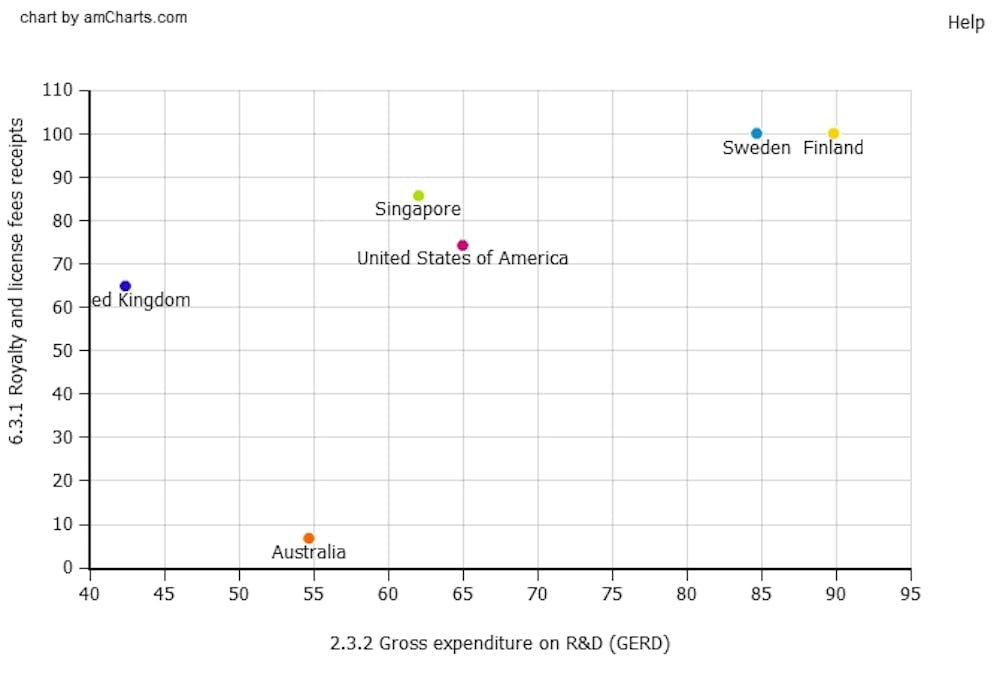
Global Innovation Index (GII): Gross R&D Expenditure (GERD) and royalty and license fee receipts – Australia compared to the leading innovator nations INSEAD & WIPO (2012)

The third relationship is that of GERD and the percentage of high technology exports less re-exports. As shown in the following diagram Australia exports relatively few high-tech products in comparison to the other six countries. Singapore does particularly well in terms of the percentage of high-tech exports less any re-exports.
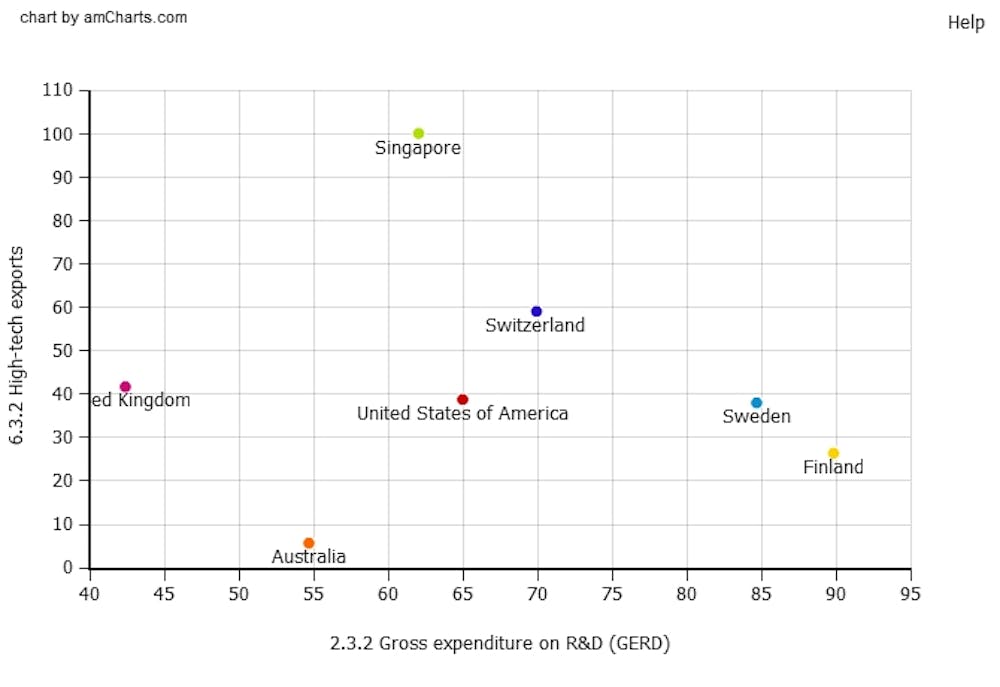
Global Innovation Index (GII): Gross Expenditure on R&D (GERD) and high-tech exports – Australia compared to leading innovator nations INSEAD & WIPO (2012)

So what should be done?

There are no easy solutions for enhancing Australia’s innovation profile and getting us into the Top 5, or even the Top 10 of the GII ranking. It will require a national consensus by all sides of politics that this is an important national aspiration. There will need to be significantly greater investment in education, R&D and the willingness to innovate and collaborate for the greater national good.

I use the analogy with the Olympics deliberately because it is clear that when Australia is engaged in these international sporting events all sides of politics, the mainstream media and the majority of Australians are united in their common desire to see this nation win. Yet we are complacent in a world in which our longer term economic prosperity will depend on how well we compete in the global Innovation Olympics.

This should be something that attracts more attention than it currently does.

Join the conversation

24 Comments sorted by

  1. Dale Bloom

    Analyst

    I would agree that Australia is being kept afloat by the resources boom (and much of the money from the resources boom has been wasted to pay for infrastructure costs for an expanding population that we don’t need).

    However, spending more and more money on education does not automatically give better results.

    For example, from Finland:

    "We are spending less money than average for developed countries, much less than the United States. We spend less time, but the learning achievements are high," Sahlberg said. "You put more money and more time there, but the outcome, the achievements are less.”

    http://news.stanford.edu/news/2012/january/finnish-schools-reform-012012.html

    report
    1. Michael Hay

      retired

      In reply to Dale Bloom

      I have a strong feeling that this country of ours will never succeed in the ways we want it to, until we re-design the Federal/State arrangements.
      I my book, the Federal Govt. should be responsible for the infrastructure - schools, hospitals, roads, railways - while the States should be in charge of operational matters - staff, administration, fittings etc.
      Certainly there would be a huge amount of rationalisation to be accomplished, but if we had politicians who were prepared to put governance ahead of party politics, it could be done.
      Once such a system was in place, the scene would be set for citizens to take part in either the infrastructure or the implementation.
      But I fear such a rationalisation is beyond us - we do not have the imagination or the will to succeed in our elected representatives.

      report
  2. Tim Mazzarol

    Winthrop Professor, Entrepreneurship, Innovation, Marketing and Strategy at University of Western Australia

    Hi Dale,

    Thank you for the comment. I agree that a simple increase in expenditure on education may not by itself enhance the national innovation system. However, David Gonski's report noted the widening gap between top and bottom performing students and called for more money and better targeting of that money.

    One of the key issues is to look at spending per student and here Australia lags behind all these leading nations. Even New Zealand is significantly in front of us in this regard and…

    Read more
    1. Dale Bloom

      Analyst

      In reply to Tim Mazzarol

      I think it is a common misconception that improving student results depends on spending more and more money on education, but the costs of education in Finland are about average for OECD countries

      “In 2005, the costs of educational institutions in Finland comprised 6.0% of the GDP, which is almost exactly at the OECD average level. “

      http://www.minedu.fi/OPM/Tiedotteet/2008/09/education_at_a_glance2008.html?lang=en

      However, few students will get a reasonable job with only secondary school qualifications, and the main issue is getting sufficient higher education qualifications or a traineeship or an apprenticeship.

      I also think general levels of innovation have declined in Australia because we now import so much.

      Productivity and innovation is now being imported rather than developed in Australia.

      report
    2. Joseph Bernard

      Director

      In reply to Dale Bloom

      @Tim,

      would like to share with you the following link which presents a number of testimonials from some leading researchers/ innovators (note bio below). In the online introduction on this site, they discuss the importance of federal funding in the research and its role it played in achieving their specific results.

      http://www.goldengooseaward.org/

      A point which i would like to add to this video, is that marketing is the key to attracting interest and funding. In my personal experience…

      Read more
  3. Richard Helmer

    REsearch Engineer

    Thanks for the analysis. i look forward to reading more (and will make an effort to read your prev post)...some of my passing thoughts follow...

    at a community level, i believe innovation is an 'espirit de corps' requiring a team mentality (that transcends organisational boundaries in $s and intent = difficult) ... clusters can help to foster some aspects of this....i have witnessed some reasonable implementation of this within Australia

    at an organisational level its about choice and balancing…

    Read more
  4. Stuart Saunders

    Inventor

    What destroys so much Australian innovation is the fraudulent patent system.
    The rules for evidence for patent are so contrived - totally different to rules for evidence in all other law.
    If criminal law was written to the same standard as patent law, you could not be charged with murder unless before the event you had gone to the police station and filed an AKSB - and Application to Kill Some Bastard.

    And we are trying to encourage inventors to solve societys' problems!

    Demanding that patents…

    Read more
  5. Patrick Ross

    Senior Industry Fellow - Department of Management

    Another good article, Tim!
    One of the concerns that rarely gets an "airing" is our national culture regarding academic performance, or more bluntly, the decline we have seen over the years.
    It seems that the pursuit of academic excellence is seen less and less as a mandatory pre-requisite - our Gen Y could almost be acused of mocking academic achievement (nerds, geeks, etc). And our secondary education system has been consistently dumbing down a wide range of subjects, to the extent that some…

    Read more
  6. Michael Gilding

    Professor of Sociology at Swinburne University of Technology

    Excellent article Tim. I'm interested in your measures of cluster development. What is this based on? I'm doing research on biotech clusters, and I have yet to see persuasive measures in this respect.

    report
    1. Tim Mazzarol

      Winthrop Professor, Entrepreneurship, Innovation, Marketing and Strategy at University of Western Australia

      In reply to Michael Gilding

      Hi Michael

      Thank you for this important question. The GII uses a range of measures, some are quantitative and drawn from other data sources. Others are drawn from more qualitative findings that emerge from surveys they have done in each country or that have been done by other agencies.

      In the case of university/industry research collaboration and state of cluster development the original source data is from the World Economic Forum's Executive Opinion Survey from 2010-2011.

      This surveyed…

      Read more
  7. Stephen Prowse

    CEO at Wound CRC

    Many politicians of both persuasion at the national and state level do seem to truly understand how innovation works and the importance of innovation. Those who do understand are captured by the short term opinion poll cycles. This decline will continue until policies change. The best education system in the world will not help when the underlying policies do not support innovation.

    The establishment of a translational (innovation) research council that has similar status to the ARC and NH&MRC to support innovation, would send a strong signal to research and industry on the importance of innovation and start to get innovation back on track. This could be established from current Programs without additional funding.

    report
    1. Michael James

      Research scientist

      In reply to Stephen Prowse

      "The establishment of a translational (innovation) research council that has similar status to the ARC and NH&MRC to support innovation, would send a strong signal..."

      My main problem with these ideas are that insistence on translational research is the cart leading the horse. As a pure research scientist my entire career since the 70s I have observed the creation of new industries that have become giants that indeed form the basis for real translational outcomes. None of which were nurtured in…

      Read more
  8. Joseph Bernard

    Director

    With my Business partners I have been participating in innovation through research in software development and business applications over the last 25 years.
    My contribution is made possible through the policies of the Honourable Gough Whitlam, who made universities free for a while and that gave me an opportunity to earn the benefits of a sydney university degree that I would argue has delivered benefits that far exceed the investment into my education..
    Now, Free education is making a come back…

    Read more
  9. Gary Murphy

    Independent Thinker

    "For a country that cannot compete on low costs of production, the only long term salvation is to build an innovation-driven economy."

    But innovators will just move offshore where labour costs are lower anyway.

    The only long term salvation is trade barriers against countries with low labour and environmental standards.

    It doesn't matter how many widgets and super-efficient production methods we invent. It will always be more profitable for the companies involved to do their manufacturing offshore.

    report
    1. Stephen Prowse

      CEO at Wound CRC

      In reply to Gary Murphy

      Innovation is about culture, behaviour, incentives, drivers and rewards. We need to be innovative because of low offshore labour costs. Manufacturing off shore is a different issue from innovation.

      report
    2. Joseph Bernard

      Director

      In reply to Gary Murphy

      @Gary,
      While I agree it is not easy and factors like the high Australian dollar do not help, I must say that all is not lost. By definition Innovators and entrepreneurs make opportunities which then create wealth.
      What, I believe, is we have to get over is the concept of the magic bullet that cures all.. Large industry, while important, is not the Australian economy and that a significant percentage of australia’s business is generated by small micro business that nobody has ever heard of…

      Read more
    3. Gary Murphy

      Independent Thinker

      In reply to Joseph Bernard

      For what benefit? So people can fund their own retirement.

      You are right though. To compete internationally we need to get rid of superannuation, sick leave, holiday pay (and holidays), 40hr working week, and reduce the minimum wage to $2 a day. And we probably need get rid of all of that nasty 'red tape' and 'green tape'.

      Or we could just have tariff barriers and focus on producing for the domestic market.

      report
    4. Joseph Bernard

      Director

      In reply to Gary Murphy

      @Gary

      re: for what benefit?

      I have coached / worked with a number of small business owners. Believe it or not, small business find that some employees, rather than make the business money, the employee costs the business money.. then to rub salt into the wound, the Business owner finds that on top of having to pay for the loss incurring employee they then have to pay the person's super which sends them further into debt..

      The business owners end up legally liable for the employee…

      Read more
    5. Gary Murphy

      Independent Thinker

      In reply to Joseph Bernard

      I hear you Joseph. Maybe it should be easier to get rid of unproductive employees.

      And I am no expert on superannuation either. I was actually trying to provoke a discussion with someone who was prepared to defend free trade. I wonder if anyone can...

      report
    6. Joseph Bernard

      Director

      In reply to Gary Murphy

      @Gary,
      Free trade.. no such thing.. Most countries around the world have either direct tariffs or back handed subsidies that prop up their industry or like China have controlled their exchange rate.

      All these mechanisms are in place to protect strategic industries such as food, or certain industries.. and most importantly the health of our own economy.

      Seems like Australia is out there in promoting free trade which has created a blood bath killing 90% of our manufacturing industry…

      Read more
  10. Robert Tony Brklje

    retired

    The best bet for Australia to develop an environment for innovation is to restructure higher education.
    A separation between education universities and research universities.
    Specifically one post graduate university per state tightly bound to research and collaboration with industry. The remaining undergraduate universities to be education only, with a strong focus on tutorials and labs.
    Lecturers and post graduate students can rotate through the education universities to lead tutorials and labs.
    The idea is to create that centre, that focal point of higher thought, of research.

    report
    1. Stephen Prowse

      CEO at Wound CRC

      In reply to Robert Tony Brklje

      This makes sense but there still needs to be the drivers and incentives. We will not improve innovation until the political culture supports it, the academic culture rewards it and funds are specifically targeted at innovation.

      report
    2. Patrick Ross

      Senior Industry Fellow - Department of Management

      In reply to Robert Tony Brklje

      The principle of separating education from research comes up regularly as a possible solution to this issue, and whilst it has clear disadvantages, should not be dismissed or avoided either! But as Stephen rightly points out, it's about getting the drivers, incentives and enablers aligned. One of the key enablers for innovation is education, and the decline in our education standards has been one of the main influences on our similarly weakening performance in the innovation field.
      It may be that…

      Read more
  11. Robert Talty

    engineer

    I'd love it if Australia were a knowledge based economy but it is not!
    Frankly I can see no way that Australia can transition from the current Minerals based economy to Innovation or knowledge based because the risk, inherent in these innovation industries, is simple not differentially rewarded in Australia.

    Australian business has very high operating costs, which unfortunately are absolutely necessary to support the incredibly high cost of living. The end result is that Australian engineers…

    Read more