


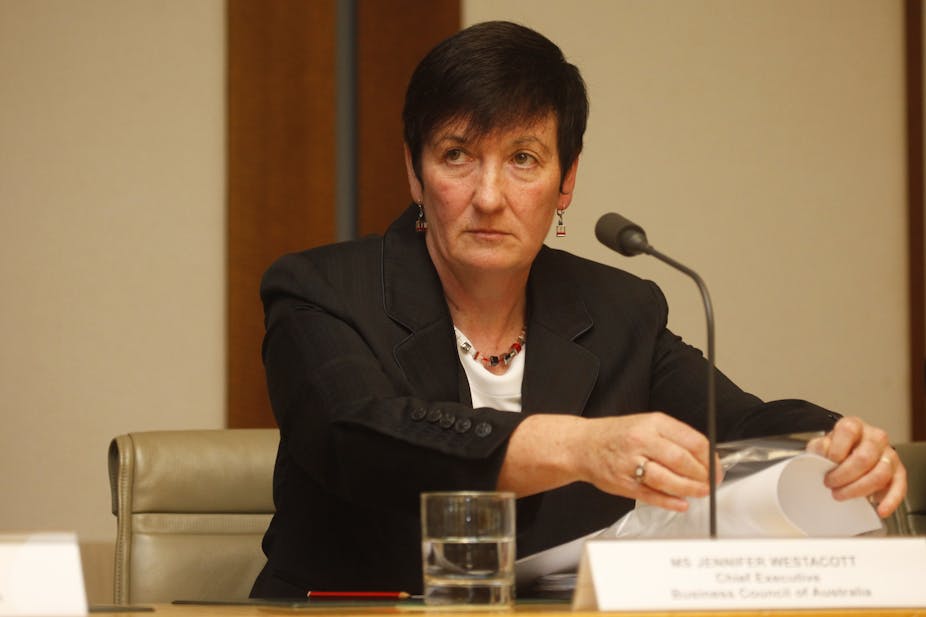
The provocative address by Business Council of Australia chief Jennifer Westacott to the Institute of Public Administration Australia (IPAA) International Congress in Melbourne yesterday achieved something almost unprecedented in contemporary Australian politics.
It focused debate squarely on the quality of debate, analysis and advice that informs decision-making about public policy issues that are of vital importance to Australia’s prosperity, competitiveness and the living standards of its citizens.
Westacott’s was a serious and important critique by an individual who has significant experience of policy processes both within and outside of government, at state and federal levels.
She has held a variety of senior roles in the NSW and Victorian governments, as a lead partner with consulting firm KPMG and now as head of the BCA. Reaction has been mostly supportive, including from the retired former Secretary of the Department of the Prime Minister and Cabinet Terry Moran, and Roger Beale, a respected PWC consultant and former Secretary of the Department of the Environment and Heritage.
Her comments have clearly resonated with people concerned that populism and adversarial politics is undermining Australia’s ability to address the problems identified in her first major address in the BCA Chief Executive role.
These include: the high costs of doing business in Australia; poor productivity; and the need to embrace reforms the BCA believes will enable Australia to weather continuing global economic weakness and position itself for future opportunities.
It is not the first time Australian business leaders have drawn attention to the need to strengthen the public service; to streamline regulation, overhaul the tax system; and to fix a federation that many believe is “broken”.
These issues were key recommendations from Kevin Rudd’s Australia 2020 Summit in April 2008, which reminds us such criticisms precede the Rudd and Gillard governments, although some commentators have been all too quick to interpret Westacott’s remarks (and Terry Moran’s endorsement of them) as a comment on the quality and performance of Julia Gillard’s Prime Minister’s Office (PMO).
Most analysts cite 2001 as the end of the reform era which began with Hawke and Keating. Since then governments have been increasingly criticised for seeking to “buy” political support with electoral bribes and seemingly feeling obliged to compensate any individual or group that stands to lose or be affected by policy change (see Quarterly Essay contributions from George Megalogenis in 2010 and Laura Tingle in 2012).
Former Treasury Secretary Ken Henry has lamented with increasing intensity on the quality of policy debate and the ability of our political system to deal with long-term challenges. He told a forum at the Australian National University recently that he could not recall a time in the past 25 years when the quality of public policy debate had been so poor.
Analysts and commentators including former prime ministerial adviser Ross Garnaut and journalist Paul Kelly in his 2009 book, March of the Patriots, have questioned whether Australia any longer is capable of designing and implementing the kinds of reforms that underpinned sustained economic growth over the past two decades, including during the global financial crisis, or whether a “great complacency” has become the dominant posture.
It is interesting then that Westacott cites the loss of public service authority and legitimacy as a key driver of the malaise afflicting contemporary policy-making, rather than attributing it to, for example, the nature of democratic politics, greater complexity, voter disenchantment, electoral volatility, a hung parliament, or the demands of the 24 hour news media.
Among her recommendations are proposals “to halve the allocation of personal staff in ministerial offices and establish a mandatory code that prohibits them from directing public servants” and to “reinstate the tenure of departmental secretaries”.
It is worth remembering that Malcolm Fraser’s frustration with the intransigence of the Commonwealth Treasury was why he overcame his initial skepticism of the Whitlam government’s experiment with ministerial staff and developed serious policy expertise within his PMO.
From the late 1960s, Ministers became increasingly unwilling to tolerate a lack of responsiveness from some public service departments and sought support to bolster their capacity to drive policy and ensure responsiveness from their officials.
The Hawke and Keating governments implemented many of the reforms that Ms Westacott has now criticised: formalising the role of ministerial staff through the passage of the Members of Parliament (Staff) Act 1984 and, later, removing tenure for “Permanent Heads” and placing Departmental Secretaries on contracts.
It is generally agreed the partnership that developed between ministers, their staff and the public service in this era drove wide-ranging and bi-partisan reforms that have underpinned our relative prosperity and competitiveness.
It is worth noting too that ministerial staff, in particular policy experts like John Rose, John Hewson, Ross Garnaut, Don Russell, Jenny Macklin and others, made important intellectual contributions to the economic and social reforms of the 1980s, breaking the public service’s virtual monopoly over policy advising. They are credited with introducing new ideas and greater contestability that many argue has improved the quality of advice.
But the provisions that allowed the engagement of policy specialists fell into disuse under the Howard government and have not been revived. The MOP(S) Act, which governs the engagement of ministerial staff, also enables public servants to be seconded to the minister’s staff and – recognising that offices are partisan - relieves them of their obligation to be impartial for the duration of their appointment.
Through the Hawke and Keating years, this was seen as a critical opportunity to expose officials to the pressures on ministers and the politics of policy processes.
Public service leaders like Graham Evans, Sandy Hollway, Dennis Richardson, Stephen Sedgwick, Ken Henry, Andrew Metcalfe and others followed this pathway, with benefits flowing both ways.
Again, this fell by the wayside as a more partisan approach took hold – it was seen as risky to align oneself with the political party in government by taking a role in a minister’s office. Ministerial staff roles became part of the trajectory of career politics – an essential (and publicly funded) training ground for professional politics.
While under Hawke and Keating up to 70% of staffers were seconded from the APS, from Howard onwards those numbers fell dramatically, with obvious consequences for knowledge of government processes and content expertise.
My book Power without Responsibility: Ministerial Staffers in Australian Governments from Whitlam to Howard advocated addressing issues of staff accountability, conduct and behaviour, management and “fit” within a Westminster-style system of government.
Many of these reforms became election commitments of Labor in Opposition and were later adopted by the Rudd government.
But I rejected then, as I do now, the argument that problems in the interface between ministerial staff and public servants are a question of numbers. There are complex reasons why Australian ministers have the largest number of personal staff in any Westminster-style political system – mostly to do with the demands on ministers from a more complex and uncertain political environment, the expectations of citizens, the demands of the media and for federal Labor, its status as a minority government.
We know from experience that cutting ministerial numbers is rarely sustainable – deeper structures condition the size and organisation of offices. But we should aim to ensure the system operates on the principle of complementarity, where there is mutual respect for the professional skills that staffers and officials each bring to their shared task of supporting ministers.
My research, which now includes a forthcoming study of Prime Ministers’ Chiefs of Staff and other work examining the support needs of ministers, leads me to conclude instead that the reactive policy-making that Jennifer Westacott rightly criticises is attributable to the nature of politics and it is there we must look for solutions.
I concur we should value and invest in a professional, impartial public service. But I would argue we need also to be attentive to the organisational skills and capacities of our leaders: their ability to select a quality team (official and partisan) and get the most out of it; to create effective arrangements for priority-setting, deliberation and decision-making (in Cabinet, policy committees etc); and ensure as decision-makers they can get the advice they need (as well as advice they want to hear); and to maintain effective relationships with key stakeholders within and outside of government. It seems to me this, as much as anything else, could address the concerns that have been expressed.
I welcome Jennifer Westacott’s contribution to what I hope will be a spirited debate about the advisory systems that enable decision-makers to make informed policy choices in Australia’s long-term interests.