Is the US set to jump off a fiscal cliff?

As we check our political calendars, many look to November 6 as the crucial date that will determine the future direction for US politics and the nation’s ailing economy. But in policy terms, it is January 2nd, 2013 that arguably matters more. That is the day of reckoning for federal government spending…

98z2k7y7-1347863092
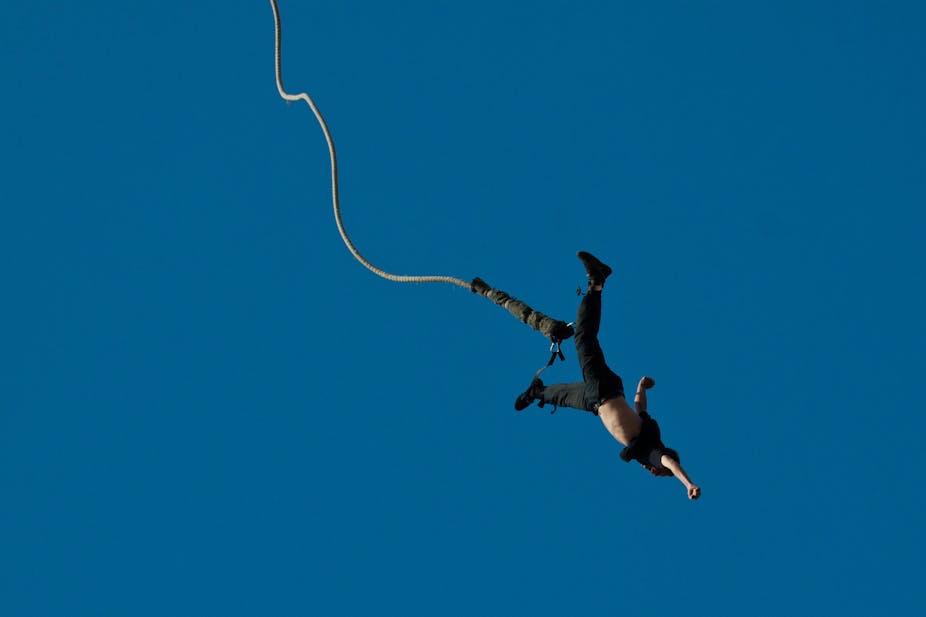
Without serious, structural fiscal reforms — which require bipartisanship and compromise — the US economy could go into free fall. Bungee jump image from www.shutterstock.com

As we check our political calendars, many look to November 6 as the crucial date that will determine the future direction for US politics and the nation’s ailing economy.

But in policy terms, it is January 2nd, 2013 that arguably matters more. That is the day of reckoning for federal government spending in the United States. During last year’s dramatic Congressional showdown over raising America’s debt ceiling (to honour payments to foreign creditors), it was agreed by a petulant congress that automatic cuts would occur on January 2, 2013. This is also when the so-called Bush tax cuts of 2001 will expire.

This date is dubbed the “fiscal cliff” because of the dramatic changes to the government’s revenue and expenditure that will be brought about by the automatic changes set to take place that day: over $400 billion worth of tax cuts will expire at the same time as about $100 billion of spending decreases are implemented. Many predict that this will likely send the economy into a double-dip recession.

The Congressional Budget Office estimates a drop in the deficit by about $560 billion between the 2012 and 2013 fiscal years, but the short-term effect is a dampening of economic growth and increased unemployment in an already sputtering economy.

Most analysts and elected officials agree that something must be done by Congress to avoid the automatic changes it set in motion last year as a political dare to inaction. The opening positions are that the Republicans want all the Bush-era tax cuts to be extended, while Democrats argue that long-term spending cuts should also be offset by tax increases for those earning over $250,000 a year.

The problem is that the system requires bipartisanship and compromise. However, because power is currently shared by a Republican House and Democratic Senate — and ill will is running high – compromise will be particularly hard to achieve. Furthermore, any bill without widespread partisan approval will be blocked in the Senate by the threat of the filibuster; if it passes that hurdle it could still be vetoed by the president.

The current thinking is that there are three possible scenarios for the coming months. The Obama administration could cross their fingers and hope that Congress can reach a deal. The second option is that Obama could go bold and head straight for the cliff. He could declare that if Congress is unable to strike a deal on fiscal reform, he will allow the “double fiscal time bombs” to explode. The hope is that this will cause Republicans to abandon their commitment not to raise taxes and force them to the negotiating table. The problem is this will take the iron will of LBJ or FDR. Many wonder whether a president who ran in 2008 on a promise of compromise has such grit in him.

Alternatively, Washington could do nothing — close their eyes and jump off the fiscal cliff. Despite the short-term consequences, commentators are increasingly suggesting that this wouldn’t be such a bad thing. It would allow the debate to “reset”. Taxes would automatically increase in the New Year when the Bush tax cuts expire; if this was allowed to happen then in 2013, lawmakers would be able to enjoy the political benefits of cutting some of the new hikes rather than being blamed for raising taxes.

In the meantime, the uncertainty over what will happen come January is taking its toll today. In July, supply chain management company, UPS – often considered a gauge for future economic performance – downgraded its growth estimates for the rest of the year, partly due to uncertainty over the likely outcome.

Although Congress is ultimately the forum where tax and spending reforms will be decided upon, we are likely to hear more about the fiscal cliff in the coming weeks in the presidential campaign. The Obama campaign is arguing that Romney’s solution to every problem is tax cuts for America’s highest income earners. Obama even had a tax joke in his convention speech: “Feel a cold coming on? Take two tax cuts, roll back some regulations, and call us in the morning!” Romney argued this weekend that “President Obama is passively allowing us to go over a fiscal cliff".

Insider accounts of the debt crisis such as Bob Woodward’s latest fly-on-the wall book, The Price of Politics, finds plenty to fault about Obama’s negotiating skills during these very tricky and important debates. However, Romney and Ryan’s solutions to America’s debt problem – which they suggest is like a wildfire sweeping across America – are likely to leave lots of poorer Americans worse off at a time when poverty is already at a two-decade highpoint in America. Watching the fiscal cliff negotiations in the months ahead is thus just as important as watching the Obama and Romney popularity contest.

Join the conversation

12 Comments sorted by

  1. Derek McKinnon

    Manager

    A few years ago I might have disagreed. However I'm beginning to believe that the president of the USA doesn't really matter. The only significant difference I can see between Bush and Obama is Heathcare. Afganistan is still a mess and they want out. Guantanamo is still open. The economy is still in trouble and the rising US debt levels are still unsustainable. Furthermore none of the proposed remedies to the unsustainable debt levels are big enough to actually fix the problem. They are all fiddling while Rome burns.

    report
    1. Michael Hay

      retired

      In reply to Derek McKinnon

      The USA is responsible for the greed involved with money trading and from there the 2008 financial crisis, the financial problems in Europe and the disastrously high Australian dollar.
      Richard Nixon abandoned the Bretton Woods Agreement, which had held all the currencies of the world in concert for decades. There was no currency trading, no hedge funds, no prime mortgage fiascos while the agreement was in place. There has been no American President sufficiently concerned with world affairs and…

      Read more
  2. Peter Ormonde

    Peter Ormonde is a Friend of The Conversation.

    Farmer

    Excellent piece.

    And all the time - ticking away quietly in the corner - is the pile of sub-prime toxic debt. Ben Bernanke's latest offer - of buying the stuff up - soaking it up with a pubic sponge will dab about at the edges a bit. But sometime the collapse in overvalued housing assets must be recognised on balance sheets. And that will be in all probability an ugly business. For the US and for the world's banking system.

    Makes one wonder why anyone in their right mind would want to pretend to run the show. Some unquenchable hunger for celebrity I suspect.

    report
  3. Nick Kermode

    logged in via email @hotmail.com

    Even more scary is the fact the the budget deficit is only a small part of their total fiscal responsibility.

    report
  4. Gavin Moodie

    Principal Policy Adviser

    I gather the authors don't expect the elections to change the balance of the House or Senate significantly.

    Obama's healthcare is a big improvement and worth his first term. The presidential candidates' policies on higher education are rather different.

    report
    1. Peter Ormonde

      Peter Ormonde is a Friend of The Conversation.

      Farmer

      In reply to Gavin Moodie

      Morning Gavin...

      You mean the Islamic communist Obamacare plot to bring in sharia law, nationalised medicine and death squads?

      Have you read some of the insane commentary on these obviously long overdue and much needed reforms? My goodness!!!

      The US needs some major mental health care initiatives more than just the current rather limited proposals.

      report
  5. Harry Xing

    logged in via Facebook

    Can't happen soon enough. Perhaps then the USA will mind it's own business, stop acting like a glorious self appointed world ruler and look to fixing it's own problems. The world has seen the dishonesty of America, Hillary rushing around the world preaching one thing and the USA CIA doing exactly the evil opposite such as the rendition program for Gadaffi. Does America ask, what did we do that would have made Bin Laden do what he did on september 11. No! Never. The USA is as pure as snow. BS, and yet the world can see American foreign policy was and still is an obscentiy, take Cuba for example. Americans love their wars of revenge and their domestic killing weapons,guns. Fortunately so many are on food stamps we don't see so many in Austrtalia anymore and for that a lot of us are truly grateful, too poor to travel!

    report
    1. Yoron Hamber

      Thinking

      In reply to Harry Xing

      Seems too harsh that view Harry. USA may have its flaws, but it still have a lot of goodwill in the world. I agree on that it may be time for them to look over their own house instead of others though.One has to remember that they are the 'superpower', and today, as all other days in history, 'superpowers' build on their ability of force. If another country stepped into that role I would expect it to behave in a similar manner, sooner or later.

      Take a look at Russia and China for example, and how they solved their problems. The main thing one might want to see though is USA behaving, and treating others, as their own constitution proclaim to treat themselves.

      report
  6. Ian Donald Lowe

    Seeker of Truth

    It needs to be asked, what is the US Federal Reserve using to buy this high-risk, toxic debt?
    This time around there won't even be printed money to back the 'quantitative easing', it's all just numbers on a screen. What does this mean in real terms? The federal reserve is moving private, toxic debt from the privately owned banks to their balance sheets, which are based on treasury bonds, so they are moving private debt to public debt. This will allow the banksters to pay themselves nice fat, juicy…

    Read more
    1. lavinia kay moore

      child and family counsellor

      In reply to Ian Donald Lowe

      Choosing peace is the only option. War enriches arms manufacturers and the usual carpet-baggers such as Halliburton, KB and Root etc. And those who bear the cost are ordinary innocents, mothers and grandparents and most of all, children.
      Maybe we could see the context of America's most recent aggressions and breaches of Geneva and the rule of law etc as a symptom that commonly emerges when empires are in their death throes, and the Emperor and his cohorts act in desperation to make someone else…

      Read more
    2. Michael Hay

      retired

      In reply to lavinia kay moore

      Both Lavinia and Ian are correct, and Australia should stand up for itself as an independent nation. ANZUS treaty was concocted when there was a danger of war. Since then, the only wars have been those inspired by American ideology - Korea, Vietnam, Afghanistan. If one refused to follow USA's need to bolster its arms manufacturing by utilising its weapons and bullets all by itself, we would have a basis for a peaceful world. Lavinia's 3rd paragraph is an excellent comment on the stupidity of following this (so-called) leader of the Western world, to our own detriment. Tell me, why would any self respecting nation wish to adopt the stupidity and expense involved with the USA's version of democracy.? For that matter, why do we put up with our own excess numbers of parliamentarians, none of whom appear to have heard of the term 'governance'?

      report
  7. Firozali A.Mulla

    PhD

    Bank of America plans to cut 16,000 jobs by year-end in a major restructuring that would end its title as the biggest US banking industry's largest employer, The Wall Street Journal reported on Thursday. The cuts will take the banking giant's total employment to 260,000, the Journal said, the lowest level since 2008, when the bank acquired failing mortgage lender Countrywide Financial and the Merrill Lynch investment bank. World food prices are forecast to reach record highs in 2013, according to a Rabobank report. The trend is expected to extend well into the third quarter of 2013, the report said. Unlike the staple grain shortage 2008, this year's scarcity will affect feed intensive crops with serious repercussions for the animal protein and dairy industries,'' the report said. I thank you Firozali A.Mulla DBA

    report