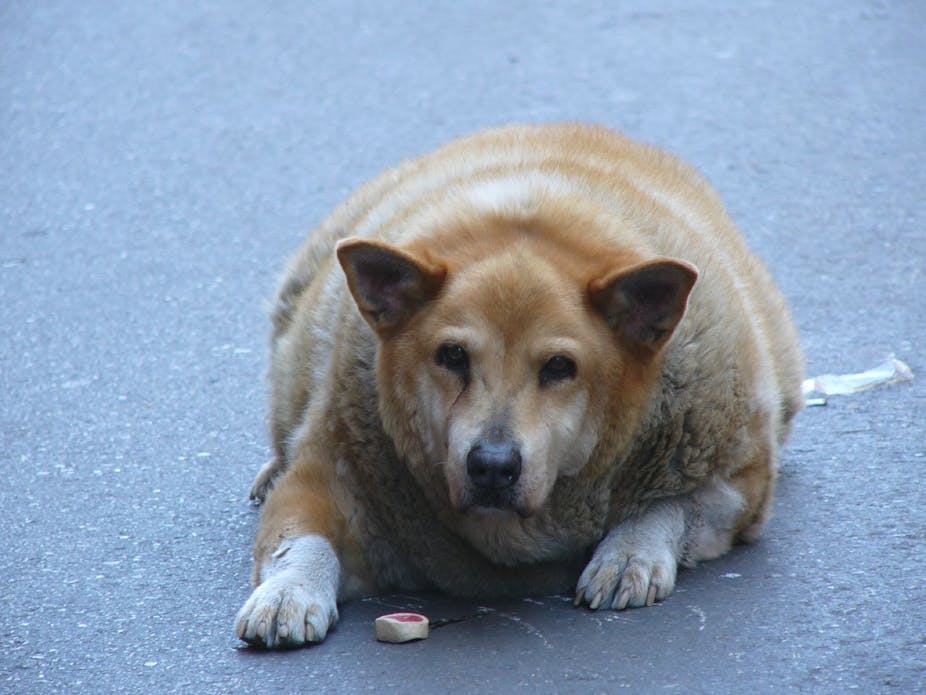
It’s a dog’s life when man’s best friend becomes his fattest

A study published this morning in Nature offers further insight into how dogs became domesticated. The comparative analysis of human, canine and wolf genomes suggests that humans and dogs have evolved in parallel as a response to the increasingly starchy diets on offer after the agricultural revolution…

6rfgjrtw-1357614276
Overweight pets have become collateral casualties in the ongoing war against human obesity. MrTGT/Flickr

A study published this morning in Nature offers further insight into how dogs became domesticated. The comparative analysis of human, canine and wolf genomes suggests that humans and dogs have evolved in parallel as a response to the increasingly starchy diets on offer after the agricultural revolution. Such a wholesale change in diet has not necessarily been benign for either species.

As our waistlines have expanded, so have those of our pet animals. In fact, the rising incidence of obesity in humans and dogs seems to be linked; people at high risk of obesity are more likely to own and care for an overweight canine companion.

Problems and solutions

The problem of excess weight in dogs isn’t just a matter of aesthetics. As with humans, obesity in dogs is linked to conditions such as arthritis, diabetes and heart disease. This makes excessive weight gain in pet dogs both a veterinary medical and animal welfare issue.

In biological terms, obesity in pet animals occurs for the same reasons it does in people. Affected individuals eat more than they need, and might also have a genetic susceptibility to putting on weight.

Current approaches to addressing canine obesity involve restricting the number of calories owners give their animals. This typically involves a proprietary “diet” food and owner education.

A weight-loss industry for pets has emerged in the United States, the United Kingdom and Australia. Canine boot camps and dieting clubs have sprung up to help owners achieve their dog’s weight-loss goals.

At the same time, “fat dog” stories have become a news staple. Indeed, overweight pets have become collateral casualties in the ongoing war against human obesity.

Interestingly, the emphasis in this coverage revolves around one or more of three basic causal stories about people who own overweight animals:

  • they buy and feed their dogs the wrong types of foods,

  • they overfeed their animals to compensate for their inability to look after them properly, or

  • they’re morally culpable and are partaking in a form of abuse.

Despite a concerted campaign by animal health professionals, the incidence of canine obesity remains much the same. And efforts to make people “own the problem”, including prosecution, have done little to curb canine excess.

While the application of surgical solutions to human obesity is rising rapidly, so far the consensus is that weight-loss surgery for dogs is unethical and that drugs are a shortcut for lazy owners.
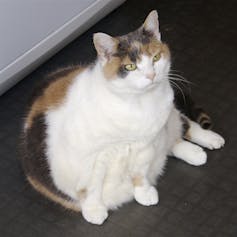
Obesity in pet animals occurs for the same reasons it does in people. Becky EnVérité

A bigger issue?

The emergence of a canine health problem that reflects cultural and socioeconomic patterns is significant. As well as sharing our capacity for weight gain, pet dogs share our homes and built environment, our leisure activities and lifestyles.

We know socioeconomic status maps onto differences in health across human populations. The increasing rates of obesity in people is now recognised to involve a complex mixture of biology, individual choices, socioeconomic drivers of food consumption and declining levels of physical activity.

Studies in Britain and the Netherlands suggest these same factors are at play in the growing proportion of pet dogs that are overweight. And because people at higher risk of obesity are more likely to own an overweight animal, links between canine disease and the environment provided by the owner raises an ethical dilemma for companion animal veterinarians.

Recent controversies in the livestock and horse racing industries signal a major societal shift in attitudes towards animal welfare. If the way people live puts their pets at increased risk of debilitating disease, are we going to start regulating companion animal ownership on the grounds of future animal welfare? We might also wonder if it’s fair to deny some people the benefits that come from sharing life with a pet animal.

These questions point to a number of unresolved tensions in our relationship with companion animals and the role vets play as protectors of animal welfare.

Treating disease in animals in our care is clearly the right thing to do. And since prevention is better than a cure, more attention needs to be given to the drivers of weight-related health problems in pets.

Experience with human populations indicates that teaching people how much to feed their animal may only be part of the solution. If vets are serious about reducing the burden of obesity-related disease in pet dogs, then the profession needs to take a larger role in public health.

Vets need to engage with community-based approaches to human and animal welfare. These could conceivably involve a role in urban planning, the framing of animal by-laws, and even directly promoting beneficial human health behaviours to encourage health and well-being across species boundaries.

Articles also by This Author

Sign in to Favourite

Want to follow The Conversation?

Sign up to our free newsletter to get the day's top stories in your inbox each morning, with a special wrap on Saturday.

Spinner
Become a friend of The Conversation and donate

Join the conversation

15 Comments sorted by

  1. Joe Gartner

    Tilter

    I've always given my kelpie cross dog whatever she has wanted to eat, in terms of quantity. Throughout her 16 years she has been lean to the point of skinny. I've also given her all the exercise she has wanted, or that I could manage. We've both been lean for those 16 years..... I wonder if there's a connection?
    That was, of course, a little flippant - my dog has a very active disposition and a limited appetite and I'm informed that some dogs don't. I wonder if satiety and activity in canines have some sort of genetic component?

    report
    1. Neville Mattick

      Grazier: Biodiversity is the key.

      In reply to Joe Gartner

      Joe I think you are correct, we have eight working Black and Tan Kelpies and it isn't until they reach old age or are de-sexed that weight becomes a problem.

      Actually some of the females are very light eaters, even after a hard days work, might not bother with much food, yet are all well filled out and shiny coat on all those chook eggs in their diet.

      My thought is the Kelpie (World's best dog - now diving for cover...) has been bred for agility and those that were heavy don't get to multiply as Graziers' quite often prefer small dogs for a range of reasons.

      Having observed wild dogs in other Nations' though, even my dogs look obese on a scale where they are natural!

      report
  2. Craig Minns

    Self-employed

    I can identify with this story. My dog, Max, is a very large cattle dog X collie, probably with a bit of rottweiler or similar in the mix. He's only ever been fed meat (stuff on markdown at the local supermarket) and scraps, with lots of bones. At last weigh-in he was 47kg and so I've been forced to take steps.

    These days he gets a mix of about 50:50 meat and rice with some lentils, half the meat cooked in with the rice and the rest mixed in raw as mince. he also gets whole eggs n the mix and…

    Read more
    1. Monica's wicked step

      logged in via Twitter

      In reply to Craig Minns

      Brown rice is much healthier than white rice, as the outer part of brown rice contains many of the essential vitamins. Brown rice also has a lower GI, and takes more energy to digest - all good reasons to switch to brown rice. I cook brown rice by the absorption method in the diluted meat juices to make it tastier.

      report
    2. Craig Minns

      Self-employed

      In reply to Monica's wicked step

      I've just made a big batch that'll last him a good couple of weeks, so I'll try brown rice next time in a smaller batch. No sense feeding him stuff he won't eat.

      report
    3. Monica's wicked step

      logged in via Twitter

      In reply to Craig Minns

      My recipe:

      Brown mince in the bottom of a stockpot with olive oil. Add brown rice and water in a ratio of 1:3 (eg 500ml rice and 1.5L water). Bring to boil and simmer for 30 minutes. Add vegies (I use carrots and green beans) towards the end of the cooking. Turn hotplate off and the excess water will absorb into the rice as it cools, leaving a solid mass of dog food.

      I've never met a dog that didn't like this food.

      report
    4. Craig Minns

      Self-employed

      In reply to Monica's wicked step

      I'm still experimenting. Up until recently he's been fed meat, bones and scraps. My most recent batch is 2 cups white rice, 1 cup lentils, 8 cups water, cooked with 500g ox heart, 800g lamb offcuts, 2 stock cubes, 2 potatoes, 2 carrots. Cooked in a slow cooker for about 6 hours on low, then cooled and a dozen eggs (shell and all) and 1kg of raw mince mixed in, plus water as needed to make it mixable. Bagged up into 17 bags and frozen.

      He seems to love it and it's only about 150g of meat a day. I like the idea of some raw meat and eggs in there, since they're adapted to a raw diet and cooking can degrade some of the nutrients. Next time I'll give the brown rice a go, but he can be very fussy about eating around things he doesn't like. Still, he's very healthy apart from being a bit hefty, so he can't be missing much he needs.

      report
    5. Monica's wicked step

      logged in via Twitter

      In reply to Craig Minns

      My dogs don't just receive the cooked food. They get a raw bone (kangaroo) every day, some good quality dry food and pot-set yoghurt every evening.

      (The yoghurt keeps the gut flora in balance and stops the room-clearing farts)

      report
  3. Peter Hobbins

    PhD Scholar at University of Sydney

    Is the converse also true? When owners choose to lose weight, do their dogs benefit too? Or if they actively intervene in managing their dog's weight, does their own body mass index increase?

    Given that dog walking is a great impetus for regular, low-impact exercise, it strikes me that a vet's advice in this regard could be just as beneficial as a doctor's - whoever recommends it, both dog and owner are likely to benefit.

    On the other hand, humans who decide to cut down on their serving size might find themselves scraping the extra leftovers into their hound's bowl. The reverse situation seems somewhat less likely. However, observing the effects of a straightforward reduction in the quantity in a dog's meals could be a powerful and - I imagine - rapid illustration as to how effective this strategy can be if it's comprehensively applied.

    Cats, of course, do whatever they want.

    report
  4. David Paxton

    Veterinarian

    On the matter of "parallel" evolution between people and dogs (what does it mean, all evolution is) , I invite readers to visit my website www.compositeconversationalist.com where I argue that people and dogs evolved as extended phenotypes/mutualistic symbionts and are therefore part of each other's biological natures.. I have written Why It's OK to Talk to Your Dog to argue that the anatomy for speaking words could not have evolved in us unless the dog was evolving in association, to do the smelling for us. Among many things, the dog and we learned each other's body language and developed close communication (obesity being one contemporary outcome). As is said, if your dog is fat YOU are not getting enough exercise. Thanks for the Conversation.

    report
    1. Craig Minns

      Self-employed

      In reply to David Paxton

      Yes, you're right, I'm not getting enough exercise, especially at the moment, since I have a broken ankle. Neither's Max - he grew up on a large acreage and now he lives in suburbia. Doesn't seem to bother him much, although he loves his walks. Such is life, we all adapt.

      report
    2. Mark Amey

      logged in via Facebook

      In reply to David Paxton

      Thanks, David, for the link. I note on your site that your thesis is available for all to read. Very generous.

      report
  5. Michael Kennedy

    Public policy thinker

    What about Labardors? In my experience they seem to have evolved with no food off switch. An you see a lot of fat Labs with slim owners!

    report
  6. Monica's wicked step

    logged in via Twitter

    I recommend regular swimming to help obese dogs slim down. I've been swimming my blue heeler for seven years, as she has hip dysplasia and an arthritic spine. Swimming is the perfect non-weight-bearing exercise and helps strengthen leg muscles. It's made an incredible difference to my dog's general fitness and she can manage the daily walk with ease.

    I wonder if fat dogs, like their fat owners, don't exercise enough? Regular daily exercise is essential for a dog's physical, mental and emotional health. If you don't like walking, don't get a dog.

    report
  7. Comment removed by moderator.