It’s still a long way to the top for Australia’s working women

The 2012 Australian Census of Women in Leadership, released on Tuesday, paints a mixed picture of gender equality in the workplace. According to the Census report, women now hold 12.3% of ASX 200 directorships, up from 8.4% in 2010, but they only hold 9.7% of executive key management personnel (executive…

Pf42czn3-1353988751
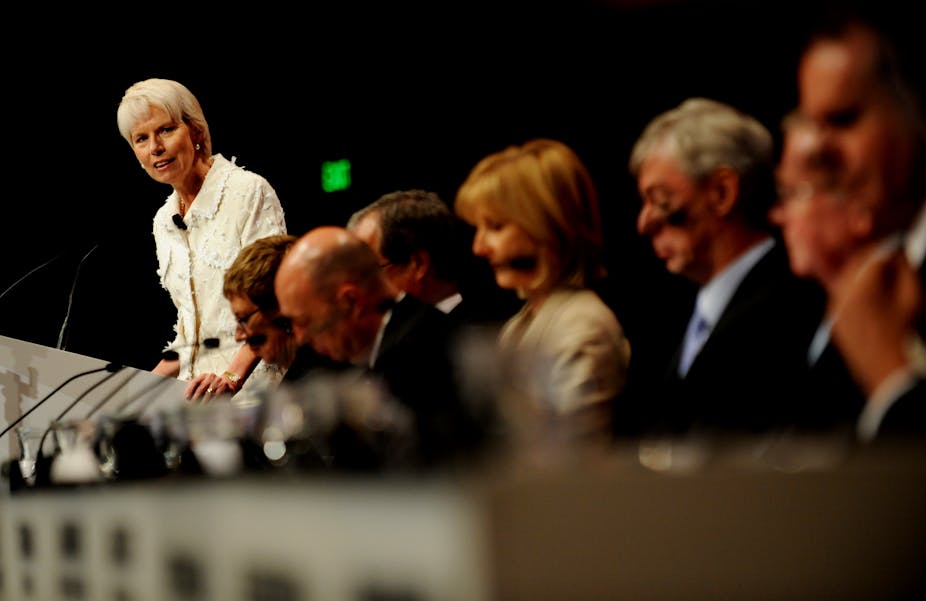
Australian women are still significantly under-represented in senior management positions. AAP

The 2012 Australian Census of Women in Leadership, released on Tuesday, paints a mixed picture of gender equality in the workplace.

According to the Census report, women now hold 12.3% of ASX 200 directorships, up from 8.4% in 2010, but they only hold 9.7% of executive key management personnel (executive KMP) positions in the ASX 200. There are 18 more women in executive KMP positions than in 2010. The report suggests some explanations for this: “the recent focus of attention on women in leadership has been directed at boards rather than executives”, and that “although it is possible to secure a board position by having demonstrated ability in other organisations and activities, senior executives normally need to have worked their way up the executive ladder. The pipeline for senior executive positions is generally narrower than for board positions and it will take time to channel more women through it”.

If corporate Australia wants to sustain the significant gains it has made in valuing women’s leadership, it needs to focus its attention on building pathways for career advancement.

To channel more women through the pipeline requires a shift in workplace cultures to enable women and men to share and balance work and life responsibilities. The model of the ideal worker dedicated only to work needs to change to reflect the realities of family and society. The Census report echoes this sentiment: “the ascent through executive ranks often requires time and availability that conflict with other commitments. While women attempt to balance these commitments, often male executives feel free to focus on their careers. More needs to be done to support women and to achieve greater work/life balance for both women and men in demanding executive positions”.

A much broader shift in other equality measures is also needed to enable women’s retention and advancement. ABS statistics released in August 2012 show that across Australia, women’s average full-time weekly earnings are now 17.5% less than men’s earnings. In fact, over the period of 18 years, the pay gap has increased by 1.5 percentage points from 17.2% in February 1996 to 17.4% in February 2012. The pay gap in the private sector is considerably larger than the public sector. In February 2012, the private sector gender pay gap was 20.8%, compared with 12.9% in the public sector. Furthermore, the gender pay gap in mean weekly earnings of managers in full-time positions was 20.5%.

The new Workplace Gender Equality (WGE) Act 2012 consolidates Australia’s effort to accelerate gender equality in workplaces. From the 2013–14 reporting period, gender equality indicators (GEI) set by the Minister will underpin the new reporting framework, steering attention to “address the most pressing contemporary challenges to gender equality in Australian workplaces”.

GEIs will include the gender composition of the workforce and of governing bodies of relevant employers; equal remuneration between women and men; and availability and utility of employment terms, conditions and practices relating to flexible working arrangements for employees and to working arrangements supporting employees with family or caring responsibilities.

No longer can it be said that the slow pace of progression for women is because of a lack of constructive support, analysis, information and successful business case examples. The Workplace Gender Equality Agency’s “light touch” approach is supporting employers and leaders in workplaces to remove barriers to the full and equal participation of women in the workforce.

The elimination of discrimination on the basis of gender in workplaces ultimately requires a values shift that translates understanding into action. Only then will Australia see a reduction in the gap between policy and practice. The possible implementation of mandatory quotas in the not too distant future would be a sad reflection on Australia’s organisational leaders, who had chosen not to take action of their own volition.

Join the conversation

10 Comments sorted by

  1. Dale Bloom

    Analyst

    25% of women don’t even have children, and the number of 1 person households is nearly 30% of all households.

    I sense something is being left out, when saying that women have these huge “family commitments”

    report
    1. Regan Forrest

      logged in via Twitter

      In reply to Dale Bloom

      "Family commitments" are not limited to dependent children or other people you live with. Many people have sick or elderly parents to care for as well. Things like driving relatives to medical appointments, etc. all have to be done during normal office hours, and can be frowned upon by some employers.

      report
    2. Dale Bloom

      Analyst

      In reply to Dale Bloom

      Regan Forrest
      The contagion of divorce may have significantly increased the number of parents someone has, but the vast majority of elderly people I know of drive a car, and in fact, elderly people do a lot of voluntary work.

      The evidence is mounting that many women don’t want to do the hard slog through junior management and then middle management and then senior management, and then into a board position.

      report
    3. Regan Forrest

      logged in via Twitter

      In reply to Dale Bloom

      It's great that you know so many healthy and socially active older people Dale. Not everyone is so lucky. I know plenty of people who have (married) parents who need a bit of help - either on an ongoing basis or every now and then. My mum is disabled and does not drive. There was a period where Dad was ill too, so I helped out during his convalescence. Because that's what families do.

      report
    4. Dale Bloom

      Analyst

      In reply to Dale Bloom

      Regan Forrest
      “so many healthy and socially active older people”

      Yes, and they are the majority.

      I think some other excuse will have to be found to propel women straight into board and senior management positions, whether they deserve to be in those positions or not.

      The excuse that women are “carers” with huge “family commitments” simply doesn’t work, and the longer time goes on, the less believeable becomes that excuse.

      report
    5. Dale Bloom

      Analyst

      In reply to Dale Bloom

      Regan Forrest.
      You might be right. I went and talked to a successful woman, not my usual practice I admit, and she had some interesting things to say about the gender 'club' at the top of her profession. While she claims there was no overt misogyny, although it may have been unconscious, she stated that quite subtly but obviously she wasn't part of the gentlemen's club at the top - which limited her advancement.

      report
    6. Regan Forrest

      logged in via Twitter

      In reply to Dale Bloom

      That wasn't the point I was trying to make, but nonethless you've made an important point Dale. It is the (often unconscious) tendency for those at the top to see "management potential" in people that most resemble themselves. Hence the "gentlemen's club" as you say - in fact it tends to be a gentlemen's club populated by a certain kind of man: white men from the "right" families who went to exclusive private schools.

      report
  2. Lisa Milne

    logged in via Facebook

    Regan - a 'bloomism' is a term used in the comments section of articles on the conversation to denote absolute fantastical, baseless, claims made as part of what is trolling and not serious commentary, for obvious reasons.

    report
    1. Dale Bloom

      Analyst

      In reply to Lisa Milne

      Lisa Milne

      But how can someone "remove barriers to the full and equal participation of women in the workforce." when 43% of women work part time.

      I sense hyperbole.

      report
  3. Dianna Arthur

    Dianna Arthur is a Friend of The Conversation.

    Environmentalist

    Most people are living long and healthy lives, until the inevitable decline leading to death.

    My mother was a typical example; up until she was 82 my mother was active, healthy and involved in her community. Then followed 4 years where my sister and I watched as disease (Scleroderma) claimed her inner organs - specifically her lungs. Pain and suffering after a life spent working in a dead end job in order to keep myself and my sister clothed, housed and fed after my father's early death at age…

    Read more