
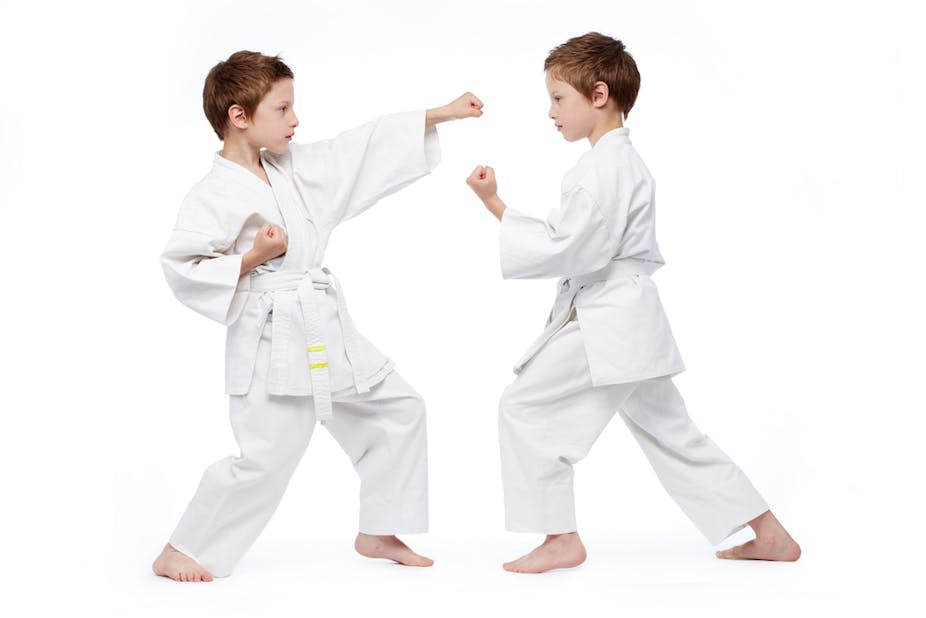
Karate kids: should we be worried about martial arts in pre-schools?

When you think of martial arts, you probably think of bare fists and bloodied faces, not a four year-old in a child care centre. But martial arts and self-defence programs do appear to be growing in popularity in childcare centres and pre-schools. In one case, three and four year-olds at a childcare…

X29cyqct-1361332883
Some pre-schools and early childhood centres are teaching young children self-defence – but is this ok? Child/self-defence image from www.shutterstock.com

When you think of martial arts, you probably think of bare fists and bloodied faces, not a four year-old in a child care centre.

But martial arts and self-defence programs do appear to be growing in popularity in childcare centres and pre-schools. In one case, three and four year-olds at a childcare centre in Melbourne are being taught self-defence techniques based on Krav Maga – a martial art developed by the Israeli military .

While there is some concern about safety and exposing pre-schoolers to violence, martial arts and self-defence can have a place in the physical education of young children, even before they reach primary school.

But this all depends on how it’s taught.

Self-defence classes, as with any physical education program for children of this age, can be a fun way to learn new skills and keep active. But there are other dangers here and we must be extremely cautious how martial arts and self defence classes are carried out.

First, we need to ensure that those doing the teaching are qualified, have the necessary training and understand the best pedagogy. Pre-schools, childcare centres and parents need to ensure that instructors have the right qualifications and experience to teach these programs.

After all, children learn in different ways and at different rates. They need an environment that is deliberately and skillfully created by the teacher, enabling all abilities amongst the group of children to be inclusively catered for.

We also need to recognise that we’re dealing with very impressionable young minds. If they have a good experience (likely their first learning through movement) then it can have a positive effect and help them enjoy a physically active life.

But if the class is not taught carefully or professionally then children can easily be given the wrong impression.

This is where the major dynamic in physical education comes into play – safety. In Japan for example, where martial arts is a mandatory part of the curriculum for older students, there have been serious concerns. In some cases, lessons by unqualified instructors have resulted in injuries and even fatalities.

Yet funnily in Australia safety has been one of the main selling points for self-defence organisations, who argue that students need to protect themselves from predators or bullies.

But is it okay for children to forcefully handle their peers in the name of self-defence? Are they mature enough to identify a self-defence situation from that of child’s play?

If martial arts and self-defence are being taught to young children then we need to make sure this is happening for the right reasons and that’s part of a wide range of physical activities.

Participating in a variety of physical activities enables children to discover what they enjoy and are good at. It enables them to develop the fundamental motor skills that will lay the foundation for them to continue to enjoy physical activities. After all, punching and kicking, the movements primarily developed through martial arts and self-defence, are important movement skills.

Martial arts and self-defence can supplement an early childhood physical education program only if done in a quality educational manner. But they cannot and should not replace such physical education programs.

Physical activity and sport can be a powerful learning tool where children learn to respect each other and themselves and where they can be proud of their improvements. Undoubtedly self-defence can play a positive role, but parents and educators also need to be aware of the risks.

Sign in to Favourite

Want to follow The Conversation?

Sign up to our free newsletter to get the day's top stories in your inbox each morning, with a special wrap on Saturday.

Spinner
Donate and become a friend of The Conversation

Join the conversation

17 Comments sorted by

  1. Mike Swinbourne

    logged in via Facebook

    I used to teach Karate a few years ago, but our school would not start kids until they were 5 years old.

    Karate - and other martial arts - are more than a means to defend yourself or to use violence. In fact, most martial arts schools de-emphasise the use of violence, and continually urge students to never use violence except in extreme situations and only as a last resort. This is especially the case for younger kids. And in most cases, the need to 'protect' yourself from violence comes not from your ability to use some form of fighting skill, but from the way you project an air of confidence and self assurance that comes from knowing that you can protect yourself if absolutely necessary.

    And martial arts are more than fighting. They are a great way to keep fit, which most would agree is a problem for kids in our society. They also help kids to develop discipline, because you cannot truly develop your skills in any martial art unless you have good self discipline.

    report
    1. Ross James

      Engineer

      In reply to Mike Swinbourne

      I've also taught karate for nearly 40 years. I fully agree with your comments. It very much depends on the instructor and club. Those who truly understand martial arts will teach students to avoid physical contact when possible, but have the confidence to stand up for themselves. Students learn to test themselves in the dojo, and have no need to prove themselves outside.

      The skills that make martial arts truly effective aren't learned in a few months of training, and kids aren't going to become dangerous machines in a hurry. However, they must be taught at a level suitable for their age and maturity.

      Some of my greatest rewards have been watching shy 4yo kids develop self confidence, self discipline, and a healthy attitude to life through martial arts training and instruction.

      report
  2. Ben Heard

    Director, ThinkClimate Consulting

    Mike, I have enjoyed a range of martial arts and I agree with all of your points.

    I would be very careful, now as a parent, about what the teaching is like to 4 year olds. At that age, they have a lot more to learn from social graces and non-violent problem solving than "self-defence" per se, and I would not want the latter to detract from the former.

    I am struggling to grasp how Krav Maga could have been the choice for 4 year olds

    report
  3. Michael Hunt

    logged in via Twitter

    "Yet funnily in Australia safety has been one of the main selling points for self-defence organisations, who argue that students need to protect themselves from predators or bullies."

    This is ridiculous. Most martial arts are more a sport or exercise in discipline. They do not teach the 'dirty fighting' you should teach a kid to protect themselves from a predator in a dangerous situation: you need to hit a guy as hard as you can in the groin, or if not a guy or that fails, poke out their eyes or hit them in the windpipe.

    If people are teaching kids that a roundhouse kick is going to save them from an abduction or rape then they are being irresponsible.

    report
    1. Mat Hardy

      Lecturer in Middle East Studies at Deakin University

      In reply to Michael Hunt

      I would say it is overall a misguided idea to be teaching a 5 or 6 year old that slugging it out with an adult male is a viable option.

      report
    2. Susan Ruthenbeck

      Luftmensch

      In reply to Mat Hardy

      My five year old son left the house and went wandering on his own last weekend. When we found him after a short time, we were all distressed.

      I wanted to talk to him about it and said things like - "you know that there are some people who are mean to children and they might not look mean, so you won't know who they are. That is why the police don't catch them." (Yes, it was a five y.o. level discussion).

      Mr Five said that I didn't need to worry, because he was a good ninja. And that is what worried me - in his mind, he was comptent to leave the house without an adult. Clearly, he's not.

      Now my little boy doesn't do martial arts, but children of this age are still have fantasy and reality intermingled. So the only sense that martial arts can benefit a child is as a fitness tool. Any suggestion that it might help them in relation to protecting themselves from an aggressor is ridiculous and heightens the risk that a child might place themselves in danger.

      report
    3. Michael Hunt

      logged in via Twitter

      In reply to Mat Hardy

      You are right, of course, but still teach them to punch, kick or knee bad guys in the nuts if they are in real trouble. I've been taken down by a 4 year old whacking me in my nuts, though it was my nephew thinking he was a power ranger or whatever is on TV these days, and I haven't liked him as much since then.

      report
    4. Mike Swinbourne

      logged in via Facebook

      In reply to Michael Hunt

      Yes, kids can do that to you.

      And as an aside, I have to say that I love your name!

      report
  4. Gerald Officer

    Lab rat

    "... who argue that students need to protect themselves from predators or bullies."
    Fortunately "bullies" never study martial arts. Only "good guys".

    Last century, when I asked a very skilled & fit boy to teach me some basics of what had been quite impressive, he replied along the lines of:
    First, talk. Say whatever you must to avoid a fight.
    If that doesn't work, then run, fast.
    If he catches you, you may need the fighting, but remember, you could not outrun him.

    report
  5. Sally Boteler

    customer service officer at health & leisure

    No, i do not " think of bare fists and bloodied faces" when i think of karate.
    I think of when my kids did a little and were taught that, most importantly, they were never to use it against other kids and would be turfed out if it was ever discovered that they had.
    You claim : "Yet funnily in Australia safety has been one of the main selling points for self-defence organisations, who argue that students need to protect themselves from predators or bullies."
    That requires some evidence to be attached.

    report
    1. Timothy Lynch

      Senior Lecturer in Education at Monash University

      In reply to Sally Boteler

      1. The most televised martial arts (a form of mixed) in western society is known as UFC (Ultimate Fighting Championship). This is a violent sport and children are familiar with this version.

      2. A couple of recent publications/sites that support this claim: http://www.dynamightkids.com.au/

      http://www.heraldsun.com.au/news/victoria/childcare-centres-offer-self-defence-classes-for-youngsters/story-e6frf7kx-1226580664158

      Thanks for your comments.

      report
    2. Peter Hindrup

      consultant

      In reply to Timothy Lynch

      Long years ago when a parent was quizzing the boxing gym trainer re the possibility that ayoung kid taught boxing could injure another kid on the street, he laughed and said: 'Watch these kids on the street, they swing punches with the best of them.'

      No, he was not saying that they punched 'well', they forgot their traiining and behaved like any other little kid, swinging rather ineffective punches.

      IF the training is being run properly, then anyone getting too smart, too aggressive is introduced to somebody, preferably smaller, who can take them apart without inflicting too much pain. This is usually all it takes to make them understand that it is much safer to talk, or run, than to be a bully.

      report
  6. ACHPER National

    logged in via Twitter

    This article raises questions about the purpose of martial arts, the maturity level of pre-schoolers, as well as the knowledge and competence of teachers or ‘instructors’ who spend their time with pre-school children. This is no simple issue. Any physical activity if carefully planned with safety foremost in everyone's mind, can have a place in the PE program, but at what stage of development? Movement exploration, the development of spatial awareness and movement competence are the critical learning…

    Read more
    1. Ross James

      Engineer

      In reply to ACHPER National

      Jeffrey - I agree, but if the kids enjoy it, get physical exercise, self confidence, and an experience of self achievement, then the benefits are there. The grading system introduces goal achievement, and measurable progress.

      report
  7. Bernie Victor

    Martial Arts Instructor

    Krav maga is a violent military style system that was designed purely for combat and nothing else. It has little if any of the basic ideals that asian based martial arts have which include a strong philosophical and spiritual base.
    If we want our kids to gain a good understanding of self defence with good philosophies, then asian martial arts are way ahead of Krav Maga. The core ethos behind asian martial arts are self defence and children are taught to use verbal defence first and body weapons as a last resort.

    Having the right instructor is key to the delivery of a good, fun and enjoyable class. Being taught age appropriate self defence is vital....

    report
    1. Molly Cat

      logged in via Facebook

      In reply to Bernie Victor

      Um. Weren't most martial arts designed by the army? And asia doesn't hold any special right to spiriit. I personally study wingchun and i can say without a doubt that it too is about combat. Not fighting... Beating!
      I wouldnt suggest it for kids, but i have friends who teach parts of it to kids. If they are shown how it allows one to be more, then it can be great... My studies have changed me into a more thoughtful person. Kravmagra can accomplish the same, it is not the style, or the origin of the art.. It is the teacher, the school and the family.

      report
  8. Merilyn Thompson

    Student at Monash University

    The concept of pre-schoolers learning a martial art whilst in care is disturbing. The element of surprising your opponent to gain advantage is inherent in this activity. Youngsters, however, do not have the ability to plan ahead and control impulses, as this only develops during early adolescence, around the age of ten (McDevitt & Ormrod, 2010). Certainly, there is discipline involved in learning Karate. I do not think that pre-school children will learn these skills and then discern when it will…

    Read more