

Lead poisoning of Port Pirie children: a long history of looking the other way

It is shocking to discover that more than 3000 children have been lead poisoned in the South Australian town of Port Pirie during the last decade. Whilst Australia continues to be a world leader in lead mining, smelting, and processing, the adverse impacts associated with production have been consistently…

V85kdrm6-1342587921
Unsafe: thousands of Port Pirie children have been poisoned over decades, and yet government after government fails to stop it. Flickr/Viola Ng

It is shocking to discover that more than 3000 children have been lead poisoned in the South Australian town of Port Pirie during the last decade.

Whilst Australia continues to be a world leader in lead mining, smelting, and processing, the adverse impacts associated with production have been consistently downplayed by industry, governments, councils, health officials, and regulators. Even some academics argue the effects of low lead exposures are not of significant concern. Due to ignorance, misinformation, and deliberate obfuscation of evidence, generations of families living next to lead-mining, smelting, and refining centres such as those in Broken Hill, Port Pirie, and Mount Isa, have been and continue to be exposed to environmental lead, a known neuro-toxic contaminant.

More than a century of IQ-lowering poisoning continues

Childhood exposure to lead has been linked to lower IQ and academic achievement, and to a range of socio-behavioural problems such as attention deficit hyperactivity disorder (ADHD), learning difficulties, oppositional/conduct disorders, and delinquency. The disabling mental health issues from lead exposure often persist into adolescence and adulthood.

Port Pirie has been affected by lead-smelting emissions for over 120 years. A 1925 South Australian Royal Commission on Plumbism (lead poisoning) identified that the principle cause of poisoning was fine lead dust. Government officials had argued in the 1980s and 1990s that historical lead-smelter dust-emissions held in the city’s soils and home environments were the primary cause of elevated blood lead in children (Body et al., 1991). Indeed, they are still arguing that this is the case:

The Government understands there are legacy issues at Nyrstar’s plant at Port Pirie and has been working with all parties for many years to come to a solution.

Examination of the published research and the data collected by South Australia’s Environment Protection Authority (lead-in-air measurements) and SA Health (blood lead measures in children aged 0-4 years) shows that the contemporary and historical lead-in-air emissions are the primary causes of elevated blood-lead levels in Port Pirie children.

Local independent MP not facing facts

Despite the overwhelming evidence available in publicly accessible documents, it is staggering to read that the town’s Independent state MP, Geoff Brock, has not been accurately briefed on the matter. Mr Brock says Port Pirie does not deserve its negative image:

“I think it is unwarranted, quite frankly,” he said. “We have got that stigma of, I call it a polluted city, and we are not a polluted city. It is an inherited issue through the lead smelter over many, many years.”

Mr Brock’s comments are the same line of argument that has been plied for decades – in effect, he is arguing that historical lead emissions are causing elevated blood-lead problems in Port Pirie and that it is not a contaminated town.

That line of argument is inconsistent with the evidence. The “legacy” argument has delayed effective action over the last three decades and the current commentary coming from government suggests that there is a real risk that the primary cause of the problem will not get addressed. But with the potential for change at the smelter, this is a golden opportunity to clean up Port Pirie properly and effectively.

Contaminated playgrounds

As part of a 2011 lead exposure research study at Port Pirie, 26 surface soils (0-2 cm) at air monitoring and playground sites were sampled. Our samples had an average lead value of 1442 mg/kg, (approximately 38 times above background) confirming that surface soils are contaminated and also present a serious risk of harm to the children. The focus of our study was dust-lead exposure at four children’s playgrounds in Port Pirie (Memorial Park, Foreshore Park, Sports Park, and Woodward Park (see figure 1).
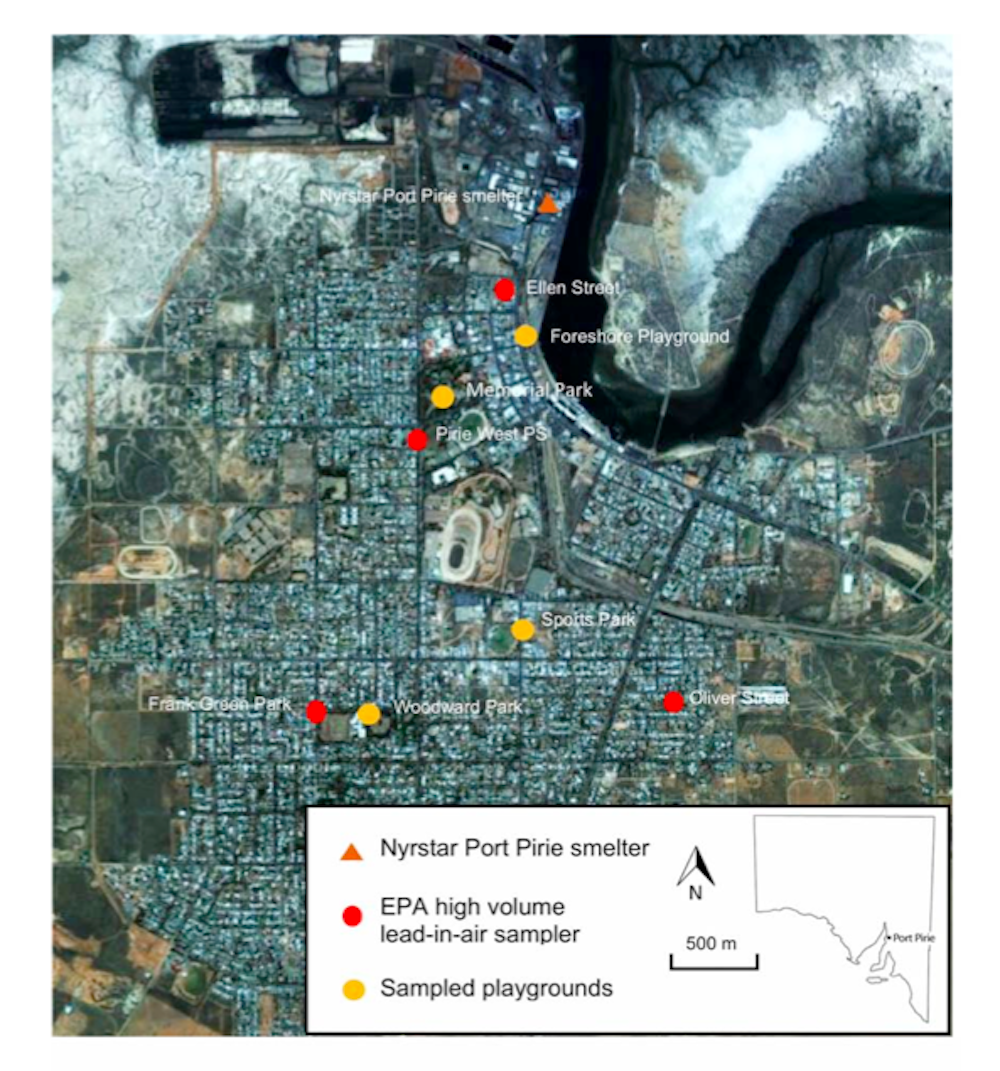
Figure 1: map of Port Pirie with EPA lead-in-air sample sites and playgrounds marked. The Port Pirie smelter is located at the north of the town. Image taken from Google Maps

Muliple dust-wipes collected daily from surfaces at four Port Pirie playgrounds returned average lead values of 3286 µg/m2, compared to 18.9 µg/m2 at a control playground at Port Augusta, 85 kilometres to the north. The Port Pirie values exceeded the Western Australia (WA) Health lead-level of 400 µg/m2, which was applied as a goal for surfaces accessible to children as part of the recent Esperance lead clean up program.

We also collected hand wipes before and after 20 minutes of timed play at each playground. Hand lead is of greater concern because young children tend to put their hands in their mouths, and it is therefore a significant pathway for childhood lead exposure. Memorial Park playground, the playground closest to the smelter that we sampled (figure 1), returned the highest lead-loadings after 20 minutes of play, with a daily mean increase of approximately 18,158 µg/m2. Overall, approximately 95% of all post-play hand-wipe samples from Port Pirie playgrounds exceeded the WA Health clean up goal of 400 µg/m2. By contrast, no samples from the control playground at Port Augusta exceeded the lead goal.

We have also examined the relationship between lead-in-air at the time of the study and our dust measurements. The data show that for each 1% increase in air lead (µg/m3), surface dust loading at playground sites increased by 0.713%. In addition, for each 1% increase in air-lead the post-play lead on hands increased by 0.612%. Thus, the evidence shows that airborne lead is significantly contaminating playgrounds.

These findings are not dissimilar to previous studies completed in Port Pirie that have shown that atmospheric emissions are the primary source of lead exposure. Therefore, it is misleading and a gross over-simplification to argue that the lead problem in Port Pirie is caused by legacy effects, without reference to the ongoing smelter-emissions.

As far back as 1976, the CSIRO demonstrated that the smelter had contaminated soils, grains, and vegetables around the Port Pirie area. A further CSIRO study in 1981 confirmed the negative impact of smelter emissions on environmental quality around Port Pirie. In 2004, Crikey reported that grain from the Port Pirie area had to be blended because cadmium and lead levels exceeded internationally accepted standards.

The impact of the smelter can also be understood by examining SA Health’s blood-lead monitoring of children. This monitoring data shows that in 2011, 25.5% of children (excluding the use of surrogate values) under 5 years-of-age have elevated blood-lead values, i.e. more than 10 µg/dL – the Australian national goal for blood lead in children.

Even though children are born with relatively low blood-lead levels (predominantly well below 5 µg/dL), research shows that blood leads rise rapidly from 2 to 3 months of age, demonstrating that infants cannot escape the environmental lead emissions. At this age, children would not have been crawling and would have been lying in their bed, receiving lead-dust on their hands, face, clothes, and cot.

By the time children are 24-months-old, the geometric mean blood lead level is 6.1 µg/dL, which is beyond the level at which the US National Toxicology Program identified multiple adverse health effects in children. Indeed, in May 2012, the US Centers for Disease Control and Prevention lowered their action threshold blood-lead to 5.0 µg/dL after accepting the weight of evidence for no safe threshold and the need to intervene much earlier to limit damage to children.

The most lead-contaminated town in Australia
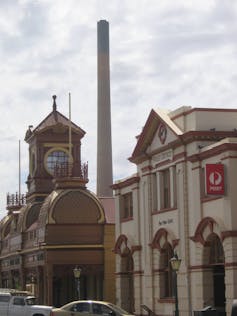
Port Pirie’s CBD, with the lead-smelter’s chimney overlooking the town. Flickr/Royston Rascals

The EPA’s 2010 air quality raw data shows that the city is blanketed regularly in elevated lead in air emissions. These emissions contaminate the whole town, its soils, exterior and interior surfaces, and then children’s hands. National air quality data shows that Port Pirie is unequivocally the most lead-contaminated urban environment in Australia. Another health pollutant, sulfur dioxide, exceeded the national 1-hour standard 44 times in 2010. Sulfur dioxide affects respiratory conditions, such as asthma. Childhood blood-lead exposures are more than twice those recorded anywhere else in Australia – higher than Broken Hill or Mount Isa. While these are uncomfortable facts, especially for young families in the city, they need to know the truth so that they can make fully informed choices.

While government knows the truth, the public wait for effective action

It is also clear that there has been and continues to be significant government knowledge of the true nature and extent of the problem. The fact that the politicians have not acted on the evidence demonstrates they have ignored the information coming from their staff, and/or have not had the willpower or commitment over the last 30 years to take effective action to eliminate preventable and damaging exposures once and for all. In 1983 Dr Phillip Landrigan, a world-renowned paediatrician called for urgent action in his report that was commissioned by the then-health minister. He identified that airborne lead and its accidental ingestion from atmospherically contaminated dust and soil were the main sources of exposure.

While it acknowledged that some useful work was undertaken by the Task Force set up in 1983 to deal with the problem and tens of millions of dollars have been spent, the tenby10 goal of reducing blood lead levels of 95% of children up to the age of four to below 10 µg/dL by the end of 2010 failed.

It has failed because the clean-up of household dusts and soils was incomplete and, more importantly, the primary source for lead exposure – smelter emissions – was not eliminated. As a result, businesses, houses, playgrounds, schools, and outdoor areas have been further contaminated.

Residents advised to protect themselves

Residents are advised to protect themselves in their homes by washing hands, surfaces and food and to not transport in dust and soil from outside. This approach is problematic for two reasons:

(1) A recent review of household interventions for preventing domestic lead exposure in children finds that household interventions do not work;

(2) Asking home owners to protect themselves from a seriously polluting industry instead of implementing complete or more effective emission capture is simply inappropriate and unreasonable.

Telling people to wash their hands is not good enough. Flickr/firexbrat

Lead pollution still pouring from the smelter

Due to a lack of adequate action to limit or eliminate Port Pirie’s significant smelter emissions (44,000 tonnes of lead into the air in 2011), lead-rich particulates continue to contaminate indoor and outdoor surfaces, and soils, as well as the atmosphere. As a result, blood-lead poisoning is almost an inevitability for residents of the city, especially children.

The only conclusion one can draw from the failure to eliminate preventable lead exposure in Port Pirie is that there has been an absence of decisive and competent leadership from successive governments over the last 30 years.

In order to break the cycle of exposure and poisoning there needs to be a quantum shift in the approach to the problem at Port Pirie, including more transparent and accurate reporting. Solutions might entail smelter closure or perhaps, as is being suggested, a refit with modern, clean technology coupled to comprehensive soil and household dust remediation across the city. Both treatments are required to reduce exposures significantly.

Preventable, elevated blood lead values are unacceptable for any child. The source and extent of the problem in Port Pirie have been established and the solutions are well known to industry professionals. The unanswered question is whether the South Australian government is going to resolve this problem finally or if they will fold once again because of the fear of losing the industry and jobs.

Comments welcome below.

Articles also by This Author

Sign in to Favourite

Want to follow The Conversation?

Sign up to our free newsletter to get the day's top stories in your inbox each morning, with a special wrap on Saturday.

Spinner
Help us have better conversations — donate

Join the conversation

32 Comments sorted by

  1. Paul Rogers

    Manager

    I've followed this issue for over 30 years and all I can say is the response of governments, some authorities, and industry has been shameful, and, frankly, criminal, in my view.

    It seems it gets shoved into the 'too hard basket' and every opportunity.

    report
    1. Dianna Arthur

      Dianna Arthur is a Friend of The Conversation.

      Environmentalist

      In reply to Peter Ormonde

      Lead poisoning is just a part of the multitude of toxins that reside in the air and landscape of Port Pirie. Rates of cancer are also above the Australian average.

      Anecdotally, both my mother and aunt who were born and raised in Port Pirie died of the very rare disease scleroderma. It is a slow, inexorable disease that produces an excess of collagen in the skin of all body organs. It slowly asphyxiated my mother by turning her lungs to scar tissue and my aunt's legs to gangrene.

      http://www

      Read more
    2. Peter Ormonde

      Peter Ormonde is a Friend of The Conversation.

      Farmer

      In reply to Dianna Arthur

      That is a shocking story Ms A... tragic and deeply disturbing.

      True your grandparents would not have known what was happening and would have been lied to by governments and by the industry. But for 30 years or more to my knowledge the hazards of lead - particularly for children - have been well known in Port Pirie. And they stay there.

      It is criminal. And I hope eventually that generations of Port Pirie's kids are able to be recognised and compensated for it. No different to asbestos. And there were kids in Wittenoom too. How Gina's dad got his start.

      report
    3. Dianna Arthur

      Dianna Arthur is a Friend of The Conversation.

      Environmentalist

      In reply to Peter Ormonde

      I still have relatives living there still. They are not stupid, ignorant nor irresponsible. The reasons are far more complex than would appear at first glance.

      I would never live there. But then, I wasn't born there and my only connection were family - all of whom I adore - they are lovely people. Then again I want to stay where I am living despite the threat of bushfires - humans are perverse creatures.

      However, the people who knew and have always known - government, industry, doctors and other people directly involved have either done nothing or been silenced.

      There may well be easy targets on which to lay blame - but the solution is not so easy. Not until the human race has evolved to an extent where ALL of us realise we are in this together, that what we do has consequences for others either immediate or long term.

      Won't be in my life-time - we can't even discuss body functions without being denigrated - what hope for the whistle blowers?

      report
    4. Peter Ormonde

      Peter Ormonde is a Friend of The Conversation.

      Farmer

      In reply to Dianna Arthur

      "I still have relatives living there still. They are not stupid, ignorant nor irresponsible."

      Well yes Diana, they are... especially if they have kids. Let us hope they are ignorant and do not know that lead is such a horrendous toxin.

      Hopefully they are not stupid - unless the lead has already done its work.

      But if they do know that lead makes your kids stupid - then yes you bet they are irresponsible. No, worse actually negligent and uncaring. Irresponsible implies foolish risk-taking…

      Read more
    5. Dianna Arthur

      Dianna Arthur is a Friend of The Conversation.

      Environmentalist

      In reply to Peter Ormonde

      Not only Port Pirie - any town that supports processing of minerals is home to people, human beings who choose to work and live there - for reasons I do not fully understand or support.

      Perhaps you can judge them or even myself - I would not presume to. Instead I prefer to communicate, assist in education and protest that which needs to be protested against. Even if it means having my views rejected discounted or ridiculed.

      report
  2. Michael Gioiello

    High school music teacher/ freelance Opera singer

    It is amazing the level of corruption that goes on when large sums of money are involved. Authorities are willing to play with people's lives, overlooking the health concerns for many decades. No doubt they were getting their "cut'', in order to overlook the issue.

    Are these devious acts any less malicious than what drug dealers do? I think that they are virtually the same in their disregard for human life. These criminals should be brought to justice for downplaying the threat of the lead in the environment and its cost to life.

    report
  3. Geoff Crozier

    Project Manager

    I lived near PP once and turned down the 'opportunity' to live there for this precise reason!! I gree with other comments, it's disgraceful what people won't do when money, power and politics are involved! The people need to stand up and shout it out loud - poisioning is not 'OK' - this is one of the most significant public health threats in this state.

    report
    1. William Raper

      Mr.

      In reply to Geoff Crozier

      Sorry to sound cynical, but this is just another of the crimes committed by industries denials and their influence on governments. Well known examples are, in no particular order:

      Mercury from gold mining operations
      Asbestos mining and use
      Tobacco

      and now "carbon" pollution of our atmosphere.

      All these and Lead pollution have been vigorously defended by those who knew the facts but were more interested in profits than human health.

      In relation to governments, Bob Dylan said it - When will they ever learn!

      Bill Raper, M. Env. Sc. (Monash)

      report
    2. Janet Grogan

      Communications provider

      In reply to William Raper

      Not cynical Bill, just realistic.
      It seems that industry's needs and profits will always be paramount to the welfare of the community.
      You mention a few..asbestos, tobacco. I'd also add genetically modified crops and foods.
      In all of these the science showing real problems are denied, and scientists are silenced.
      With governmnets it's a case of 'don't look, don't find'

      report
    3. Jon Brodie

      Research scientist

      In reply to William Raper

      And all over Australia - Mount Isa of course but also Townsville where lead containing dust blows from the Port into residential areas. Coal dust in Gladstone, Mackay.

      report
    4. Rodney Cooper

      logged in via LinkedIn

      In reply to Janet Grogan

      Just a gentle reminder.

      I have lived and worked in Mount Isa and Townsville. I think some of you may be forgetting that they were both built because of the activities you are trying to comment about. Yes these are legacy issues and authorities and industry should do more but it is your choice to live in those areas and take the risks. Those industires have been there prior to your arrival so I suggest do your research prior to moving somewhere.

      No one is innocent in this situation.

      report
    5. Shirley Birney

      retiree

      In reply to Rodney Cooper

      Firstly residential developments should not be permitted near hazardous industrial sites. Further, governments, councils and developers have a moral and ethical obligation to inform potential home buyers of existing properties on the possible health and environmental risks of residing in close proximity to these hazards.

      There is a long history of catastrophic events caused by reckless corporations operating within the boundaries of residential areas where taxpayers continue to pick up the tab for these disasters.

      report
    6. william mcinnes

      investigator into medical negligence

      In reply to Rodney Cooper

      Sorry Rodney... but the innocent sufferers of lead contamination (which is preventable), are the fetus, the infant and the child of anyone who for whatever reason lives in a town suffering from widespread lead contamination. They do not have a say in where they live, what their parents decide or what has happened to damage their brains and organs. From the womb, to the cot to the child up to about 6years old lead is absorbed into the body paving the way to future organ and brain dysfunction. The…

      Read more
    7. Rodney Cooper

      logged in via LinkedIn

      In reply to william mcinnes

      Yes William I do understand the effects of lead and many other products/ by-products of industrial processes on people including unborn children. My concern is the lack of accountability being displayed from individuals who point the finger at others for their issues. We do need better accountability from ALL sides of the equation. I can understand the situation you describe regarding government and industry not informing the public of potentially harmful situations in a space where the risk is not…

      Read more
    8. aligatorhardt

      logged in via Twitter

      In reply to Rodney Cooper

      Blaming the victim is always unjust and non productive. The operator of the smelter is guilty of poisoning the town. The legislature is guilty of collusion in allowing the operation of a smelter without emission controls. No business is more important than food and water. The costs of emission controls is a normal cost of doing business, and the cost of not using them is far greater, but that cost is pushed off onto the whole society. This is typical short sighted planning that ignores long term losses in favor of short term gains.

      report
    9. Dianna Arthur

      Dianna Arthur is a Friend of The Conversation.

      Environmentalist

      In reply to aligatorhardt

      Agree.

      Having experienced personal impact of the poisoning of Port Pirie, I know how useless it is blaming the victims. Particularly when the solutions require the cooperation of government and big business - who were the best informed and in the best position to prevent the toxicity to begin with.

      Perhaps there should be a relocation of all residents of polluted towns - funding provided by both government and big business for the provision of homes, schools and medical centres in non-polluted regions. This would give the population somewhere to go to and avoid being accused of irresponsible behaviour for having the temerity to be born in towns like Pirie.

      Nah, its cheaper just to point the finger and blame, blame, blame.

      report
    10. Peter Ormonde

      Peter Ormonde is a Friend of The Conversation.

      Farmer

      In reply to Dianna Arthur

      At the risk of precipitating another spat Ms Art, I shall wade in undaunted.

      You are dead right that it will take government leaning on business to fix this - but without a display of local anger and fury proportional to the crime - any government will (apparently safely) assume that everything is fine by the locals. and they want this foul business to continue.

      And sadly, by the look of things, they do. And that is the real tragedy to me.

      Why aren't the streets of Port Pirie flowing with the blood of the children of smelter executives?

      report
    11. Dianna Arthur

      Dianna Arthur is a Friend of The Conversation.

      Environmentalist

      In reply to Peter Ormonde

      "Why aren't the streets of Port Pirie flowing with the blood of the children of smelter executives?"

      Why aren't the streets of any mining town awash with the outrage of their inhabitants?

      I DO NOT KNOW.

      But I do know it stinks and has a lot to do with how our planet came to be polluted, deforested and stripped of all resources to the point where we now have farmers fighting the frackers (hydraulic fracturing for scant reserves of gas) . Much tussle within the National Party - would be entertaining if not so fraught.

      However, it is all part of human nature - part of which is to prefer blissful ignorance.

      I also know that pointing the finger of blame at the least powerful members of society is unhelpful at the very least. Not how you win people over.

      report
  4. william mcinnes

    investigator into medical negligence

    I commend Professor Mark Taylor for his comments regarding lead poisoning in Port Pirie and Broken Hill. Having investigated lead contamination in these two cities, I would agree that in South Australia, the facts relating to how the lead contamination of Port Pirie and Broken Hill took place are known to all of the major stakeholders mentioned by Professor Taylor. The constraints for the endangered public who may suffer toxic lead exposure in these two cities, are mainly that the facts which…

    Read more
  5. Shirley Birney

    retiree

    Thanks to Professor Taylor for a timely reminder that only a compilation of academic research, activism and community outrage will bring about significant reforms in the pervasive culture that exists in state-corporate crimes against citizens and the environment.

    Unfortunately the concept of state-corporate crime highlighting joint government and private corporate actions/collusion causing criminal harm has few published case studies. And it is a rare event for a government to both acknowledge…

    Read more
  6. Andy Miller

    Inspector

    I grew up in Port Pirie, I ate dirt, never washed my hands and I turned out perfectly fine. In fact I believe I am smarter than a majority of you on here. Why don't you hippies actually go to Port Pirie and talk to the residents? they aren't stupid.

    In fact you should probably do some research on the Ten by Ten project but the environmentalist author funded by the EPA failed to mention it. FUNNY

    report
    1. william mcinnes

      investigator into medical negligence

      In reply to Andy Miller

      Unfortunately Andy it seems that you have allowed your emotions to interfere with the salient point made by the results of the research regarding the widespread lead contamination / pollution at Port Pirie. That is the fact that children in Port Pirie have probably suffered cognitive dysfunction and impairment as a result of exposure to the inhalation, ingestion and dermal absorption of micron size lead particulate and that they should not have suffered that insult.

      That research conclusion…

      Read more
    2. Dianna Arthur

      Dianna Arthur is a Friend of The Conversation.

      Environmentalist

      In reply to william mcinnes

      Thank you Mr McInnes for your sensible reply to Andy Miller's post. I think Mr Miller may have responded in reaction to some of the comments on this topic, where posters have blamed the parents for remaining in Port Pirie and not those responsible for the pollution.

      And, perhaps, Mr Miller should consider himself most fortunate that he has, apparently not suffered any of the potential hazards that living with lead poisoning and other pollutants can bring. Mr Miller would appear to have the type…

      Read more
    3. william mcinnes

      investigator into medical negligence

      In reply to Dianna Arthur

      Dianna regarding your concerns.

      Critics should consider that any poster blaming the parents for remaining in Port Pirie are a distraction from the fact that even though children are born with relatively low blood-lead levels (predominantly well below 5 µg/dL) research by Dr Bruce Lanphear shows that the brain damage is already established in utero before birth. Can any parent therefore be held accountable for remaining in Port Pirie when they have not understood the gravity of their unborn childs…

      Read more
    4. Peter Ormonde

      Peter Ormonde is a Friend of The Conversation.

      Farmer

      In reply to william mcinnes

      William,

      I'm sorry but I cannot agree with your view.

      You say: "Can any parent therefore be held accountable for remaining in Port Pirie when they have not understood the gravity of their unborn childs situation, I don't think so."

      Now who in Port Pirie has not heard about lead and what it does? Seriously?
      This is not ignorance here William, this is self-interest - this is making a quid "and the outsider hippie lead-panic- merchants in white coats can go whistle. We don't believe it…

      Read more
    5. Dianna Arthur

      Dianna Arthur is a Friend of The Conversation.

      Environmentalist

      In reply to Peter Ormonde

      For the same reason we tolerate the continued use of fossil fuels instead of clean.

      Dig more pits for rich people.

      Frack ground water systems.

      Erect McMansions on good farming land.

      Protest against wind farms but not oil refineries.

      But don't let this deter you from insulting my family: Recently deceased and still living.

      report
  7. David Aldridge

    Community Support Worker

    Wow. My daughter lived only a couple of hundred metres from the front gate of the Port Pirie smelters and had a peak lead in blood reading of 73. She lived there until she was almost 18 yo. Went to her uni graduation earlier in the year she completed a 4 year psychology degree with 1st class honours, won the university medal and has just finished the first year of a PHD. My new wifes children also lived close to the smelters and had lead levels in the 30s and 40s. Her oldest child, a daughter achieved the highest marks in the entire state when she did her own honours degree. Her youngest, a son, has already done 2 years at uni and is sitting on distictions and high distinctions. I'm sick to death of all the bad press our city recieves and i agree whole heartedly with Andy Miller. BTW a few weeks ago the smelters announced a multi million dollar upgrade to its plant to even further reduce lead emmissions.

    report
    1. Peter Ormonde

      Peter Ormonde is a Friend of The Conversation.

      Farmer

      In reply to David Aldridge

      I've had exactly the same conversations with wheezing asbestos miners. Not here, in the old Yugoslavia. I recall one rattling old war hero turned miner defending the partisan government and the progress it had brought to his town. To his dying breath.

      Might seem odd but actually every now and again I realise how grateful we all should be that places like Port Pirie exist and that they are such a long way away.

      report
    2. David Aldridge

      Community Support Worker

      In reply to David Aldridge

      Just read an article where Port Pirie has the highest number of people per capita over 90 years old than any place in South Australia. After i finished raising my daughter i did a bit of handyman work before i started working for a builder. At one time i painted a house for a woman who was over 90 yo. She had lived in the same house for 64 years in Solomontown, one of the highest polluted areas near the railyards. She had drunk the rainwater all her life and played on the slagheaps as a child. Yet she was 92 yo and she only passed away from eventual heart failure. There is no doubt that we need to minimise pollution of all types but all i see here is out and out scaremongering.

      report
    3. David Aldridge

      Community Support Worker

      In reply to David Aldridge

      Andy Miller makes a valid point in that nowhere is mentioned the work carried out by such entities as the environmental health centre, in the early days, then such people as ten by ten. Many houses including my own were remediated and a number, demolished. Perhaps people should do a bit more research, take a look at the already very significant reduction in our childrens Lead levels that has occured in the last 30+ years. I challenge anyone to find me another place in Australia where industry, the local community, the local council and governments of both political persuasions have all worked together to combat a problem like this and with such dramatic results too. Go on look at the scale of the reductions and find me one.

      report