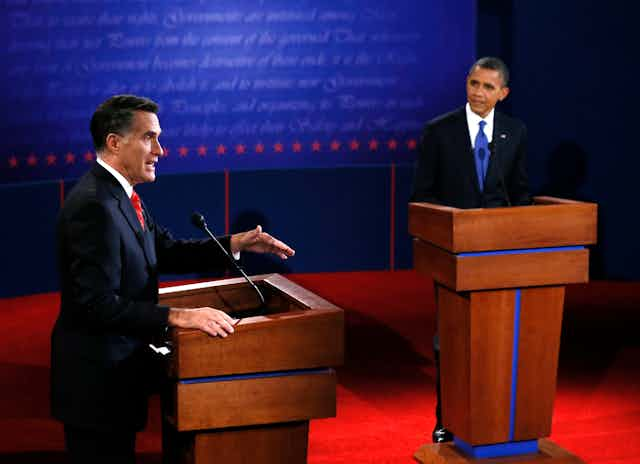
Only a month ago the outcome of the US presidential election was seen my most commentators as being a question of the margin of President Barack Obama’s victory. But then the television debates intervened. Obama’s lacklustre performance in the first leaders debate, a democratic innovation that began with Kennedy and Nixon in 1960, made the president appear complacent and lacking focus.
From then, whether in the subsequent debates or any other intervention, the narrative was set for the last weeks of the campaign. Would Governor Romney’s “bounce” sustain? Could the president regain his standing? Few would now argue those debates weren’t important.
Politics has many characteristics, but when you get to the pointy end of the electoral process in the United States, it is certainly high drama. But debates also create key moments where the electorate can observe alternative leaders responding to focused questioning. With each candidate on the same platform and at the same time, debates provide structure to a campaign: a time to scratch beneath the surface of the well rehearsed lines and phrases and shed light on the style and character of the candidate.
They are, as is the case in other liberal democracies in Canada, France, the United Kingdom and – until the 2010 campaign – here in Australia, generally positive contributions to the democratic process.
Engaging the audience
In my role at the Institute for Democracy and Human Rights I have spoken with those involved in broadcasting and negotiating leaders debates in four jurisdictions. I have spent hours watching Gore, Hawke, Bush, Bush (again), Clinton, Mitterrand, Reagan, Cameron, Howard and Gillard.
The high points are few: John Hewson and Paul Keating in 1993 having a sharp exchange regarding their respective views of the role of the government supporting a public health system; Ronald Reagan making President Carter appear smaller and smaller as each moment passed in 1980; and the innovation of the first prime ministerial debates in the UK two years ago. But what we learn from the debates themselves is less important than what we learn from the process surrounding them.
Leaders debates fulfil a more important role than an hour and a half of television. Competing policies and characters are presented and assessed in the wider media.
And people watch. In the UK, more than eleven million people watch each of the three prime ministerial debates: more than hit show Strictly Come Dancing. Around 67 million people tuned in to the first Obama–Romney debate.
These numbers don’t reveal how many people engage with the substance of the debates through newspapers, radio, television, or on their smart phones and computers. In 2010 all the major UK newspapers ran pages of analysis following each debate. In the US, numerous news sites ran immediate fact checks on what was said and developed engaging ways to explain differing perspectives and policy positions.
Breaking eggs to make an omelette
Of course, the situation in the US is not the same as in Australia. In the US the electorate has very little exposure to their prospective leaders prior to the debates. In Australia, we get to see our alternative leaders in Question Time whenever parliament is sitting.
In the 2010 campaign, our one televised debate on free to air television made international news. Sadly this was because it was moved to ensure that it did not compete with the MasterChef final. Why let questioning the prospective leaders of the nation compete with preparing a simple three-egg omelette?
In Australia, decisions on how many debates there are, and what format they take, have been conditioned by largely self-serving negotiations between the broadcasters and political parties. In 2010, Julia Gillard thought a small target strategy would serve her best, and she agreed to a short, single debate. Only when the election appeared closer than expected did the prime minister seek to debate Tony Abbott at every opportunity. This resulted in ill-prepared public forums where the main questions to emerge were whether jackets stayed on, white was worn or politicians talked from the stage.
Countering the sideshow
We can, and I believe must, do better. The US and UK experience shows us that these debates matter. They may not decide elections, but in the spirit of Hans Christian Andersen, they do allow us to view our prospective emperors and assess the thread of their clothes.
Whether it is Kevin Rudd calling for greater civility in politics; Malcolm Turnbull arguing for greater truth, leadership and responsibility or Malcolm Fraser’s pithy description of both political parties “rattling around at the bottom of the barrel trying to find something derogatory they can say about the other party”, there is a growing argument that Australia must find new ways of engaging the public on the substance of politics and policy.
The tired clichés, hugged babies, tested platitudes, and apparent nastiness of the political art are wearing thin. There is a hunger for something different. A series of more effective prime ministerial debates overseen by a non-partisan Electoral Debates Commission would be one counter to the “sideshow”.
The most effective form of debate is largely a matter of subjective taste, but there are a few elements that would make a good start: agreement between the parties and broadcasters to three debates of an hour and half each; using different formats for each; using a creative process for establishing the questions and engaging new media.
Achieving this will be hard. The stakes in any democracy at election time are high. Decisions will be taken in a highly politicised environment involving the parties, politicians and broadcasters. Yet it should be the people who are best served by effective democratic engagement. Through more credible prime ministerial debates, they can be.
Rajan Venkataraman
Citizen
Thanks for the article Nick, but I have mixed feelings about debates in the context of the Australian political system.
As you point out, we have a parliamentary system here where the alternative leaders and their respective front benches eyeball each other "across the despatch box" on every sitting day - particularly in question time. And all of the key spokes-people seem to front up to the media on a regular basis and are expected to be able to answer detailed questions of policy. We voters…
Read moreNick Rowley
Research Fellow, Institute for Democracy and Human Rights at University of Sydney
Rajan -
Thank for these remarks. I certainly wouldn't argue for the US style debates here. I think Australia can do it very much better. Something lost in the editing, but that I believe is true, is that these debates should not be viewed solely as the theatre they are. They also provide a means for wider democratic engagement well beyond the debates themselves. One example: the NY times coverage fact checked every statement on policy and presented graphically the different approaches presented. New media means these pieces of TV can be used to provide a structure the campaign and a means whereby the electorate can be effectively involved and engaged . . .
Rajan Venkataraman
Citizen
Hi Nick
I'm certainly a big fan of the fact checking websites and similar publications they have in the United States. I'd like to see something like that in Australia that could be applied to every media release, press conference and parliamentary debate (as well as to the once-every-three-years leaders debates). I made a similar point with respect to David Smith's article a couple of months ago:
https://theconversation.edu.au/the-lost-cause-of-american-political-fact-checkers-9534
The Conversation is already doing this to a degree and is providing a valuable service. See for example Tom Conley's article:
https://theconversation.edu.au/punching-above-our-weight-sizing-up-australias-economy-10153
The question now is: how can we take this one step further?
Norm Stone
logged in via Facebook
Just like our fearless leaders I think you are missing the main point here. ..."these debates should not be viewed solely as the theatre they are". Why not ? What is the use of fact checking when the most important issues are not even mentioned and when speaking in the normal, totally controlled and far more influential, rally situation both candidates can tell lies to their hearts content. Have a look at Romney's lies about Jeep moving to China. It is precisely because they are theatre that these debates, in Australia, US or anywhere, detract from the democratic process rather than contribute to it.
Matt Hickey
logged in via Facebook
Interesting article, Nick. While the US debates were certainly entertaining, I'm concerned that one's performance in staged events such as debates and press conferences are increasingly becoming the measure by which a leader is considered successful. The truth is that the ability to debate well in a strict format on a given night (perhaps just once before an election) really says little about that person's abilities to govern over a period of three years, yet this small ninety-minute, artificial sample is put forth as a consideration almost unrivalled in importance.
Nick Rowley
Research Fellow, Institute for Democracy and Human Rights at University of Sydney
Yes. That is true. But is our democracy better served by having them, or not having them? If you don't have them then the media still focusses on what it chooses (often the superficial). At least through formalised debates there is a recognised time and place where our prospective leaders can set out their stall and engage with each other on policy. And as per my point to Rajan: the debates themselves can stimulate very effective examination of the alternative policies on offer.
Linus Bowden
management consultant
I would rather commit harakiri than live in a polity whose elected leaders thought "civility" was the greatest civic virtue. Democracy is a rebellion against civility. Democracy is the public square where the brilliant, brave, sharp, and deadly truthful get to shout what the rest of us only wish we had the wit to emulate. Australia already has far too many dim, inexperienced, parochial, philistine, wet MPs with low IQs demanding more "civility". Let's hope they all get sprung rorting their expenses, rooting their staff, or anything to rid our deadly dull faux democratic culture in 2012.
Gavin Moodie
logged in via LinkedIn
I agree with most of this article. Recent Australian federal elections have been dominated by heavily controlled photo opportunities and sound bites, some as paid advertisements but many as 'news' reports. Establishing a series of formal debates would reintroduce the 'long form' of political discussion to Australian politics.
However, having 3 debates between the Labor and Coalition leaders would reinforce the trend to presidential politics, which I think is unfortunate for Australia. The debates should be between the leaders, deputy leaders and front benchers for an issue that is particularly prominent in the election.
Rob Crowther
Architectural Draftsman
These debates are the biggest waste of time.
Each political party is on show for three years. We have three years to judge them. It seems its best to forget their track record and merely focus in on the final week of highly spun election campaigning.
I wish my job was like that. You know, do a crap job all year and then get to keep it because I can spruik BS better then the next guy.
It would be far better to spend the time holding up a report card and illustrating what these people have done rather then said.
Peter Ormonde
Peter Ormonde is a Friend of The Conversation.
Farmer
I am most wary of comparisons and particularly of imitating US political behaviour in Australia. Couple of fundamental reasons:
(1) The US system involves the election of a monarch actually ... an individual and his (or her) appointed administration. Congress acts - much like the old UK parliamentary system - as a house of review over the monarch's initiatives. The President does not sit in the chamber and is not directly accountable to Congress. In such a system - personality counts big…
Read moreArthur James Egleton Robey
Industrial Electrician
Leaders debates matter?
No, they don't.
When Corporations become "people" and are entitled to buy politicians they will do exactly as they are told, just like any other person on the payroll.
And when the Media is bought and paid for all "News" and "debate" and "opinion" become propaganda.
Garbage in and Garbage Out.
Didn't you watch Oprah or read 1984?
David Kenny
Journalist/Writer
Presidential debates, like the new UK versions, diminish democracy in the long term by putting style over content. It simply gives the candidates another chance for duplicity and they have ample time for that as it is.