
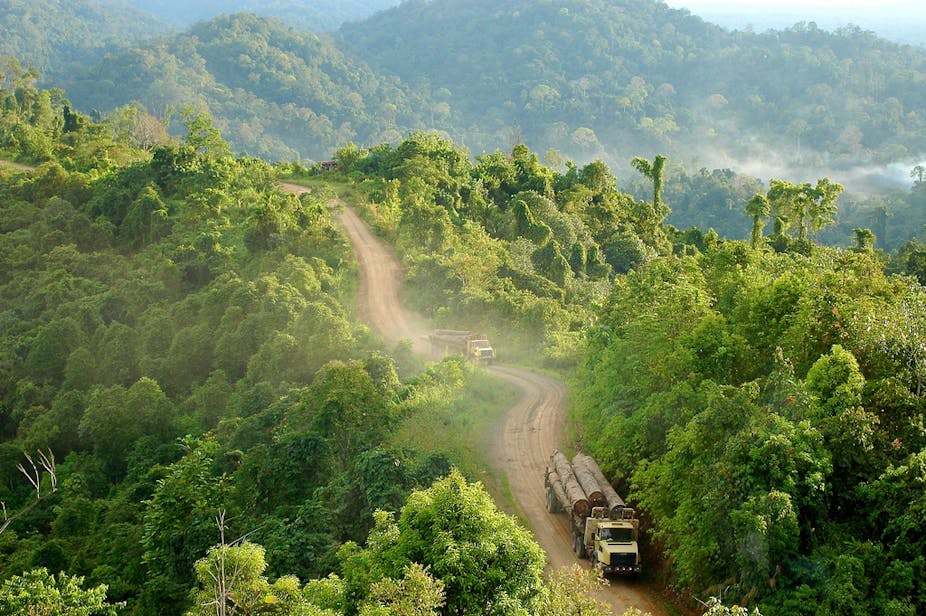
As the Australia Parliament currently debates legislation to fight illegal logging, it’s worth considering the impact of the American and European laws on which the Australian effort is modelled. We may be in a unique position to do so: our long careers in the timber industry led both of us to be strong initiators and advocates of the US Lacey Act, which prohibits the import and trade of illegal wood and wood products.
Our philosophy, like most of the forest products industry, has been to conduct business and manage forests in a way that ensures the timber resources we rely upon will remain healthy and available for future generations.
However, these efforts are severely undermined by illegal loggers, who pillage national parks and protected areas around the world. Some employ slave and child labour, aid drug trafficking, fund terrorism, and spur violent conflict in communities. Illegal logging has devastated forests and wildlife and is a significant driver of the 30 million acres of tropical forest cleared every year.
Many of Australia’s closest neighbours, including Papua New Guinea, the Solomon Islands and Indonesia, are struggling with some of the highest levels of illegal logging in the world. A recent example reported by the Environmental Investigation Agency reveals that the palm oil company PT Suryamas Cipta Perkasa illegally cleared a peat forest in central Borneo that contained substantial stands of the valuable hardwood species ramin, illegal to cut in Indonesia. This clearing destroyed the habitat for a population of 600 endangered Bornean orangutans, which – adding insult to injury – the company also paid people to hunt and kill. The livelihoods of the local residents were destroyed along with the forest. One-third of the community moved away.

Indonesian President Susilo Bambang Yudhoyono has prioritised halting illegal deforestation and has called upon importing countries to help by stating,
If you want to do good, let’s work together to sort out the timber industry. Other countries should stop fencing illegally felled timber.
While illegal logging is a lucrative business for organised criminal operations, it robs developing countries of an estimated $10 billion annually. Logging gangs evade paying fees for use of natural resources, smuggle timber out of forest nations, and do the high-value, job creating work of processing thousands of miles from the communities that depend on the forests for their livelihood. Illegal logging also undercuts companies who play by the rules, making it extremely difficult to compete in the global marketplace and resulting in job losses.
That’s why, in 2008, we worked with a broad coalition to advance the world’s first prohibition on the import and trade of illegal wood and wood products. Just as in Australia, environmental groups and the timber industry are often at each other’s throats. But when it comes to illegal logging, we’ve found common ground. Supporters of the Lacey Act include everyone from Greenpeace and the Sierra Club to Fortune 500 companies like International Paper and American’s largest landowner, Plum Creek, as well as smaller lumber businesses.

Extraordinarily, support for this law has, for the most part, crossed the partisan divide in America at one of the most politically polarised times in our history. The law emerged from a Bush administration initiative, but was supported as enthusiastically by left wing Democrats as conservative Republicans. Indeed, when the Lacey Act recently came under attack from a politically well-connected importer that was accused of violating it, the law’s opponents couldn’t muster the votes to undermine it.
Coming together to achieve this goal has cut global illegal logging by 22% – good news for orangutans, tigers, and communities that depend on forests. And it’s helping to protect the lungs of our planet which are increasingly important as we all face the challenges of climate change.
It’s also been good for the economy. In 2006, the US ran a $20.3 billion deficit with China in forest products; in 2010, the US ran a $600 million surplus. This dramatic reversal is due in large part to the 2008 Lacey Act forest provisions, which spurred many Chinese manufacturers to ask for low risk, legal and sustainable hardwoods. Our domestic resource fit that bill; so would Australia’s.
One country alone cannot fully stop illegal logging, which is driven by a complex global market. With the US Lacey Act, the EU Timber Regulation, and hopefully the Australian Illegal Logging Prohibition Bill joining forces in blocking illegal wood imports, we can continue to make significant progress in curbing global forest crime.
This article was co-authored by Jameson S. French, the President and CEO of Northland Forest Products, Inc, based in New Hampshire, USA.
DoubleHelix
logged in via Twitter
The global movement for legality whether it is Lacey, EUTR, the Aussie legislation or Indonesia's fledgling SVLK - it's all good. After all very few procurement officers actually specify stolen timber as part of their requirements.
Customers of the big brands who sell us furniture would be shocked to learn that not only is their product made from stolen property, but that buying it would put money in the pockets of organised criminals ... but probably not as shocked to learn that there was no…
Read moreTimothy Curtin
Economic adviser
There are many deceptions in the various campaigns against Forestry in Tropical Countries, and this article is full of them, whilst conspicuously devoid of any documented evidence of illegal logging anywhere. The article covers up the fact that the main thrust of the campaign against so-called illegal logging always comes from white countries that themselves produce 60% of the world's forest products and would like to increase their market share at the expense of non-white countries.
This is…
Read moreTom Keen
BSc
"white countries that themselves produce 60% of the world's forest products"
And where did you get that figure from? Are you referring to produce in terms of financial returns, or volume of wood? Got a copy of Google Earth? If so, check this out: services.google.com/earth/kmz/disappearing_forests_n.kmz
Read moreNot only can you visually see that deforestation rates are far higher in developing tropical nations (Southeast Asia and South America in particular), but you can also check the numbers, based…
Tim Scanlon
Debunker
Curtin is once again denying reality. Not only is he falsely attributing CO2 sequestration in his comments, he is blithely ignoring the very real problem of illegal logging.
Has Curtin not heard of the recent case against Gibson guitars? Has he not heard of the slaying of a reporter in Cambodia for exposing logging there: http://www.theaustralian.com.au/news/world/slain-journalist-exposed-illegal-logging-in-cambodia-colleagues-said/story-e6frg6so-1226472829580 Has he not watched Ross Kemp's documentary where he flies directly over a logging and mining operation?
Curtin continues to live in his dream world where the laws of physics and the environment have not part to play.
Jane Rawson
Editor, Energy & Environment at The Conversation
Timothy C, whatever the merit of your other comments, I"d like to address your statement that the author sits 'in a faculty glasshouse'. Mark Rey administered forestry under the GW Bush administration. His co-author is CEO of a forest products company. They're far from locked in an ivory tower.
Timothy Curtin
Economic adviser
Tim: I am still waiting for your long promised econometric analysis of the relative importance of CO2, H2O, and temperature to agricultural production and yields.
I have published my own, and so have Crimp and Howden. Don't hide your modesty under mallees!
Tim Scanlon
Debunker
A strawman? Really?
You are still trying to ignore what Crimp and Howden actually wrote aren't you! You still like to pretend that water isn't important, that the soil has nothing to do with anything and that temperature has no bearing on how a plant grows.
But since you seem incapable of reading the literature and understanding place science, here are some papers that prove my points: "As drought increased in severity, D values decreased, presumably as a result of increased stomatal control…
Read moreTimothy Curtin
Economic adviser
Tom Keen: The 60% figure I quoted is for production data on timber products (excluding pulp and paper) for 2004 from FAO 2005; the whitey’s proportion of pulp and paper production in 2004 was 70%. I leave it to you to update to 2010, but all indicators I know of show those proportions have increased.
What do you mean by deforestation? Although virtually all Australian climate scientists and economists think that non-whites are congenitally stupid, so log trees just for the hell of it, actually…
Read moreTim Scanlon
Debunker
You still haven't addressed my central point Curtin. You claimed that illegal logging was "not documented". Yet it is. I gave several examples of recent media coverage of the issue.
Your points on CO2 still lack any basis in reality, since you refuse to accept and understand that CO2 is not the driver of plant productivity, but rather one of many ingredients plants use, with water being the key productivity driver. Until you accept the reality that climate change is real and that plants will not necessarily do better under it due to mostly reduced rainfall and higher temperatures (as has already been shown in actual measured data) then your comments are nothing more than wrong.
Bart W van Assen
logged in via LinkedIn
The American Dream: legalise displacing/killing/alienating the vast majority of indigenous peoples, transfer their (often communal) tenure rights to state or private ownership, and then commoditize their natural resources based on simplified models for timber production (basically timber plantations). Is this the kind of lessons from the US (and other Western countries) that should impress the rest of the (tropical) world?
Timothy Curtin
Economic adviser
Thanks Jane Rawson. But what kind of office does Mark sit in? timber-free or not?
And I see that his co-author is part and parcel of the USA's determination never to allow any imports of ANY non-industrial (namely primary) products from any non-white country. Think cotton, sugar, palm oil etc etc unless USA does not produce same (e.g. tea).
See my website (www.timcurtin.com) where I document US definition of all 3rd world timber as illegal: Economics of Forestry in Australia and Papua New Guinea, March 2007: (1) my Submission to the Australian Government's Discussion Paper, Bringing down the Axe on Illegal Logging, January 2007, published in Pacific Economic Bulletin 2007, and (2) a short piece on Yale University's evaluation of PNG's forestry (The National, June 2007), Sustainable and legal logging (PDF File); Bringing down the axe on illegal logging (PDF File).
However I freely admit the USA will allow duty and quota free imports of Boeing 747s from Tuvalu and Nauru.
Timothy Curtin
Economic adviser
Tim Scanlon: As you can't/won't do LSR on WA wheat yields relative to CO2, rain, temperature, whatever, I'll be glad to if you would kindly send me time series data on production and yields since 1960 until 2011 if possible for the main centres, e.g. those listed in Garnaut or Crimp & Howden, to tcurtin at bigblue.net.au.
Many thanks in advance.
Tim
Tim Scanlon
Debunker
*sigh* Another strawman.
Crimp and Howden have already covered the main points, you just haven't read the paper properly. There is also plenty of data I've pointed out in the past, such as the ABS data and the papers I posted above.
But of course, you just ignore any inconvenient information and pretend I haven't responded.