
London 2012: an Olympics without controversy … almost

And so the London Olympics are over and we can all sit back and reflect on the past few weeks with some kind of clarity. Compared with the events of previous Games – such as the Munich Massacre of 1972, the Centennial Olympic Park bombing of 1996, or the use of performance-enhancing drugs in 1988 and…

Wk8kt3v5-1344932723
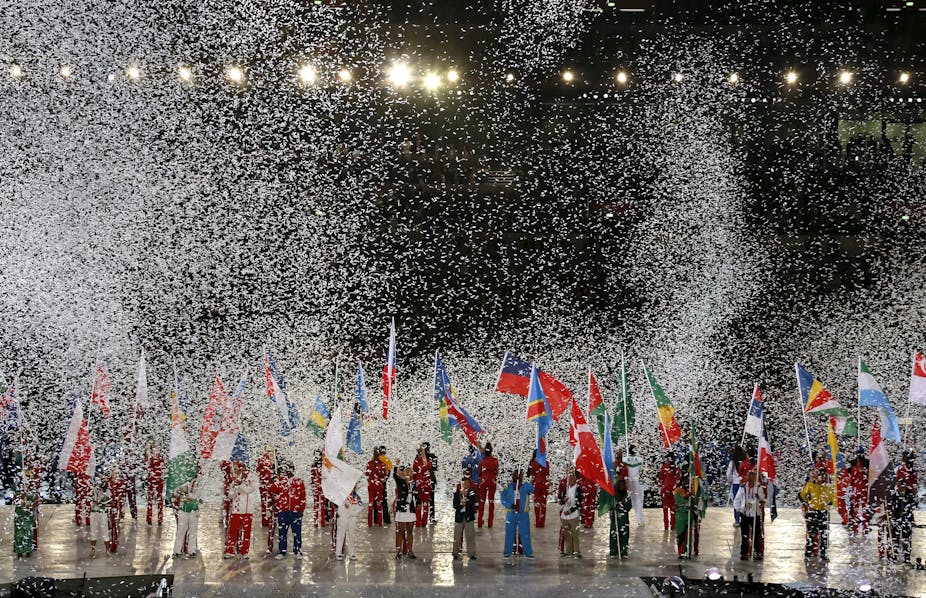
The Olympics are at their best they bring people together. EPA/Denis Sabangan

And so the London Olympics are over and we can all sit back and reflect on the past few weeks with some kind of clarity.

Compared with the events of previous Games – such as the Munich Massacre of 1972, the Centennial Olympic Park bombing of 1996, or the use of performance-enhancing drugs in 1988 and 2000 that resulted in athletes being stripped of gold medals – London has been a mostly controversy-free Olympics.

Mostly.

Perhaps the most controversial incident in the Games was the disqualification of four women’s pairs badminton teams on the basis they were trying to lose their final pool matches, to save energy and get a more favourable draw in their quarter finals.

Thomas Lund, secretary general for the Badminton World Federation, explained the decision to suspend the players in the following way:

“The rules say you have to win every match, and that doesn’t mean you throw some matches and win other matches.”

This was a horrible decision by the Badminton World Federation. The disqualified badminton teams used a strategic awareness of the competition structure to produce the most effective and efficient means available to ensure they, and their country, would win a medal.

This is now, fortunately or unfortunately, the Olympic spirit and one that is embodied in many Olympic sports. It’s evident in the willingness of domestiques in road cycling to sacrifice their own chances of medalling for the sake of a team leader; in resting the best performers from heats in relay swimming and running; and in the resting or conservative use of star players in pool games in basketball, soccer and water polo.

Yu Yang (right) and Wang Xiaoli (left) of China, two of the eight players disqualified for match fixing at the London Olympics. EPA/Bagus Indahono

In the case of the offending badminton players, there seems no doubt they were deliberately playing badly in order to lose a game. But all teams had not played badly in their earlier games. They had already done their jobs to the degree that was necessary to get to the next round.

The response by the badminton federation appeared to be a knee-jerk reaction to unrest from the fans and media, coupled with unfounded suggestions that such actions by badminton teams could interfere with the integrity of Olympic gambling.

Anyone that gambles on pool matches in badminton, where there is a strong possibility that teams who had already qualified for the quarter-finals would not play their hardest prior to the game starting, is a person that should not gamble on sport.

The issue of the men’s pole vault provides an interesting contrast with the badminton.

In the heats, vaulters from different countries – including Australia’s Steve Hooker – apparently colluded by not attempting to win the heat, ensuring all of them made it to the final. In contrast with the badminton, there was no suggestion that these pole vaulters should be disqualified.

But it’s perhaps the fans that lose the most when athletes don’t give their all in the opening rounds of competition. Spare a thought for the fans that paid good money to watch Team USA play Nigeria in the men’s basketball, only to see superstars Lebron James and Kobe Bryant play for just over ten minutes of the match.

Ye Shiwen raised eyebrows with her impressive performance, but fellow athletes supported the Chinese swimmer. EPA/Barbara Walton

The second major controversy of the Games was an allegation of doping against Chinese swimmer Ye Shiwen, courtesy of some impressive improvements in her 200m and 400m individual medley times.

As further substance to this claim, the Chinese swimmer had swum the final 50m of the freestyle leg of the 400m medley faster than the winner of the men’s race, American Ryan Lochte.

Reports from a small segment of the media, supported by some coaches, suggested that, given the history of drug use by many members of the Chinese swimming teams in the 1990s and the use of EPO by a teammate of Ye’s recently, Ye’s swimming performance should be viewed with suspicion.

This allegation was a beat-up and should have been ignored by the media. The only uplifting aspect of this story was that other reporters were not just quick to refute it, but also to question the underlying racism and sexism that informed it.

We in the Western media would not question the current American track and field sprinters on the basis of the many athletes of previous eras that were found guilty of drug use before and during the Bay Area Laboratory Co-Operative (BALCO) trials of the early 2000s.

Furthermore, it was explained by some reporters that the Chinese government, and Chinese sporting organisations, embarrassed by that legacy of swimming in the 1990s, had implemented a rigorous drug testing and control program that was at least the equal of any other in the world.

Many of Ye’s competitors, and many former swimmers, explained that the improvement in the swimmer’s freestyle leg was expected, and celebrated her achievement as a positive for women’s swimming.

Britain’s Victoria Pendleton (right) grabs the hand of Australian gold medal winner Anna Meares after the women’s sprint final. EPA/Christophe Karaba

While there were other controversies throughout the Olympics, including a couple of positive drug tests (most recently to women’s shot put gold medallist Nadzeya Ostapchuk), and some off the field regarding ticket prices, ticket allocations, economic benefits for London, and future allocation of funding to Olympic programs, the ethical legacy of these Games is overwhelmingly positive.

These Games should be viewed as an example of the ways friendships can occur between individuals of different nations who forget self-interest and unrestrained patriotism.

The competitors who finished second and third in the 100m hurdles race won by Sally Pearson appeared genuinely happy for the person who had just defeated them in a photo-finish. And as mentioned previously, female medley swimmers celebrated the performance of Ye Shiwen in the face of criticism.

Even the great cycling rivals, Australia’s Anna Meares and Britain’s Victoria Pendleton, appeared to finally understand the friendship that often results from intense and close competition, after facing off in the women’s sprint final.

It is images such as the above that should remain as ethical beacons for future Olympics because they support the vision of International Olympic Committee founder Pierre de Coubertin’s of using sport to promote international peace and understanding.

Did these positive images sell as many newspapers and pay-TV subscriptions as the wildly ethnocentric celebrations of moving upwards on the Olympic medal tally?

Well, we’ll know this eventually, too.

Join the conversation

14 Comments sorted by

  1. Paul Rogers

    logged in via Twitter

    "The only uplifting aspect of this story was that other reporters were not just quick to refute it, but also to question the underlying racism and sexism that informed it."

    That's a bit tough. Nothing in that Nature article was racist or sexist. Poor science perhaps, but that's about it.

    As the article stated: "Such debates have arisen over many outstanding feats in the past, by athletes from many countries, and it is wrong to suggest, as many of the critics do, that we singled her out because of her nationality. "

    And as for not questioning US track and field athletes in relation to past offences. Not so. They are always under suspicion, and the same questions would have been asked if dramatic improvement was noticed by any of that group of athletes.

    Let's not bring race and gender into a debate where it has no place.

    report
  2. Anthony Kaye

    Retired Vet. Surgeon

    The spectators at the badminton heats loudly booed the Chinese team for deliberately losing. I would have done so as well if I'd paid £75+ for a ticket.
    The Chinese could hardly be said to have subscribed to the ethos "It's not the winning, it's the taking part".

    report
  3. Craig Henderson

    Horticultural Scientist

    Michael, most of the non-badminton examples you mentioned are individuals/teams not doing their utmost to win. From what I saw of the badminton, the offending teams were actively trying to lose. It seemed to reach the stage where they were trying to outdo each other in serving into the net.

    The analogy in swimming would be where each swimmer deliberately swam slower when they saw themselves heading their competitor. Until one of them drowned. An ambivalence about winning is different to deliberately…

    Read more
    1. Michael Burke

      Senior Lecturer, School of Sport and Exercise Science at Victoria University

      In reply to Craig Henderson

      Again, it is the inconsistency of the decision when compared to other sports, especially the heats of the pole vault, that worries me. If the two teams in the badminton competition had simply decided that, as they were both in the quarter finals, they wouldn't bother playing their last match, would they have been allowed to continue. Because this is what appeared to occur in the pole vault.
      Perhaps the badminton players should have turned up with strapping on their hamstrings, or claimed they had the flu, and disguised their efforts to lose better.

      report
    2. Craig Henderson

      Horticultural Scientist

      In reply to Michael Burke

      Michael, I agree with you in your concern about the pole vault, although in that instance the non-continuance was discussed with the officials, who apparently agreed.

      With respect to your second point, I personally don't admire sports people who 'game' the rules (e.g. feigning injury, diving to receive penalties). It is cheating, just that it's undetected or not penalised. I suggest sports competitions only really have authentic value when conducted in the spirit of competition. To win by deceit…

      Read more
    3. Byron Smith

      PhD candidate in Christian Ethics at University of Edinburgh

      In reply to Michael Burke

      It was also in direct contravention of the rulebook for Badminton. Like it or not, all international badminton competitions, including the Olympics, take place under certain rules and they clearly rule out the kind of behaviour displayed by these eight players.

      report
    4. Michael Burke

      Senior Lecturer, School of Sport and Exercise Science at Victoria University

      In reply to Craig Henderson

      The rules of the Badminton World Federation clearly state that a forfeit in pool play will mean that all other pool results are deleted, and the teams would have forfeited their quarter final spots.

      The failure to use one's best efforts to win a match is listed in the playing code of behaviour as an 'on-site offense'. It is not listed as a 'major offense,' although the notion of 'conduct contrary to the integrity of the sport' could be stretched to include this behaviour by the badminton players…

      Read more
    5. Michael Burke

      Senior Lecturer, School of Sport and Exercise Science at Victoria University

      In reply to Byron Smith

      Yes they do. But the regulations do not clearly state what the penalties are for such breaches.
      I would also suggest that anyone that has a quick look around the Badminton World Federation would not suggest that the actions performed by these players are 'clear' breaches of the code of ethics or the regulations. The regulations use such 'unclear' terms such as 'conduct contrary to the integrity of the game.'
      The failure to 'not use one's best efforts to win a match' comes within a category of actions that would normally result in a small fine, rather than exclusion from a major tournament.

      report
  4. Geoff Crozier

    Project Manager

    I support balanced arguments and think this was an attempt at that. However, and it's fair to note that there was a high level of public eyebrow raising at the very public tanking going on in the badminton.
    As for the Chinese swimmer, and as noted by the author of this article, anyone who improves markedly, and who swims faster than the equivalent male, surely needs to be questioned! We need to be able to question without being racist, sexist or biased!

    report
    1. Michael Burke

      Senior Lecturer, School of Sport and Exercise Science at Victoria University

      In reply to Geoff Crozier

      In the womens 800 metre freestyle, the US teenage gold medallist, Katie Ledecky improved her time by 5 seconds in less than a month, and 39 seconds over the 2 years before the Games. In the year before the 2008 Beijing Olympics, Australia's Stephanie Rice improved her personal best 400 IM time by 11 seconds. Ian Thorpe also commented that he had improved his 400m freestyle time by 5 seconds between the ages of 15 and 16. Check out http://www.bbc.co.uk/news/health-19061026 for an explanation.
      In…

      Read more
    2. Paul Rogers

      logged in via Twitter

      In reply to Michael Burke

      Yes, the BBC analysis, but Ross Tucker does a nice technical analysis here:
      http://www.sportsscientists.com/2012/07/london-day-2-quick-thoughts.html

      As you prob know, Tucker and Dugas do very astute technical analyses of sports performances -- Tour de France, track and field etc.

      I agree that we should not accuse without evidence, but as Tucker says: "All I'm saying is ask the question, but don't accuse or judge."

      That's not racist or sexist.

      report
  5. Ben H

    logged in via email @gmail.com

    "As further substance to this claim, the Chinese swimmer had swum the final 50m of the freestyle leg of the 400m medley faster than the winner of the men’s race, American Ryan Lochte."

    This is a textbook example of crap journalists being very selective with information to make a sensational story. Yes, her final 50m split was faster than Lochte's, but he was obviously coasting due to being several metres in front his competition. Lochte's 7 other splits were much faster than hers, and his total…

    Read more
  6. Ross Armstrong

    OHS consultant. Adj.A. Prof. Latrobe University

    If people want to participate at the elite level that's their business as long as I don't have to pay for it. I resent my taxes (> A$300,000,000 of direct funding for the Aust Olympic team this time + god only knows how much more in other taxes and government support) being wasted on such pointless pursuits. Any of our taxes (local, state and federal) and other government resources spent on sport should only go to the grass roots/local level and be focussed on supporting, encouraging and enabling…

    Read more