
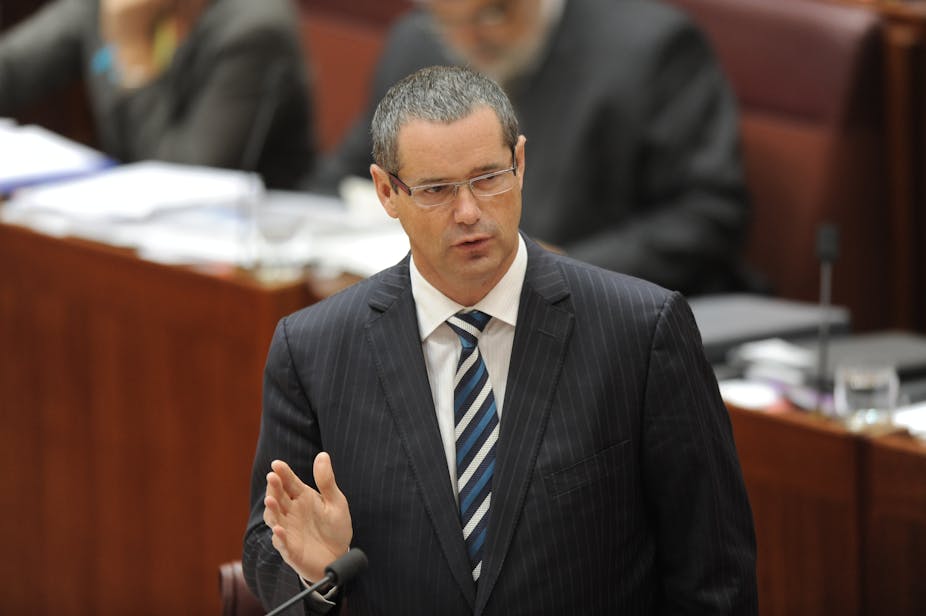
The ongoing criticism in the major news media of Communication Minister Stephen Conroy’s very soft and watery proposed media reforms is predictable but still breathtaking.
Conroy’s proposals go nowhere near the recommendations of the Finkelstein Inquiry to introduce an independent News Media Standards Council; and nowhere near the more sweeping changes recommended by the Convergence Review to take Australian media law into a converged, forward-thinking era.
Instead, Conroy has – for the most part – bowed to early criticism and concern from media owners, CEOs, editors-in-chief and conservative commentators and opted for some tame options which sound purposeful but will deliver little.
Despite this, the roar about “Soviet-style” reforms, restrictions on freedom of speech, and government bureaucratic “tsars” running the media are deafening.
It is a great irony that one of the most important institutions in our society which exists to protect democracy – the news media – consistently sees itself as above scrutiny, requiring no monitoring except from within its own ranks.
Even Conroy is recognising this morning in a necessary defense of some of the reforms that there are no new rules, and that the proposed Public Interest Media Advocate (PIMA) will have no power to act against the press or journalists.
Well, why not?
Why shouldn’t an advocate representing the public and the public interest – supposedly at the heart of the news media’s raison d’etre – be able to impact upon the behaviour of journalists and editors when independent investigations indicate they are, indeed, acting against the public interest?
It should have that power in particular circumstances, especially when the behaviour of news organisations is not meeting the standards and levels of accountability required of such an important political and social institution.
The provision of independent statutory bodies to monitor such policies and positions exists in many parts of the democratic world (and in Australia), and have been proven time and again to be able to exist without government interference.
The key problem the media groups – and those currently dancing to their tune – have with something like a public interest media advocate is captured perfectly in the words of the Institute of Public Affairs’ James Paterson, writing for The Australian last night:
“Placing this power in the hands of a government regulator inevitably will insert political considerations into what should purely be a commercial decision-making process.”
And there you have it. News media are a business, they should be free to make commercial decisions in the best interests of their organisation’s commercial viability.
If that happens to conflict with the public interest, then, the public interest can go hang and no-one can say otherwise.
And they want to make sure that power is preserved. The media get a great deal of traction and kudos from being the “protector” of the public interest, the “watchdog” on government, the public’s only buffer between democracy and Soviet-style dictatorship – but heaven help anyone who dares suggest that their ability to fulfil this role should ever be interrogated.
And heaven help anyone who suggests that someone other than media proprietors and editors – who currently control the Australian Press Council and other self-regulatory bodies, and will continue to – should be the only ones to judge whether they’re doing a good job or not.
Conroy probably thought his reforms, in this election year, were the soft option and would attract minimal criticism. Overwhelmingly disappointing and weak compared to what they could have been, they are really the expected response from a government in a tenuous position.
What Conroy probably didn’t expect was the level of vitriol coming from the media, and the ability of phrases like “threats to freedom of speech”, “political censorship”, and “government-controlled media” to spread like wildfire through the numerous, homogenous news services we currently rely on.
As through history – from numerous media inquiries and Royal Commissions in Britain, Canada, the United States, Europe and Australia – any government who attempts to make the news media accountable to the public is thwarted, viciously.
And that is what we’re now seeing.
Ronald Ostrowski
logged in via Facebook
The MSM fact-impaired, and politically active bullies are screaming their lungs out. Let them, so that Australia finally wakes up to their true agendas.
Bring on the Guardian! The timing for its entry into this monopolistic market of incestuous and biased commentary and reporting can never be better. These guys led the charge against Murdoch in Britain, and hopefully they will do so here as well. Let 2013 be the year of life changing consequences for News Ltd, Fairfax and the ABC. Their stewardship will be questioned and the fifth estate will invade the public conversation as they retreat into the cesspit of falsehoods of their own making. I want my democratic right to truth and objective political analysis back! I want it now!
Felix MacNeill
Environmental Manager
This morning's Daily Turd was genuinely spectacularly shameful - and they are past masters of shamelessness.
At the risk of straying a bit off topic, what has happened here beautifully illustrates my growing belief that there is absolutely no point in attempting to compromise, when players of the aggression of Murdoch have skin (actually money, but that seems to be the same thing to him) in the game. It's like trying softer, more 'don't mention the war' approaches to climate change - it ends up…
Read moreJeremy Alexander
Director
The media have for a long time been incapable of self policing, and reporting in a fair and reasonable way. They make the story profitable, not correct. And who cares about those they hurt and defame along the way. Who can afford to fight them? I have heard, from a friend suing Fairfax for defamation, that to bring a defamation case against an organisation like this is $150,000. If you can't afford that, you have no legal avenue of restoring your credibility. Hopefully these reforms will see media that reports fairly and truthfully, and a media that are accountable to what they say. Props to Conroy!
John Phillip
John Phillip is a Friend of The Conversation.
Grumpy Old Man
Susan, I disagree with you closing statement : "...any government who attempts to make the news media accountable to the public is thwarted, viciously". The premis on which it is founded is false. The legislation will not, in any way, make the news media accountable to the public. It will only make it accountable to the government. That may work for you while the government you support is in power but it's a bit more of a problem when the other mob get in. In another related article on the implication is raised that support for this legislation from the independants may be as a response to the criticism they have received from the msm. Surely, if this is the case, it is 'inserting political considerations' (sic) into media contol.
Felix MacNeill
Environmental Manager
For a typically succinct summary of the issue, see David Pope's cartoon in this morning's Canberra Times:
http://www.canberratimes.com.au/photogallery/opinion/cartoons/david-pope-20120214-1t3j0.html
wilma western
logged in via email @bigpond.com
A good article ,noting the importance of an informed public in a democracy. Conroy's reforms are weak and it could be that the over-the-top reaction by News Ltd might actually work in the govt's favour.
What are we to make of Turnbull's parroting the News Ltd line - then adding that the defamation laws are there to protect the citizenry . The issue is not defamation - though it's fime for the well-heeled such as Gina, Clive Palmer and others to be forever in the courts. Malcolm in his silver…
Read moreVictor Boase
Retired
I think the complexity of this issue is at least in part due to the increasing complexity of the media. It is an ever changing thing and trying to regulate "the media" means always dealing with a chamleon. And not all media is licensed so attaching conditions to a licence does not appear to be the answer.
Read moreI agree with John Philip that much of the argument about the media is about the conflict of values attaching to politics. This cannot and should not be regulated.
Perhaps the answer lies in the…
John Nicol
logged in via email @bigpond.com
Victor Boase,
Read moreI think you have provided the best comment on this article which seems to be suppportive of the regulations and even strict censorship than is contained in Conroy's legislation, referring as it does to his "very soft and watery" reforms. It beggars belief that this view would be held by an academic, where freedom of speech is of paramount importance and a Professor of Journalism, a profession whose raison detre is based upon informing the npublic honestly and as completely as possible…
Peter West
CEO at Property
I think this attack on freedom of speech is an hysterical reaction to perceived media hostility!
Read moreIt is last gasp of a Government that is "on the nose" with an extraordinary number of Australians, and the so-called "reforms" are being introduced with incredible insensitivity to an electorate sick of various "reforms" that seem more and more to restrict freedoms.
The media in Australia is fairly robust, as it should be. We need a media absolutely fearless, totally free to say anything, to research…
Joseph Armand
logged in via email @gmail.com
I have occasion to read both The Australian and The Daily Telegraph quite often (pity me not!). I don't think any fair-minded person could find either of these News Ltd publications anything but virulently against the Gillard Labor government. Every negative is magnified, headlined and sustained. Every positive is either ignored, relegated or downplayed. It is not subtle. These papers are engaged in a project to change our government by blatantly influencing electoral opinion. I think if we look…
Read moreLiam Maher
logged in via email @hotmail.com
Whether you like the people criticising the reforms and whether the reforms are weaker than the recommended reforms, does not take away from the fact that these reforms limit free speech in an unacceptable way.
What the reforms do
The reforms will result in an Minister-appointed body deciding the control of media organisations, based on a concept of public interest. The new body, the Public Interest Media Advocate (PIMA), will have the ability to prohibit media transactions. If a media transaction…
Read moreTerrence John Snedden
retired public servant
To be honest I am tired of journalists linking their right to abuse, misrepresent, distort and use the power of their privileged position to pursue the private agenda of their media masters to my right to free speech. It is a rare occasion indeed that a journalist reflects my views or that I have any capacity to express them myself in a form that makes a cracker of difference. Journalist cannot be above or outside the laws that govern the rest of us, if they don’t like it go on a hunger strike. Really, journalists broadly over-estimate their role in protecting and promoting our freedom.