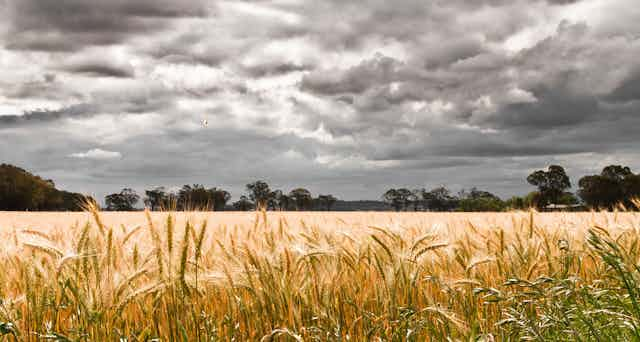


Welcome to The Conversation’s series on megatrends. What are the compelling economic, social, environmental, political and technological changes Australia must grapple with over the coming decades?
In this series, Stefan Hajkowicz explores in more detail some of these issues as part of the CSIRO’s new report, Our Future World 2012.
Today, he discusses food and water security, scarcity and a growing world population.
As I write this I’m sitting in small twin engine propeller plane flying out to Longreach to give the inaugural “megatrends” presentation to local business leaders.
Just 20 minutes into our journey, the city of Brisbane is now far behind. High rise has turned into suburbia, then into rural. And then the vast outback. From this view, it’s hard to imagine resource constraints ever being a problem.
Do we really need more from less? This is the first megatrend in the CSIRO’s Futures report “Our Future World”, launched this week, with food security as one of its major themes.
Food prices today are at all time highs. Peaks in 2008 and then again in 2011 created a humanitarian crisis as hundreds of millions of poor people were thrown into hunger and malnutrition.

The world’s governments are searching for solutions and in 2011, the G20 nations agreed to implement five objectives in an action plan aiming to mitigate food price volatility.
Yet today the world has one billion hungry people. Perhaps one remedy for food high prices is high food prices. It certainly sends a powerful market signal to the agricultural sector to boost production. Supply could meet demand and thereby stabilise prices and help improve food security.
Whether by market forces or other means, the world does need to increase food production. The United Nations Food and Agriculture Organisation forecasts that the world will need to increase production 75% by the year 2050 to feed itself with population projected to increase to almost 10 billion people.
In addition, as incomes grow rates of per capita calorie consumption are rising. Rapid income growth in Asia is associated with an increased demand for high protein foods such as meat, fish, milk and eggs. The world clearly wants, and needs, much more food in coming decades.
But the supply side faces some challenges. There’s lots of land out the window but how much of it can we use to make food? Probably not much.
In 2002, in my first CSIRO research project as a post-doctoral student, we built an economic model which found that 80% of the profits of Australian agriculture are generated from just 1% of the agricultural land area.
At a global scale we lose 12 million hectares of productive agricultural land each year to factors such as desertification, land degradation and urbanisation. If this land stayed productive it could have made 20 million tonnes of grain.
It’s not just land we need to make food. We also need water. The water scarcity story might even be worse. The International Water Management Institute (IWMI) estimates that 1.6 billion people live in water-scarce river basins with inadequate financial and human capacity to develop future water resources.
Combined modelling by the International Food Policy Research Institute and IWMI explores the possibility that, under extreme scenarios, water scarcity causes crop prices to be 1.8 times greater than business-as-usual for rice, 1.7 times for potatoes, 1.6 times for soybeans and more than double for all other crops by the year 2050.
In addition to land and water, modern agriculture needs oil and energy resources. These too are under pressure. Global energy use is forecast by the International Energy Agency to rise by 40% between the years 2009 and 2035. Under this forecast oil consumption increases by 18%.
The rise in energy demand will increase the amount of biofuel production which will place yet further pressure on the scarce resources available for agriculture. Currently 1% of the world’s arable land area is devoted to biofuel production.
This is forecast to grow to between 2.5% to 3.8% by 2030.
So the data in the report provides a compelling story about more from less. Demand for food is set to grow hugely. But the supply side faces challenging constraints. Will all this vast space I can see out the window be useful in meeting the demand? Can Australia become the food bowl of Asia? Will we see a resurgence of the agricultural sector? Is it just about production or are markets, distribution systems and governance systems where the answers lie?
These and other such questions are a few that jump out of the “more from less” megatrend.
In addition to food the world faces challenges in meeting demand for mineral, energy and water resources. Many of the innovations over coming decades will find clever ways of obtaining more from less.
Gerard Dean
Managing Director
And what planet did you say you were flying over Mr Hajkowicz when you wrote this line, 'Food prices today are at all time highs."
That statement doesn't make sense historically. The percentage of income spent on food is has continually declined since the 19th century in all but the poorest nations.
Up until then, most people spent the majority of their day hunting, gathering or growing food. The explosion of wealth following industrialisation means we earn our daily bread in a fraction of the time at work.
Furthermore,gone are the truly terrible famines such as in China under Mao or the Ukraine under Lenin or Ireland during the potatoe blight and the famines that have devastated communities since the beginning of agriculture. India and China, once blighted by famines, can now feed its 1.3 billion people while simultaneously increasing living standards.
Your statement is wrong.
Gerard Dean
Dennis Alexander
logged in via LinkedIn
Gerard, I was going to agree with you. Your arguments make apparent, intuitive sense.
However, then I thought that maybe there was actually some basis for Stefan's assertions, counter-intuitive as they seem.
Perhaps you might like to check the following, which do tend to support the notion of record high food prices:
http://www.fao.org/worldfoodsituation/wfs-home/foodpricesindex/en/
http://www.rba.gov.au/publications/bulletin/2011/mar/3.html
http://finance.ninemsn.com.au/newsbusiness/motley/8525318/global-food-prices-jump-10
http://www.abc.net.au/lateline/content/2012/s3565592.htm
Craig Minns
Self-employed
Dennis, the second link has a graph showing food prices indexed against a 1900 standard price. They have trended consistently down over that time, with a couple of spikes, most notably in the 70s during the "oil crisis", which is the only time the index has risen above the baseline set by the prices in 1900. Given this is a RBA document, I'm prepared to accept it as valid.
I think Gerard is correct - the assumptions in the article are not supported by the evidence. Although we do seem to be experiencing an upward trend at the moment, prices relative to income aren't anywhere near what they were in the early part of this century, which is entirely intuitive given the vast increase in mechanisation and the "green revolution" due to pesticides and fertilisers.
Craig Minns
Self-employed
A small correction: I should have said that prices are below those of the early part of LAST century. I guess I need to move into the 21st century...
Roger Crook
Retired agribusiness manager & farmer
Craig, Gerard, this may help.
At 2004 prices, that is, in 2004 dollars, wheat values in Australia have been declining since 1914. The extent of that decline is evident from the Australian Bureau of Statistics (Australian Year Book 2006) records.
In 1914, in 2004 dollars, wheat was $600 per tonne. In 1924 it was over $500 per tonne. Ten years later in 1934 it was still around the $500 per tonne mark. At the height of the Great Depression—from the records this appears to have been 1929, again…
Read moreCraig Minns
Self-employed
Hi Roger, I'm a little puzzled. Given that many farmers have the ability to offset considerable personal expenses against farm income, how much of that debt exists to fund such expenses with the understanding that it will be offset against tax? For example, the homestead, the family vehicle(s), possibly aircraft, communications such as phone, would all be expensed against the farm, or at least the cost of servicing the loans would be, is that not so?
A bald taxable income figure tends to disguise the actual funds available, it seems to me.
If they're losing money, why do farmers bother? Also, why is the subsidy paid to farmers elsewhere relevant to Australia except where our farmers are competing for sales in the same markets?
Sorry if these questions seem naive, I don't know a lot about agribusiness, but I am fairly well-informed about some aspects of horticulture.
Roger Crook
Retired agribusiness manager & farmer
It is true that many 'every day' expences, like they are for for many business people, motor vehicles and other such costs are paid for by the farm business as they are legitimate expences incurred in the running of the business, and yes the majority live on the farm.
Read moreI tried to find the ABS address for the numbers I quoted, I have it somewhere but I can't find it right now, I'll have a look later, but it does detail all expences and income to arrive at the conclusion it does. I'll post when I…
Craig Minns
Self-employed
Thanks for that Roger, some fascinating points. I certainly wasn't aware of how aged our farmers are, for a start. On that point though, what is the reason for such a situation? Is it because younger people have less ability to raise the necessary funds, leading to consolidation of ownership under more senior people, or is it because they are simply not interested in the hard work of farming? I recall reading a piece a few weeks ago lauding the fact that at our Ag colleges the vast majority of enrolments…
Read moreTim Scanlon
Debunker
Fantastic comments Roger.
I'm very concerned with the age gap and profitability of agriculture. People have taken it for granted that the proportion of their income spent on food has had a relative decline in first world nations, whilst those growing it have had increases in all costs and no increases in commodity values.
I'm of the opinion that there are several ways to deal with this, my favourite being a land custodian grant, similar to those used in Europe and USA. It doesn't address the…
Read moreDale Bloom
Analyst
“Rapid income growth in Asia is associated with an increased demand for high protein foods such as meat, fish, milk and eggs.”
I’m not certain that rapid income growth in Asia has not run parallel with income decline in various other countries, or simply a transfer of wealth has taken place from Europe and the USA to various Asian countries.
Regardless of that, many farms simply use the soil to hold the plant upright, and the plant is grown with artificial fertilizers, unnatural irrigation water and unnatural pesticides and herbicides.
The big question is whether artificial fertilizers, unnatural irrigation water and unnatural pesticides and herbicides will run out, or become so expensive it makes eating food too expensive.
Craig Minns
Self-employed
Already some major fertilizer components are becoming scarce. There is a world shortage of phosphate, for example and few new phosphate sources are being proven up, although there is a lot of work being done to recover it from waste.
http://phosphorus.global-connections.nl/
Fortunately there is no shortage of potassium and nitrogenous compounds, although here in Oz we do hobble ourselves through making ammonium nitrate hard to come by
http://www.incitecpivot.com.au/zone_files/pdfs/ammonium_nitrate_agritopic.pdf
and use calcium nitrate instead for a lot of applications, which has its own problems with respect to the uptake of other nutrients, including iron and potassium.
Dale Bloom
Analyst
There may be a possible phosphate scarcity, although the Haber-Bosch process for extracting nitrogen from air is estimated to be feeding 1/3 of the world’s population, and also produces a considerable amount of pollution and consumes a considerable amount of energy.
In all, an increasing population is leading to reduction of natural resources and pollution.
It is interesting that there seems to be more concern about possible climate change than impending overpopulation.
Craig Minns
Self-employed
There's most definitely a scarcity and it will become worse over time. Phosphate minerals are easily leached, so tend not to persist except where there is ittle water available to do so, or where replenishment has exceeded the rate of depletion, such as is the case for guano deposits.
Since phosphorus is one of the "big 3" nutrients that is needed in quite large quantities by growing plants, especially when they are producing flowers and setting seeds, it's a big problem.
I suspect the population will stabilise through natural attrition caused by a lack of resources at some time in the future. No need to take drastic steps unless we want to save the future people of Africa and some parts of southern Asia from starvation...
Dale Bloom
Analyst
“No need to take drastic steps unless we want to save the future people of Africa and some parts of southern Asia from starvation...”
I have been very poor and living on one meal a day, and it taught me that eating food is actually a privilege, but in our society we tend to take it for granted.
Australia would have to be the dumbest country in the world for wanting to double its population in a few decades, when food could be so expensive it becomes barely affordable.
There may be unmined…
Read moreJohn Zigar
Researcher
The title of the story was: "Do we really need more from less?"
I'd like to change the focus here a little bit. Why do we necessarily have to create more and more which leads to more of other resources being used to make 'more'.
Our priorities on planet earth are twisted and irrational. We have created a set of rules that dictate what is perceived to be a healthy economy and a thriving nation, and what the economy needs to do to stay healthy. We believe that our GDP must increase by a certain amount, otherwise, we're in recession. We equate population growth and a range of other stats as being 'good'.
Why not limit population growth and make living on this planet sustainable so that we do not have to expend more and more resources to feed more and more people?
Stefan Hajkowicz
Leader - CSIRO Futures at CSIRO
Thanks for all the discussion on this megatrend. The possibility of a phosphate scarcity isn't something I know too much about but intend to research & reed more.
Just a note on the food price situation. A summary on the FAO website (http://www.fao.org/isfp/isfp-home/en/) I think tells us the story about high and volatile prices well. A quote from this webpage ... "By mid-2008, international food prices had skyrocketed to their highest level in 30 years. This, coupled with the global economic…
Read moreRoger Crook
Retired agribusiness manager & farmer
So, Stefan, what is the answer to the problems facing farmers and the disparity between prices paid and prices received, their terms of trade? Perhaps you have the answers to what I wrote earlier on this thread.
I my lifetime the population of the world has more than doubled, scientists, farmers and their advisers, have seen to it that those people have been fed. Yes there has been and is starvation in the world. There have also been wars and they have taken precedent over getting food and aid…
Read moreStefan Hajkowicz
Leader - CSIRO Futures at CSIRO
I think the agricultural sector has a vital role to play in coming decades. I think that food prices will stay high driven by population growth and income growth. We know the Aussie farm sector has the ability to rapidly respond to price signals, ramp up production and help improve food security in other countries. It happened with wheat production. There may also be an opportunity for the Australian agriculture sector to supply the new and expanding markets for high-protien foods in Asia as incomes…
Read more