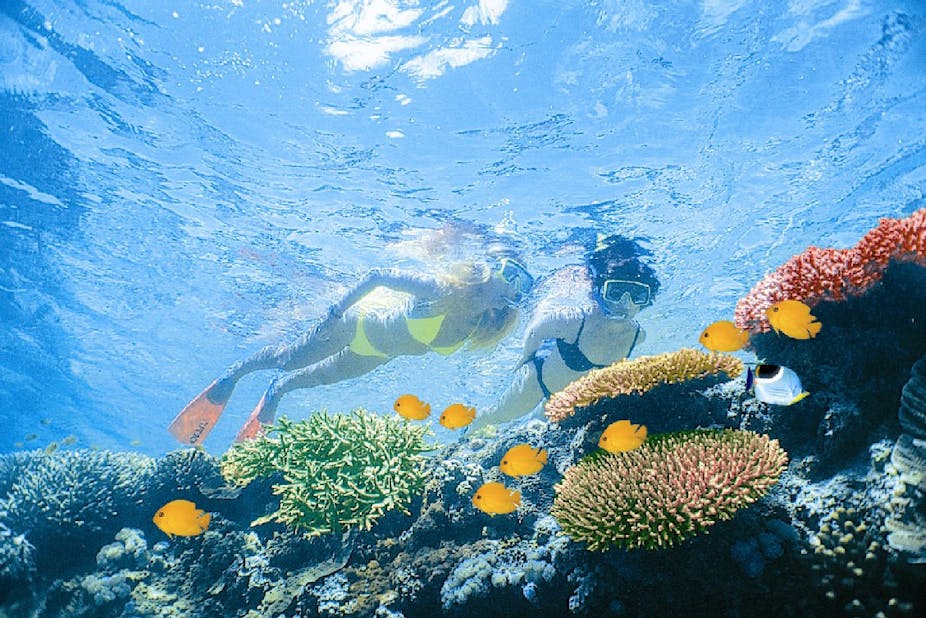
Australia has built a strong global brand based on its iconic natural beauty. For example, the new Australia Tourism campaign, “There’s nothing like Australia”, features icons like the Kimberley, Uluru, and the Great Barrier Reef. But on the flip-side, mining is an important part of the Australian economy, representing the third largest sector-share of GDP in 2009-2010 at 8.4%. As the economic importance of mining accelerates, can these two core Australian brands continue to co-exist without impacting one another?
The environmental and social impacts of recent mining proposals have met heated debate. These include two proposals currently under assessment by Environment Minister Tony Burke: James Price Point, and Alpha Coal. These cases represent two of Australia’s largest mining exports, LNG and Coal, but also raise serious environmental concerns for key assets: the Kimberley and Great Barrier Reef. While Environment Minister Tony Burke is limited in his decision-making to the relevant legislation, namely the Environment Protection and Biodiversity Conservation Act 1999 (EPBC Act), his decisions on these high-profile cases will likely set the tone for environmental policy as it relates to mining proposals in the near future.
Coal and the Great Barrier Reef
The Great Barrier Reef (GBR) is a World Heritage site and is an important environmental and economic asset, estimated in 2005 to contribute $5.8 billion in gross domestic product to Australia. However, the natural values of the GBR are being affected by increased port and shipping activities primarily driven by mining-sector demands. In the wake of the UNESCO report on the Great Barrier Reef, Minister Burke halted movement on the Alpha Coal project to properly assess the likely impacts on the reef. This may have implications for similar projects in the Galilee basin including the China First and Kevin’s Corner Projects. The discussion surrounding the Alpha Coal mine will be closely watched by many for an indication on the future of the proposed Galilee basin coal mines. In addition to possible impacts on the GBR, the China First project will wipe out an existing private protected area, Bimblebox Nature Refuge. The open cut coal mine will severely impact the environmental values that have been protected by the Nature Refuge. In addition, mining within private protected areas, such as Queensland’s Nature Refuges, creates social consequences that could erode the public’s willingness to participate in such programs in the future. These potential social costs are not currently being valued in the decision making process.
James Price Point and potential impacts on the Kimberley
The Kimberley is known for its natural beauty and cultural and biological diversity. Purnululu National Park (Bungle Bungle range) is World Heritage listed and the west Kimberley was recently national heritage listed. The north Kimberley is one of two regions in Australia with no recorded mammal extinctions. However, the proposed James Price Point gas hub now represents a major threat to the pristine natural values of the region. The proposed gas hub will threaten natural values such as the heritage-listed dinosaur tracksites, plus whales and dolphins as well as endangered species such as sawfish, dugongs, and turtles. Notably, Kimberley coast is an important Humpback whale nursery and the proposed Kimberley marine protected area will provide protection for some of the nursery.
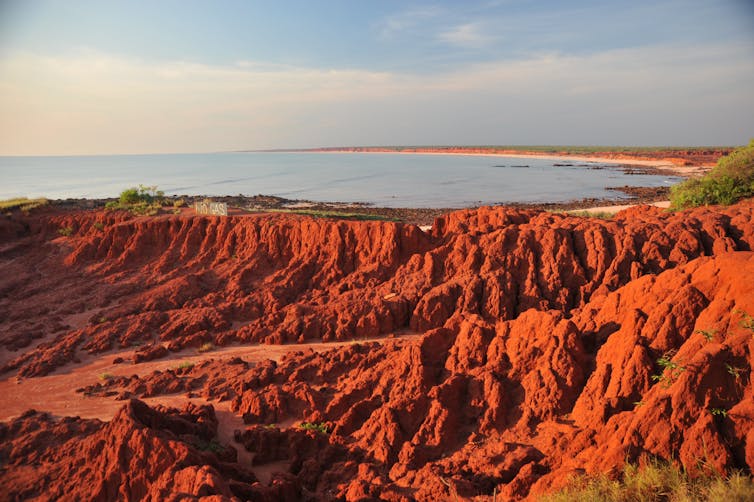
Can the impacts from the James Price Point gas hub be avoided?
The James Price Point gas hub differs from other mining proposals in one key way. While many mining proposals are site specific, the gas hub proposed for James Price Point has alternate proposed sites, including the Pilbara. Thus, the impacts from the James Price Point gas hub on the natural values of the Kimberley can be avoided. Following the mitigation hierarchy of avoid, minimise, reduce then offset, the consideration of alternate locations for the gas hub deserves serious attention.
If the James Price Point proposal does move ahead, Woodside environmental policy is to minimise impacts and undertake restoration activities where appropriate. Although Woodside has pledged to protect whales, turtles, fish, and water quality in the area, details surrounding the environmental management and financial commitment to these activities have not been released. Projects of this nature are often also accompanied by an environmental offset package. For example, the Inpex’s Ichthys project has committed to voluntary and required offsets. However, there are a number of species found only in the Kimberley. If any of these species were to be lost an offset simply could not achieve a “no net impact” outcome.
What about the locals?
Many of the proposed mines are in rural areas of Australia where the local landholders have been caretakers of the land for generations. In these rural communities, do the people stand to win or lose from the mines? This question doesn’t have a clear answer. What is clear is that there is a great deal of local discord over these proposals.
For example, James Price Point has attracted significant community protests and an additional 140 police were recently sent to Broome at a cost of ~$100,000 a day to ensure the road to James Price Point was open and safe to travel as Woodside work resumed. Similarly, the coal and coal seam gas (CSG) proposals in Queensland have been met with local concern including active Lock the Gate Alliance protests and media statements. In addition, there has been a great deal of local support to save Bimblebox, including more than 1800 public submissions in response to the Waratah Coal’s Environmental Impact Statement, and the production of a film highlighting the potential effects of planned coal and CSG expansions.
This escalating level of protests and local conflicts suggests that the public debate over the value of mining has not reached a consensus. An in-depth examination of the broader costs and benefits of proposed mines is needed to facilitate a public debate of the issues.
Mining and the Australian Brand
Mining is an important part of the Australian economy. However, tourism and other industries built on maintaining the natural values of Australia are also important economic sectors.
The Kimberly and Great Barrier Reef represent not only important wilderness areas but also brands for iconic nature that attract tourism. They are spectacularly beautiful and unique areas that have been maintained in their natural states to preserve environmental values. The tourism value of the Kimberley was estimated in 2008 to be $637 million, an important 35.8% of the region’s economy. Approximately 88% of the GBR’s contribution to gross domestic product is from tourism, or ~$5.1 billion in 2005.
However, the future security of tourism in these regions relies on the branding of environmental assets. Mining impacts on these assets could severely impact these brands and have lasting implications for the tourism industries in these regions. The decision to mine these areas has important consequences for Australia’s reputation as an environmental steward of world heritage areas. But the decision also affects industries, such as tourism, that have worked to build brands around the environmental values of these regions. Is the loss or devaluing of these brands something we can afford or is the price of mining too great? Impending decisions by State Governments and Environment Minister Tony Burke will be making that call, whether presented as such or not.
Comments welcome below.
Aden Date
Student of Clinical Psychology
When we talk about natural beauty as part of Australia's brand, and try to measure that brand in terms of tourism dollars, we've potentially already lost the battle. Drag the environment in to the arena of economic rationalism and it is assured to leave bloodied and broken in most cases.
There is a discussion to be had on the costs and benefits of resource exploitation, but financial benefits can only ever be a part of the picture.
Vanessa Adams
Research Fellow, Research Institute for the Environment and Livelihoods at Charles Darwin University
Hi Aden-
Read moreCertainly many people believe that nature has an infinite value. But the article by Mark Colyvan and colleagues:
http://onlinelibrary.wiley.com/doi/10.1111/j.1755-263X.2010.00118.x/abstract
summarizes my personal opinions quite well, even with the title "The natural environment is valuable but not infinitely valuable". I think that the economic values of nature have to come into the debate and this actually goes beyond just financial benefits, for example valuing the contribution to…
Aden Date
Student of Clinical Psychology
Thanks for the reply Vanessa.
I agree that the value of nature is not infinite: Clearly we wouldn't get too far if leveling a single shrub was an unacceptable cost.
My concern comes from the idea of how the debate is framed. While economic arguments have a role to play, they must be managed carefully so as they are not co-opted as the basis for all debate. An argument for environmental protection should not come from a place of infinite benefit, but the argument can include an appeal to intangible benefits (or at least, difficult to measure) at times, and a focus on economic rationalism can detract from these benefits. I feel that these intangible benefits cannot be understated as it is they that ultimately tip the balance in favour of conservation.
Dale Bloom
Analyst
There is an interesting aspect now occurring. White Australians have been here for about 200 years, and there are areas that are now becoming part of our heritage. The GBR is one of them, particularly with locals who have lived nearby for most of their lives.
I spent many years sailing around the Whitsunday Island. I know almost every inch of some of those islands, and I know their moods, the seasons, the weather conditions, the currents, the surrounding reefs, where to look for fish, the different…
Read moreVanessa Adams
Research Fellow, Research Institute for the Environment and Livelihoods at Charles Darwin University
Hi Dale-
Thanks for your points. Places like the GBR support such a diversity of economic activities as well as cultural values and ecosystem services, like biodiversity. I agree with you that striking a balance that protects and sustains all of these values into the future is not a trivial task. Hopefully public debate can continue to contribute to robust decision making so that these values (economic, social and environmental) are maintained.
Mark Duffett
logged in via Twitter
What proportion of the Kimberley coast (let alone the region) is going to be occupied by the James Price Point gas hub? If it's less than, say, 1%, I think it's reasonable to expect the author to justify the statement "the proposed James Price Point gas hub now represents a major threat to the pristine natural values of the region". She fails to do so. As such, it's hard to accept she is fair dinkum about contributing to the 'public debate' on 'the broader costs and benefits of proposed mines' when the costs are not even put into proper perspective, let alone the benefits.
Vanessa Adams
Research Fellow, Research Institute for the Environment and Livelihoods at Charles Darwin University
Hi Mark-
I'd argue that there are 2 aspects of impacts from James Price Point (JPP) that need to be evaluated:
1. the direct footprint of the gas hub and it's correlation with natural values.
2. the cumulative impacts of the gas hub on natural values.
The first point corresponds to your point about the percentage of the region occupied by JPP. The foot print when considered against the full region is certainly not huge. However, it does directly correlate with a significant portion of natural…
Read moreSteve Hindle
logged in via email @bigpond.com
I agree with your sentiments.
This author relies too much on exaggeration to make her claims. It is too hard to provide evidence that the James Price Point gas hub is going damage places like the Bungle Bungles, which are over 1000kms away. so instead the argument is moved to the "Brand" being damaged.
Wilderness areas need protection, but there still needs to be some balance and perspective kept in the argument.
Mark Duffett
logged in via Twitter
Vanessa, thank you for your considered response, however I think it would be fair to summarise it as 'there is no evidence that JPP will jeopardise any species at all'. Asserting that whale calving activities will be curtailed is unsatisfactory - where is the evidence?
The question of cumulative impacts is one for regulators to bear in mind, but it's completely unreasonable to consider each development as if there were a dozen more like it - which is the logical conclusion of your position.
It also seems rather disingenuous to raise concerns about the effects of resource projects on tourism image - when the whole tenor of the piece is to magnify those effects.
James Jenkin
EFL Teacher Trainer
One way to measure the effect of a particular industry on a country's image is arguably to look at other countries - from our perspective as outsiders and potential visitors.
Canada might be a good example - it's also well-known for its untouched natural beauty. Do mining and logging damage its brand? Or do we take these industries for granted (lumberjacks are iconic, after all), and do we picture the Canadian wilderness as so massive, it won't be affected?
I'm describing image here of course, not reality.
Vanessa Adams
Research Fellow, Research Institute for the Environment and Livelihoods at Charles Darwin University
Hi James-
I think your idea of looking to Canada for perspective is a great one. In fact the mining of the oil sands has strong parallels to some of the mining proposals in Australia. If interested here's an article from 2009 - a bit outdated but very good:
http://ngm.nationalgeographic.com/2009/03/canadian-oil-sands/kunzig-text/1
Looking to Canada I do think their wilderness is being impacted. Particularly in the case of Alberta I think there are legitimate environmental concerns, but I haven't seen quantified numbers on whether this is impacting tourism or the international perception of their environmental policies. However, the article mentioned above gives some very strong portrayals of the types of trade-offs that have to be made when moving ahead with large scale mining operations.
James Jenkin
EFL Teacher Trainer
Thanks Vanessa, very useful link!
Anthony Nolan
Ruminant
Would you care to provide an example of what such balance and perspective might be in this instance?
Bruce Moon
Bystander!
Vanessa - great article.
In some respects, this 'play' of public sentiment versus political will is but another example of the stalemate that has been Australian governance since the 1970's. Franklin River, Fraser Island, Wet Tropics, Tuntable falls... the list is soooo long.
I suggest the central issue is the way we Australians talk of 'public debate'.
Unlike other western nations, Australia fails to debate matters of public interest 'publicly'.
Our Washminster system of governance…
Read moreBruce Moon
Bystander!
Vanessa
I should have also added that in the absence of a decent 'public debate', there tends merely to be a series of similar but polarised statements 'representing' the 'debate'.
Many Australians let themselves fall into the fact of polarisation by either supporting one side, or criticising the 'other' (polarised) side.
Sadly, the 'debate' just becomes more polarised.
New information - like your view on the National Brand - is either subsumed into the polarised debate or sidelined.
It appears there are no shades of grey - between the black and white of polarisation.
I wish it were otherwise.
Cheers
Vanessa Adams
Research Fellow, Research Institute for the Environment and Livelihoods at Charles Darwin University
Hi Bruce-
Great food for thought in your comments. While I can't speak to most of it I agree that these types of proposals get drawn into a very polarised debate without much room for understanding and valuing the nuanced shades of grey. I think this is reflected to some degree in my statement in the article that with respect to rural communities winning or losing from the mines there simply isn't a clear answer.
With regards to public debate as it relates to movements such as the Wet Tropics and Franklin river you might enjoy this article with Bob Brown reflecting on just that:
http://nsw.greens.org.au/content/what-bob-brown-did-next
Gil Hardwick
Anthropologist
Why mining and the environment, Vanessa? Why not cities and the environment? Or agriculture and the environment? Or mining and agriculture? Or cities and mining?
Tourists do not come here to Australia to look at one thing or another, they take in the whole experience.
There are successful tours to the Big Hole at Kalgoorlie, the rice mills at Leeton and Deniliquin, the night life on the Gold Coast. The most successful tours in terms of repeat business are those where the tourists, when asked…
Read moreVanessa Adams
Research Fellow, Research Institute for the Environment and Livelihoods at Charles Darwin University
Gil-
Thank you for your thoughts. Certainly cities, agriculture and a multitude of industries, tourism included, have the potential to impact the environment and conversely rely on the environment to support those industries. In this article mining and tourism were simply the most robust examples with concrete research to examine all of the intricacies of making robust development decisions that will result in long term sustainable benefits (social, economic and environmental).
Tourists certainly…
Read moreDale Bloom
Analyst
Give tourists something to do?
I have repeatedly seen large boatloads of tourists taken to the reef. They spend some time in the morning snorkelling, have a large smorgasbord lunch, and then fall asleep due to the gentle rocking of the boat. That is good, because if they did anything more such as fishing or even more snorkelling (during which they often urinate in the water and pollute the coral), they will impact on the environment.
The GBR is already full, and any more tourist resorts or tourist boats will have an adverse impact on the environment.
Anthony Nolan
Ruminant
Vanessa,
The trouble with assigning dollar values to ecosystems is that the higher dollar value always wins. In other words, where there is a conflict between the dollar value of industrial development and the dollar value of intact ecosystems then the former always wins because of the need to realise a dollar value within the foreseeable future of one lifetime. The specific interests of particular groups always succeed over long term ecological values.
The problem with economic arguments…
Read moreMark Duffett
logged in via Twitter
Anthony, I hear what you're saying. However, the fundamental problem with your framing is your implicit equation of development with destruction. It simply doesn't have to be that way; in the 21st century, gas hubs (and nuclear power plants) and whales and everything else can co-exist.
The Kimberley coastline is roughly the same length as that of the entire State of Victoria. After well over a century of quite intense near-shore development, much of it under standards far lower than those applying today, including major hydrocarbon extraction and processing facilities, would you really describe Bass Strait as an ecological wasteland? And the Kimberley coast will never be developed to anywhere near the same extent as that of Victoria, even if you allowed complete open slather.
Anthony Nolan
Ruminant
Mark Duffet,
I'm sure that it might be possible for many different types of industrial activity to be conducted in environmentally non-injurious ways; this is without doubt technically feasible. However, it certainly would impact on the rate of profit. Environmental accounting and environmental protection laws exist because the history of industrialism (under both capitalism and state socialism) externalizes many of the costs of production onto the commons of nature - especially waterways, the…
Read moreShirley Birney
retiree
The article immediately stirred memories of the excuses invoked countless times over recent years by WA’s successive governments and tardy regulators, after environmental catastrophes. And the irrefutable evidence of “hit first, fix later” culture in the DEC prevails where the taxpayer collects the bill for remediation.
The Oil and Gas Journal reported that “ Woodside has been keen to develop the project through government-serviced shore facilities at James Price Point on the Kimberley coast…
Read moreAnthony Nolan
Ruminant
Shirley Birney suggests that Woodside, BHP Billiton, Royal Dutch Shell, BP, Chevron and MIMI (Mitsubishi and Mitsui) is a rogues gallery of corporate criminality. I am shocked, shocked I tell you, at this sort of libel.
Anthony Nolan
Shocked father of eight.
Mister Anderson
Student
Fantastic article Vanessa. I can't help but wonder what the dollar value of mining would be against the value of natural areas if we'd put (even an estimated) value on ecosystem services such as clean water and biodiversity. I can't guarantee it, but I reckon that the short term value of mining would lose out to the sustenance of Australia's future as a liveable place.
It would seem that research in environmental economics is in early days, but this furtherance of the topic seems to be something that is strangely absent from public debate (from all parties) with serious consequences.
We've socially evolved to evaluate the world in units known as dollars. It's time for economics to start validating environmental 'externalities'. Is it just me or is the triple bottom line actually just one line that we've broken apart...