

Mining could invest in a future that belongs to all of us – education

Prime Minister Julia Gillard delivered one of her strongest messages to the mining sector last night, telling mining bosses at a Minerals Industry dinner in Canberra that they don’t own Australia’s minerals resources, the Australian people do. And what’s more they “deserve their share.” The idea of…

Qfwzd8mh-1338437685
Prime Minister Julia Gillard has called on miners to accept that the resources they mine belong to the people. AAP Image/Alan Porritt

Prime Minister Julia Gillard delivered one of her strongest messages to the mining sector last night, telling mining bosses at a Minerals Industry dinner in Canberra that they don’t own Australia’s minerals resources, the Australian people do. And what’s more they “deserve their share.”

The idea of “spreading the benefits of the boom” has been strongly countered by the Australian mining sector for some time. Their mantra is that they are too heavily and unfairly taxed.

This was argued again last night by Minerals Council president Peter Johnston who criticised the “endless dialogue about redistribution”.

BHP Billiton chairman Jacques Nasser also complained earlier this month that Australia’s industrial relations and tax systems would force his business offshore.

But the truth is the mining sector in Australia has been taxed lightly. As University of New England’s Christopher Lloyd points out we’ve known this since the Henry tax review, and have had it confirmed again in this year’s Budget papers (see figure below).
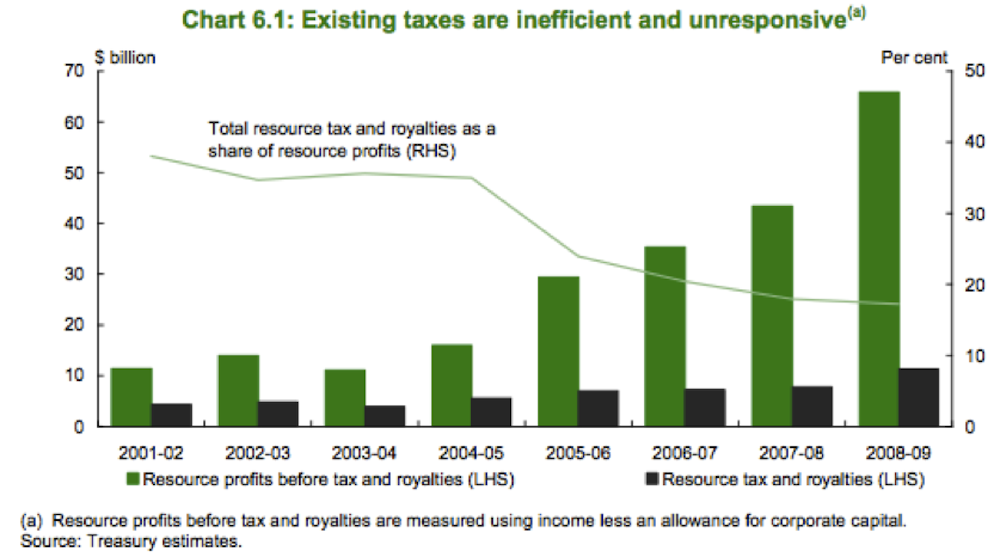
Despite mining companies turning up the volume, their tax rates are relatively low. Australian Resource Tax and Royalties (Henry, 2010 reproduced in Lloyd 2012)

Looking at the history behind this debate, Loyd points to the collective social ownership felt by Australians, expressed through their parliaments, for material endowments like minerals, water and ecosystem services.

Political history, he contends, was built, in part, on the hegemony achieved by those who monopolised economic rents from exclusive access to these endowments. Some countries, like Australia, managed to “…transform its dependency [on commodities] into a wealthy, middle class, democratic, urban society from the early 20th Century.”

However, the governments of Australia suffer from a deficit of effective policy to capture the extraordinary commodity boom incomes being generated by the mineral mining companies. The consequence is that Australia is now near the bottom of OECD countries in its long-term provision of social and physical infrastructure.

But I would contest Loyd’s point that “the private sector lacks the capacity or is prevented from providing the shortfall.”

Rather than directing cash into the Mineral Resources Rent Tax I have suggested that iron ore giants BHP Billiton and Rio Tinto use their extraordinary profits to deliver endowments to Australian universities.

It’s not that they can’t or don’t already make contributions to public social and physical infrastructure. For example, most recently, Rio Tinto agreed to pay for a Professorial Chair in Geotechnical Engineering at the University of NSW and donated $3 million to the University of Western Australia (UWA) for engineering and mining related education. BHP Billiton Mitsubishi Alliance made a donation to the University of New South Wales of $2.7 million for two Professorial Chairs in mining-related research and education.

Both companies already donate about 1% of their profit to community development within the respective catchment zones of their mines around the world. Other notable donors from the mining industry include personal pledges from Clive Palmer of $100 million for medical research and Pilbara communities development, and commitment from Andrew Forrest to a program to employ 50,000 Indigenous people.

The Australian Government allocates about $10 billion per annum for universities’ operations. Higher Education is one of those sectors of social infrastructure that adds significantly to the well-being of all Australians, yet is horribly under-funded and subject to the dead hand of corporatist compliance management.

This situation does not augur well for our future lifestyle or livelihoods. There is, however, very good reason to think that the mining companies have the capacity to inject new life directly into this sector and should bow to the pressure of our collective Australian social expectations. They should divert/endow the equivalent of one year’s Federal budget allocation into higher education sector from their extra-ordinary profits from 2012 to 2020.

Mining companies should use their profits to fund higher education. AAP/Rebecca Le May

Not only do endowments mean that the cash as a capital base is secured, but the investment income can be put toward recurrent funding needs, like salaries, vastly improving the current parlous state of higher education in its capacity to respond to societal needs.

And of course, this investment should be given without strings attached. Universities know what and how to educate; this level of endowment will effect change across the many disciplines that make society whole, not advance narrow self-serving interests.

Such an investment would mean so much for the key people whose lives are affected by these social actors – the companies. For BHP Billiton and Rio Tinto employees – being identified with such a process would change how they thought of their roles, their employer, themselves as citizens, possibly enhancing retention and productivity for the companies. It might force a change in negotiations when the companies encounter other governments, unions, or even their key customers; it’s not all about the money.

Investing in higher education, without attaching strings, is in the companies’ medium to longer term benefit, as well as a benefit for rest of the myriad small to medium-sized businesses in Australia, who will, most likely, be the employers of the children of current mining company employees and of mining company shareholders.

But it the legacy of such transformational investment – of a mineral endowment to an educational endowment – that would be seen by Australians; A legacy that would represent the true, on-going value of the mining boom, working over generations, beyond the lifetime of any mine, that would satisfy our social expectations of the distribution of ‘profit’ from the exploitation of our common resources.

Investing in Australian higher education now, in the current maelstrom and uncertainty of our economic and social systems, by two of the largest companies in the world, would be a signifier of the need for an alternative to business and politics as usual.

Join the conversation

19 Comments sorted by

  1. Pauline Montagna

    Writer/teacher

    This is all rather pie in the sky. Companies may pledge funds, but there is no guarantee they will deliver, or that they will continue to deliver year after year. They will also pick and choose what kind of education they will fund. I doubt they would fund chairs in Australian literature. However, having worked in TAFE I have discovered that the Australian corporate sector has an aversion to paying for training and education. If they can avoid it they will. I can still remember the song and dance they made when Keating applied a 2% training levy. Most of it was spent sending management to conferences in exotic locations. The only way to make corporations pay their share of education or any social costs is to tax them.

    report
    1. Jason West

      Associate Professor, Griffith Business School at Griffith University

      In reply to Pauline Montagna

      This is true. The mining boom will not continue forever. Iron ore and met coal prices will take a hit at some stage in the next 5-10 years as China struggles with excess supply leaving the mining company profits to be spread thin. Endowments will be among the first things to be cut so any form of addiction to corporate funding should be avoided, unless such funding is directed towards research that directly benefits the company who funded it. These large companies have tried this in the past and were burned for their efforts. So now they avoid such promises and keep to themselves.

      report
    2. Jonathan Sobels

      Lecturer, Human Geography at University of South Australia

      In reply to Jason West

      Jason, thank you for considering the crux of the idea. However, the idea of the endowment is as a capital asset that yields annul interest income, thus protecting the capital asset in perpetuity. $10 billion as an asset would, for example, return $500 million interest income at 5% ROI, enough to pay the annual academic salaries of the 3 universities in Adelaide plus $35 million. I did not expect the mining companies to have the capacity to keep donating beyond this period of extraordinary profits…

      Read more
  2. Dale Bloom

    Analyst

    I would think the government’s job should be to encourage mining magnates operating in Australia to be diversifying their investments in Australia. Perhaps some of these mining magnates think mining is the best investment they can make at present, but mining as a prosperous industry will not last indefinitely.

    If mining magnates operating in Australia do not want to diversify their investments in Australia, then we will have to find some other mining magnates who will.

    report
    1. Dale Bloom

      Analyst

      In reply to Ken Swanson

      There may not be much difference between newspapers and education. Part fact, part fiction, part entertainment.

      I would think mining magnates should be told to diversify their investments in Australia, or find some other country. If most of the major investments in Australia are in mining, then Australia becomes too reliant on mining, (if this has not occurred already)

      report
    2. David Arthur

      n/a

      In reply to Dale Bloom

      Instead of getting mining magnates to stump up directly for Australia's education system, how about they invest in industries that would employ Australians?

      For example, they could make use of Australian expertise in mineral processing and metallurgy by developing value-adding industry; instead of just blowing up country to put it on a ship to go overseas for someone else to make money out of it, how about they do the value-adding in Australia by extracting and refining the metal, then exporting that?

      Swinburne's Prof Geoffrey Brooks has contributed several "The Conversation" pieces around similar statements to this.

      https://theconversation.edu.au/treasure-your-metal-why-we-need-to-respect-embedded-energy-6802

      https://theconversation.edu.au/why-australia-must-forge-a-future-in-chinas-age-of-steel-6278

      https://theconversation.edu.au/the-solutions-to-alcoas-problems-may-lie-in-its-backyard-5289

      report
  3. woolfe

    logged in via Twitter

    Well Tim Flannery is Professor Panasonic so only logical that we should have an Iron Prof?

    report
  4. Bernie Masters

    environmental consultant at FIA Technology Pty Ltd, B K Masters and Associates

    Sadly, it's not hard to see why Julia Gillard is such a poor PM. Assuming that she was correctly quoted when she said the Australian people own the minerals, not mining bosses, her comments completely fail to recognize or acknowledge that, according to our constitution, it is the states that own the minerals. Only in the Australian territories and beneath offshore marine waters do 'the Australian people' own the minerals. Her failure to acknowledge the role of state governments in regulating the…

    Read more
    1. David Arthur

      n/a

      In reply to Bernie Masters

      Thanks Bernie.

      I've not heard a better-argued case for dissolving the States and transforming Australia from a Federation of States to a single sovereign nation than this.

      report
    2. Bernie Masters

      environmental consultant at FIA Technology Pty Ltd, B K Masters and Associates

      In reply to David Arthur

      David: Is your vision to form a single sovereign entity similar to what the creators of the European Union had in mind 20 or 30 years ago? Being based in the west, I can attest to how Canberra has often ignored over many years and many governments what happens in the western third of the continent. A single sovereign nation would be even worse than the poorly operating federation that we currently have in place!

      report
    3. David Arthur

      n/a

      In reply to Bernie Masters

      Thanks Bernie,

      Being based in regional Queensland, I can attest to how Brisvegas ignores over many years and many governments what happens in 90% of the State.

      Having been raised in non-metropolitan NSW, I can attest to how Macquarie Street ignores over many years and many governments what happens in 90% of that State also.

      The answer I suggest is proportional representation - a single national electorate that votes on all 150 (or whatever) members by preferential voting.
      The politician that gets the most votes automatically becomes Leader of the House, and hence PM. That person then chooses their ministry from among their colleagues in that House.

      This way, we all get to directly vote on PM, and on every member of the Cabinet.

      We then also elect an Upper House, based on single-member electorates.

      With the States dissolved, the two levels of government are National and Local/Regional.

      report
  5. david poole

    logged in via LinkedIn

    Interesting story. A bit of balance is required. Why give money to Universities? The statement " Universities know what and how to educate", is made without any evidence. I recall numerous examples of ineptitiude, corruption among vice chancellors, maladministration, and poor business decisions by Universities( UNSW going into Singapore? How much did we lose on that one?).
    Agree with the sentiment however, that there is a need to use the wealth generated to provide for our country.
    Like the words".... dead hand of corporatist compliance management.". Could mean a lot of things, but if applied to the VETABs and TAFEs that we have, then I understand it totally

    report
  6. Lincoln Fung

    Economist

    I have to disagree on the argument that mining companies have paid light taxes. The argument is based some numbers to show superficially a relationship between profits and taxes and lacks a real understanding of the Australian tax system and how it works.
    For example, company profit is taxed at the company income tax rate based on the assessed income and no companies must pay the assessed tax to the ATO. How can mining companies not pay the company tax?
    Royalties are levied by state governments and can display the sort of phenomenon shown in the graph. But that is the basic nature of royalties, the rates are ad volerum and do not vary by profit. Should the price of minerals fall, those companies still have to pay the royalties. One cannot and should not be jealous when mining companies make more profits due to price increases.
    Wrong premise will lead one to the incorrect conclusion.

    report
    1. Michael J. Lew

      Senior Lecturer, Pharmacology at University of Melbourne

      In reply to Lincoln Fung

      You ask how a mining company might avoid company tax. What about by transfer pricing arrangements with wholly owned subsidiaries in tax havens? I imagine that would work quite well. http://www.crikey.com.au/2011/04/18/glencore-and-the-cautionary-tale-of-zambia/

      You also say that "One cannot and should not be jealous when mining companies make more profits due to price increases", but I disagree. If the price of the commodity has increased then the value of the stuff in the ground has increased. If that stuff is not owned by the mining companies then it makes perfect sense to me that they might be asked to pay more for the privilege of profiting from extracting the it.

      I agree that wrong premises lead one to the incorrect conclusions, but I think you might look at your own premises.

      report
    2. Bernie Masters

      environmental consultant at FIA Technology Pty Ltd, B K Masters and Associates

      In reply to Michael J. Lew

      Lincoln is correct about the risk posed by transfer pricing but my 40 year exposure to the mining industry suggests that it is mainly overseas companies operating mines here in Australia who sell mineral commodities at artificially low prices. In theory, BHP and Rio could arrange some of their commodities to be sold in this way but companies such as Fortescue and most Australian gold and nickel miners are unlikely candidates as they have no overseas subsidiary to sell to. Even if they did, the liability to pay tax then transfers from Australia to the country in which the overseas subsidiary is registered. This is a pretty good reason for making sure Australian tax rates are competitive in the global market place, although this should never result in a race to be the lowest taxing nation on the planet.

      report
    3. Michael J. Lew

      Senior Lecturer, Pharmacology at University of Melbourne

      In reply to Bernie Masters

      Well, Bernie, the possibility for companies to opt out of paying tax in Australia by exploiting tax havens and transfer pricing is a good reason far calling them out when they do it. I note that Rio Tinto has statements about their policies in this area on their website: they are clearly sensitive to perceptions.

      Your suggestion that it be used as a reason to keep tax rates for mining companies low in Australia _will_ lead to a race to be the lowest taxing nation. I would prefer to combat cheating by enforcing rules and shaming the cheaters rather than changing the rules to suit the cheaters.

      report
  7. David Arthur

    n/a

    For every skilled worker brought into Australia on a 457 visa, the employer of that worker should be required to fund 100% of the education of TWO Australians from kindergarten to completion of the qualifications of the imported worker.

    This could be applied across all sectors, from mining to health care.

    report
  8. David Daly

    Data Analyst

    I agree and think the proceeds of safe mining should be invested in education. Mining is going to happen anyway so atleast lets use the monies for social good.

    report