Mining is digging the heart out of conservation covenants

Across Australia, landholders are signing conservation agreements or covenants to protect biodiversity on their property. These agreements, offered by state governments, create private protected areas that commonly bind future landholders to protect the property’s biodiversity, ensuring the long-term…

Ghbv8qrg-1337146583
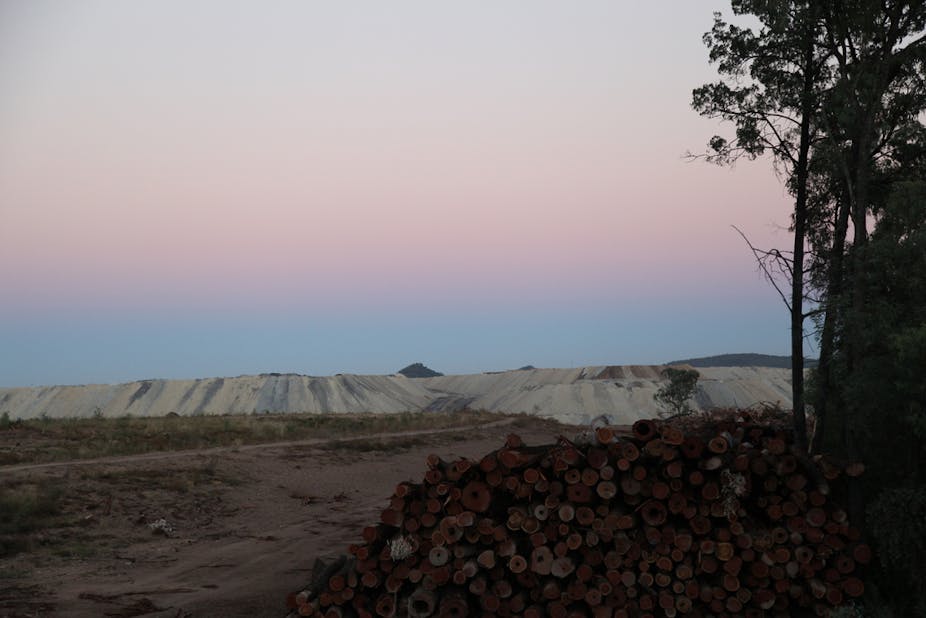
Conservation doesn’t fare well once the miners move in. Kate Ausburn

Across Australia, landholders are signing conservation agreements or covenants to protect biodiversity on their property. These agreements, offered by state governments, create private protected areas that commonly bind future landholders to protect the property’s biodiversity, ensuring the long-term survival of plant and animal communities.

It seems like a good deal: a private protected area comes at little to no cost to the government and offers protection to biodiversity that might not otherwise have been protected.

Unfortunately there’s a catch. The government does not exempt these private protected areas from mining activities. Rather, in all states of Australia, the government can still give miners permits to explore and extract in these private protected areas.

How protected is protected?

Private protected areas can be created on privately-held properties when the landholder signs a conservation agreement or conservation covenant with the state government. Conservation covenants define the limitations, conditions or restrictions on the use of that land for both the current and future landholders of the property.

Conservation covenants are becoming a popular conservation mechanism in Australia to complement the public protected area system. Organisations like Bush Heritage and the Australian Wildlife Conservancy are built on these covenants. The Queensland Government has committed to add 12 million hectares of land to the reserve system by 2020. Only one-third is being added to the national parks system; the remaining eight million hectares will come from other land including Nature Refuges, a type of covenant.

Covenants are binding. They restrict not only how the current landholders uses the land, but how future landholders use it too. So you might think private protected areas are secure mechanisms for long-term biodiversity protection. Yet, in all states of Australia, conservation covenants are not exempt from mining activities. Legal rights to the topsoil and to minerals below the soil are held by different people; because of this, the security of private protected areas is not a given.

Let’s say the landholder signs a covenant and thereby restricts their topsoil rights to conserve the biodiversity of the property. In this situation the government can still exercise their mineral rights. If the government does exercise their mineral rights, they create an inequitable distribution of the costs and benefits. The landholder pays to maintain biodiversity on behalf of the government and community. But the landholder does not personally derive any ongoing benefits of mineral extraction; the government and third parties get all the benefit.

Governments need to choose: mining or conservation

From a conservation perspective, the ecological benefits of the covenant are lessened or negated once there is mining on the land. From a social perspective, landholders might have a reduced willingness to place a covenant on their property in the future if they know it could be threatened by mining. A conservation covenant will only be equitable so long as the landholder and the government both choose to restrict their use rights in favour of conservation over extraction.

The contradictions in government’s conservation and mining policies are becoming clear. This is particularly true in Queensland, where there is a push to both increase mining development and expand the Nature Refuge program.

In Queensland, 149 of the 379 existing Nature Refuges have mineral exploration permits within their boundaries. Notably, ~70% of those exploration permits were approved after the Nature Refuge was gazetted: the Queensland Government knew about the properties' conservation value and intended use. Waratah Coal’s proposed Galilee (China First) Coal Project would put a “mega” mine on Bimblebox Nature Refuge, an 8,000 ha private protected area gazetted in 2003. If the mine was approved, it would significantly impact the natural values the area was set up to protect.

Can everyone win?

Given Australia is in the midst of a mining boom, what is the likely future of our private protected areas? To protect the legacy of these programs and make sure landholders still want to place covenants on their property, we need to reform the covenant process. Reforms would need to redress potential use conflicts at the start of the process and assure the landholder that their commitment to a covenant is secure.

A possible solution to this problem is to mirror the process used for national parks. In Queensland, for example, the government resolves any conflicting interests in the property at the start of the process so that once the park has been declared its conservation status is secure. If this model was followed, existing interests in the property would be resolved before the conservation covenant was signed. The area would be given temporary conservation status while mineral exploration or extraction permit conflicts are resolved.

Without reform and a stronger commitment from the government to ensure the integrity of conservation covenants, it is easy to envision a future in which the benefits of conservation covenants, and the efforts of private landholders, are eroded by mining interests.

Articles also by These Authors

Sign in to Favourite

Want to follow The Conversation?

Sign up to our free newsletter to get the day's top stories in your inbox each morning, with a special wrap on Saturday.

Spinner
Become a friend of The Conversation and donate

Join the conversation

14 Comments sorted by

  1. Yuri Pannikin

    Director

    Don't expect the Queensland Government to make any decision to favour conservation. Campbell Newman, the Premier, is, in my view, the most pro-development and anti-environment premier since Joh Bjelke-Petersen.

    Many conservation-minded Queenslanders who voted for him would not have been aware of this, and they have been suckered . . . big time.

    report
  2. April Reside

    Postdoctoral research fellow

    Nice article Vanessa and Katie. I thought the statement that the Warratah Coal mine would "significantly impact the natural values" of Bimblebox to be a remarkable understatement. When/if Bimblebox becomes a great big hole in the ground surrounded by piles of gravel it will cease to have any biodiversity value.
    Another interesting point of discussion is the future market for all this coal being dug up, given the investment China, India & other countries are making in alternative energy development: we will turn vast tracks of land into a moon scape to produce a product with decreasing market value?

    report
    1. Vanessa Adams

      Research Fellow, Research Institute for the Environment and Livelihoods at Charles Darwin University

      In reply to April Reside

      Thanks for your comments April. Indeed, aside from the immediate social repercusions of mining within conservatin covenants and the potential impact on the future security of covenant programs I think the long term market for these mines deserves a much more robust public debate. We should be considering both the immediate and long term economic gains so that our state and national economy is as robust as possible.

      report
  3. Dr Jayne Fenton Keane

    logged in via LinkedIn

    A critical issue at the moment and I'm glad you helped raise it Vanessa. It challenges the rights to those who invest in the land to determine what use the land is entrusted with. How does this fit in with democracy and capitalism?

    report
  4. Jack Arnold

    Director

    Thank you Vanessa & Katie, you have identified another example of government duplicity.

    The answer is simple "Shut the Gate" to CSG exploration & extraction as a start.

    @Yuri: Most Queenslanders were "suckered big time" when you have some knowledge of Newman's time at Brisbane City Council.

    report
  5. Dora Pearce

    Research Fellow, Melbourne School of Population Health at University of Melbourne

    Since government policies enable mining of private and public land designated to protect biodiversity, the very least we should be able to expect is that mined land is returned to its original state on cessation of mining.

    Therefore, government policies should be extended to ensure that environmentally sustainable mining practices are employed to prevent offsite contamination, and as a condition of mining commencement, a bond of sufficient magnitude should be put aside to cover all costs associated with site remediation.

    report
    1. Vanessa Adams

      Research Fellow, Research Institute for the Environment and Livelihoods at Charles Darwin University

      In reply to Dora Pearce

      Hi Dora-
      I agree that in the event that a mine goes ahead that there should be strong environmental policies to ensure that the site is returned to a reasonable state after the cessation of the mine. Certainly most states have these types of laws but perhaps are enforced to varying levels of success. Queensland now also has an offset policy such that the loss of Bimblebox would be offset by the purchase of an alternate property; however I would argue that mining on a conservation covenant may have disproportionate social impacts and seriously erode the future participation in these important programs which simply cannot be offset.

      You may also be interested in this relevant article by Andrew Campbell and Stephen Garnett on insuring against environmental damage from mining acidents (such as accidental spills):
      https://theconversation.edu.au/insuring-the-environment-who-pays-when-mining-goes-wrong-5060

      report
    2. Dora Pearce

      Research Fellow, Melbourne School of Population Health at University of Melbourne

      In reply to Vanessa Adams

      Thank you, Vanessa,
      I very much like the idea proposed by Andrew Campbell and Stephen Garnett (https://theconversation.edu.au/insuring-the-environment-who-pays-when-mining-goes-wrong-5060) to improve risk assessments and fund mining 'mishaps' by engaging with the insurance industry.

      I appreciate your concerns, and suggest that we need a systematic (national?) approach to ensure that corridors of biodiversity - on public and/or private land - are protected for future generations, irrespective of what minerals lay beneath the surface!

      report
  6. Dale Bloom

    Analyst

    My comments here are not for or against mining, but it has been estimated that the total area of open pits and mine overburden in the country is no greater than the area taken up by supermarket car parks in the country.

    Possibly true, and not withstanding the area taken up by roads and town suburbs that seem to be forever stretching outwards into farmland and bushland.

    report
    1. Ned Stephenson

      Environmental Manager

      In reply to Dale Bloom

      It's a shame people have jumped on your comment Dale as it raises an valid point.

      It would be interesting if anyone can provide links to studies on the surface area impact of mining across the nation, and even better if those studies have made comparisons with other industries. I have worked in both mining and agriculture for quite a few years. One mine I worked at was to produce close to $4B over it's planned lifetime of 25yrs. In the process it will damatically damage an area of about 400Ha…

      Read more
    2. Yuri Pannikin

      Director

      In reply to Ned Stephenson

      The issue is rarely about the impact of mining per se in terms of area, it's about the downstream environmental impacts, and the clash of mining with sensitive environmental areas of natural and national significance.

      The assumption that mineral ores should take precedence in the wider economic and socio-economic context is the issue here.

      report
    3. Ned Stephenson

      Environmental Manager

      In reply to Yuri Pannikin

      I agree with you Yuri.

      I wasn't trying to change the direction of the conversation, just supporting Dale's comment which I felt had been unjustly criticised.

      report
  7. Stephen Garnett

    Professor of Biodiversity and Sustainability at Charles Darwin University

    Your plea for betting planning of conservation covenanted land is sensible, and well-argued, Vanessa and Katie, but may lead to some unintended consequences.

    Currently current owners can been as benefiting current and future generations by retaining conservation values of lands that would otherwise be alienated, given that they have the rights to do so. However an alternative argument might be that current owners, with the collaboration of environment departments, assert the right to impose their…

    Read more
    1. Vanessa Adams

      Research Fellow, Research Institute for the Environment and Livelihoods at Charles Darwin University

      In reply to Stephen Garnett

      Hi Stephen-
      Thanks for your thoughts. The main point that we were really trying to focus on (and discuss in more detail in a peer reviewed article: http://www.sciencedirect.com/science/article/pii/S0264837712000439) is that there is a serious imbalance in the costs and benefits of mining in a conservation covenant and that this social inequity may erode the future support for these important programs.

      Placing a covenant on your land is permanent but particularly with freehold land the very…

      Read more