


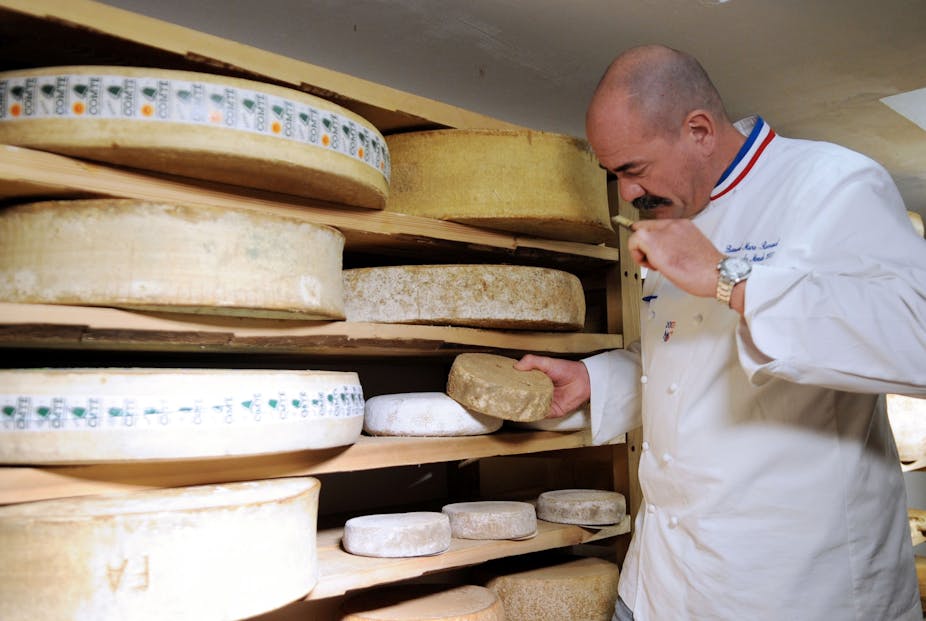
I am fortunate to have recently returned from a holiday in France. While there I couldn’t help noticing the much lower price of many foods.
Croissants and brioches retail for around $1.35 (1 euro) or less, while away the more stylish but expensive Parisian bakeries, baguettes can sell as cheaply as 80 cents.
Choosing wine from the well stocked supermarket or hypermarket shelves can be mind boggling.
As a “middle of the road” wine drinker I often assume that price is indicative of quality, so my problem when wine shopping in France is to choose from the hundreds of bottles with price tags ranging from $2.71 to $6.79 (or 2-5 euros).
Even Parisian restaurants offer very affordable set price “menus” around $20 to $28 for both the main course and a dessert.
Coming back to the inner city suburbs of Sydney, I was again reminded how dear Australian food is. The local baker sells any of the sweet croissants or brioches for up to $4.50 and baguettes for $3.50 to $5.
Cheese and wine prices are even more challenging to rationalise. A main course in any café or restaurant will set you back at least $25 - potentially much more.
Why are these foods so expensive in Australia?
There are a number of possible explanations. The most obvious one is that costs of production are much higher in Australia than they are in France.
But official statistics tell us otherwise. According to the Australian Bureau of Statistics (ABS) productivity has increased since the late 1980s and labour costs in Australia are less than the highly taxed workforce in France.
In 2008, the average gross annual income in France was around $67,000 or 47,000 euros (an interesting aside: net income for the same year was around 24,000 euros, showing income tax combined with social contributions of 49%!) bringing the weekly average 2008 wage to $1285, or 900 euros.
In 2010, the average weekly gross earnings of Australian employees was $1010, 20% lower than their French counterpart.
If the Australian cost of labour cannot justify the higher retail food prices, could it be the cost of raw commodities on the price of the finished product?
Both countries enjoy healthy local food production. France and Australia are wheat producers and exporters; both grow grapes and have a local wine industry and both have a dairy industry.
So, it is very unlikely that production costs can explain the difference in retail food prices between these two countries.
We are told that competition is essential to keep prices low but could it be the case that competition amongst retailers becomes complacent when the watchdog is asleep?
Could it be that Australia suffers from a ‘workable’ competition syndrome?
A recent OECD study comparing food price inflation between Australia, the United Kingdom and France has showed that over the last 10 years (2000 to 2010) food price inflation in Australia was 43%, compared to around 37% in the UK and 22% in France.
So why is food price inflation so much lower in France? The answer: although food prices are not regulated in France, the government actively intervenes in the affairs of the retail industry by controlling anti-competitive practices and by coordinating efforts within the food industry.
Although our politicians tell us that everything is done to encourage healthy competition within the industry, the fact is, it is very difficult for any government to foster a competitive environment without regulatory intervention.
To address unfair trading practices - in other words, the significant imbalances in bargaining power between contracting parties (usually between large retailers and food producers/farmers) - the French government has taken a very structural approach by reforming their agricultural industry through legislation in 2010.
The central objective of this key reform is to protect the farming community by re-regulating the agricultural market.
Mechanisms to protect farmers’ revenues include enforcing long-term contractual arrangements between farmers and large retailers, and ultimately to protect the farming community against price volatility and price fixing by large retailers.
Anti-competitive practices are closely monitored and sanctioned by ‘L’Autorite de la Concurrence" (ADLC), the French equivalent to the Australian ACCC.
Over the last 40 years, the French government has introduced a series of legislative steps that includes measures such as forbidding loss leader practices (unlike in Australia, which allows it).
It also regulates and assesses the viability of large commercial centres and considers the long-term benefits to local communities and existing retailing centres and forbids the practice of retrospective rebates paid by suppliers to large retailers.
As well as other European states, France has recognised that bringing transparency along the supply chain is essential to encouraging competition and therefore improving resilience of the food supply chain to price volatility.
In 2008 for instance, France launched its “Observatoire des Prix et des Marges” (Observatory of Prices and Profit Margins) to compare food price developments with other European countries; but more importantly to monitor and analyse the price transmission from international markets to end-consumers.
The price monitoring available to public viewing, is reported monthly and submitted to the French parliament once a year for negotiations between governmental agencies and the food industry sector.
The observatory tracks price development at the various stages of the food supply chain, from farm gate to end consumer, showing the price evolution by product.
In July 2008, completing an inquiry into the competitiveness of standard grocery items, the Australian Competition and Consumer Commission (ACCC) conceded that food prices had significantly risen in Australia, but it expressed the opinion that causes of such inflation were rooted in other domestic or international factors difficult to capture precisely.
Soon after the release of the inquiry report, the ACCC launched the “Grocery Choice” website, a grocery price monitoring platform where retail prices from different sources were to be listed.
The proposed website was never designed to monitor profit margins like the French price observatory is achieving.
But significantly, it was perceived as a wasteful exercise which failed to deliver transparency and meaningful information. By June 2009, the Federal Government cancelled it.
Since then, no other price monitoring instrument has been implemented or even suggested.
So could a softer tax regime foster cheaper food and beverage prices? It would appear that the answer is no for food items.
France applies a value added tax (VAT) of 5.5% on food items whilst Australian food items are GST exempt.
While French wines and spirits are also subject to a VAT of 19.6%, Australian wines attract only 10% GST but are subject to a 29% Wine Equalisation Tax (WET) on wholesale value.
France has low excise duties on wines and spirits of 3.55 euros per 100 litres.
Is consumer tolerance of higher food prices also part of our answer? Is our understanding of food different from our European counterparts? Or we Australian consumers simply asleep?
It appears that the pricing of food is situated at the crossroads between the highway of ‘workable’ competition and the gentle path of tolerant consumerism.
Food is not only essential for life but it brings pleasure and lubricates social interaction. Food plays an important role in our cultural identity and is one of the key agents for opening the gates of cultural diversity within a cosmopolitan city.
We must wake up and not let unjustified expense ruin it all. The environment and our food producers should receive the respect they are owed.
We also may want to be more circumspect with the people in-between us and the producers: otherwise they may become the only ones to benefit.