
More cyclists? That depends on where you live

If you have heard comments from friends or colleagues that there seem to be a lot more cyclists these days, chances are that you live or work in the inner city of an Australian capital city. A new report released by the Prevention Research Collaboration of the University of Sydney examined journey to…

Ybkxd4n3-1354764582
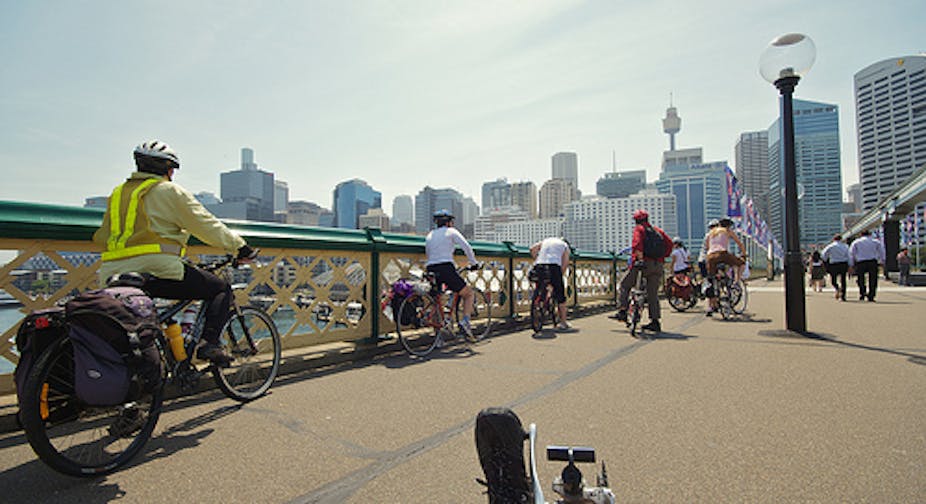
Cycling numbers are growing in the inner city, but falling on the outskirts. yewenyi/Flickr

If you have heard comments from friends or colleagues that there seem to be a lot more cyclists these days, chances are that you live or work in the inner city of an Australian capital city.

A new report released by the Prevention Research Collaboration of the University of Sydney examined journey to work data for Sydney from the 2001, 2006 and 2011 Census.

It shows that while the proportion of people cycling to work in inner Sydney has increased markedly since 2006, the proportion cycling to work in outer Greater Sydney has gone down consistently since 2001.

Overall, cycling to work has increased marginally but remains low at around 1% of all journeys to work.

What’s in a choice?

More people commuting by bicycle means cleaner, less congested cities, less stress on public transport systems and a more active, healthier population. In light of Australia’s commitment to reduce greenhouse gas emissions and ever increasing rate of obesity, normalising cycling to work has multiple benefits for cities, government and individuals. But participation needs to be far greater than its current levels for any of these benefits to be felt on a population level.

A person’s decision to cycle to work is influenced by a range of factors, including availability of cycle infrastructure, perceptions about safety, end-of-trip facilities like showers and public attitudes about the acceptability of cycling. The weather, distance to destination and topography of a city also make a difference.

Examining the characteristics of the areas where cycling is increasing or decreasing may hold clues to the best methods to increase cycling participation.

Case study: Sydney

In 2011, 2.22% of people in inner Sydney rode to work on Census day. This was followed by 0.92% in the greater metropolitan region, and 0.59% in outer Sydney.

Since 2001, inner Sydney has seen large increases in both the number and proportion of people cycling on their journey to work, from 5351 people in 2001 to 11,442 in 2011, an increase of 114%. Driving this increase were Local Government Areas like Sydney, Marrickville, Ashfield, Leichhardt, Lane Cove and Willoughby, which all experienced more than a 100% increase in the number of people cycling to work.

The top performing Local Government Areas with the highest proportion of people riding to work in the whole Sydney region were Marrickville with 4.39% of people cycling to work, followed by Leichhardt (3.81%), Sydney (3.64%), Waverley (2.91%), Manly (2.79%), Randwick (2.50%) and Newcastle (2.46%). Five of the top seven Local Government Areas are in inner Sydney (the exceptions are Manly, in outer Sydney and Newcastle, in the greater metropolitan region).

Finally, while the proportion of people from inner Sydney cycling on their journey to work is on the rise, a reverse trend is evident for the greater metropolitan region. In 2001, inner Sydney and the greater metropolitan region had similar rates of cycling to work (1.21% of trips in inner Sydney compared with 1.13% in the greater metropolitan region), but by 2011 inner Sydney rates of cycling have almost doubled, but almost halved in the greater metropolitan region.

Research consistently tells us commuters want safe bicycle paths and end-of-trip facilities such as showers and bike parks in order to be able to cycle to work.

Much of the cycling rise in inner Sydney has occurred since 2006, coinciding with improved cycling infrastructure and other support for cyclists. For example, cycling levels jumped by up to 30% immediately after the opening of Sydney’s King Street and Bourke Road cycleways, demonstrating that when safe paths are provided, demand increases.

Improvements should continue as the inner Sydney regional bicycle network, a network of 284 kilometres of interconnected cycleways being built throughout the City of Sydney, develops, and Local Government Areas continue to show political and financial support for cycling.

The decline in cycling in the outer city areas is likely due to the greater distances to workplaces, a lack of cycling infrastructure, increasingly suburban rural environments, heavier traffic and a more hostile riding environment.

Australia’s National Cycling Strategy aims to double the number of cyclists by 2016, and the City of Sydney Cycle Strategy and Action Plan 2007-2017 aims to increase the number of bicycle trips made in the City of Sydney, as a percentage of total trips, from less than 2% in 2006 to 5% by 2011, and to 10% by 2016.

These analyses show again that where facilities are being built, cycling is increasing. But despite encouraging increases in some areas, cycling to work in Sydney remains a minority activity. Much, much more needs to be done before cycling to work becomes widespread.

Join the conversation

28 Comments sorted by

  1. James Jenkin

    EFL Teacher Trainer

    Are there any data on the impact of outer-suburban bike paths?

    The article tells us that greater distances to work in the outer suburbs make cycling unattractive. Clearly the distances aren't going to change, so will bike paths compensate?

    report
    1. Seamus Gardiner

      Citizen

      In reply to James Jenkin

      That's a great point, I've lived in cycling commute distance (5-20km) my entire working life. The only time I didn't commute by bike regularly was when I was living near parramatta and working near Liverpool. The commute was 35 km on bike paths and around 30 directly.
      I wouldn't ride on the direct route as Henry lawson drive is suicidal on a pushie, the only time I've been deterred from riding in my life.
      I managed the ride/train combo a few times but it was more trouble than what it was worth…

      Read more
  2. Tim Churches

    logged in via email @gmail.com

    It is now pretty clear, based on mounting evidence from around the world, that cycling infrastructure which separates cyclists from high-speed motorised traffic, thus improving both objective and subjective safety, is key to substantially increasing cycling participation. This report adds more weight to that argument. And there is no doubt that there is a lot, lot more yet to be done with respect to provision of appropriate, well-designed and affordable cycling infrastructure in Australian cities…

    Read more
  3. Peter Campbell

    Scientist (researcherid B-7232-2008)

    I think the small electric hub motors that provide pedalling assistance have great potential to push out the envelope of cycling trips. A person who might ride to the local shops but not to work might take the longer trip by bike with that assistance. A strong, young, fit cyclist might extend their longer trips by another few 10s of kms. An older person might keep cycling a decade longer than they might otherwise do with the assistance.
    Commuting from a further suburb might be more attractive to a larger number of people if the last hill is made less of a slog and the rider can go straight to work, not too sweaty, without parking hassles and greatly reduced environmental impact.

    report
    1. Tim Scanlon

      Debunker

      In reply to Peter Campbell

      I agree. Electric bikes are a great way to commute, several of my friends have them and speak highly of them.

      report
  4. Noel McFarlane

    Cycling advocate

    I agree about the likely involvement of new electric technology in middle and outer suburbs. Electric bikes have implications for traffic management. Who else has noticed guys in suits on electric bikes but on footpaths? Also they are often going too fast for the conditions when they are on paths.
    Separated bike paths in the ACT are not working as well as one might hope. Is it the distances?
    We need nothing less than a top down genuine belief that cycling is to be encouraged.
    When we get that…

    Read more
    1. Martin Hill

      logged in via Facebook

      In reply to Noel McFarlane

      Electric bike motors aren't the problem, it is the cycle paths that are the problem. A fit cyclist doing 30-40 kmph on a cycle way is just as dangerous as an electric bike doing those speeds.

      As with cars, we need to institute speed limits on certain paths, not power limits. A 3L V6 doesn't require a different license or different roads than a 1.3L 4 cylinder.

      report
    2. Andrew Corby

      logged in via Twitter

      In reply to Noel McFarlane

      Until last week I was commuting 39 km a day by bike in ACT, the large majority of it on the shared paths. I gave up last week after two near death experiences, one in an on-road cycle lane and one on the road. I like the shared use paths in general, but you eventually have to join the road because the path network is limited, and Australian drivers are shockingly bad at safely dealing with vulnerable road users.

      I really miss the ride each day and would get back on my bike as soon as I could make it all the way to work safely.

      I notice that there's a recent trend in ACT to add cycle lanes to roads in small unconnected sections as well, almost all petering out at round-abouts and intersections where they are needed most.

      report
    3. Spiro Vlachos

      AL

      In reply to Noel McFarlane

      Andrew, its a pity you do not cycle anymore for this reason. If you have to return to the road when you come off a cycle path, you should take up as much of the lane as you can to indicate to motorists behind you that it is not safe for them to pass you. This is legal, since a bicycle travelling in the same direction as a motor vehicle is not obstructing the roadway (unlike a door opening). In Sydney, many roads a single lane and I do not let vehicles pass me on these roads especially since vehicles are leaving their parks, or doors are being opened. I also drive a motor vehicle and believe that if you want to get somewhere fast, find a motorway. If Sydney had a motorway system like Shanghai for instance, the minor roads would be much safer for cyclists. It amazed me on my first visit to Shanghai how a developing country with scant regard for written road rules can be safer to cycle than Sydney with our complex schedule of pecuniary penalties for road offences.

      report
  5. Andrew Watkins

    Neonatologist

    We don't need to be too depressed about these findings - commuter cycling is concentrated in the area in which it offers the most advantage to the cyclist ( clogged inner city streets ) and also offers the greatest advantage for general traffic ( clogged inner city streets with slow traffic speeds ).

    Agree also that good infrastructure is essential, although the serious commuter doing longer distances is generally stuck with mixing it on the road ( try doing 25-45kph on most bike paths and see…

    Read more
  6. peter mackenzie

    Transport Development and Road Safety Researcher

    I know that as the authors say, cycling can have many benefits. And while one of those is health benefits, for too many riders each year loss of life and serious injury, suffering and grief is the end result.

    Of course there is risk with so many human activities, but particularly with cycling mixed with motorised traffic, it is a bit like Russian Roulette- far too high a risk.

    Other comments on this page have rightly mentioned the need for better infrastructure, and improved driver/cyclist…

    Read more
    1. Tim Scanlon

      Debunker

      In reply to peter mackenzie

      I largely agree Pete. I actually stopped riding to work after being clipped by a truck. No injury but I felt it was only a matter of time.

      Roads and bike paths need to be more readily available and user friendly. When roads are too narrow or drivers/cyclists too arrogant crashes occur. When bike paths are clogged with pedestrians, crashes occur.

      report
  7. Spiro Vlachos

    AL

    More cyclists on footpaths? Try a stat for cyclists riding to work from Parramatta, or Bankstown. Are there any? Is it possible?

    Also, cycleways are great. But, if you ride a cycle that is designed for the road only, it is like riding on the footpath, which can be more dangerous than the road. Try cycling at more than 40kph on the King Street cycleway.

    Also, cyclists should not be on footpaths. The maximum age that you are permitted to cycle on a footpath is twelve.

    report
  8. Andrew Remely

    logged in via Facebook

    @ Peter - hang on there. This article does not mention having an electric motor as a factor increasing cycling to work. What it does say is safe routes, showers, etc make all the difference. So based on this article I’m going to suggest that electric bikes will be irrelevant in significantly increasing cycling to work; the research clearly points to other factors being the key. I wish people would stop promoting adding a motor as some sort of ‘cure all’ for getting people on their bikes…

    Read more
    1. Mark Amey

      logged in via Facebook

      In reply to Andrew Remely

      Andrew, I tend to agree. I think that electric motors on bikes are superfluous...as one gets fitter (which happens pretty quickly if one cycles more than three days/week), one can ride further, faster, steeper hills, and so on.

      I live in Newcastle, where there are some excellent bike tracks, which do actually go to useful places. Most cyclists are critical, in that, they are shared with pedestrians, dogs, skateboards, roller bladers, prams, small children learning to ride, and so on. The suggestion…

      Read more
    2. Martin Hill

      logged in via Facebook

      In reply to Andrew Remely

      This study doesn't even indicate whether it took bike motors into account at all so I would suggest assuming they are irrelevant is jumping the gun. My personal experience shows me that having a decent size bike motor has made the difference between riding or not riding to work.

      I can let the electric motor do most of the work in the morning and thus turn up to work not needing a shower and as it is powerful enough to allow me to keep up with local traffic and yet still take shortcuts, I get…

      Read more
  9. Comment removed by moderator.

  10. Chris Gillham

    Journalist

    The great (public health and safety) tragedy is that this article makes no reference to cycling participation before NSW bicycle helmet laws were enforced in 1991.

    Compared per capita, cyclist numbers in NSW increased 9.8% from 1985/86 to 2011 while the population increased by 34%. See http://www.cycle-helmets.com/cycling-1985-2011.html

    There are numerous studies confirming the cycling decline in Australia but it's well worth looking at the helmet law results in New Zealand ... http://www.cycle-helmets.com/new-zealand-helmet-disaster.pdf

    Peter Mackenzie, considering your occupation and absence of the word "helmet" in your comment, I urge you in particular to check these links.

    report
    1. Seamus Gardiner

      Citizen

      In reply to Chris Gillham

      Helmets are irrelevant to the debate as there is no evidence that relaxing helmet laws will stimulate an increase in cycling. There was a a decline in cycling coincident with the introduction of Mandatory Helmet Laws, some of which is probably attributable to the the MHLs. There is little evidence to suggest that removing MHLs now would increase cycling uptake. as the authors of this article state the bulk of the evidence is that infrastructure is the greatest barrier to cycling. Cycling has increased…

      Read more
    2. Seamus Gardiner

      Citizen

      In reply to Chris Gillham

      I forgot to add my reference to my comment:
      Relative cycling rates between the UK and Australia:
      http://www.infrastructureaustralia.gov.au/publications/files/Cycling_Infrastructure_Background_Paper_16Mar09_WEB.pdf
      Head injury rates subsequent to MHLs in oz ( not completely germane to my comment but the comment that helmets are not protective is often used):
      http://www. ncbi.nlm.nih.gov/pubmed/23026203
      For those who don't like the argument from physics that helmets protect kid's heads:
      http://www.nlm.nih.gov/medlineplus/news/fullstory_129836.html and
      Oblique impact testing of bicycle helmets
      N.J. Mills, , A. Gilchrist

      report
    3. Will Hardy

      logged in via Twitter

      In reply to Chris Gillham

      Seamus Gardiner:
      "there is no evidence that relaxing helmet laws will stimulate an increase in cycling."

      Come to Europe.

      report
    4. Seamus Gardiner

      Citizen

      In reply to Chris Gillham

      @will,
      I'm in prague right now. I've seen 4 cyclists in as many days, all bike couriers. Just been to London, seen a few- but as my post suggests the UK has poorer cycling participation rates than Australia, despite no MHLs.
      It rather supports the point that cycling occurs independent of helmet laws but dependant upon cycling distances, infrastructure, safety and culture.
      I'm off to Salzburg tomorrow.... Shall I keep reporting anecdotal cycling rates for you?

      report
    5. peter mackenzie

      Transport Development and Road Safety Researcher

      In reply to Chris Gillham

      Thanks for adding those references Chris. I was trying to compress much info into something others might read., so could only touch on issues.
      But the helmet question is important. Whether they should be compulsory or maybe just compulsory for children? The other question of whether they improve safety or work against it, is to me (and I stress the "me") even more important. I just skim read the reference on New Zealand, but would have to see a much more detailed breakdown of the data befiore drawing any real conclusions.
      That a spike of any significance in m/v injuries resulted indirectly from helmet laws turning X people away from cycling to me is questionable, but would be worth examining further.
      You would have a very up hill battle to convince mainstream researchers and transport authorities/pollies that helmets are not improving injury reduction -so would require top quality data.

      report
    6. Seamus Gardiner

      Citizen

      In reply to Chris Gillham

      @Martin. Cold, -5 yesterday. Roads slippery and narrow, probably explained why the bike courier I saw had a helmet on :)
      Don't know how they keep traction on icy cobblestones.

      report
    7. Seamus Gardiner

      Citizen

      In reply to Chris Gillham

      Also;
      http://www.infrastructureaustralia.gov.au/publications/files/Cycling_Infrastructure_Background_Paper_16Mar09_WEB.pdf

      'Unfortunately, the general upward trend since 2000 is simply reversing a rapid downturn that occurred between 1996 and 2000 when the percentage of commuters travelling by bicycle plunged 73% nationwide (from 1.9% to 1.1%). This large drop remains unexplained.'
      6years after the 'catastrophic' introduction of MHLs.... Not even correlation, let alone causation.

      Also:
      From…

      Read more
  11. Keir Whitcher

    business owner

    I have long believed that we require bicycle highways following freeways, feeder routes feeding onto them etc. I have done a lot of cycling over the last ten years in Adelaide, Perth, Sydney and Melbourne (where I live). One of the problems is the topography differences between these cities. Perth has some excellent bike paths running parallel to it's major freeways. They are well maintained and feed straight into the city from long distances. Taking Melbourne for example, we could have far…

    Read more