


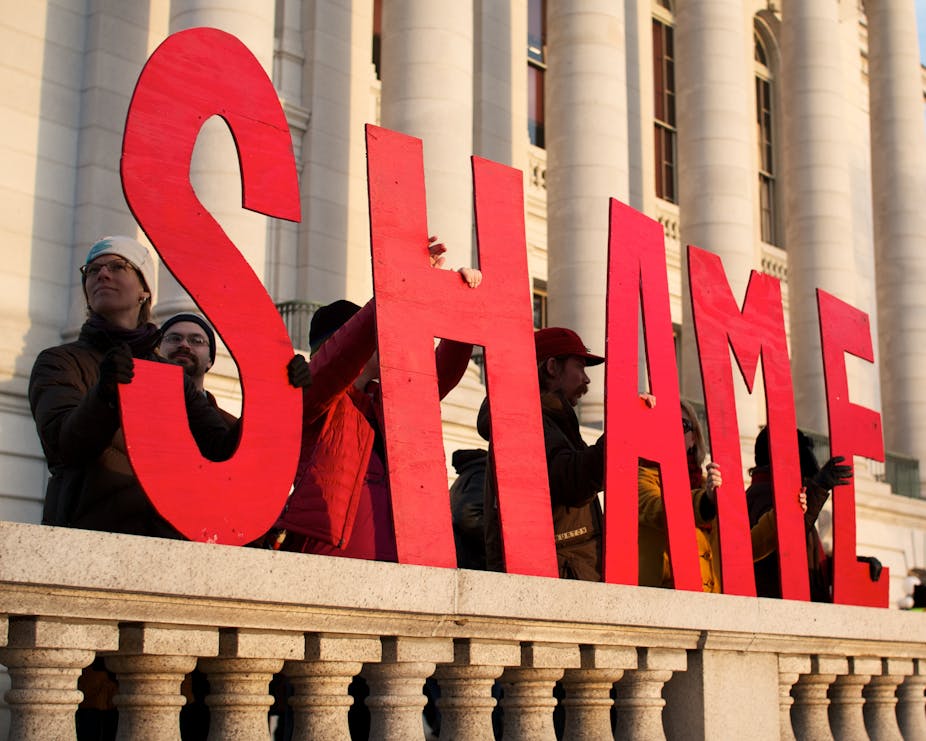
Last month, Queensland’s Attorney-General Jarrod Bleijie called for the public naming of all youth who appear in court.
Echoing practices from the deep south of the USA where t-shirts, signs outside homes and photographs of errant teenagers have been used, Queensland has jumped on the “name and shame” bandwagon … and not for the first time.
During the 2006 Queensland election campaign the then-Coalition parties wanted to make it mandatory to name juveniles over 13 years who had committed a serious offence.
Again in 2009 there was political stoushing between Anna Bligh and Lawrence Springborg about identifying delinquent youth.
A nation-wide issue
Queensland is not alone in promulgating name and shame policies. This issue has been raised in New South Wales and more recently in Western Australia.
Similar proposals have emanated from Canada, and were put into practice via civil Anti-Social Behaviour Orders in the United Kingdom under its previous government.
But where is the evidence to suggest that the public identification of juveniles who are involved in criminal proceedings will have a positive effect on their subsequent behaviour? Where is the evidence that such naming will be of benefit to communities or even to victims of crime?
The short answer: there is precious little.
‘Good’ shaming versus reactionary rhetoric
Recent research has centred on the more positive forms of shaming, which are believed to be a part of restorative justice practices, such as “youth accountability conferences”. These programs utilise the positive, transformative power of shaming, while avoiding the negative effects of public stigmatisation.
While apparently politically appealing, cries to openly name and shame are ill-informed.
Politicians pushing for the names of juvenile offenders to be in large bold type in newspapers or, worse still, depicted on broadcast news or captured forever on the internet fail to deal with the stigma attached to these kinds of practices.
The name and shame proposals, apart from ignoring fundamental international principles espoused in documents such as the Convention on the Rights of the Child, also fail to consider which young people might be subject to such naming.
These young people are often from backgrounds of multiple disadvantage, and who may be subject to some form of welfare protection. In these cases, welfare acts often contain provisions that prohibit public disclosure of identities.
So while reactionary politicians seek reform to juvenile justice regulations, they may find that efforts to name and shame will be stymied because young people are under the “care” of their own governments.
It is also the case that those calling the loudest to name and shame offer the caveat that they “only wish to name the really rotten ones” (and I am aware of at least one newspaper editor who invoked this refrain, only he used somewhat “bluer” language).
Presumably then, a key aim of the calls to name and shame is addressed at recidivism. This is based on the false assumption that if the names of young offenders could be published or broadcast then this would thwart their criminal careers.
The reality is that those young people already well-embedded in the juvenile justice system are unlikely to be swayed by naming and shaming.
A self-fulfilling prophecy
There is little evidence to demonstrate that the naming of young people will prevent recidivism.
In fact, recent research conducted by Professor Duncan Chappell and myself in the Northern Territory (the only jurisdiction in Australia where juvenile justice provisions permit the naming of youth brought before the courts) presents anecdotal evidence that naming and shaming can have the opposite effect.
In a few instances, young people were actually emboldened in their offending, convinced they had a sullied reputation to live up to.
This view is supported by Russell Goldflam from the Criminal Lawyers Association of the Northern Territory (CLANT) who says there is potential for a “badge of honour” effect from public identification.
For many others though, being named simply brought greater police attention not only to themselves but to their families and communities as well.
Detrimental outcomes for indigenous youth
Professor Chappell and I have noted elsewhere that there are a number of detrimental outcomes arising from any disclosure of juveniles’ identities. These include a misuse of the concept of shaming (i.e. stigmatising),the potential for vigilante action, a false sense of community protection, and the possibility of disrupting rehabilitative efforts.
Our research found that youth were rarely named in the media often because of welfare provisions, or because most juvenile offending is petty and lacking in salacious news values. However, some individuals were singled out and, in these instances, there was evidence of repeated naming to the detriment of those young people and their families.
Of particular concern, were Indigenous youth – so grossly over-represented in the juvenile justice system, who were similarly over-represented in those singled out for public identification.
There was evidence too that the naming of these young people meant that sporting scholarships were jeopardised, employment prospects were diminished, and even the capacity for their families to obtain housing was badly affected.
The movement to publicly name juvenile offenders is clearly gathering momentum. We are witnessing the erosion of long-held protections for youthful offenders, and the international conventions that support them. The imperative to rehabilitate and educate young offenders is being ignored, if not abandoned in favour of more politically expedient and popular positions.