
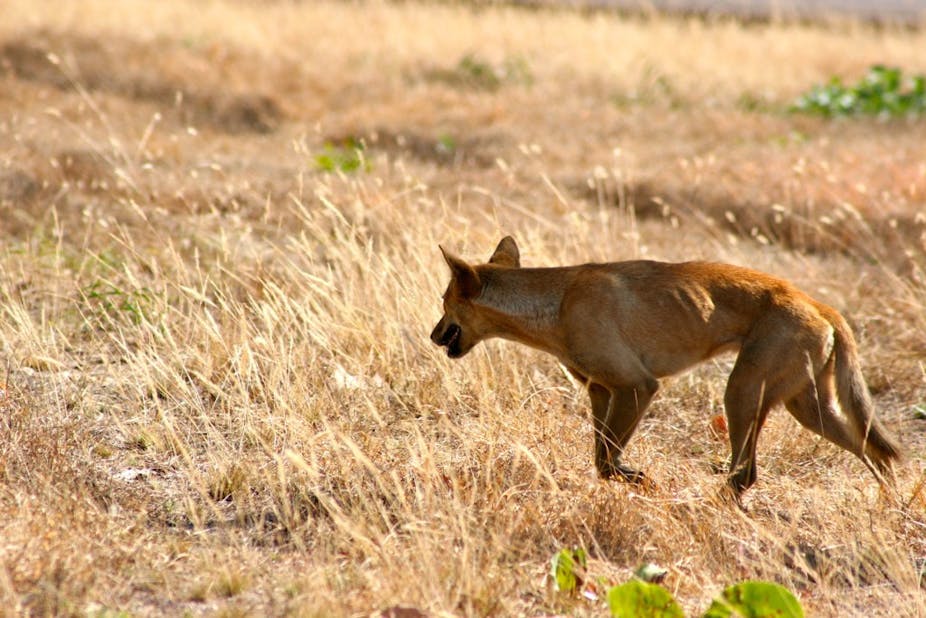
The sad reality of human-dingo relations is that blood will be shed, as Brad Purcell recently reminded us in these pages with his article about non-violent co-existence, The Australian Dingo: to be respected, at a distance.
Although Dr Purcell’s piece was well intentioned, our experiences suggest that his “Techniques for keeping wild dogs away” (playing recordings of a wolf pack howling, using scent marks, and flying bright red “fladry” tape) are unlikely to work in situations where direct human-dingo conflict is most likely or is already happening. Although we disagree with this aspect of Dr Purcell’s article, we stress our intention is not to discredit him, but rather to support his call for better education programs and to provide readers with additional food for thought about managing human-dingo clashes.
The ecological niches of humans and dingoes overlap and some dingoes are “anthropic” – that is, they actively seek food and water from people. This is not surprising given that people probably initially selected dingoes from among the less aggressive wolves they encountered (dingoes are a sub-species of wolf). This overlap and the subsequent conflict between us are exacerbated by spreading urbanisation and the expansion of industry and tourism. From a human perspective, dingoes are formidable competitors because of their resilience – an artefact of amazing behavioural and physiological “plasticity” that makes them capable of surviving and thriving in virtually any situation across Australia. Indeed, we have worked with dingoes and other free-ranging dogs in many of the situations where they occur: on beaches, in coastal towns, wetlands, rainforests, rugged gorge country, savannas, and in deserts.
We agree with Dr Purcell to the extent that human interventions are necessary in order to minimise further aggression between dingoes and humans. We endorse broadening and intensifying wildlife managers' efforts to exchange unsafe human practices for safer ones. That is, substitute practices that attract dingoes and other wild dogs, such as feeding them at campgrounds, for those that remove incentives for close contact and reduce the risk of aggression when proximity occurs, such as ensuring people use “dingo-proof” receptacles for rubbish.
Unfortunately, we have seen with our own eyes that education is not enough. Sometimes, this is because some people don’t think that the warnings apply to them. Even strategies to reduce association between people and dingoes can be insufficient to totally prevent trouble. Indeed, if dingoes are already dependent upon food or water that they get from humans, then when it is removed, their aggression against humans, domestic animals and wildlife can intensify. Plus, when people stop providing food and water to dingoes that have become dependent, the animals that cannot find alternative sources will die.
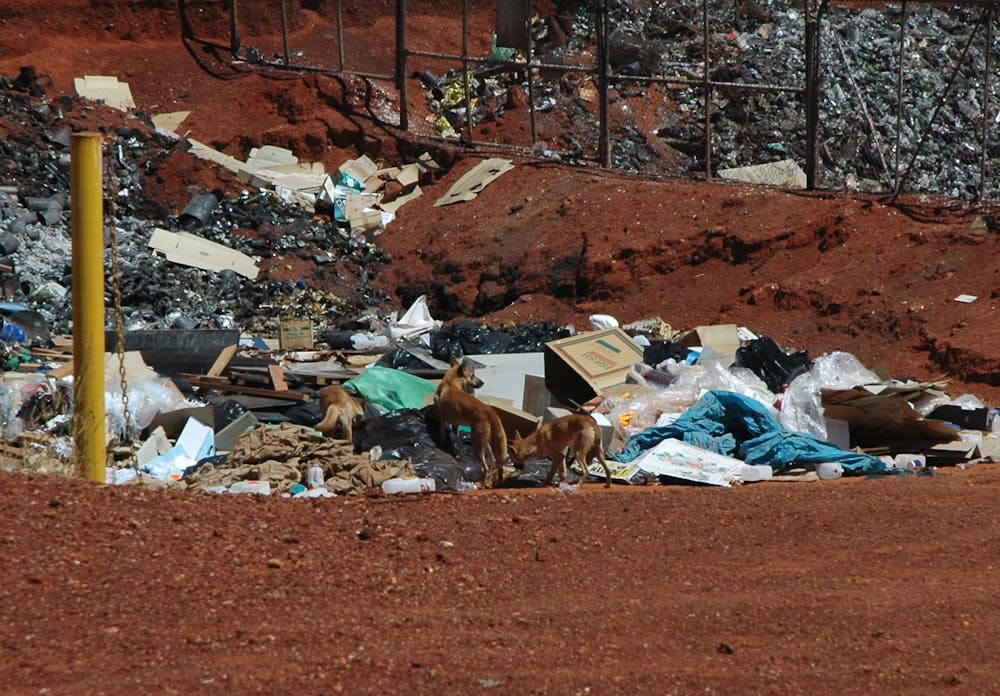
Hunger and thirst are great motivators: they drive dingoes to climb fences or dig under them, to enter buildings and vehicles and even to directly confront larger apex-predators, i.e. people. Faced with food or water shortages, dogs kill other dogs, eat more wildlife (both native and invasive species) and move further afield to hunt, scavenge, and find water. Consequently, in addition to educating humans and removing the food or water that people provide to dingoes, it is sometimes necessary and arguably more humane to simultaneously kill anthropic (human-reliant) dingoes. This can minimise the risk of further aggressive confrontations and associated flow-on effects, for dingoes, domestic animals and wildlife.
Dr Purcell specifically suggested three techniques for keeping wild dogs away:
Playing recordings of howling to simulate a resident social group;
Artificial scent marking to establish false dingo territories;
Using fluttering “fladry tape”.
Unfortunately, these are all techniques we and other dingo trappers, whether for research or control purposes, successfully use to attract dingoes, not to repel them. Although work at both Macquarie University and the University of New England on dingo vocalisations may make it possible, in future, to isolate sounds that will serve to repel animals, what we already know is that playing or simulating dingo vocalisations is a good way to attract dingoes into an area.
Similarly, our extensive GPS-tracking of dingoes has found that individuals will venture into other groups’ areas of activity and are commonly attracted to scent marking by other dogs, whether known or unknown to them. Lastly, many trappers use visual lures, such as flag-like material, pinwheels or flashing LEDs to attract dogs into trap sets.
Despite this contrast between our experiences and Dr Purcell’s suggestions, we concede that some dingoes would be deterred by strategically used sounds, smells and objects. Dingoes, like people, vary between individuals and some are much more cautious than others. However, the cautious individuals are also least likely to be the ones posing the greatest risk of aggression toward humans. Confident, experienced dogs, inquisitive individuals, and animals so desperate for food or water that they will overcome a reasonable fear of a larger predator are most likely to be involved in direct confrontations with humans. These same animals will be the ones least likely to respond to the measures Purcell proposed.
We recognise that many, if not most, Australians find the idea of killing dingoes confronting. They have become iconic, adopted by our nation in the absence of the charismatic apex predators that occur elsewhere throughout the world (such as much larger wolves, or lions and tigers and bears, for example). Their adoption has been made easier by the fact that dingoes are dogs, the same species that has contributed to human success and become our valued co-workers and companions. However, just because killing dogs is unpopular, it does not automatically make it unnecessary, or even unsound, as a strategic tool for wildlife management and protecting people, particularly where populations are locally overabundant.
We reiterate that managing human behaviour to avoid human-dingo conflict in campgrounds, tourist spots and urban fringes should be our primary strategy. However, if conflict has already occurred, then it will sometimes be necessary to reduce both the availability of anthropogenic food and water, as well as dingo density to avoid further attacks or harassment. So long as non-lethal techniques for deterring dingoes do not simply shift problems elsewhere, or worse still exacerbate them, we support such attempts to find effective ways to minimising human-dingo conflict. However, to be effective, such techniques must give dingoes due credit, something that is only likely if they are based on a thorough understanding of dingo biology and behaviour and human behaviour towards dingoes.
This article was co-written with Dr Thomas Newsome, who holds a PhD from the University of Sydney on the ecology and behaviour of the dingo.
Comments welcome below.
Ian Donald Lowe
Seeker of Truth
I wonder if the authors could inform me if the dog fence is still in place and maintained? I know we have extended our human activities and populations on 'the other side of the fence' but it was put in place for the specific purpose of defining an area where dingoes could exist and an area where humans could operate without the problems that any wild dog can cause.
I am also wondering how effective the dog fence is/was as a barrier to dingo movement?
Thanks in advance for any replies.
Guy Ballard
Adjunct lecturer at University of New England
Hello Ian,
There are still lots of 'dog fences' in Australia, from localised fences around landfills, to the world- famous dog fence, which stretches from SA to Qld. Well maintained dog fence can be an effective barrier to wild dogs, including dingoes, but maintaining such a barrier can be challenging. Recently flooding caused substantial damage to the dog fence in western NSW. In some parts of eastern Australia native fauna, such as wombats, and introduced species, such as rabbits, literally undermine barrier fencing. Adult dingoes will sometimes push through rabbit-sized holes to access sheep and cattle properties. Barrier fencing is typically only one part of integrated strategies aimed at reducing the probability of contact between dogs and other species of interest, be they livestock, humans or threatened fauna.
Ian Donald Lowe
Seeker of Truth
Thanks Guy, I meant the main fence from SA to Qld. Maintenance is an ongoing expense and I wasn't sure that governments would be motivated enough to have kept paying for it. Wombats always were a problem for fences as they just bulldoze their way through but they are creatures of habit, so they travel the same paths every time. This meant that farmers in SA could employ Wombat Gates in their fences, which were swing gates, designed and weighted in such a way that only a powerful and compact beast could get through, like a wombat. It saved a lot of work.
Colin Samundsett
retired BSurv
To cull or not to cull? Whether or not culling is anathema to human society, it will occur one way or another.
From observations made by the CSIRO team studying them in the (then) comparatively undisturbed regions of Australia, even the Dingoes carried out their own culling. That maintained their normal social cohesion in those particular environments (As documented by Lauie Corbett in The Dingo in Australia and Asia)..
Thanks to the authors and to Thomas Newsome for their information on this dingo/wild dog issue which becomes ever more complex in its ever-changing environment.
Dingo Simon
Owner, Durong Dingo Sanctuary Qld
Gidday Guy, have you seen the end of the Dingo Fence where it ends at Jimbour ?
Read moreIt is 27kms north of Dalby. The fence just stops beside a large tree. Any dog can just walk around it.
Recently an information Board was set up plus a picnic table and rainwater tank for tourists to relax.
The fence itself is 1.8m high made of cyclone mesh and I assumed buried into the ground.
But the point I would like to make is that the end of the fence is useless to prevent any animal from just walking around…
Ian Donald Lowe
Seeker of Truth
That's pretty rough for the sheep graziers of central Queensland but it's a long fence and it would take a very dedicated dingo to walk around the end if they were somewhere near the middle.
Dingo Simon
Owner, Durong Dingo Sanctuary Qld
It is mainly crops at that end of the fence, and further back is cattle country. I haven't seen sheep in that area.
Ian Donald Lowe
Seeker of Truth
Which is probably why they decided to stop the fence there. Very little or no potential game around would mean a dingo (or dog) would have to be desperately looking for food to even enter the area.
Ian Donald Lowe
Seeker of Truth
I would prefer to see the mixed breed wild dogs destroyed first, if that's possible in a mixed population but it seems the dingoes are the primary target. Dogs, even domestic pets can do incredible damage if they get in a pack and find a flock of sheep. I have seen the results, it's not pretty.
Our imported carnivore pets, namely cats and dogs (let's be honest, the dingo is one of them as well) have destroyed whole species in a very short time because people let them roam and stray, or dump them in the bush and wash their hands of the results of that. I like dogs and cats but they should never be allowed to roam, especially in rural areas and anyone who dumps a pet should spend some time away from society to think about what they did.
Dingo Simon
Owner, Durong Dingo Sanctuary Qld
If it is true that dingoes have lived here for over 18,300 year ( according to Prof. Alan Wilton and co) then they maintained the environment quite well. But always with white man's progress it becomes an invasion of the environment. White man brought so many foreign animals into this country over the last 200 years. Many have escaped , become feral and began destroying the wildlife and caused erosion. And like so many times when man enters the environment , he destroys it instead of learning to…
Read moreShirley Birney
retiree
Well said Dingo man with a big heart. And I note you're not intoxicated with the medieval theatre of cruelty that prevails in outback Australia. The wild dog and dingo will never be conquered by foolish men with 1080 baits and traps - ignorant men who audaciously blame the canine for its "savage" disposition.
Kylie Cairns
PhD student
There is clearly a problem with the way that humans are interacting with dingoes - particularly in camping scenarios like those in the Kimberley or on Fraser Island. Education is key - clearly. But perhaps the failure of humans to follow warnings/guidance should not be used as a justification to cull. It's interesting that in today's "informed" modern world the primary reaction to a human being attacked by a predator (shark, lion, bear, wolf, dingo...) is still culling.
Violence seems to be a…
Read moreGuy Ballard
Adjunct lecturer at University of New England
Kylie,
We agree that further modifcation to human behaviour is important if we want to minimise agressive confrontations between humans and dingoes. We are open to the use of non-violent strategies so long as they do not simply shift the problem, spatially or temporally. To this end, relocation, like culling, may not always be an ideal option but we believe both should remain 'in the mix' for consideration as tools for management. We believe it is important to diagnose each scenario and then implement tailored management actions.
Kylie Cairns
PhD student
Guy,
Thanks - I can understand that there may not be a suitable option besides culling is some scenarios. A tailored management action is exactly what is needed.
I think the onus needs to be placed on humans to avoid conflict not the predator and failure to do so does not always mean that "action" needs to be taken. We are supposed to be the most intelligent life on Earth... but not always the "top" in the food chain.
I'm interested to see what the inquiry of Fraser Island finds/suggests regarding the management of dingoes (and their future). According to various experts, the culling cannot continue much more without making the population genetically unsustainable which effectively ruins any hopes of "dingo" tourism on the island and removes one of the sole remaining genetically intact dingo populations.
Thanks for the insightful and interesting comments and article.
Gil Hardwick
Anthropologist
It has to be asked, since the suggestion here is that dingoes are rampant and need to be controlled against a stable, non-intrusive human population, whether this is in fact the case?
I'd be prepared to argue on the basis of clear longitudinal field data that it is the dingo population which is stable and non-intrusive, and the human in rampancy.
Go figure.
Ian Donald Lowe
Seeker of Truth
I think the dingo populations would be stable at best but an increasing problem is wild dogs of mixed breed, which is a direct result of human activity in dingo areas as well.
Many of these wild dogs have aggression bred into them in them as they can come (quite often) from dogs originally bred for fighting or hunting. They also don't have the natural survival instinct to "cull" their own populations in hard times that the dingo has developed over thousands of years. Sometimes the wild dogs look like dingoes because of cross-breeding and the dingo gets blamed for many things it never did.
There's no doubt it's our intrusions that cause the major problems. People think Australian animals are harmless (I don't know where they get that from) and a dingo can be treated like a domesticated dog. Education, once again, is vital.
Euan Ritchie
Lecturer in ecology at Deakin University
I must say that I found this piece deeply concerning and disheartening. The reason for this is that it continues a history and justification of violence against wild animals because they have offended human’s interests.
Just because education campaigns or non-lethal management approaches have not been 100% successful does not mean we should revert to violent and unethical solutions (poisoning, shooting and trapping), it probably just means the education campaign/management action has not been…
Read moreDingo Simon
Owner, Durong Dingo Sanctuary Qld
A big thank you from me. This is what I like to hear.
Guy Ballard
Adjunct lecturer at University of New England
Hi Euan,
We didn’t avoid the contribution people make to conflict between humans and dingoes. Indeed, we stated a preference for humans to stop feeding dingoes. Further, we highlighted that people can be problematic because they won’t heed warnings.
Your arguments, at least in part, seem to be based on some points better described as assumptions, than absolutes.
Assumption 1: Human non-compliance is necessarily the result of poorly targeted education campaigns.
Read moreEven when 100% of…
Euan Ritchie
Lecturer in ecology at Deakin University
Hi Guy,
It’s great to the have the opportunity for an open and frank discussion on this controversial topic, so I thank you and your co-authors for the opportunity.
I will begin my response by posing this question. Why when humans do things that would seem wrong or in extreme cases arrogant and ignorant (e.g. deliberately avoiding public education and/or signs etc. warning of the dangers of dingoes, or any other wild animal for that matter), and then something unfortunate happens (e.g. an…
Read moreShirley Birney
retiree
Me too Euan- thanks again for your rationale and wisdom.
Peter Gerard
Retired medical practitioner
I agree with you Euan. Human encroachment on and destruction of native wildlife habitat is a very sad spectacle, whether it is in relation to dingoes, koalas, or bird life. Our National Park system needs additions desperately and there must be areas where people are limited in numbers and there presence, on a place like Fraser Island, subject to strict controls. For instance guided tours by Park Rangers. This approach seems a forlorn hope in view of the apathy of our populace and politicians. and the prevailing anthropocentric view of most humans.
I'm very pessimistic about all conservation issues and the way the Greens are being demonised by populist ignoramuses.
Peter Fleming
Leader, Wild Canid Theme, IACRC at University of New England
Hello Euan,
Read moreThank you for your comments and it has been interesting to follow where the conversation has gone.
We agree that the rare problem of dingoes attacking humans is usually facilitated by inappropriate behaviours towards dingoes by people. These actions, such as actively feeding dingoes or accidentally feeding them by giving them access to food waste, can be mitigated by ongoing education and raised awareness. However, the issues we were addressing in our article relate to prevention of…
Mister Anderson
Student
While I enjoyed reading your article and laud your work, I was disappointed to read yet another article about human-dingo relations article with no mention of Indigenous Australians. I can't help but feel researchers are deliberately obfuscating a key part of the issue here.
Guy Ballard
Adjunct lecturer at University of New England
Mister Anderson,
No we didn't mention indigenous Australians in the article but we have, and continue to work with traditional owners. I won't try to speak for the range of indigenous people we've worked with but can relay that, unsurpisingly, people's attitudes to dingo management vary within and between communities.
Regards,
Guy
Mister Anderson
Student
Thanks for the response Guy,
Sorry if I seemed overly critical. I admire that you're not trying to put words in the mouths of Indigenous communities. My point was more to the point that it would be nice to see an acknowledgement that, exactly as you've said, there are complex and various attitudes to dingoes in Indigenous communities which can further complicate the issue.
Cheers,
M
Dingo Simon
Owner, Durong Dingo Sanctuary Qld
Gidday Guy and Peter, it just dawned on me to read your disclosure statement.
Upon realising that you are being funded by the Beef and sheep Industries, is there not a " conflict of interest" if you are being paid by Industries that want the dingoes killed at all costs?
It appears they are paying for a type of research that requires the dingoes to be killed.
Quite often many people consider the dingo to be a feral animal, but considering it has now been proved to have existed here for greater…
Read moreGuy Ballard
Adjunct lecturer at University of New England
Hello Simon,
I’m glad you’ve enjoyed the discussion about dingo management. We have too. Re our disclosure statement: yes, we openly stated that we have and continue to work on projects that receive funding from livestock industries but this article was focussed on the issue of direct human-dingo conflicts, rather than the issue of managing interactions between wild dogs and livestock. When we have worked on direct conflicts between humans and dingoes we have been funded by other sources, including 'National Parks' agencies, mining companies and Natural Resource Management groups. I hope you’ve seen from the article, and our comments, that our argument was not simply to ‘kill dingoes at all costs’ but rather to keep lethal control on the table as a management option because sometimes it is appropriate where dingoes have become a direct threat to people, e.g. some campgrounds, work sites and peri-urban areas.
Regards,
Guy
Peter Fleming
Leader, Wild Canid Theme, IACRC at University of New England
Hello Simon,
Read moreThanks for your comments and helping to make the conversation interesting.
I, too, am interested in the length of time that dingoes have been in Australia. The Oskarsson et al. (2012) paper indicates from mitochondrial DNA evidence that dingoes likely arrived between 4, 640 and 18,100 years ago (95% confidence intervals= 4,600 to 18,300). That is a very broad range of dates and confidence intervals (for reasons that Oskarsson and colleagues describe), and is earlier than the archaeological…
Shirley Birney
retiree
Any old animal abuser in this country can own an animal and dump it in the bush when he/she tires of it. An issue I have raised previously on this forum is the failure of farmers to desex their working dogs. WA’s Kondinin Groups National Agricultural Survey found that a mere 39% of farmers desexed dogs that were no longer needed for breeding.
An example can be seen here:
http://www.perthnow.com.au/news/western-australia/farmer-fined-113000-for-cruelty-to-sheep-cows/story-e6frg13u-1226446906557…
Read moreClinton Collins
logged in via Facebook
The article presently posted in my opinion wreaks of some basic well sounded out science! However it does come across to me that modern society seems uneasy with the actual killing of something.
I did enjoy the following quote of the above article " However, just because killing dogs is unpopular, it does not automatically make it unnecessary, or even unsound, as a strategic tool for wildlife management and protecting people, particularly where populations are locally overabundant.
Australia wants to see the end of Wild Dogs, shall we than keep the dingo, it is impossible for a mainland pure dingo, running wild and free, except of course for Fraser island as their harbour, we cannot look upon the mainland for pure strains of Dingo.
So let us be done with our conservation efforts of the Wild Dog, for that is what they are.
So then lets call them the Wild Dog and be done
Kylie Cairns
PhD student
Clinton Collins: "Australia wants to see the end of Wild Dogs, shall we than keep the dingo, it is impossible for a mainland pure dingo, running wild and free, except of course for Fraser island as their harbour, we cannot look upon the mainland for pure strains of Dingo."
This is simply untrue. There are large populations of genetically intact dingoes on Mainland Australia, specifically in areas such as NT and WA where there are less humans and consequently domestic dogs. There are also genetically…
Read more