
NSW’s coal seam gas ban – where the frack to next?

Fracking. It’s a hotbed of controversy that spans our increasingly energy-hungry globe. The French have turned their back on it. Permanently. And now the NSW government has temporarily frozen the use of fracking for extracting coals seam gas. The use of fracking to extract coal seam gas in eastern…

Screen_shot_2011-07-25_at_11.05.46_am
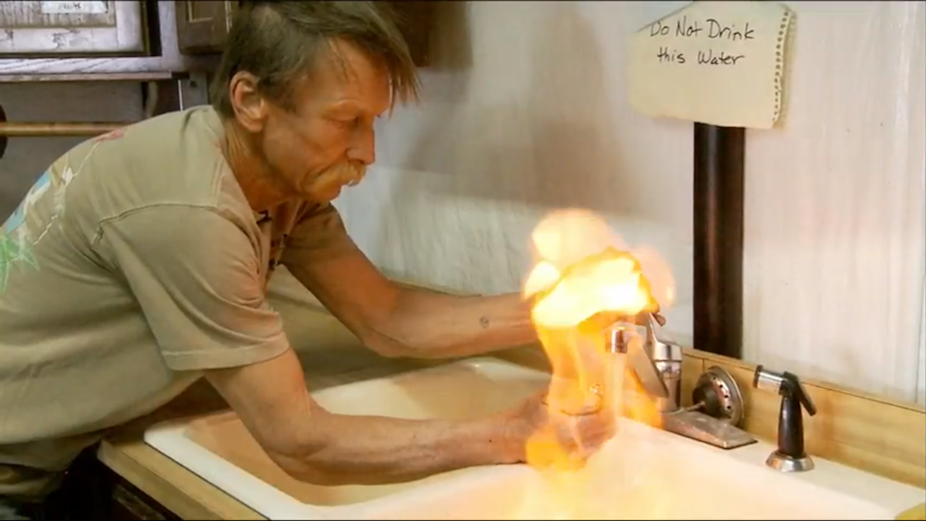
The movie Gasland galvanised the public on the dangers of fracking. Gasland

Fracking. It’s a hotbed of controversy that spans our increasingly energy-hungry globe.

The French have turned their back on it. Permanently. And now the NSW government has temporarily frozen the use of fracking for extracting coals seam gas.

The use of fracking to extract coal seam gas in eastern Australia has been receiving much negative publicity, particularly in the last few months.

Also known as hydraulic fracturing, fracking is a technique to produce gas from coal seams and shale rocks. It involves pumping water, sand and chemicals under high pressure into the coal or shale to create fissures or cracks, to enable the gas to come out. The process requires vast amounts of water, and results in enormous amounts contaminated water containing chemicals and excessive amounts of salt.

Last week the NSW government extended their initial sixty-day moratorium on fracking to 31 December 2011 for new licences. “The community expressed a number of concerns and we’ve listened,” the government said. “Now we are acting by introducing these tougher conditions.”

The NSW government also now requires the gas producer to hold a water licence for water use of more that 3 megalitres per year (that’s 3 million litres). In addition the use of a cocktail of chemicals, known as BTEX’s, have been banned.

While some may argue the steps that NSW has taken is not enough, other critics argue that it is at least more than their northerly neighbours.

In Queensland, the tool used to manage environmental issues related to fracking is “adaptive management”. As the Queensland government notes on its web site, it is a system to monitor and instigate change where required, and to enable best practice to be implemented as technologies to develop.

By its own admission, adaptive management in Queensland is used to “address unknown and unintended impacts when making important management decisions”.

This would seem a rather risky form of regulation – if the impact of a process is either unintended or unknown, why not test it before allowing it to be used in the environment?

If fracking were a vaccine or a new cancer medicine, it would have undergone many years of testing and trials before it was allowed to be used on its intended target – a human. Only when a drug is completely safe is it released for human consumption.

We don’t rely on adaptive management of drugs in humans, so why would we allow it for our agricultural lands?

The decision by the NSW is timely. With changes to legislation afoot, and the national Lock the Gate groundswell by farmers to stop fracking until independent scientists research the effects, the decision to extend the moratorium is a wise one.

But the concern is that this moratorium is nothing more than a political delay, to enable the furor to die down after several highly publicised incidents concerning wells in Queensland.

What is certain is that some countries such as France have evaluated the use of fracking and given it the boot. In a parliamentary vote last month, the French Senate voted 176-151 to ban fracking. This ban was the result of increasing concerns by the French public over health and safety effects of water contamination and the use of chemicals.

The French ban on fracking has created a wave of reexamination of the use of fracking.

At the top of the list is the New Jersey Senate in the USA. In a vote of 31-1 in the Senate, and 56-11 in the Assembly, New Jersey banned fracking last month, sending a clear message that the moratorium imposed in 2010 was permanent.

The Senate cited ground water contamination as the reason for the ban. This ban is important, since the gas extracted in that state is part of the Marcellus Shale Formation, which was the subject for the movie Gasland.

What will happen in NSW is unclear.

What is clear is that fracking is a global issue, one that governments are standing up and saying loudly that they don’t want it in their patch. NSW has at least made a start.

Join the conversation

7 Comments sorted by

  1. Andrew Whitacre

    logged in via Twitter

    On news stations in the U.S., the American Natural Gas Alliance is now running ads addressing fracking concerns more directly, and they claim, as industry spokepeople have done informally, that it's technically impossible for well water to be contaminated because fracking happens in rock thousands of feet below the water table.

    A gas company CEO made the same claim on an American TV news magazine recently as well.

    So for your readers, could you run through the mechanism by which fracking fluids could contaminate water?

    report
    1. Daryl Deal

      retired

      In reply to Andrew Whitacre

      The information is available from many reliable and unreliable industry based sources.

      Sadly, I have found that industry based sources always fail to provide full disclosure at all times, and they are not adverse to routinely using feel good spin propaganda, to sell their contentious point of view, all in the name of profit first customer and environment last business mantra.

      Both types of information regarding "Hydraulic Fracturing" are readily available on "youtube" by merely asking the right…

      Read more
    2. John Bastion

      logged in via Facebook

      In reply to Andrew Whitacre

      I talked to a professor of geology and he said that people often have the erroneous view that the structures underground are like a lump of concrete. He told me that it is normal for liquids to migrate underground and that if you dig and dump sewerage then the it can seep and migrate to contaminate nearby wells.

      In the case of the migration of fracking compounds, then it seems obvious to me (and I am not a geologist) that this is going to migrate along rock fissures and the like. Our knowledge of the geology in any area is always going to have limitations, and hence mistakes are inevitable...and the consequences will be permanent.

      report
  2. Dennis Alexander

    logged in via LinkedIn

    Good article with a good comment - even given my inherent distrust of industry associations. However, given that fracking expressly fractures the rocks to allow escape of gas and that under these kinds of extreme pressures the water and the chemicals used in fracking could sublimate up the same fissures, I think there is a reasonably plausible physical mechanism for contamination of higher level strata from fracking. The question is has it been adequately researched, which would be neither a small nor a cheap effort, and which, because of the depth and possibilities for slow upward progress of contaminants, involves quite long-term study to preclude preemptive dismissal.

    report
  3. Paula Chavez

    activist

    I hope that this distinguished audience has had a chance to read Zero Carbon Australia Stationary Energy Plan by Beyond Zero Emissions (BZE). BZE has formed a strategic research partnership with the University of Melbourne Energy Research Institute and published the major research work, the Zero Carbon Australia Plan. Please go to http://beyondzeroemissions.org/ to download a copy. The Zero Carbon Australia (ZCA) project is a detailed roadmap for the transformation to a decarbonised Australian economy in ten years. With regard to the approved coal seam plants that are in the news, that is the wrong direction. There is no point in having targets and goals that only solve half the problem. Coal seam energy still emits carbon. Investment in another dirty energy generation plant does not solve the problem. Please take the time to visit http://beyondzeroemissions.org. Hopefully, you will decide to become involved in the right solution - zero carbon emissions in ten years.

    report
  4. Steve Foster

    Area Manager

    This is a very well balanced article. I do a lot of work with renewables, and also considerable work with CSG. A couple of points about the NSW CSG industry.
    Firstly, this is Coal Seam Gas, there is really no parallel with Shale Gas as in "Gaslands".
    Secondly, I am not aware of any producer in NSW who has fracture stimulated a well for some years. On a majority of coal seams, it is far cheaper, cleaner, and productive to horizontally drill. The ban on "fracking" really does nothing.
    Having been involved with this industry in NSW for some years, I have found all of the players I have dealt with to be very keen to give accurate information, it would be nice if some of the more uniformed objectionists would be so kind.

    report
    1. John Bastion

      logged in via Facebook

      In reply to Steve Foster

      Thank you Steve, and yes we are basing our concerns on the experiences of those who live overseas.. in the US there has been a terrible lack of regulation. Apparently companies do not even need to declare what chemicals will be used over there, as it is considered a trade secret.

      If it is as you say, that simple drilling is far more economical in Australia then I will be very happy. If fracking is unimportant in Australia, then why even make allowances for it, given the huge risks.

      report